AMD and the x86 Underdog
Abstract
For most of its history, Advanced Micro Devices was Intel’s perennial second: founded in 1969 by Fairchild defectors and kept alive as a legally mandated “second source” for the chips IBM and others refused to buy from a single supplier. AMD broke out of that role twice: in 2003, when its Opteron and Athlon 64 chips extended x86 to 64 bits and forced Intel to copy its design; and again after 2017, when CEO Lisa Su’s “Zen” architecture and a chiplet design that rivals considered too risky turned a near-bankrupt company into Intel’s equal and Nvidia’s chief AI rival.
Eight Men from Fairchild
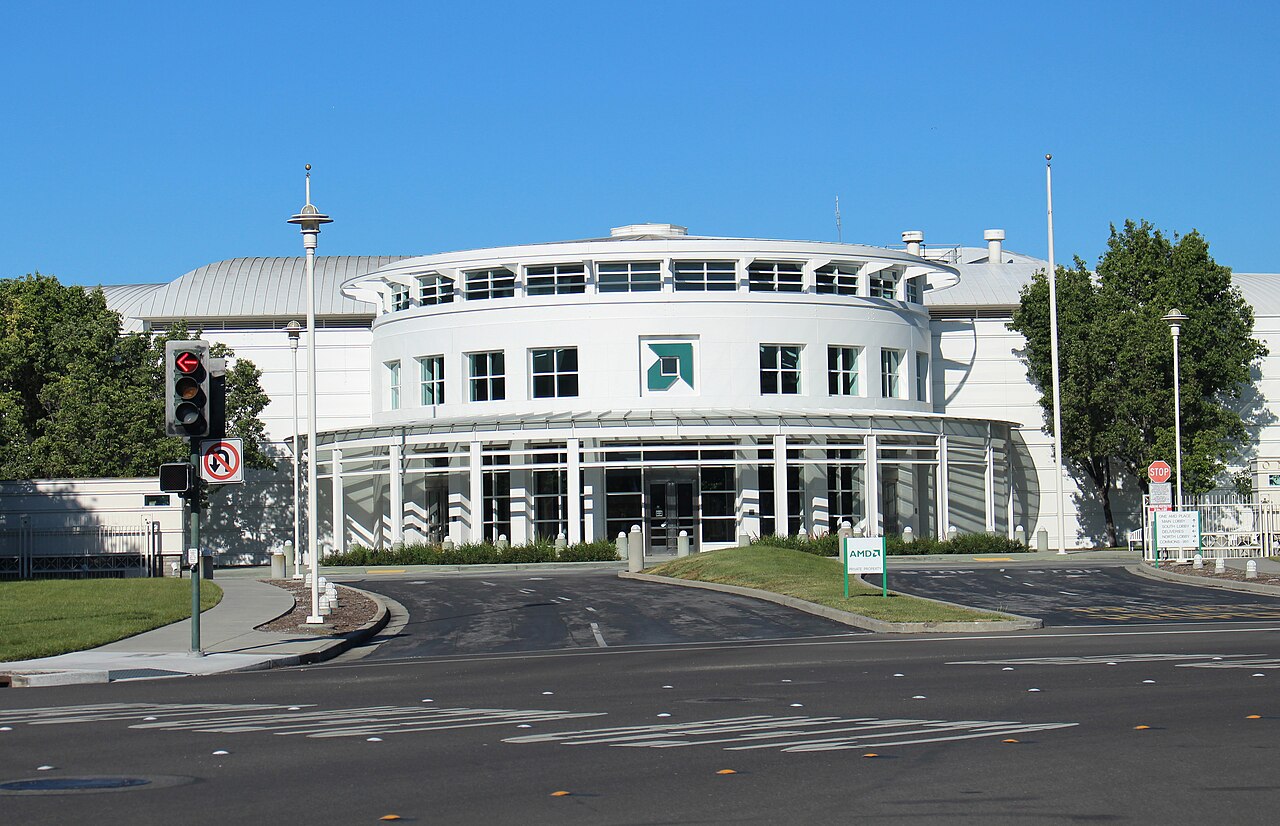
Advanced Micro Devices was founded on May 1, 1969, by Jerry Sanders and seven colleagues from Fairchild Semiconductor, the same company that produced Intel a year earlier. Where Intel’s founders Noyce and Moore were physicists, Sanders was a flamboyant salesman, and AMD’s early identity reflected it: rather than invent, it would out-manufacture, making reliable second-source versions of other companies’ chips to tighter quality standards.
Its first product, the Am9300 shift register, shipped in 1970. Through the 1970s, AMD made clones of popular logic and memory parts and a clone of Intel’s 8080 microprocessor (the Am9080).
Second Source
A quirk of the IBM PC secured AMD’s existence. When IBM chose Intel’s 8088 for the PC in 1981, it demanded a second source, a guarantee that the chip would still ship if Intel stumbled. In 1982, Intel signed a licensing deal letting AMD manufacture x86 processors. For most of a decade, AMD was the contractual safety net of the entire PC industry.
Then Intel tried to close the door. As the 386 generation arrived, Intel refused to license the new designs, and the companies fought each other in court through the late 1980s and 1990s over whether AMD’s license extended to microcode and newer chips. AMD largely won the right to keep making x86 processors, but its supplier was now also its main competitor.
The 64-Bit Coup
AMD’s first true breakout came in 1999 with the Athlon, the first time its chips matched or beat Intel’s at the high end, and the first x86 processor to reach 1 GHz, in March 2000.
The bigger break came in 2003. Intel’s bet for 64-bit computing was Itanium, a clean-sheet architecture incompatible with existing x86 software. AMD made the opposite bet: extend x86 itself to 64 bits while running all existing 32-bit code unchanged. The Opteron (server, April 2003) and Athlon 64 (desktop, September 2003) shipped this AMD64 instruction set. It won so completely that Intel was forced to abandon Itanium’s claim on the mainstream and license AMD’s design; the 64-bit x86 in essentially every PC and server today is AMD’s architecture, not Intel’s. For a few years in the mid-2000s, AMD led the x86 market on merit.
The Near-Death Years
AMD lost the lead quickly. In 2006, it bought the graphics company ATI Technologies for $5.4 billion. The purchase gave AMD the GPU expertise behind its later console chips and AI accelerators, but it loaded the company with debt just as Intel’s “Core” comeback and the disappointing Bulldozer CPU architecture (2011) sent AMD’s chips to the back of the pack.
Unable to afford its own leading-edge fabs, AMD spun them off in 2009 into GlobalFoundries, becoming a fabless designer reliant on foundries (eventually TSMC) to build its chips. By 2014, the stock traded near $2, and bankruptcy was openly discussed.
The CEO through the Opteron years and into the slide was Hector Ruiz, born in 1945 in Piedras Negras, Mexico. At 13, a missionary, Olive Givin, offered to pay his first year at a high school in the United States; he arrived behind in English, graduated as valedictorian, studied electrical engineering at the University of Texas at Austin, and took a doctorate at Rice in 1973. After about six years at Texas Instruments and 22 at Motorola, he was recruited by Jerry Sanders as AMD’s president in 2000 and succeeded him as CEO in 2002. In 2005, AMD sued Intel in Delaware, alleging that Intel kept computer makers and retailers away from AMD chips with discounts and threats of retaliation; in November 2009 Intel settled for $1.25 billion and a new cross-license, without admitting wrongdoing. By then Ruiz was gone. He resigned as CEO in July 2008 after seven consecutive quarterly losses, chaired GlobalFoundries from March 2009, and left that post in November 2009 when reports named him as the unidentified AMD executive who had allegedly discussed the spin-off with an investment manager before it was announced; he was never charged.
Lisa Su and the Zen Turnaround
In October 2014, Lisa Su, an MIT-trained engineer who had worked on chip technology at IBM, became CEO. She bet the company on a single new CPU core, Zen, and a manufacturing idea that competitors thought too risky: chiplets. Instead of one large, expensive monolithic die, AMD built processors from several small dies stitched together over a fast interconnect (Infinity Fabric). Small dies meant higher yields, lower cost, and the freedom to scale core counts far beyond what Intel’s monolithic designs could match.
Ryzen (desktop) and EPYC (server), both launched in 2017 on Zen, reversed a decade of decline. By exploiting TSMC’s process lead while Intel’s own fabs stalled, AMD took performance and efficiency leadership across PCs and the data center. AMD chips power the PlayStation and Xbox, and its Instinct GPUs (the MI300 line) made it the only credible challenger to Nvidia in AI accelerators. Under Su, AMD’s market value rose more than fiftyfold.
⚠️ Dead End: Bulldozer
Much of AMD’s near-collapse goes back to one architecture. The Bulldozer family (2011) let pairs of integer cores share hardware, which made high core counts cheap to advertise. Each core was weak, though, and the chips lost badly on single-threaded performance, which most software depended on. For five years AMD had no competitive high-end CPU. It lost market share and lived mainly on console chips and cost-cutting. In 2003 AMD had judged where computing was going better than Intel did. In 2011 it bet on many weak cores, software did not follow, and the company nearly went under.
📚 Sources
- Computer History Museum, “Trailblazers and Change Agents” (Hector Ruiz: Piedras Negras, Olive Givin, valedictorian, UT Austin, Rice, the suit against Intel) and Wikipedia: Hector Ruiz (born 1945, degrees 1968/1970/1973, TI and Motorola years, AMD 2000, CEO 2002, resignation 18 July 2008, GlobalFoundries chairmanship and the November 2009 resignation)
- “Intel to pay AMD $1.25 billion to settle lawsuits”, NBC News / Associated Press (12 November 2009) (the 2005 Delaware suit and its allegations, settlement terms, no admission of wrongdoing)
- EE Times: Fifty Years of AMD, a Tech Leader
- Computer History Museum / History of Information: Jerry Sanders and Colleagues Found AMD
- The Franklin Institute: Lisa Su laureate biography
- The Register: Ten Years of Lisa Su at AMD
- NBC News: AMD to buy graphics chip maker ATI ($5.4B, 2006)
- Wikipedia: AMD · x86-64 / AMD64 · Bulldozer (microarchitecture) · Zen (microarchitecture) · Lisa Su
- Image: 1amdplace.jpg by Coolcaesar (CC BY-SA 4.0), via Wikimedia Commons