Dead End: DIVX
Abstract
DIVX (Digital Video Express) was a DVD that expired. A disc cost about $4.50 and could be watched as often as the buyer liked for 48 hours after the first play; after that the player, which reported to a billing centre over a telephone line, refused it until the owner paid again. The system was developed by the electronics retailer Circuit City and a Los Angeles entertainment law firm, went on sale on 8 June 1998, and was withdrawn on 16 June 1999. Rival retailers would not stock a competitor’s format, video enthusiasts campaigned against it online, and half of Hollywood stayed away. Circuit City put its total after-tax loss at $337 million. The name survives, with a winking emoticon attached, on a video codec that has nothing to do with it.
A Rental Without a Return
A rented videotape had to go back to the shop. DVD, when it arrived, was sold instead: discs listed at $30 to $35, and when DIVX was launched they could not yet be rented.
Circuit City’s idea, in development since 1995 and first called Zoom TV, was a disc cheap enough to throw away. The customer would buy a DIVX disc for about $4.50 and keep it. The first time it was played, a 48-hour clock started. When the clock ran out, the disc could be put in a drawer or the bin, or “recharged” for another two days for a fee. For a larger one-off payment a title could be converted to unlimited viewing on the owner’s account, a status called DIVX Silver. A “DIVX Gold” disc, playable without limit on any DIVX player, was announced and never sold.
The Machine
A DIVX player was an ordinary DVD player with additions, and it played ordinary DVDs. DIVX discs carried a second layer of encryption, Triple DES, on top of DVD’s own copy protection, so they were unreadable in a standard player. Each DIVX player had a modem. It had to be plugged into a telephone line and registered to an account, and it called the company’s billing computer about twice a month to report what had been watched and to collect permissions.
Players cost more than comparable DVD machines. The first, a Zenith model, was $499 when the system went on trial sale in San Francisco and Richmond, Virginia, on 8 June 1998. RCA, ProScan, and Panasonic players followed by December.
Circuit City and the Lawyers
The partnership was announced on 8 September 1997. Circuit City committed a further $100 million, which made it the majority owner of Digital Video Express with about two-thirds of the equity. The rest belonged to the Los Angeles entertainment law firm Ziffren, Brittenham, Branca & Fischer. Four studios had agreed to supply films: Disney, Paramount, Universal, and DreamWorks. 20th Century Fox signed in February 1998.
Warner Home Video, Sony, Toshiba, and the DVD Forum opposed the format publicly.
The retailer problem was built into the ownership. Van Baker, an analyst at Dataquest, said afterwards: “The fact that it came out of Circuit City was a problem, as other retailers were very reluctant to support a model that would help a competitor.” Blockbuster never carried DIVX. Hollywood Video ran advertisements for “Open DVD.” The few outside chains that tried the format had dropped it by early 1999, and on the first anniversary of the launch Circuit City was the only place to buy a disc.
The Campaign
Opposition started online within weeks of the announcement, a year before any product existed. Its arguments were ownership and privacy. John Giberson, a Texas real estate agent who ran the site bandivx.com, put them this way: “When you go to the store, you purchase a DVD, you own the disc and the rights to watch it wherever and whenever you want to. With Divx, you could only watch it in a certain time period.” And: “No one really has the right to know what movies you watch, when you watch them, or how often you watch them.”
Enthusiasts also feared that DIVX would supplant open DVD, which they regarded as the better format.
The economists David Dranove and Neil Gandal later tested what the announcement did to the market. Their study of sales data found that the preannouncement of DIVX in September 1997 temporarily slowed the adoption of DVD: some buyers waited to see which format would win.
Fifty-Three Weeks
The national rollout came in the autumn of 1998 with an advertising campaign for the Christmas season. In the fourth quarter of 1998 about 87,000 DIVX players were sold and 535,000 discs. By Circuit City’s account most of its DVD player customers from that autumn on chose a DIVX-capable model. Fewer than 17,000 accounts were opened in the quarter.
By the spring of 1999 the studios were drifting. Paramount refused to allow Silver conversions in May and then stopped releasing DIVX titles. The gap DIVX was meant to fill had also closed. When it was launched, Baker pointed out, consumers could not rent films on DVD and the studios were slow to release them in the format. A year later both had changed.
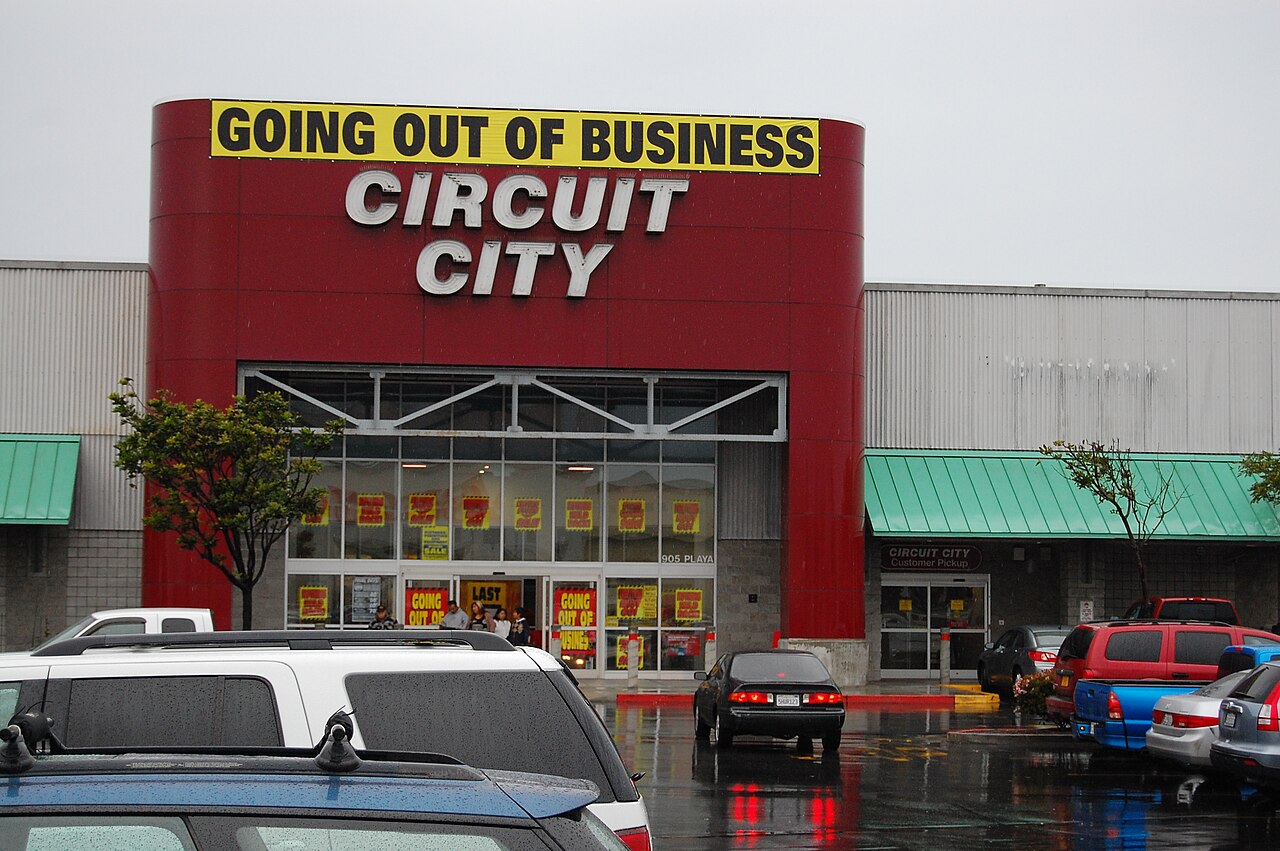
On 16 June 1999 Digital Video Express announced that it would stop selling the system. “Despite the significant consumer enthusiasm, we cannot create a viable business without support in these essential areas,” said Richard Sharp, the chief executive of Circuit City, meaning studios and other retailers. Circuit City took an after-tax charge of $114 million and reported a net loss of $88.8 million for the quarter. A spokesman for the venture put the total after-tax cost to Circuit City at $337 million.
Owners were offered a $100 rebate on players bought before that day. Remaining discs were cut from $4.49 to $1.99. The billing computer stayed on for two years so that existing discs could be played, and was switched off after 30 June 2001. A DIVX disc has been unreadable ever since.
“Ding dong, Divx is dead,” Giberson told the San Francisco Chronicle. Gregg Stauffer of San Francisco, who owned more than 100 of the discs and had defended them online, saw it differently: “It has to be one of the few consumer products that was destroyed before consumers had a chance to say whether they liked it or not.”
Dead End: The Disc That Phones Home
Paying a few dollars to watch a film for 48 hours is a familiar offer today from online video shops. What failed in 1999 was the attempt to enforce it with a plastic disc, a modem, and a format owned by one retailer.
DIVX asked each party to accept a cost for someone else’s benefit. Customers paid more for a player that watched them. Competing retailers were asked to sell a product that belonged to Circuit City. Studios had to press a second, incompatible disc for a tiny installed base. The beneficiaries were the format’s owners, and a toll booth works only when travellers have no other road. Open DVD, at the same quality and without the telephone line, ran alongside from the first day.
The name had an afterlife. When a hacked version of a Microsoft MPEG-4 video codec began circulating on the internet, it was called “DivX ;-)”, the emoticon marking the reference as a joke at the dead format’s expense. The company later formed around that codec kept the name.
📚 Sources
- Circuit City Stores, Inc.: Current Report on Form 8-K, 17 June 1999 — US Securities and Exchange Commission (the announcement of 16 June 1999, the reasons given, the $100 rebate, viewing until 30 June 2001, the $114.0 million after-tax loss)
- Circuit City Stores, Inc.: Quarterly Report on Form 10-Q for the quarter ended 31 August 1997 — US Securities and Exchange Commission (the September 1997 announcement, the additional $100 million, the law firm’s minority interest, four studios)
- Circuit City Stores, Inc.: “Circuit City Stores, Inc. Announces Divx Partnership”, press release, 8 September 1997 (the four studios, majority partner with about two-thirds of the equity; no online copy currently resolves)
- Fost, Dan: “Divx’s Death Pleases Opponents” — San Francisco Chronicle, 18 June 1999 (pricing, the recharge options, the phone connection, Giberson, Stauffer, Van Baker, the $1.99 clearance)
- “Circuit City Kills Divx” — TWICE, June 1999 (the $114 million charge, the $88.8 million quarterly loss, the $337 million total given by a Divx spokesman, disc prices cut from $4.49 to $1.99)
- “End of the road for pay-per-view DVDs” — Salon, 16 June 1999 (Sharp’s statement)
- Dranove, David and Gandal, Neil: “The DVD-vs.-DIVX Standard War: Empirical Evidence of Network Effects and Preannouncement Effects” — Journal of Economics & Management Strategy 12 (2003), pp. 363–386
- DIVX — Wikipedia (development from 1995 as Zoom TV, the launch dates and players, Triple DES, DIVX Silver and Gold, the opposing companies, fourth-quarter 1998 sales, Paramount’s withdrawal, the retailers, the 2001 shutdown)
- DivX — Wikipedia (the origin of the codec’s name)
- Image: Circuit City, Sand City CA (3320518365).jpg by Adam Kent (CC BY 2.0), via Wikimedia Commons