Elizebeth Smith Friedman: The Hidden Codebreaker
Abstract
Historical cryptology has a canonical hero (Alan Turing) but American codebreaking was substantially founded by a Shakespeare scholar with no mathematical training. Elizebeth Smith Friedman (1892–1980) broke the codes of rum-running syndicates during Prohibition, testified against Al Capone’s suppliers, and in the Second World War dismantled the Nazi spy network in South America. Then J. Edgar Hoover’s FBI took the credit, her records were sealed for decades, and history remembered her (when at all) as the wife of cryptologist William Friedman. Her story is a founding chapter of signals intelligence and pattern analysis, and a case study in how credit gets assigned.
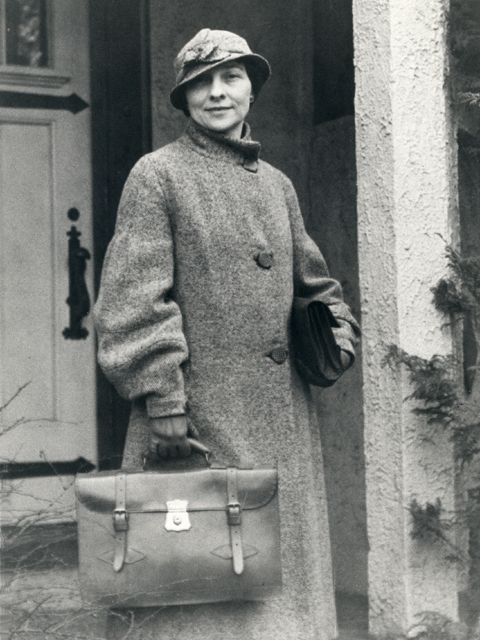
From Shakespeare to Ciphers
Elizebeth Smith was born on August 26, 1892, in Huntington, Indiana, and studied English literature at Hillsdale College, with Latin, Greek, and German on the side. Cryptology found her by accident: in 1916 the eccentric textile magnate George Fabyan recruited her to his private research estate, Riverbank Laboratories in Geneva, Illinois, for a project attempting to prove that Francis Bacon had written Shakespeare’s plays, a hunt for ciphers hidden in the First Folio.
The Baconian theory was pseudoscience, and both Elizebeth and the young geneticist she met there (William F. Friedman, whom she married in 1917) eventually said so publicly. But the methods were transformative. Riverbank was, almost by accident, the only place in America doing systematic cryptanalysis. During the First World War the Friedmans ran Riverbank’s Department of Ciphers, training Army officers and developing much of the conceptual toolkit (statistical, structural, linguistic) on which modern American cryptology was built.
The Rum Row Years
In 1925 Elizebeth Friedman went to work for the U.S. Coast Guard, then part of the Treasury Department, and through the Prohibition era she was the government’s essential weapon against the smuggling syndicates, whose radio traffic used commercial codes and increasingly sophisticated custom ciphers. The scale of her work was industrial: in one three-year period she decrypted over 12,000 messages; in 1929 she broke 24 distinct smuggling code systems. Her solutions contributed to some 650 criminal prosecutions, including cases against Al Capone’s liquor-supply operation, and she testified as an expert witness in 33 cases, a small woman at the stand calmly explaining codebreaking to juries, which made her, briefly and against her will, a press sensation. By 1931 she headed her own cryptanalytic unit at the Treasury, the only codebreaking unit in American history led by a woman. Her casework even settled international incidents: her decrypts resolved the dispute over the sunken smuggling vessel I’m Alone in 1934.
What she was doing, in modern terms, was traffic analysis and pattern recognition under adversarial conditions, the intellectual core of what would later be called signals intelligence, and a direct ancestor of the analytic tradition described in Cryptography: The Secret Science.
Operation Bolívar and the Doll Woman
In the Second World War, Friedman’s Coast Guard unit was transferred to the Navy and became the principal American source on Operation Bolívar, the German espionage network in South America, which reported Allied shipping movements to Berlin. Her team decoded some 4,000 messages across 48 clandestine radio circuits, including traffic from Enigma machines used by the network, and tracked the SS spymaster Johannes Siegfried Becker where every other agency had failed. The intelligence enabled the roll-up of the network across several countries.
She also supplied the decisive evidence in the era’s most famous espionage trial: Velvalee Dickinson, the New York doll dealer whose letters about “dolls” encoded reports on U.S. warships damaged at Pearl Harbor. Friedman’s analysis helped convict the “Doll Woman” in 1944.
Dead End: How Credit Disappears
What happened next is why Friedman belongs in this encyclopedia rather than only in intelligence history.
The FBI claimed the victory. After the war, J. Edgar Hoover ran a publicity campaign (magazine features, even a film) presenting the destruction of the South American spy rings as an FBI triumph. Neither Friedman nor the Coast Guard was mentioned. Wartime secrecy sealed the truth: bound by her Navy oath, Friedman could not correct the record, and her wartime files remained classified until 2008, twenty-eight years after her death.
Her husband’s fame absorbed hers. William Friedman led the Army team that broke Japan’s PURPLE cipher and coined the very word cryptanalysis; histories that mentioned Elizebeth at all tended to cast her as his assistant. The couple themselves joked bitterly about the asymmetry. Recognition came almost entirely posthumously: induction into the NSA’s Cryptologic Hall of Honor (1999), the naming of the NSA’s main operations building as the William and Elizebeth Friedman Building (2002), a U.S. Senate resolution (2019), and the PBS documentary The Codebreaker (2021), following Jason Fagone’s 2017 biography The Woman Who Smashed Codes.
The pattern (a woman’s foundational technical work reassigned to an institution or a husband) recurs throughout Women in Computing. Friedman’s case is among the starkest, because the theft was contemporary, deliberate, and abetted by classification.
Why She Belongs in Computing History
Friedman never used a computer; her instruments were pencil, graph paper, and frequency tables. But the discipline she helped found is one of computing’s taproots. The wartime cryptanalytic bureaus she and William helped build became the NSA; the problems of her trade (searching keyspaces, exploiting statistical regularities, automating pattern detection) are precisely the problems that drove early computing machinery from Colossus onward, and they seeded the fields now called cybersecurity and signals intelligence. She stands at the point where codebreaking was still a human craft, the last generation before the machines took over the work.