John von Neumann
Abstract
John von Neumann (1903–1957) worked at the founding level of more fields than any other figure in this encyclopedia: axiomatic set theory, the mathematics of quantum mechanics, game theory, the Monte Carlo method, numerical weather prediction, cellular automata, and the stored-program computer that carries his name. He was one of the original professors of the Institute for Advanced Study, a Manhattan Project consultant who designed the implosion calculations for the plutonium bomb, and the author of the 1945 EDVAC report that spread the blueprint of the modern computer around the world under his name alone. He wrote the first sorting program before any machine existed to run it, built a computer at an institute dedicated to pure thought, and died at 53 under military guard, because the things he knew were classified.
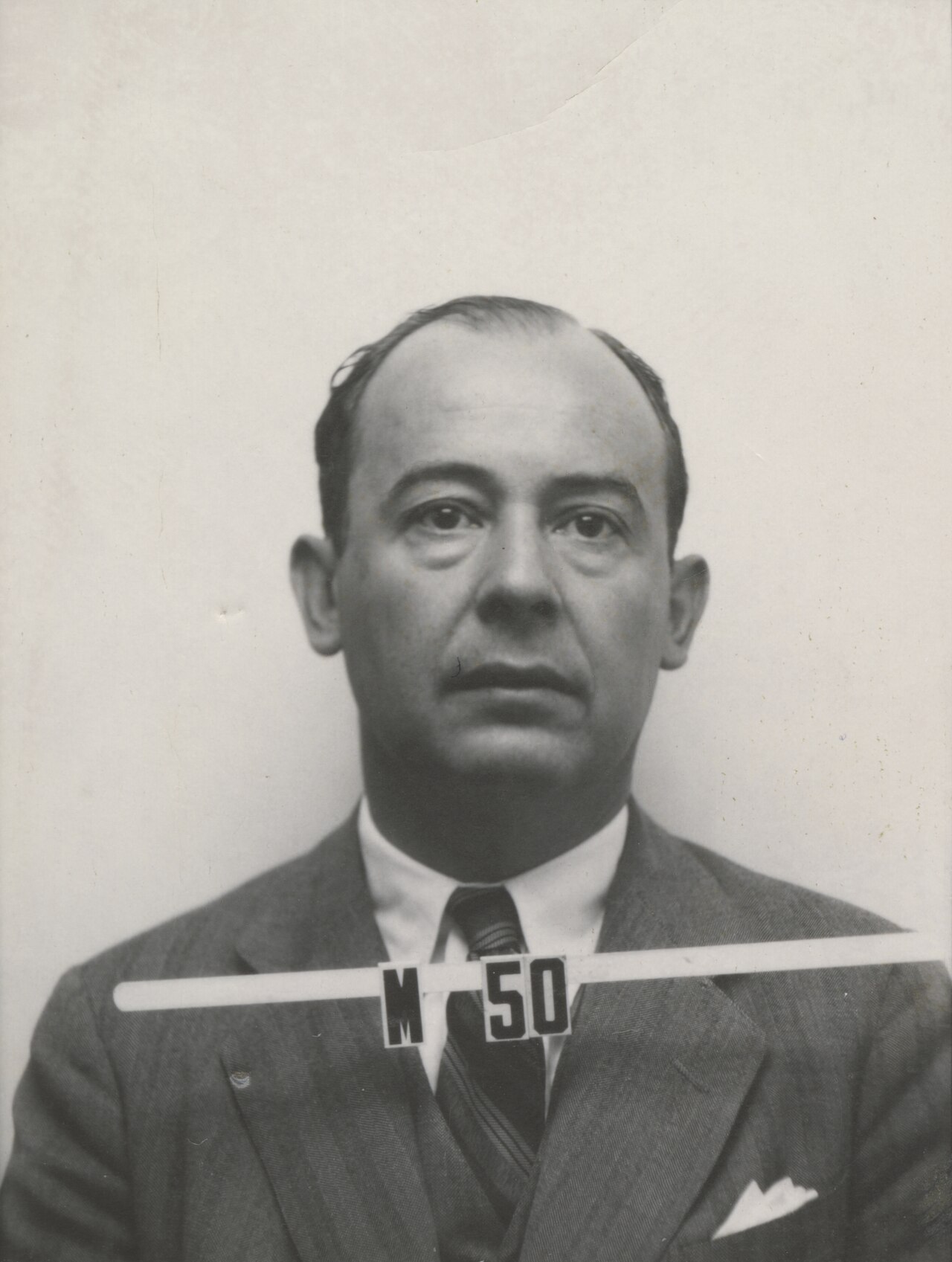
Budapest
Neumann János Lajos was born on 28 December 1903 in Budapest, the eldest son of a wealthy Jewish banker. His father acquired a Hungarian noble title in 1913, which the family name later carried into German as “von Neumann.” The boy’s abilities showed early and never stopped being a spectacle: he divided eight-digit numbers in his head as a child, absorbed a page of the telephone directory as a party trick, and retained texts verbatim years after one reading (see Von Neumann’s Memory). He attended the Fasori Gimnázium, the Lutheran school whose alumni of his generation included Eugene Wigner, and published his first mathematics paper at 18, jointly with Michael Fekete.
His father considered mathematics no way to earn a living and negotiated a compromise: the son would study chemical engineering as insurance. Von Neumann did both at once. In 1926 he took a chemical engineering degree at ETH Zurich and, in the same year, a doctorate in mathematics from the University of Budapest, with a dissertation that axiomatized Cantor’s set theory. He was 22.
Göttingen, Berlin, Princeton
A Rockefeller fellowship took him to Göttingen in 1926 to work with David Hilbert, then the center of the mathematical world (see David Hilbert and the Entscheidungsproblem). Out of this period came the work that made his reputation: a rigorous mathematical foundation for quantum mechanics, unifying Heisenberg’s matrices and Schrödinger’s waves in the language of Hilbert spaces, published as Mathematische Grundlagen der Quantenmechanik (1932). In 1927 he habilitated in Berlin as the youngest Privatdozent in the university’s history. In 1928 he proved the minimax theorem, the founding result of game theory: in a two-person zero-sum game, there is a rational strategy for both sides.
Princeton University invited him as a visiting lecturer in 1929; in 1933, at 29, he became one of the first professors of the newly founded Institute for Advanced Study, alongside Albert Einstein and Hermann Weyl. The timing needs no elaboration: he was a Jewish academic leaving Europe in 1933. He became a US citizen in 1937.
At the IAS he ranged across ergodic theory, operator algebras (now called von Neumann algebras), and lattice theory, while cultivating a persona nobody expected of a mathematician: expensive suits worn even on mule rides into the Grand Canyon, large parties at his Princeton house, a taste for limericks and Yiddish jokes, and a driving style that consumed roughly a car a year. With the economist Oskar Morgenstern he wrote Theory of Games and Economic Behavior (1944), 600 pages that turned his 1928 theorem into a discipline.
Los Alamos
Von Neumann’s expertise in the mathematics of shock waves made him a sought-after consultant for the Army and Navy from 1940 on, and from 1943 for the Manhattan Project. At Los Alamos he made the case that the plutonium bomb could be detonated by implosion, a shell of high explosive compressing the core symmetrically, and did the mathematics of the explosive lenses that shaped the blast. The calculations were beyond anything humans with desk calculators could finish in time, and the experience turned him into the country’s most determined customer for automatic computation.
The decisive accident happened in the summer of 1944 on a railway platform in Aberdeen, Maryland. Herman Goldstine, the Army liaison to the ENIAC project, recognized the famous professor and struck up a conversation; when Goldstine mentioned a machine that would do 333 multiplications per second, the small talk, as Goldstine told it, turned into a doctoral examination. Within weeks von Neumann was sitting in on ENIAC design meetings (see ENIAC and the First Electronic Computers).
The EDVAC Report
The ENIAC team was already designing its successor, EDVAC, around a new idea: store the program in the same memory as the data. In June 1945 von Neumann wrote up the design logically, stripped of engineering detail, as the First Draft of a Report on the EDVAC. Goldstine mimeographed it and mailed it out with only von Neumann’s name on it. The document became the founding text of computer architecture, the design was named after its author, and J. Presper Eckert and John Mauchly, who had developed the concept with him and before him, spent the rest of their lives disputing the credit. The distribution also counted as prior publication and helped destroy their patent claims. The full story, including what the British teams in Manchester and Cambridge did with the report, is in The Von Neumann Architecture.
Von Neumann’s own hands-on contribution to software came the same year: in 1945 he wrote out a sorting program for the still-unbuilt EDVAC, the earliest known program for a stored-program computer, to test whether the design could compete with IBM’s punched-card sorters. The method it used, merge sort, is still taught in every algorithms course.
The IAS Machine
After the war von Neumann did something that scandalized colleagues at an institute devoted to pure scholarship: he built hardware. The IAS machine, constructed in the institute’s basement from 1946 under chief engineer Julian Bigelow, ran in 1951 and became the most copied design of the era. Its clones spread through the laboratories of the world under playful names: MANIAC at Los Alamos, ILLIAC in Illinois, JOHNNIAC at RAND (named after him, over his objections), WEIZAC in Israel, SILLIAC in Australia. IBM’s first commercial scientific computer, the 701, followed the same design.
What the machine computed mattered as much as what it was. With Stanislaw Ulam, von Neumann developed the Monte Carlo method, using random sampling to solve neutron-diffusion problems no analysis could touch (see Monte Carlo Methods). With the meteorologist Jule Charney he put the first numerical weather forecast on ENIAC in 1950, opening the field that now runs on the world’s largest supercomputers. And in lectures from 1948 he worked out the theory of self-reproducing automata (see Cellular Automata and Artificial Life): a machine that contains its own description and uses it both as instructions to build a copy and as data to be copied into it. The construction, completed and published posthumously by Arthur Burks in 1966, describes the logic of DNA replication, discovered by Watson and Crick five years after the lectures.
Cold Warrior
Von Neumann’s last decade belonged mostly to the state. He consulted on the hydrogen bomb, chaired the committee whose 1954 report launched the Atlas ICBM program, and in 1955 was appointed one of the five commissioners of the Atomic Energy Commission, the highest government post then held by a scientist. He was a confirmed hawk who argued that a confrontation with the Soviet Union was better had early; game theory gave his hawkishness a mathematical vocabulary, and the phrase mutual assured destruction grew out of the strategic world he helped build.
In the summer of 1955 a routine examination found cancer, already metastatic; whether it began in bone, pancreas, or prostate is uncertain, and whether his presence at the 1946 Bikini tests caused it is speculation. He kept working from a wheelchair, then from a bed in Walter Reed Army Medical Center, where Air Force officers were posted at his door: a delirious von Neumann might recite classified secrets, so the security detail stayed to the end. The lifelong agnostic asked for a Catholic priest, explaining himself with Pascal’s wager. He died on 8 February 1957, aged 53.
He left one manuscript unfinished, the Silliman lectures he was too ill to deliver, published in 1958 as The Computer and the Brain: a comparison of the digital machine he had designed with the biological one that designed it.
Sources of the Legend
The stories colleagues told
An entire genre of anecdotes surrounds von Neumann, told by people who were themselves not easily impressed. George Gamow called him “the only man I know who can count fast enough to keep up with computers.” George Pólya said that whenever he mentioned an unsolved problem in a Zurich seminar, von Neumann tended to arrive after class with the solution. The fly-and-bicycles puzzle story (he solved instantly by summing the infinite series rather than spotting the shortcut, then asked what other method there was) exists in several versions. The stories should be read the way the memory anecdotes are: individually embellished, collectively consistent.
📚 Sources
- John von Neumann — Wikipedia
- John von Neumann — Britannica
- Ulam, Stanislaw: “John von Neumann 1903–1957” — Bulletin of the American Mathematical Society, Vol. 64 (1958)
- Von Neumann, John: “First Draft of a Report on the EDVAC” (1945), reprinted in IEEE Annals of the History of Computing, Vol. 15, No. 4, 1993
- Aspray, William: John von Neumann and the Origins of Modern Computing (1990), MIT Press
- Dyson, George: Turing’s Cathedral: The Origins of the Digital Universe (2012), Pantheon Books
- Macrae, Norman: John von Neumann: The Scientific Genius Who Pioneered the Modern Computer (1992), Pantheon Books
- Image: John von Neumann Los Alamos identity badge photo.jpg by Los Alamos National Laboratory (Attribution), via Wikimedia Commons