Julian Assange: From "Mendax" to WikiLeaks
Abstract
Before he was the most polarizing publisher of the twenty-first century, Julian Assange was a teenage hacker in Melbourne who called himself “Mendax” (the liar) and broke into the networks of telecoms, universities, and the US military. That apprenticeship in unauthorized access became the founding idea of WikiLeaks, the organization he launched in 2006 to publish secret documents at industrial scale and beyond the reach of any single government’s courts. In 2010, fed a trove of classified US material by Army analyst Chelsea Manning, WikiLeaks released the “Collateral Murder” video, the Afghan and Iraq War Logs, and a quarter-million diplomatic cables, the largest leak of classified information in US history to that point. What followed was a decade Assange spent fighting extradition: seven years inside Ecuador’s London embassy, five more in a British high-security prison, and finally a 2024 plea deal that let him walk free. He forced the question of whether a publisher of leaked secrets is a journalist or a spy, and never let anyone answer it cleanly.
Mendax: The Hacker Years
Julian Assange was born on July 3, 1971, in Townsville, Queensland, and spent a peripatetic childhood moving through dozens of Australian towns. By his mid-teens he was a skilled intruder operating under the handle “Mendax,” a member of a small Melbourne hacking group called the International Subversives. He and his collaborators ranged across the era’s most sensitive systems: in 1988 he used social engineering against the mainframes of Australia’s Overseas Telecommunications Commission, and in the early 1990s the group penetrated MILNET (the US military’s network) and the master terminal of the Canadian telecom giant Nortel in Melbourne, a 1991 intrusion that got him caught.
Australian authorities charged Assange with 31 hacking-related counts. In December 1996 he pleaded guilty to 24 of them and, treated leniently as a young man who had caused no lasting damage, was fined a few thousand Australian dollars and released on a good-behavior bond. The episode left him with two things he would carry into WikiLeaks: a deep practical understanding of how secret information is stored and moved, and a conviction that secrecy itself was the instrument of illegitimate power.
WikiLeaks
Assange co-founded WikiLeaks in 2006 on a simple, radical premise: build a publishing platform that could accept leaked documents anonymously, host them across many jurisdictions so no single court order could erase them, and publish in full rather than in the curated excerpts traditional journalism preferred. Early disclosures (Kenyan corruption, Guantánamo Bay procedures, a Swiss bank’s offshore records) established the model and the legal fights that came with it.
The defining year was 2010. Working from a vast cache supplied by Chelsea Manning, WikiLeaks published, in sequence:
- “Collateral Murder” (April 2010), classified gun-camera footage of a 2007 US Apache helicopter strike in Baghdad that killed civilians, including two Reuters journalists. The edited video, more than any document, made WikiLeaks globally famous.
- the Afghan War Logs (July 2010), roughly 75,000 published field reports;
- the Iraq War Logs (October 2010): 391,832 classified military reports, the largest such leak in US history at the time;
- “Cablegate” (November 2010), some 251,000 US State Department diplomatic cables, released in partnership with The Guardian, The New York Times, Der Spiegel, Le Monde, and El País.
The releases reshaped the relationship between states and their secrets. Governments treated WikiLeaks as a hostile intelligence operation; press-freedom advocates treated it, more ambivalently, as the logical extreme of investigative journalism in the digital age. Both descriptions captured something true, and the tension between them defined everything that followed.
The Long Siege
In August 2010, two women in Sweden accused Assange of sexual assault. He denied the allegations, calling them a pretext for his eventual extradition to the United States. When Sweden issued an arrest warrant and Britain moved to extradite him there, Assange (having exhausted his UK appeals) walked into the Ecuadorian embassy in London on June 19, 2012, and requested asylum. Ecuador granted it. In doing so he forfeited £200,000 in bail his supporters had pledged.
Why the Embassy?
Assange’s calculation was that Sweden was a stepping-stone: once there, he believed, he would be handed to the United States to face charges over the 2010 leaks. Critics countered that Sweden’s courts were no more pliable than Britain’s and that the asylum claim was a way to dodge the assault investigation. The standoff lasted nearly seven years. Assange lived in a few rooms of the embassy, his relationship with his hosts deteriorating as Ecuador’s government changed and his conduct (including WikiLeaks’ 2016 publication of Democratic Party emails during the US election) strained Quito’s patience past breaking.
The Swedish investigation lapsed (it was formally dropped in November 2019), but the deeper exposure remained. On April 11, 2019, Ecuador withdrew his asylum and British police carried him out of the embassy. He was convicted of breaching bail and jailed at HM Prison Belmarsh. The same day, the United States unsealed an indictment; in June 2020 it expanded to 18 counts, 17 of them under the Espionage Act, alleging he had conspired with Manning to obtain and publish national-defense information. It was the first time the US had charged a publisher under the Espionage Act for publishing, a precedent press-freedom organizations across the political spectrum warned could criminalize ordinary national-security journalism.
The Deal
Assange spent five years in Belmarsh fighting extradition, his health visibly declining. The British courts wavered, at one point blocking extradition over suicide risk, echoing the Gary McKinnon case, before that ruling was overturned on US assurances. In June 2024, with the High Court having granted him a further appeal, his lawyers and US prosecutors reached a deal: Assange pleaded guilty to a single Espionage Act count of conspiring to obtain and disclose national-defense documents, in a hastily convened hearing in Saipan in the Northern Mariana Islands. He was sentenced to time served (the roughly five years he had spent in Belmarsh) and flew home to Australia a free man on June 26, 2024.
The resolution was deliberately ambiguous. The US secured a conviction that affirmed, on paper, that publishing the leaks was a crime under the Espionage Act, preserving the precedent. Assange secured his freedom without spending another day in custody and without the case ever being tested before a jury. Both sides could claim they had not lost. The fundamental question his career posed (whether the man who publishes a state’s secrets is a journalist exercising a right or a spy committing an offense) was left exactly where he had always kept it: unresolved, and load-bearing.
Impact: Law, Press, Power
Assange’s significance to computing history is not technical; the hacking was the prologue. It is that he industrialized the leak. WikiLeaks proved that a small, stateless organization armed with cryptography, mirrored hosting, and an anonymous submission system could extract and publish a superpower’s secrets faster than any government could suppress them, and that the architecture of the internet made the old tools of prior restraint nearly useless. Every later disclosure apparatus, from Snowden’s document trove to the secure-submission systems now run by major newspapers (see SecureDrop), operates in the space WikiLeaks opened. He also demonstrated the model’s dangers: the same machinery that exposed war crimes published unredacted names that endangered sources, and was turned, in 2016, into an instrument of election interference. Like the others on this page, Assange is here on the principle of impact, not endorsement; he changed what was possible, and the consequences ran in every direction at once.
📚 Sources
- Julian Assange — Wikipedia
- WikiLeaks — Wikipedia
- Assange, Julian (with Suelette Dreyfus): Underground (1997)
- US Department of Justice: superseding indictment, United States v. Assange (June 2020)
- Julian Assange pleads guilty, freed in US deal — Reuters (June 2024)
- Committee to Protect Journalists: statements on the Assange Espionage Act charges
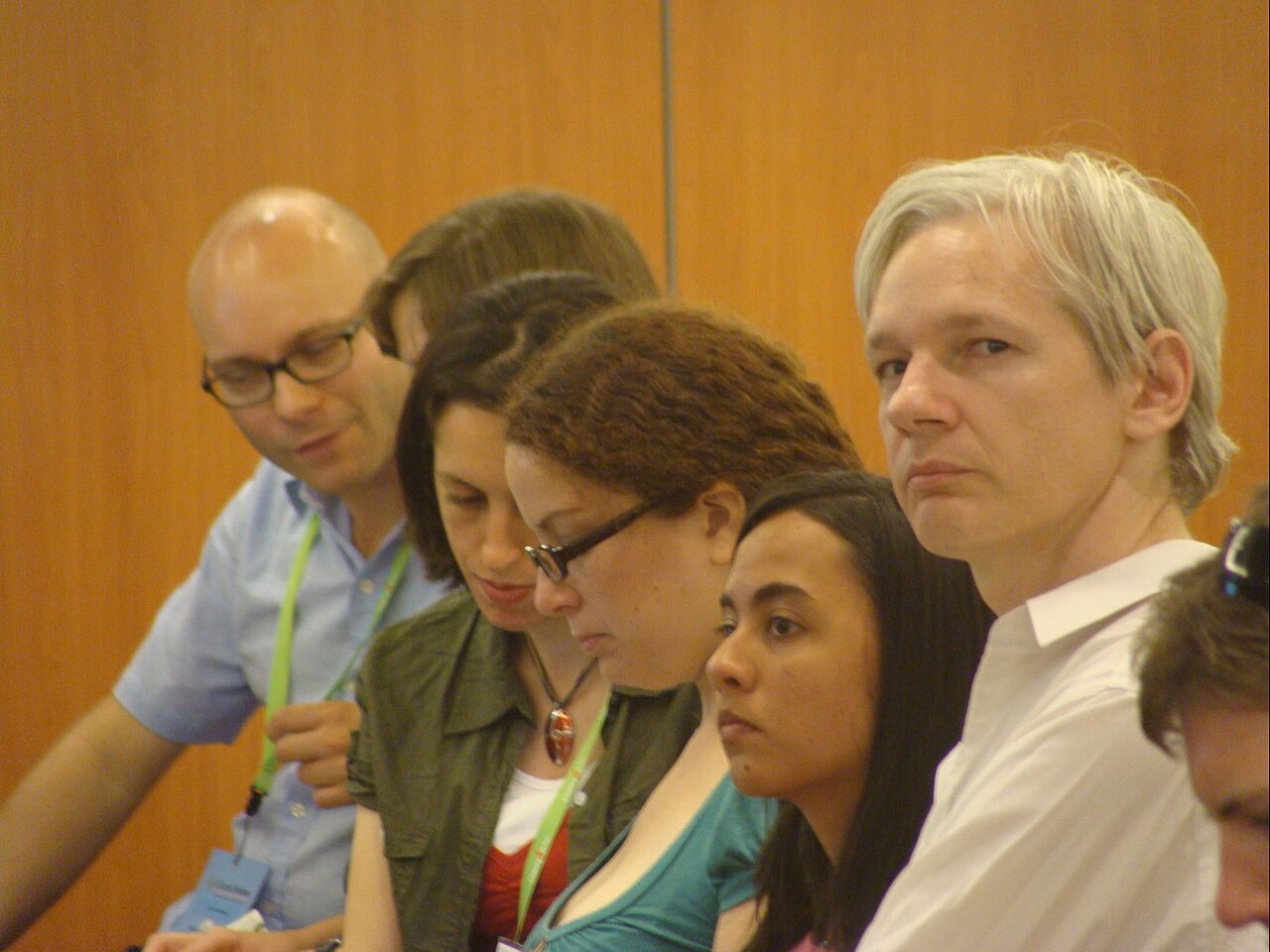
- Image: Julian Assange in 2008.jpg by Periodismodepaz (CC BY 4.0), via Wikimedia Commons