Karlheinz Brandenburg and MP3
Abstract
Karlheinz Brandenburg is the name most attached to MP3, the audio format that shrank music enough to travel the 1990s internet and, in doing so, upended the recording industry. The label “father of MP3” irritates him: the codec came out of a decades-long team effort at Erlangen and the Fraunhofer Institute, seeded by a professor whose patent application for the idea had been rejected as impossible. Brandenburg’s dissertation supplied the core algorithm, a Suzanne Vega a-cappella supplied the test signal, an office poll in 1995 supplied the file extension, and an Australian student with a stolen encoder supplied the mass distribution nobody at Fraunhofer had planned. The format made the Fraunhofer-Gesellschaft more licensing money than anything else it ever produced, and made recorded music effectively free.
An Impossible Assignment
Brandenburg was born on 20 June 1954 in Erlangen and never really left: electrical engineering diploma (1980) and mathematics diploma (1982) at the Friedrich-Alexander-Universität Erlangen-Nürnberg, then a doctorate in the lab of Dieter Seitzer. Seitzer had been chasing an idea since the 1970s: a “digital jukebox,” music delivered on demand over the new ISDN telephone lines. The arithmetic demanded compressing CD-quality audio by roughly twelve to one. Seitzer had filed a patent application on the concept; the examiners rejected it on the grounds that it could not work. He handed the impossible part to his doctoral student.
The escape route was psychoacoustics. The ear is not a measuring instrument: a loud tone masks quieter neighbors in frequency, and for a few milliseconds before and after itself in time. Whatever the ear cannot register, the encoder need not store. Brandenburg’s dissertation (1989) described OCF, Optimum Coding in the Frequency Domain, the algorithmic core of what became MP3. How the masking model works, and what the format then did to the music business, is told in The Digital Music Revolution and Data Compression.
Tom’s Diner
An encoder tuned only on test tones produces confident garbage on real music. Brandenburg’s torture track came to him by accident in 1988, when he heard Suzanne Vega’s “Tom’s Diner” playing down a corridor: a dry, warm, completely unaccompanied voice, exactly the signal a masking model has nowhere to hide behind. Early versions mangled it badly. He and the team ran the song through the encoder thousands of times, adjusting the model until the voice survived, and “Tom’s Diner” acquired its nickname as the mother of MP3. Vega herself later visited Fraunhofer and was played the historic artifacts.
After the doctorate Brandenburg spent 1989–1990 at AT&T Bell Labs with James D. Johnston, who had arrived at similar perceptual models independently; their strands merged in the joint ASPEC proposal.
Standards Politics
The MPEG-1 audio standard (finalized 1992, published 1993 as ISO/IEC 11172-3) was a diplomatic compromise, not a beauty contest. Two camps competed: MUSICAM, backed by Philips and the European broadcast institutes, and ASPEC, backed by Fraunhofer, AT&T and Thomson. The committee adopted three layers: Layer II, essentially MUSICAM, took the broadcast and Video-CD market; Layer III, essentially ASPEC, was the complex outsider that delivered acceptable music at the lowest bitrates. Digital radio chose Layer II, and Layer III looked for years like the losing branch of the standard. Its niche, decent sound squeezed through thin channels, turned out to describe the entire consumer internet.
The name came in July 1995, by an internal poll at Fraunhofer IIS in Erlangen over what file extension the Layer III team should use. The vote was for .mp3, and the institute released WinPlay3, the first real-time software MP3 player for the PC, the same year. A modest licensing business began: encoders as professional products for broadcasters, a shareware encoder called l3enc for enthusiasts.
The Stolen Encoder
Mass adoption arrived as a crime. In 1997 an Australian student bought Fraunhofer’s professional encoding software with a stolen credit card number and posted the cracked encoder online, labeled “freeware, thank you Fraunhofer.” Suddenly anyone could rip a CD to files a modem could move. MP3s flooded student networks and warez channels, and in 1999 Napster industrialized the flood. Fraunhofer’s format achieved world domination through precisely the channel its licensing program existed to prevent, and there was a period when the institute’s name was better known to teenagers from a piracy credit line than to German industry from its research.
The patents earned regardless. Legitimate licensing of MP3 encoders and players in software, stereos, car radios, and phones made the format the most lucrative patent family in the history of the Fraunhofer-Gesellschaft; the licensing program ran until the last patents expired and was wound down in 2017. In 2000 Brandenburg and his Fraunhofer colleagues Bernhard Grill and Harald Popp received the Deutscher Zukunftspreis, the German President’s technology prize, for MP3. Brandenburg has used award stages to repeat the same correction: the format had no single father. The Erlangen team around Grill, Popp, Jürgen Herre and Ernst Eberlein, Johnston at AT&T, and Seitzer’s original obsession all sit inside every .mp3 file, and the successor format AAC came from the same collaboration.
Ilmenau
In 2000 Brandenburg took a chair at the Technische Universität Ilmenau in Thuringia, and in 2004 became founding director of the Fraunhofer Institute for Digital Media Technology (IDMT) there, turning a small university town into an audio research site. His research interest moved from removing what the ear cannot hear to reconstructing what it can: wave field synthesis and spatial audio. After stepping down from the institute he founded Brandenburg Labs in Ilmenau in 2019, a startup working on “personalized auditory reality” headphones that model the listener’s own ears. He was inducted into the Internet Hall of Fame in 2014, an honor roll otherwise populated by network builders, for an algorithm that gave the network something everyone wanted to move.
📚 Sources
- Karlheinz Brandenburg — Wikipedia
- Internet Hall of Fame: Karlheinz Brandenburg
- NPR: “The MP3: A History Of Innovation And Betrayal” (2011)
- Fraunhofer IIS: mp3 history site
- MP3 — Wikipedia
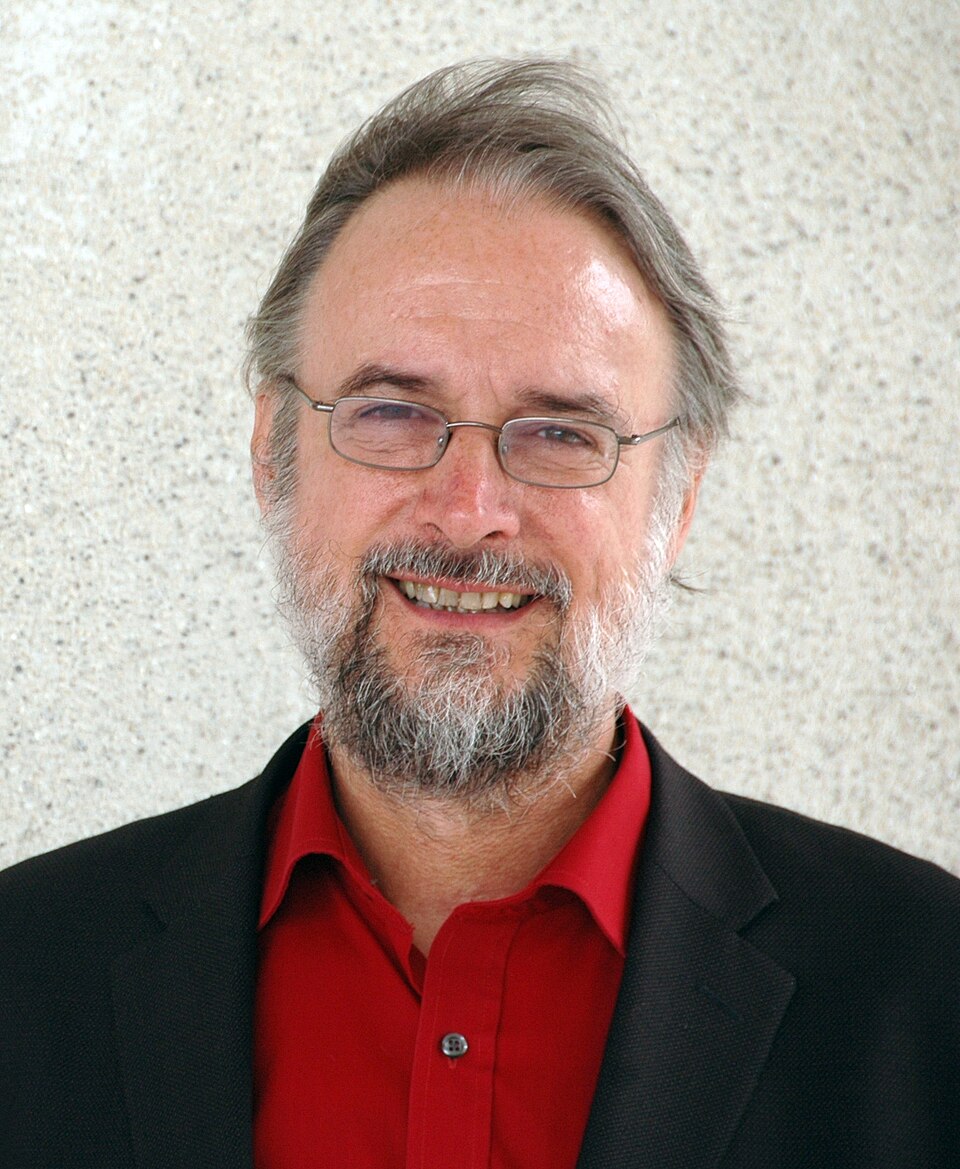
- Image: Karlheinz Brandenburg cropped.jpg by Christliches Medienmagazin pro, derivative work Pittigrilli (CC BY 2.0), via Wikimedia Commons