LEO: The Bakery Computer
Abstract
LEO (Lyons Electronic Office) was the first computer to do routine office work. J. Lyons & Co., the London tea-shop and bakery chain, paid towards Cambridge’s EDSAC in 1947, built its own copy with better input and output, and from 30 November 1951 ran its weekly bakery valuations on it. Lyons then founded a computer company, sold LEO II and LEO III machines from Johannesburg to Ostrava, and in 1963 merged it into English Electric, from where it disappeared into ICL. The Post Office ran the last LEO IIIs until 1981.
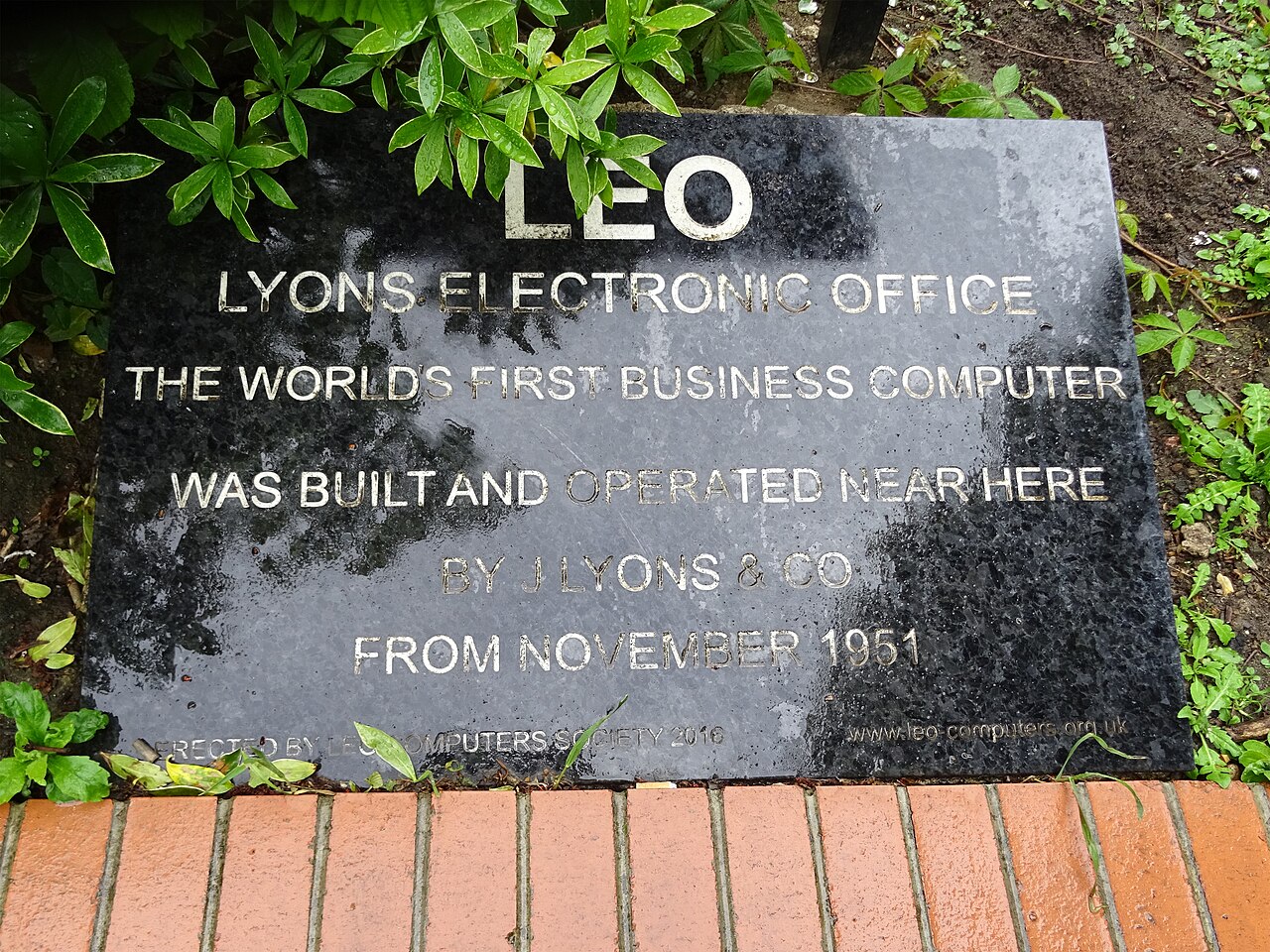
A Catering Firm With a Statistics Office
J. Lyons & Co., founded in 1887, was best known for its high-street tea shops and its cakes, baked at its headquarters site at Cadby Hall in west London. It was also known as a pace-setter in office mechanisation. Its clerical back office was run by John Simmons, a Cambridge mathematics graduate and an advocate of scientific management, who joined the board in January 1951.
In 1947, at Simmons’s urging, the board sent two managers, Raymond Thompson and Oliver Standingford, to the United States to study “the possibilities of electronic calculators in the office”. What they found was military and scientific work. At Princeton, Herman Goldstine told them that the most advanced project they could learn from was back home, in Maurice Wilkes’s Mathematical Laboratory at Cambridge.
Paying for EDSAC
Lyons made a deal with Cambridge. It contributed money to the EDSAC project (£2,500 in most accounts, £3,000 in others) and lent it an electrical engineer, Ernest Lenaerts, for six months; in return it got the right to learn from the design. EDSAC ran its first program on 6 May 1949 (see Maurice Wilkes and EDSAC). By the spring of 1949 Lyons was building its own machine in London, under a newly recruited chief engineer, John Pinkerton.
LEO I followed EDSAC’s architecture with changes for office work. Its mercury delay-line store held 2,048 words of 35 bits, four times EDSAC’s, in 64 tanks each five feet long, housed in a vault beneath the machine. Most of its 6,000-odd valves came from government surplus. The biggest change was input and output: a business computer spends much of its time reading and printing records, so Lyons gave LEO more capacity for bulk input and output than Cambridge had needed. The clock ran at 500 kHz, and most instructions took about 1.5 milliseconds.
The Bakery Job
By February 1951 LEO was running simple programs, and on 15 February Princess Elizabeth was shown the machine. The plan had been to start with the payroll, but trouble with input equipment from Standard Telephones pushed the team towards a simpler task: Bakery Valuations, which calculated the value of the week’s output of the Cadby Hall bakeries. A first run on 5 September 1951 worked. The regular service started at the end of November: Lenaerts’s notebook records the first part of the job finished on Wednesday 28 November, and Thompson reported to the board the following week that “the ‘Cadby Hall Bakery Job’ was completed by 2.35 p.m. on Friday 30th.” From then on LEO ran it every week. It was the first time any computer had been used for routine business work.
The payroll followed on Christmas Eve 1953. LEO cut the time to calculate one employee’s pay from eight minutes by hand to one and a half seconds, and it eventually paid about 10,000 Lyons staff. The machine also earned money from outside: before the end of 1951 it was computing for the Meteorological Office, it helped with calculations for the 1955 budget, and from 1956 it ran Ford UK’s payroll as a bureau job. Pinkerton led the engineers and David Caminer the systems analysts who designed these jobs. Mary Coombs, who joined in 1952, was LEO’s first woman programmer. LEO I closed down at 6 p.m. on Monday 4 January 1965, after more than thirteen years of service.
LEO Computers Ltd
The interest from other companies was enough for Lyons to found a subsidiary, LEO Computers Ltd, at the end of 1954. LEO II, from 1957, was sold to outside customers: eleven were built, among them machines for the steel maker Stewarts & Lloyds at Corby (1958) and two for Ford, one of them at Dagenham.
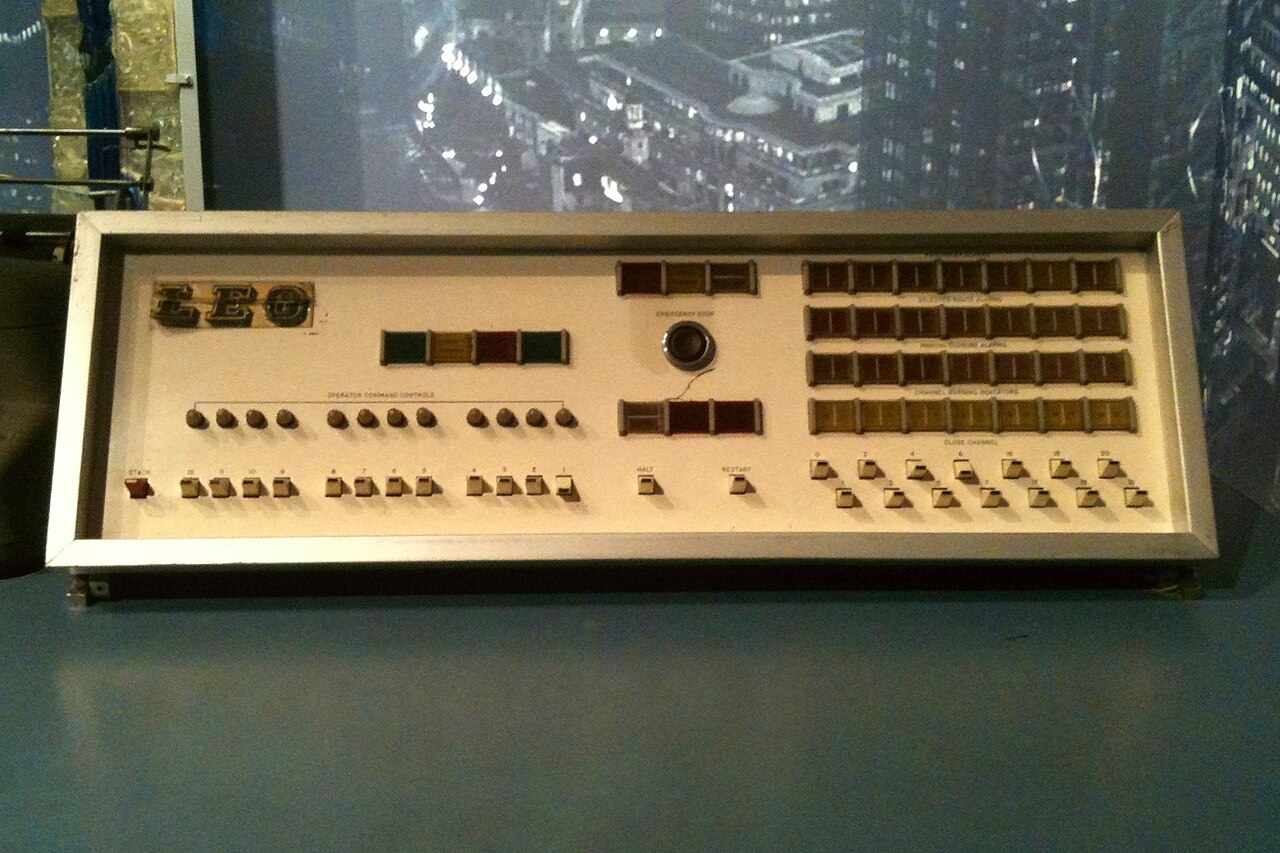
LEO III, first completed in 1961, was a solid-state machine with core memory and a microprogrammed control unit, and its operating system could run up to twelve programs at once. Its main programming language, CLEO, filled the role COBOL played elsewhere. About sixty were built, with serial numbers running to 94. The General Post Office became the largest customer, mostly for telephone billing; others went to Rand Mines in Johannesburg (1962) and to three Czechoslovak organisations, among them the NHKG steelworks in Ostrava (1966).
Dead End: The Company That Invented Business Computing
By 1962 the Lyons board had concluded that LEO Computers could not survive on its own against Ferranti, Elliott Brothers, ICT, and above all IBM. Designing a successor to LEO III was beyond its technical resources, and a catering company was not going to fund the gap. In April 1963 it merged with the computer division of English Electric to form English Electric Leo Computers. For English Electric, whose computers were built for scientific work, the attraction was LEO’s foothold in commercial data processing.
The name lasted five years. After further mergers with Marconi’s computer business, the company became part of International Computers Limited (ICL) in 1968 (see The UK Computing Industry). The installed LEO IIIs were too useful to switch off. The Post Office asked for production to be restarted in 1969 and kept its machines running until 1981. Its workload then moved to an ICL 2900, which ran the old LEO III code under emulation. No complete LEO survives. Lyons itself was bought by Allied Breweries in 1978, and by the 1990s the name had gone from the high street. Georgina Ferry told the full story in A Computer Called LEO (2003).
📚 Sources
- Ferry, Georgina: A Computer Called LEO: Lyons Teashops and the World’s First Office Computer (Fourth Estate, 2003), Open Library
- Cooper, Martin: “From baking to business computing”, BCS (28 April 2020) (Simmons, 1947 trip, Goldstine, £3,000, Cadby Hall, valves, 64 delay lines, Christmas Eve 1953 payroll, eight minutes to 1.5 seconds, 10,000 employees, Met Office, 1955 budget, Ford’s LEO IIs, 1962 decision, LEO I shutdown on 4 January 1965)
- Caminer, Hilary: “30th November 1951: a momentous day!”, Centre for Computing History (16 November 2021) (Standard Telephones equipment, switch to bakery valuations, Lenaerts’s notebook, Thompson’s memo, Met Office before end of 1951, Simmons on the board in January 1951)
- Centre for Computing History: “How Many LEOs?” (one LEO I, eleven LEO IIs, LEO III list with Rand Mines, GPO, Czechoslovak installations)
- Our Computer Heritage: “Leo Computers Ltd.” (company history, 2012) (founding 1887, “possibilities of electronic calculators in the office”, six months at Cambridge, spring 1949, end of 1954, LEO II from 1957, April 1963 merger and its reasons, ICL 1968, Allied Breweries 1978)
- Computer Conservation Society: LEO III emulator (first built 1961, about 61 machines, CLEO, GPO restart request 1969, ICL 2960 emulation 1981, no complete survivor)
- Wikipedia: LEO (computer) (finding aid: £2,500 and Lenaerts loan, Pinkerton, memory size, clock, Princess Elizabeth, 5 September 1951, Ford bureau from 1956, Mary Coombs, LEO III multiprogramming, GPO until 1981)
- Image: LEO Lyons Electronic Office … from November 1951.jpg by Spudgun67 (CC BY-SA 4.0), via Wikimedia Commons
- Image: LEO III (4813117200).jpg by tpholland (CC BY 2.0), via Wikimedia Commons