Rosalind Picard
Abstract
Rosalind Picard (born 1962) is the MIT electrical engineer who named affective computing in a 1995 technical report and a 1997 book, and then spent the next three decades finding out which parts of it were real. The parts that were turned out to be physiological: a wrist sensor built for nonverbal children with autism showed, by accident, that the skin’s electrical conductance rises before and during grand mal seizures, and the company she co-founded in 2013, Empatica, turned that into the first wristwatch the FDA cleared for use in neurology (2018). The part that sold, software that reads emotion off faces, she left behind at Affectiva in 2013. A former atheist who became a Christian as an undergraduate, she has argued in public for both science and faith, and in December 2024 a remark in a NeurIPS keynote about a Chinese student’s nationality cost her a public apology.
Georgia Tech and Bell Labs
Picard grew up near Atlanta and went to Chamblee High School. By her own account she was the clever child who had declared herself an atheist in grade school, dismissed religious people as uneducated and led debate teams for “a godless form of evolution.” A physician and his wife for whom she babysat surprised her by going to church; when she declined their invitations by pleading illness they suggested she read the Bible instead, starting with a chapter of Proverbs a day. She opened a King James Bible expecting “phony miracles, made-up creatures, and assorted gobbledygook” and found Proverbs full of wisdom she had to think about, bought a modern translation, read the whole book through, and then, trying to debunk it, read up on Buddhism and Hinduism and visited temples, synagogues and mosques. In her first year at Georgia Tech a classmate invited her to church, and after a sermon on making Jesus “Lord of your life” she prayed the words. What followed she has described as “a flat, black-and-white existence suddenly turned full-color and three-dimensional.”
She took her bachelor’s degree in electrical engineering at Georgia Tech in 1984, the Society of Women Engineers’ outstanding woman engineering student there four years running, and went to AT&T Bell Labs at Holmdel, New Jersey, as a member of technical staff from 1984 to 1987, first on VLSI architectures for signal-processing chips and then on image-compression algorithms, while Bell’s “One Year On Campus” fellowship paid for an MIT master’s (1986) (see Bell Labs: The Idea Factory). Her MIT doctorate in 1991, under Alex Pentland, Jae Lim and Sanjoy Mitter, was on texture modelling with Markov random fields, and she joined the Media Lab faculty the same year to work on content-based image retrieval; a 1997 paper with Tom Minka on interactive learning with a “society of models” won the Pattern Recognition Society’s prize. Among her early students was Steve Mann, the wearable-computing pioneer, and she was a founding member of the IEEE technical committee on wearable information technology; her first patent, in 1998, was with Mann.
Affective Computing
The 1995 report and the 1997 book, and the field they started, have their own article: Affective Computing. The short version is that Picard, coming from signal processing, argued from Antonio Damasio’s neurology that emotion is part of the machinery of rational decision, and that machines which must act under uncertainty should be able to recognize it, express it, and in some functional sense have it. Colleagues told her that putting “emotion” in an engineering title would end her career. MIT gave her tenure in 1998 and a full professorship in 2005; she is now the Grover M. Hermann Professor in Health Sciences and Technology and directs the Affective Computing Research Group she founded at the Media Lab. Aaron Sloman’s review called the book a “bold vision” that would inspire some and irritate others, and she wrote back that it did not capture the flavour of the book but that she was grateful for the misunderstandings to correct.
Her own group’s work went two ways. One was assistive. With Rana el Kaliouby it built an “emotional-social intelligence prosthesis” for people with autism, a wearable camera that read facial expression and head movement and reported one of eight states with 65 percent accuracy, shown at the International Symposium on Wearable Computers in 2007 and named one of the New York Times’ best ideas of 2006; work with the Groden Center in Providence produced the first corpus of naturally occurring expressions from people with and without autism. The other was physiological. A 2005 paper with Jennifer Healey on detecting stress in drivers from skin conductance, heart rate and respiration was later voted one of the ten best papers of the decade in IEEE Transactions on Intelligent Transportation Systems, and in 2007 the group built iCalm, a washable wristband measuring electrodermal activity, the small changes in skin conductance that track sympathetic nervous system arousal, so that the stress of a nonverbal child could be seen by someone else. In 2009 she and el Kaliouby founded Affectiva to commercialize the face-reading; she served as chief scientist for four years and left in 2013; by then the company’s product was a tool for testing advertisements. The evidence that facial expression does not map onto felt emotion in the way the product assumed, and the 2024 EU ban on emotion recognition in workplaces and schools, are told in the field article.
The Wristband
The seizure work began with a loan. Before a winter break a student asked to borrow an iCalm sensor for his younger brother, who has autism and does not speak, so that the family could see what stressed him; Picard told him to take two, one for each wrist. Reviewing the data afterwards she found a large signal on one wrist and nothing on the other, and the student told her it had come twenty minutes before his brother had a grand mal seizure. Picard telephoned the father of another of her undergraduates, Joseph Madsen, director of the epilepsy surgery programme at Children’s Hospital Boston, to ask whether a surge of the sympathetic nervous system twenty minutes before a seizure, on one side of the body, was possible, and was told that some patients report the hair standing up on one arm before an attack. Madsen let the group put sensors on children in his monitoring unit, where every seizure was also recorded by EEG.
Two papers in 2012 set out what they found. In Epilepsia, Ming-Zher Poh, Picard and colleagues showed that a wrist-worn combination of electrodermal activity and accelerometry could detect generalized tonic-clonic seizures automatically. In Neurology they reported that the higher a patient’s skin conductance during a seizure, the longer the brain’s electrical activity stayed suppressed afterwards, a state that had been linked to sudden unexpected death in epilepsy (SUDEP), which kills roughly one in a thousand people with epilepsy each year. The mechanism of SUDEP is still argued over; what mattered for engineering was that the danger period was visible from the wrist, and that most deaths happen when no one is in the room. “If somebody goes to check on a person during or after they have had a grand mal seizure,” Picard said, “then they are less likely to die.” In 2017 her group and Orrin Devinsky’s published a recording from a patient who died, showing sympathetic hyperactivity and slowed breathing before a probable SUDEP, and a multicentre trial of the improved detector.
Empatica was founded in 2013 in Cambridge, Massachusetts, by Picard with Matteo Lai as chief executive and Simone Tognetti as chief technology officer, with offices in Boston and Milan; Picard is part-time chief scientist and chair. It sold the E4 wristband to researchers and in 2014, with the Epilepsy Foundation, crowdfunded the consumer device on Indiegogo. The Embrace watch received FDA clearance in January 2018 for seizure alerting in adults, the first wristwatch cleared for use in neurology, and Embrace2 in January 2019 for patients from the age of six, the first non-EEG seizure monitor cleared for children; it detects a convulsive seizure and phones a caregiver. Later clearances covered a health-monitoring platform (November 2022) and EpiMonitor (February 2024). None of it reads an emotion. It reads arousal, which has a physical meaning, and the wristband is the reason Picard’s honours in the 2020s are medical rather than computational: election to the National Academy of Engineering in 2019 for affective and wearable computing, ACM Fellow and National Academy of Inventors in 2021, the 2022 Lombardy prize for computer science research, whose €1 million she gave to epilepsy and sudden-infant-death research, and the 2026 IEEE Medal for Innovations in Healthcare Technology. Her stated next target is mood: wearable data that would forecast a depressive episode the way a barometer forecasts weather, an “emotional weather forecast” she has said could prevent most mood-related disorders, a claim that so far outruns the evidence in the way her 1995 report did.
Science and Faith
Picard has been unusually public, for an MIT engineer, about religion. She has said that as a young atheist she thought herself “too smart to believe in God” and now regards that as arrogance; that scientists “cannot assume that nothing exists beyond what they can measure”; and that the complexity of DNA looks to her like “the mark of intervention.” She signed the Discovery Institute’s petition A Scientific Dissent From Darwinism, which states skepticism that random mutation and natural selection account for the complexity of life, while telling an interviewer she has reservations about intelligent design and that the media’s two-camp framing does “the whole state of knowledge a huge disservice.” She has spoken for the Veritas Forum, shared the 2025 Trotter Prize lecture at Texas A&M with Richard Dawkins, and wrote in Christianity Today in 2019 that digging into models of how the emotions work left her with greater awe for their author. Readers will judge the argument; the vault records it because it shaped what she chose to build, which was, by her account, devices that keep people alive rather than devices that sell to them.
NeurIPS
On December 13, 2024, Picard gave a keynote at NeurIPS in Vancouver on how AI could help or harm people. One slide quoted a Chinese student, expelled from a university for using AI to cheat, who said no one at the school had taught morals or values, with a footnote reading “Most Chinese who I know are honest and morally upright.” No other example on her slides named a nationality. An audience member asked her why during the question period; Yiran Chen of Duke and other researchers said afterwards that singling out a nationality was inappropriate, and NeurIPS posted that the remark did not align with its code of conduct. Picard’s statement the next day said the detail was “unnecessary, irrelevant to the point I was making, and caused unintended negative associations.” On December 18 she added that she had “learned over these past days the depth of the damage I did,” that Chinese and Chinese American colleagues “frequently contend with deliberate ethnic stereotyping that feeds an atmosphere of mistrust,” and that she was “deeply sorry for having caused you this additional pain.” The episode is small next to the rest of the record and is included because the record is what this encyclopedia keeps.
📚 Sources
- Rosalind Picard — Wikipedia (born 1962; Georgia Tech 1984; Bell Labs 1984–1987 and the work there; MIT SM 1986 and ScD 1991, thesis and advisors; faculty 1991, tenure 1998, full professor 2005; the Grover M. Hermann chair; Steve Mann and the 1998 patent; the Minka paper; Sloman’s review and her reply; the ESP prosthesis, 65 percent, eight states, ISWC; the Healey driver-stress paper; Affectiva 2009 and four years as chief scientist; Empatica 2013; the Bell “One Year On Campus” fellowship and the SWE awards; the New York Times best ideas 2006; NAE 2019, ACM Fellow 2021, NAI 2021, the 2022 Lombardy prize and the €1 million gift, the 2025 Trotter Prize, the 2026 IEEE medal; the Dissent From Darwinism signature and her reservations about intelligent design; the December 2024 NeurIPS keynote and reactions)
- Rosalind Picard, “An MIT Professor Meets the Author of All Knowledge,” Christianity Today, March 2019 (the childhood atheism and debate teams, the physician’s family, Proverbs, “phony miracles,” the temples and mosques, the Georgia Tech conversion, “full-color and three-dimensional,” “too smart to believe in God”)
- Rosalind Picard, “Affective Computing,” MIT Media Laboratory Perceptual Computing Section Technical Report No. 321 (1995)
- Rosalind W. Picard, Affective Computing (MIT Press, 1997) (publisher page; the host refuses scripts but loads in a browser)
- Empatica wristband detects, alerts to seizures, monitors stress — MIT News, March 9, 2016 (iCalm 2007, the 2012 Neurology paper, SUDEP at about one in a thousand per year, the “less likely to die” quote, Lai and Tognetti, the E4, the Indiegogo campaign)
- Gauging seizures’ severity — MIT News, April 27, 2012 (the Neurology finding on skin conductance and postictal EEG suppression, the autism origin, Madsen as a UROP student’s father, Loddenkemper and Poh)
- Poh et al., “Convulsive seizure detection using a wrist-worn electrodermal activity and accelerometry biosensor,” Epilepsia 53 (2012), e93–e97
- Picard et al., “Wrist sensor reveals sympathetic hyperactivity and hypoventilation before probable SUDEP,” Neurology 89, no. 6 (2017), 633–635
- Onorati et al., “Multicenter clinical assessment of improved wearable multimodal convulsive seizure detectors,” Epilepsia 58, no. 11 (2017), 1870–1879
- “The End of Seizures and Depression?” — IEEE Pulse (the brother and the one-sided reading, the Madsen conversation and the hair on one arm, the “emotional weather forecast” and the 80 percent claim, the IEEE wearable committee)
- Empatica — Wikipedia (founding 2013 by Lai, Tognetti and Picard; Boston and Milan; Picard’s roles; FDA clearances of January 2018, January 2019, November 2022 and February 2024)
- Embrace by Empatica is the world’s first smart watch to be cleared by FDA for use in neurology — press release, February 2018
- NeurIPS apology, moving forward — MIT Media Lab, December 2024 (the December 14 and December 18 statements, quoted)
- Prof. Rosalind Picard apologizes for comments at the 2024 NeurIPS conference — The Tech, January 9, 2025 (December 13, 2024; the slide and its footnote; the question from the floor; the NeurIPS statement)
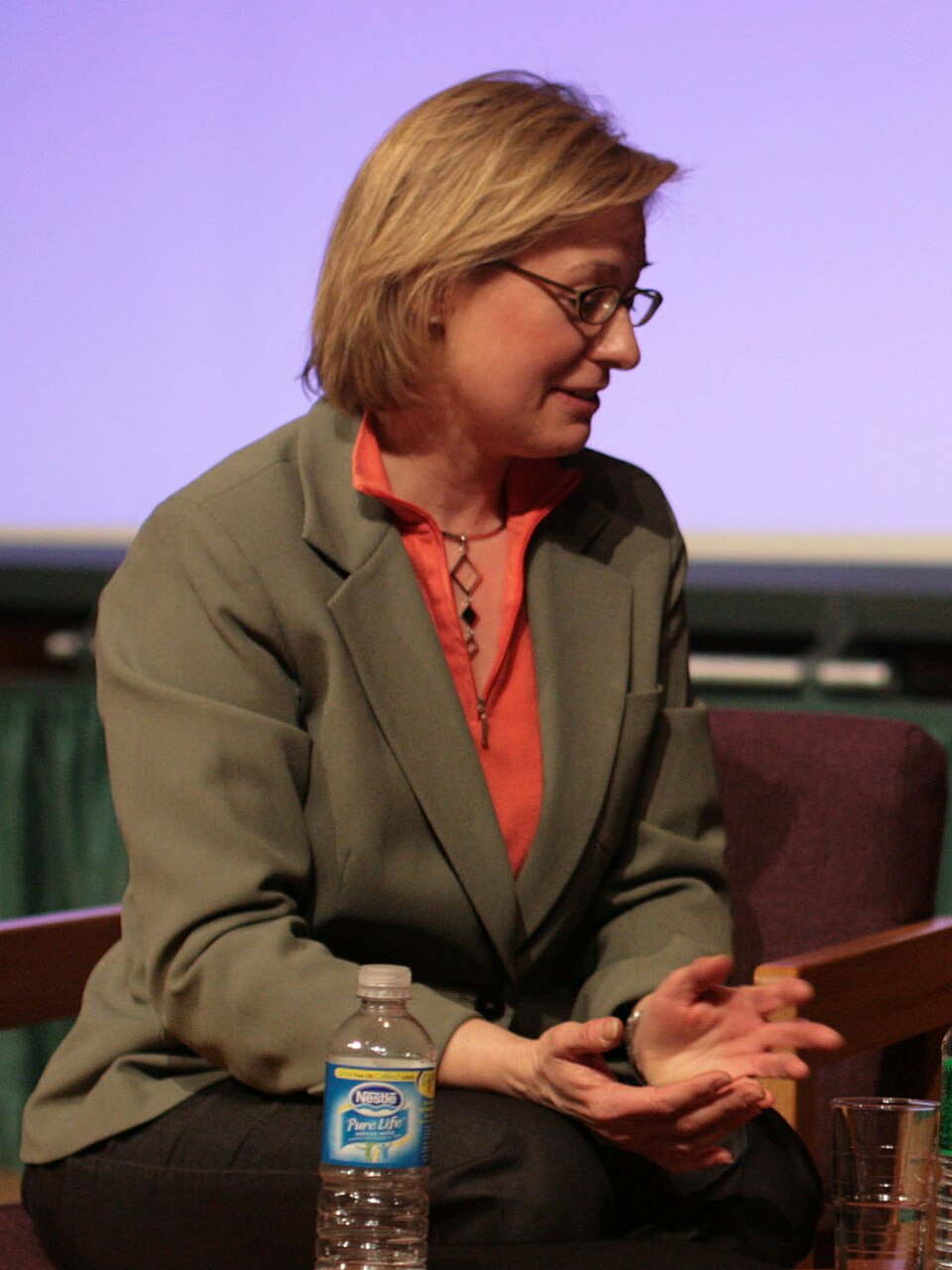
- Image: Panel Discussion Close-up, Science, Faith, and Technology Cropped.jpg by David Bruce from Boston, MA, cropped by Disavian (CC BY-SA 2.0), via Wikimedia Commons