Britannica and the CD-ROM Encyclopedias
Abstract
For about fifteen years the CD-ROM encyclopedia was the most persuasive reason to buy a CD-ROM drive, and the market it destroyed was the most prestigious in publishing. Grolier put an encyclopedia on a disc in 1985; Compton’s, owned by Encyclopædia Britannica, made the first multimedia one in 1989. Britannica itself, with 2,300 door-to-door salespeople and record revenue of $650 million in 1990, treated the disc as a threat to its sales force rather than a product. When Microsoft’s Encarta sold for under $100 from 1993, Britannica answered with a $995 disc, sold Compton’s, and watched its revenue halve by 1996, when the Swiss investor Jacob Safra bought the company for a fraction of its book value and dismissed the salesmen. The price of Britannica on disc fell to $85 by 1998, and in 1999 the whole encyclopedia went online for free. The CD-ROM encyclopedias then lost to the web in turn: Grolier’s last disc came out in 2003, Encarta closed in 2009, and Britannica stopped printing in 2012.
The Sales Force
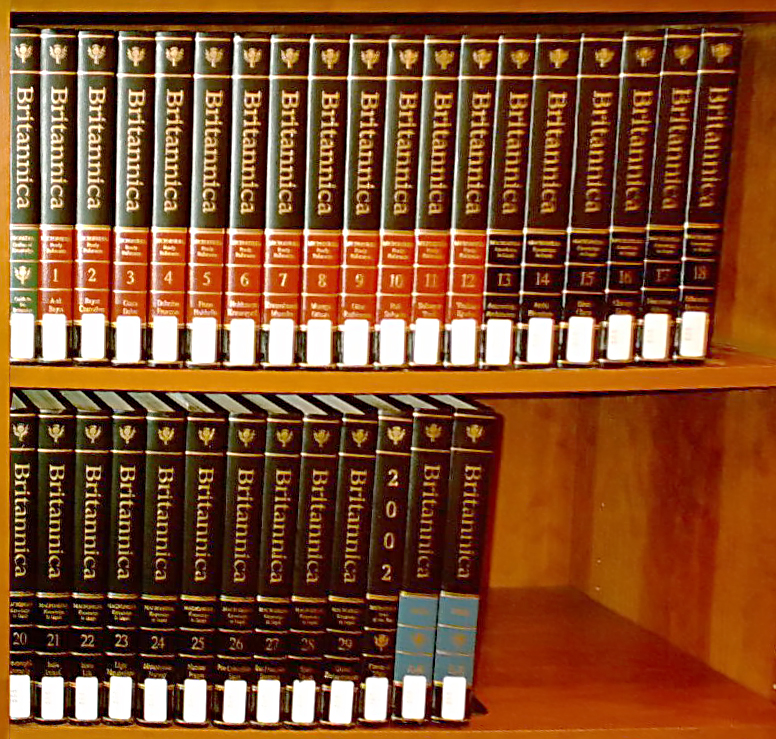
The Encyclopædia Britannica began in Edinburgh in 1768 and moved to American ownership in the early twentieth century. In 1943 the advertising man William Benton took charge and expanded the company, buying Compton’s, a children’s encyclopedia, and the dictionary publisher G. & C. Merriam. By the 1980s the main set ran to 32 volumes and was sold in the home. In 1989 the company had 2,300 sales associates, who made appointments by telephone and then sat with families in their living rooms; the case they made was as much about children’s prospects as about the text. A set cost $1,500 to $2,000 in 1990, printing and binding it cost the company about $200 to $300, and that year revenue reached $650 million, the highest in its history.
Britannica had gone electronic early and carefully. In 1981 it put its text on Mead Data Central’s Lexis-Nexis service for business users only, and specifically excluded schools, libraries and individuals. A version that anyone could read at home would compete with the salesman.
The First Discs
The CD-ROM, a compact disc holding about 650 megabytes of data, appeared in the mid-1980s, and an encyclopedia was one of the few kinds of content large enough to fill one and valuable enough to sell with the drive. Grolier, which owned the Academic American Encyclopedia, released The Electronic Encyclopedia from Grolier in 1985: 30,000 entries and 9 million words of text, with full-text search and cross-references, and no pictures. It added still images in 1990 and sound and video in the New Grolier Multimedia Encyclopedia of 1992.
Britannica’s own subsidiary went further first. Compton’s MultiMedia Encyclopedia, released in 1989 and sold to schools and libraries for $750, was the first multimedia CD-ROM encyclopedia, with pictures and sound linked from the text. It won the Software Publishers Association’s award for best education program in 1991. Britannica kept its main encyclopedia off the disc.
The Patent
In 1993 Britannica sold the Compton’s business, including Compton’s NewMedia, to the Tribune Company for $57 million. A patent went with it. On 31 August 1993 the US Patent and Trademark Office had issued patent 5,241,671, assigned by fourteen inventors to Britannica, for a “multimedia search system using a plurality of entry path means which indicate interrelatedness of information.” Compton’s NewMedia announced it at the Comdex trade show in Las Vegas in November and read it as covering almost any retrieval of linked text, pictures, sound and video from a database, on any platform. It offered competitors licences on terms that included royalties on their sales. A patent lawyer predicted that “the most likely reaction is going to be disbelief,” followed by the question of how anyone could patent something like that.
The protest was large enough that the Commissioner of Patents, Bruce Lehman, ordered the patent re-examined on his own initiative. The office concluded that the claims were neither new nor unobvious over earlier work and cancelled all forty-one of them. The case became an early reference point in the argument over software patents.
Encarta and the Response
Microsoft released Encarta in 1993, built from licensed Funk & Wagnalls text (see Dead End: Encarta). It cost less than $100 and was often given away with new PCs. Britannica’s first response the same year was a two-CD version of its full text for businesses only, on a three-year, two-workstation licence at $2,100 a year; it needed a one-gigabyte hard disk, which alone cost about $1,100 at the time. An associate publisher described it as “a powerful, adult-level research and retrieval tool” for publishers, news organisations and government agencies. Nothing changed for families.
In 1994 Britannica produced a consumer CD-ROM. It gave the disc free to anyone who bought the printed set and charged $995 for the disc alone; the disc cost about $1.50 to make. The same year it put the encyclopedia online as Britannica Online, the first encyclopedia on the internet, at $2,000 a year for universities. In 1995 the CD’s price fell to about $200. Revenue went from $650 million in 1990 to $540 million in 1993, $453 million in 1994 and $325 million in 1996, and the number of printed sets sold fell from about 117,000 in 1990 to 55,000 in 1994. The company’s best salespeople began to leave.
Safra
In 1996 Jacob Safra, a Swiss investor, bought the company for a fraction of its book value. He disbanded the door-to-door sales force, tried selling discs by direct mail, and cut the consumer online subscription to $150 a year and then $85; only 11,000 people subscribed. In May 1997 the price of Britannica CD 97 dropped to $150. “The equation is simple,” said the chief executive, Don Yannias. “When people use EB products, they like them. At $150, more people buy them.” Britannica CD 98 Standard Edition sold in shops for $85.
In late October 1999 the company put the entire text of the encyclopedia on the web at britannica.com, free, paid for by advertising and a share of online sales, and hired an advertising sales force for the first time. “We are not in the book business,” a senior vice-president said. “We’re in the information business.” Six days after the launch the site crashed under demand: more than ten million people tried to reach it, and about 100,000 got through. By mid-2000 the company had renamed itself Britannica.com Inc.; by 2009 about 60 percent of its revenue came from online operations, of which about 15 percent came from consumer subscriptions.
Dead End: The Encyclopedia on a Disc
The CD-ROM encyclopedia was a transitional format with a short life. It was cheap to copy and expensive to update, so each edition was out of date when it shipped; it was large for a disc and small for a network. When households moved from CD-ROM drives to the internet in the late 1990s, the format that had undercut the printed set was undercut in the same way, and by something free. Grolier published its last CD-ROM encyclopedia in 2003, and Microsoft closed Encarta in 2009.
Britannica survived as an online publisher selling mainly to schools and libraries. In December 2005 Nature compared 42 science articles in Britannica and in Wikipedia, and its expert reviewers found 123 errors in Britannica and 162 in Wikipedia, about three per article against four. Britannica published a rebuttal in March 2006, “Fatally Flawed,” disputing the method; Nature stood by the study. In March 2012 the company announced that the 2010 edition would be the last printed one. Of its run of 12,000 sets, about 8,000 had been sold.
📚 Sources
- Govindarajan, Vijay and Praveen K. Kopallé, “Encyclopædia Britannica, Inc. (A)”, "(B)" and "(C)", Tuck School of Business cases 2-0007 to 2-0009, 2002 (Benton and the 1943 acquisitions, the 1981 Lexis-Nexis restriction, Compton’s CD for $750 in 1989, 2,300 associates, $650 million and $1,500–2,000 sets in 1990, the 1993 business CD and the $1,100 disk, the $57 million Compton’s sale, the 1994 $995 CD and the $200–300 versus $1.50 production costs (from Evans and Wurster), Britannica Online at $2,000, the revenue series to 1996, 117,000 and 55,000 sets, the Safra purchase, the $150 and $85 subscriptions and 11,000 subscribers, Yannias’s quotation, CD 98 at $85, the October 1999 launch and crash)
- Evans, Philip B. and Thomas S. Wurster, “Strategy and the New Economics of Information”, Harvard Business Review, September–October 1997
- Academic American Encyclopedia, Wikipedia (the 1985 Grolier CD-ROM, 30,000 entries and 9 million words, images in 1990, the 1992 multimedia edition, last CD-ROM in 2003)
- Compton’s Encyclopedia, Wikipedia (the 1989 multimedia CD-ROM as the first, the 1991 SPA award, the 1993 sale to Tribune)
- US Patent 5,241,671, Google Patents and “Compton’s Multimedia Patent” (31 August 1993, the Comdex announcement, licensing terms, the patent lawyer’s prediction); “Is Patent Law Technology Specific?” (Lehman’s re-examination and the cancellation of all 41 claims)
- Encyclopædia Britannica, Wikipedia (the 1996 sale below estimated value, the Nature comparison figures, the March 2012 end of print, 12,000 and 8,000 sets) and Britannica.com, Wikipedia (60 percent online revenue in 2009, 15 percent from consumer subscriptions)
- Giles, Jim, “Internet encyclopaedias go head to head”, Nature 438, 15 December 2005; Encyclopædia Britannica, “Fatally Flawed”, March 2006; “Britannica attacks”, Nature 440, 2006
- Image: Encyclopaedia Britannica 15 with 2002.jpg by SEWilco (CC BY-SA 3.0), via Wikimedia Commons