Jimmy Wales and Wikipedia
Abstract
Wikipedia launched on January 15, 2001, as a side project to support a failing peer-reviewed online encyclopedia. Within its first month it had produced more articles than its parent managed in its entire existence. The English edition passed seven million articles in May 2025, one of over 340 language editions, maintained by unpaid volunteers and reaching more than 1.5 billion unique devices per month. Jimmy Wales co-founded it with Larry Sanger, a partnership that ended in dispute and became one of the most contested founding stories in internet history. Along the way Wikipedia refused advertising after a revolt by its Spanish editors, blacked itself out for a day to stop a US copyright bill, was blocked by Turkey for nearly three years, and, by its 25th birthday in January 2026, had become raw material for the AI systems that were drawing readers away from it.

Early Life
Jimmy Donal Wales was born in Huntsville, Alabama, on August 8, 1966. An error on his birth certificate spread August 7 into many documents and reference works; in 2011 he settled the matter by sending Britannica a scan of his passport. His mother and grandmother ran a small private school, and his early education there was less structured than a standard curriculum, with more reading and more self-direction. He has described spending hours with the family’s World Book Encyclopedia, which his mother had bought from a door-to-door salesman. Each year the publisher sent a packet of stickers with corrections and additions, and young Jimmy helped paste them onto the pages.
He finished the Randolph School in Huntsville at sixteen and went straight to Auburn University, graduating in finance in 1986, then took a master’s in finance at the University of Alabama. He entered the doctoral program at Indiana University and left without a dissertation. In his twenties he read Ayn Rand and called himself an Objectivist, a label he later dropped. In 1994 he moved to Chicago to trade interest-rate and currency options for Chicago Options Associates, and made enough money to stop.
Bomis and Nupedia
In 1996 Wales co-founded Bomis with Tim Shell and Michael Davis, a web directory and search company based first in Chicago, then in San Diego. Bomis organized web content into topical directories, ran web rings, and maintained a network of fan sites, an early-internet business built on the same category logic as Yahoo. Its most profitable vertical, which Wales has acknowledged without pride, was adult content. Bomis’s “Babe Engine” (a directory of images of women) generated the revenue that funded everything else.
Nupedia went online on March 9, 2000, funded out of Bomis revenue: a free online encyclopedia modeled on academic peer review. Wales hired Larry Sanger, then finishing a philosophy PhD at Ohio State (awarded in 2000), as editor-in-chief. Every Nupedia article went through a seven-stage process: assignment, finding a lead reviewer, lead review, open review, lead copyediting, open copyediting, and final approval and markup. Only credentialed experts were to write.
The first full year produced twenty-one articles.
The Wiki Suggestion
On January 2, 2001, Sanger had dinner with programmer Ben Kovitz in San Diego. Kovitz described WikiWikiWeb, the original wiki, created by Ward Cunningham in 1995 for the Portland Pattern Repository, a collaborative website for software design patterns. Cunningham’s idea was that if editing a page is as easy as reading it, a community of interested people will fix errors faster than they appear, and no formal editorial process is needed.
Sanger proposed wiki software to Wales as a feeder for Nupedia: an open space where anyone could draft articles quickly, with the best of them submitted to formal review later. Wales agreed. On January 10, 2001, a wiki went up under nupedia.com. The Nupedia editors did not want it there, so it got its own name: wikipedia.com was registered on January 12, wikipedia.org on January 13, and Wikipedia opened on January 15, 2001. The first edit on the home page read “This is the new WikiPedia!” Sanger picked the name, a portmanteau of “wiki” (Cunningham’s word, from the Hawaiian for “quick”) and “encyclopedia”; he later called it “a silly name for what was at first a very silly project.”
The software was UseModWiki, a Perl script by Clifford Adams. The article count passed one thousand on February 12, 2001, four weeks after launch, and ten thousand by September 7.
Info
Ward Cunningham created WikiWikiWeb in 1995 as a tool for programmers documenting software design patterns. His original software was spare: pages could be created and edited by anyone who visited the site, changes were logged, and the most recent version was what you saw. Cunningham called it “the simplest online database that could possibly work.”
Exponential Growth
The project went international within weeks. The German Wikipedia, the first non-English edition, started on March 16, 2001; French followed on May 11 along with Chinese, Dutch, Esperanto, Hebrew, Italian, Portuguese, Russian, Spanish and Swedish. On September 11, 2001, contributors created about a hundred articles on the attacks, and a link from Yahoo!’s front page brought a wave of new readers.
By the end of December 2001, Wikipedia held roughly nineteen thousand English articles. Nupedia finished its whole run with twenty-four approved ones. A retired teacher who knew the history of railways in rural England could write a stub in twenty minutes; under Nupedia’s process, that article would have needed a credentialed expert and months of review.
Nupedia ended without ceremony: its server crashed on September 26, 2003, and nobody restored it. Twenty-four approved articles and about 150 drafts were left; the finished ones went to Wikipedia. By that point, Wikipedia had passed one hundred thousand articles (January 22, 2003).
The English milestones came at a steady clip:
| Articles | Date | Milestone article |
|---|---|---|
| 1 million | March 1, 2006 | Jordanhill railway station |
| 2 million | September 9, 2007 | El Hormiguero |
| 3 million | August 17, 2009 | Beate Eriksen |
| 4 million | July 13, 2012 | Izbat al-Burj |
| 5 million | November 1, 2015 | Persoonia terminalis |
| 6 million | January 23, 2020 | Maria Elise Turner Lauder |
| 7 million | May 28, 2025 | Operators and Things |
By 2007 it was the largest reference work ever assembled in any language in any medium, and the German, French, Japanese and Polish editions were each larger than the Encyclopaedia Britannica. The scope expanded to topics print encyclopedias had never had room for: every minor character in every television series, every small municipality in every country. The first commercial casualty was not the print sets but Microsoft’s CD-ROM encyclopedia Encarta, which held about 62,000 curated articles and could not answer a free encyclopedia that had millions and grew by the hour; Microsoft shut it down in 2009. On January 13, 2021, the project recorded its billionth edit.
The Spanish Fork
The decision that shaped Wikipedia’s finances was forced on it by volunteers. In early 2002 Bomis was hurting in the dot-com bust, and talk on the project’s mailing lists turned to advertising as a way to pay for the servers. On February 26, 2002, many of the active editors of the Spanish Wikipedia, led by Edgar Enyedy, walked out and started the Enciclopedia Libre Universal en Español, hosted for free by the University of Seville. Their complaints included the expected advertising, the .com domain, outdated software on the non-English wikis, and stale database dumps.
The fork never caught up with Spanish Wikipedia, and by late 2024 it had shut down. It won its main points anyway. Wikipedia moved from wikipedia.com to wikipedia.org, and Wales announced that it would not run commercial advertising, a promise it has kept. Enyedy later said: “It was merely a form of pressure. Some of the goals were achieved, not all of them, but it was worth the cost.”
Bomis, squeezed by the same bust, stopped funding Sanger’s position in February 2002. He resigned his Nupedia and Wikipedia roles on March 1, 2002.
The Software
UseModWiki stored pages as flat files and struggled as traffic grew. In January 2002 Wikipedia switched to “Phase II,” a PHP program with a MySQL database written by Magnus Manske, a German biochemistry student. In July 2002 “Phase III,” rewritten by Lee Daniel Crocker, went live; renamed MediaWiki, it became the free software that runs Wikipedia and thousands of other wikis. On February 12, 2004, the servers moved from San Diego to a colocation facility in Tampa, Florida.
The Wikimedia Foundation
On June 20, 2003, Wales incorporated the Wikimedia Foundation as a nonprofit in St. Petersburg, Florida, and transferred Wikipedia’s domain names and servers to it. With the encyclopedia inside a nonprofit instead of Bomis, it could not be sold or restructured by investors, and it would be funded by donations. Sister projects followed: Wiktionary (2002), Wikisource (2003), Wikimedia Commons (September 7, 2004) for media files, later Wikidata for structured facts.
Wales chaired the foundation’s board until 2006 and from 2008 held a board seat reserved for the “community founder.” In 2008 the foundation moved to San Francisco. Its first executive director, Sue Gardner (December 2007 to May 2014), turned a handful of staff into a professional organization; she was followed by Lila Tretikov and Katherine Maher.
The annual fundraising banners, featuring Wales’s own photograph and handwritten-style appeals for small donations, became one of the internet’s most recognizable recurring sights. Foundation revenue was $154.7 million in fiscal 2021/22 and $185.4 million in 2023/24, against roughly 650 employees. A separate Wikimedia Endowment, founded in January 2016, passed $100 million in June 2021, five years ahead of plan.
Wales has described his role as that of a “constitutional monarch.” In 2012 he told the Canadian Bar Association that it “mostly means I wave at crowds and comport myself with dignity and set an example, and serve as a symbol,” adding: “For lots of decisions, I have a great deal of influence, but no actual power, which is exactly the way it should be.” Asked in a Slashdot interview in July 2004 what Wikipedia was for, he had answered: “Imagine a world in which every single person on the planet is given free access to the sum of all human knowledge. That’s what we’re doing.”
Wales After Wikipedia
Wikipedia made Wales famous but not rich. In 2004 he and Angela Beesley founded Wikia, a for-profit wiki host funded by advertising, used above all by fan communities for games and television series; it was later renamed Fandom. Wales stepped down as its CEO on June 5, 2006. Time named him one of the world’s 100 most influential people that year.
Later ventures were smaller. WikiTribune (2017) tried to combine paid journalists with volunteer fact-checkers and did not last; WT.Social (October 2019) was an ad-free social network. In 2015 he received the $1 million Dan David Prize.
Wales moved to London in 2012, married Kate Garvey, a former aide to Tony Blair, on October 6, 2012, and became a British citizen in 2019. In October 2025 he published The Seven Rules of Trust, a book on why institutions lose trust and how Wikipedia kept some.
Dead End: Nupedia and the Expert-Verification Model
Warning
Nupedia’s failure and the success of its amateur offshoot showed that rigorous curation at the point of creation loses, at scale, to mass editing with correction after publication. Expert knowledge still mattered: Wikipedia’s best technical articles are often written by domain experts, who can fix one paragraph in five minutes without committing to a seven-stage review. Nupedia asked the same expert to own an entire article through every stage of production. Wikipedia collected expert knowledge incidentally, a paragraph at a time; Nupedia demanded it upfront and in full, and got twenty-four articles.
The Founding Dispute
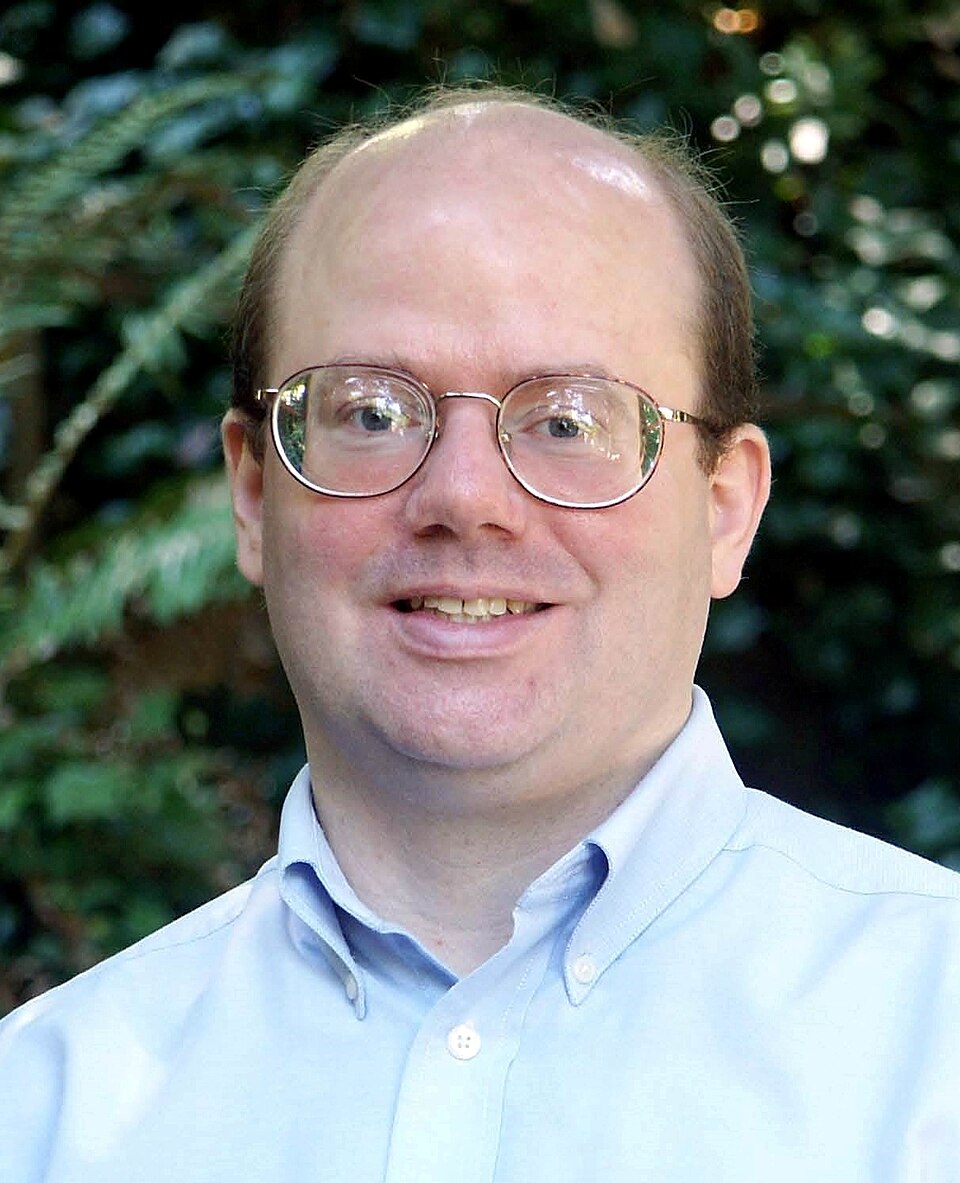
After Sanger left, his account of the founding diverged sharply from Wales’s. Wales’s public narrative described Wikipedia primarily as his own idea, with Sanger as the hired executor. Sanger, who had proposed the wiki mechanism, maintained that he was a co-founder whose contribution had been systematically downplayed. In December 2005, writer Rogers Cadenhead documented that Wales had edited his own Wikipedia biography, including edits that trimmed references to Sanger as co-founder; Wales apologized for a practice Wikipedia discourages.
The dispute has produced a substantial secondary literature and has never been settled. Wikipedia’s own article on its history names Sanger as co-founder; Wales’s public statements have varied. In November 2025 Wales walked out of an interview on the German podcast Jung & Naiv when asked about it.
Sanger announced Citizendium at the Wizards of OS conference in Berlin in September 2006 and opened it publicly in March 2007: a rival encyclopedia requiring real-name registration and giving credentialed experts editorial authority. It attracted a small community and produced a fraction of Wikipedia’s content. Sanger became one of Wikipedia’s most persistent critics, arguing that it had abandoned the neutrality he had written into its early rules.
The Reliability Question
Vandalism (deliberate insertion of false or offensive information) is constant on high-traffic pages. Bots revert obvious vandalism within seconds; semi-protection, requiring an account to edit certain pages, limits anonymous attacks on the most targeted topics. Subtle manipulation by registered accounts is harder to catch.
In December 2005 Nature had experts compare 42 science articles from Wikipedia and Britannica. They found 162 factual errors, omissions or misleading statements in Wikipedia and 123 in Britannica, and four serious errors in each. Nature concluded that Wikipedia “comes close to Britannica”; Britannica called the study “fatally flawed” and pointed out that Wikipedia had a third more errors. Both readings were used for years.
Around the same time, the Seigenthaler incident gave the problem a face. John Seigenthaler Sr., a journalist who had served as administrative assistant to Attorney General Robert F. Kennedy, found that his Wikipedia biography said he had been “thought to have been directly involved in the Kennedy assassinations” and had moved to the Soviet Union in 1971. Both were false. The text was inserted on May 26, 2005, and stayed up until October 5. The author was Brian Chase, a Nashville delivery-company manager who said he had meant it as a joke on a coworker. On December 5, 2005, Wales barred unregistered users from creating new articles, and on December 17 Wikipedia adopted its policy on biographies of living persons, which demands sources for contentious claims about the living and allows immediate removal of unsourced ones.
In 2007 the Essjay controversy hit from the opposite direction. An administrator called “Essjay” had described himself as a tenured professor with doctorates in theology and canon law, and The New Yorker had quoted him as such in a July 2006 profile of Wikipedia. After Wikia hired him in January 2007, it emerged that he was Ryan Jordan, twenty-four, with no advanced degrees, and that he had used his invented credentials in content disputes. The New Yorker printed a correction in late February. Wales, who had first defended the use of pseudonyms, asked him to resign in early March. A proposal to make editors prove claimed qualifications was rejected by the community.
Systematic bias was harder to address. The Wikimedia Foundation’s 2011 editor survey put female participation at 9 percent; a 2018 survey across twelve language editions found 8.8 percent overall and 13.6 percent among English Wikipedia contributors, while other English-focused studies have estimated up to 20 percent. The community skews young and concentrated in wealthy English-speaking countries. Technology companies received detailed coverage while women scientists from before Wikipedia’s founding were often stubs. Outreach programs (Wiki Loves campaigns, partnerships with libraries and universities in underrepresented regions) addressed the margins of the problem without changing its structure. In 2008 the press reported a brief relationship between Wales and the Canadian columnist Rachel Marsden, which had begun after she contacted him about her Wikipedia biography, raising conflict-of-interest questions about how the project’s standards applied to its founder.
The Blackout
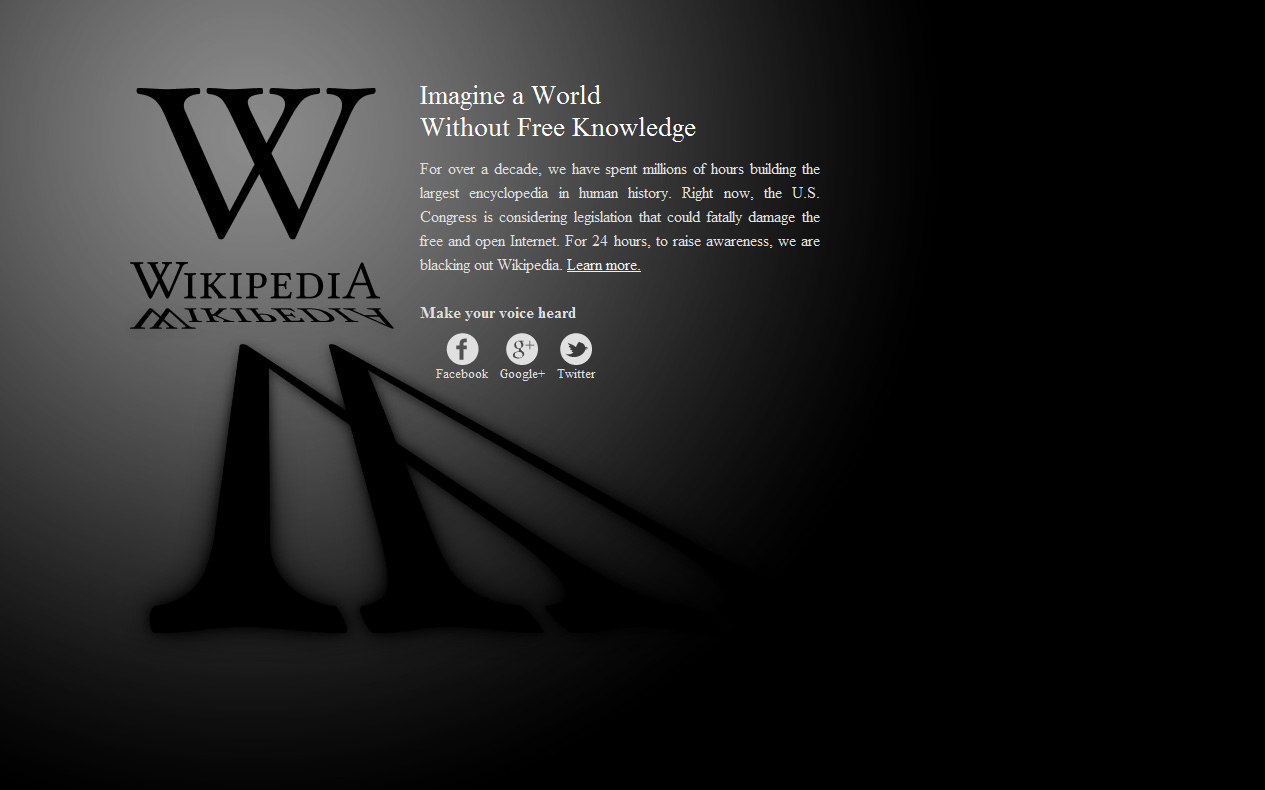
In late 2011 the US Congress was moving two bills, the Stop Online Piracy Act (SOPA) and the PROTECT IP Act (PIPA), that would have let the government and rights holders obtain court orders cutting off foreign sites accused of copyright infringement. About 1,800 Wikipedia editors voted on a response, roughly 90 percent in favor of a blackout.
At 05:00 UTC on January 18, 2012, the English Wikipedia went dark for 24 hours. Visitors saw a black page headed “Imagine a World Without Free Knowledge” and a box for finding their representatives in Congress. The blacked-out site drew more than 162 million visits that day, and more than 8 million people used it to look up their representatives. Google, Reddit and thousands of other sites joined in various forms. On January 20, two days later, both bills were shelved indefinitely.
Blocks and Politics
An encyclopedia that anyone can edit is also one that governments try to edit, block or intimidate. On April 29, 2017, Turkey blocked Wikipedia in all languages over two English articles that described Turkish support for armed groups in Syria. The Turkish Constitutional Court ruled on December 26, 2019, by ten votes to six, that the block violated freedom of expression; access returned on January 15, 2020, Wikipedia’s nineteenth birthday.
In the United States the pressure came from Congress. On August 27, 2025, Representatives James Comer and Nancy Mace of the House Oversight Committee wrote to the Wikimedia Foundation demanding documents on editors accused of organized manipulation, including records that could identify volunteer editors, citing alleged anti-Israel bias and Russian influence operations. Wales discussed the pressure in an interview with The New York Times that October.
On October 27, 2025, Elon Musk, a long-time critic, launched Grokipedia: an encyclopedia generated by xAI’s language model, with about 800,000 articles at launch. Many were adapted from Wikipedia, some nearly verbatim, with a note citing Wikipedia’s Creative Commons license.
Wikipedia and the Machines
Wikipedia’s text is under a free license, and every large language model has read it. The foundation tried to make that pay. Wikimedia Enterprise, launched on October 26, 2021, sells high-volume, structured access to Wikipedia content to companies that would otherwise scrape it; its first paying customer was Google.
In October 2025 the foundation reported that human page views had fallen by about 8 percent between March and August 2025 compared with a year earlier, after it had improved its detection of bots disguised as people. It attributed the decline to search engines and chatbots that answer questions directly, often with Wikipedia’s content, without sending readers to the source. Fewer readers means fewer new editors and fewer donors.
On January 15, 2026, Wikipedia’s 25th birthday, the foundation announced paid Enterprise agreements with Amazon, Meta, Microsoft, Mistral AI and Perplexity, joining Google and several smaller firms. Two months later the English Wikipedia’s editors turned the other way: a request for comment that closed on March 20, 2026, by 44 votes to 2, banned the use of large language models to generate or rewrite article content, with narrow exceptions for copyediting one’s own text and first-pass translation. Their argument was arithmetic: generating a paragraph takes seconds, and checking it takes hours of volunteer time.
The encyclopedia Wales grew up with was corrected once a year with a packet of stickers. The one he started is corrected continuously, in more than 340 languages.
📚 Sources
- Lih, Andrew: The Wikipedia Revolution: How a Bunch of Nobodies Created the World’s Greatest Encyclopedia (2009), Hyperion
- Jemielniak, Dariusz: Common Knowledge? An Ethnography of Wikipedia (2014), Stanford University Press
- Rosenzweig, Roy: Can History Be Open Source? Wikipedia and the Future of the Past (2006), Journal of American History
- Giles, Jim: Internet encyclopaedias go head to head (2005), Nature · Wikipedia: Reliability of Wikipedia (42 articles; 162 vs 123 errors; four serious errors each; Britannica’s “fatally flawed” response, March 2006)
- Reagle, Joseph Michael: Good Faith Collaboration: The Culture of Wikipedia (2010), MIT Press
- Wikipedia: History of Wikipedia (January 10–15, 2001 dates and domains; first edit; UseModWiki; Phase II and III; German and French editions; September 11, 2001; Tampa move; million-article milestones; billionth edit)
- Wikipedia: Jimmy Wales (education, Chicago Options Associates, Wikia, WikiTribune, WT.Social, Time 100, Dan David Prize, marriage and citizenship, Rachel Marsden, The Seven Rules of Trust, Jung & Naiv)
- Britannica Money: Jimmy Wales (August 7 vs. August 8 birth date; passport scan sent to Britannica in 2011)
- The Globe and Mail: “Jimmy Wales: Wikipedia’s ‘constitutional monarch’?” (August 2012)
- The New York Times, The Interview: “Jimmy Wales Thinks the World Should Be More Like Wikipedia” (October 2025), transcript
- Miller, Robin “Roblimo”: “Wikipedia Founder Jimmy Wales Responds”, Slashdot, July 28, 2004
- Wikipedia: Enciclopedia Libre Universal en Español (fork of February 26, 2002; Enyedy; University of Seville; move to .org; Enyedy quote)
- Seigenthaler, John: A False Wikipedia ‘Biography’ (2005), USA Today
- Seelye, Katharine Q.: Snared in the Web of a Wikipedia Liar (2005), The New York Times
- Wikipedia: Essjay controversy
- Wikipedia: Protests against SOPA and PIPA (editor vote, 162 million visits, 8 million lookups, bills shelved January 20, 2012)
- Wikipedia: Block of Wikipedia in Turkey
- House Committee on Oversight: “Comer and Mace Investigate Efforts to Manipulate Information on Wikipedia” (August 27, 2025)
- CNN: “Elon Musk launches his version of Wikipedia, Grokipedia” (October 28, 2025) · Wikipedia: Grokipedia
- Wikimedia Foundation: Annual Report and financial statements · Wikipedia: Wikimedia Foundation (move to San Francisco 2008; executive directors; Endowment; Wikimedia Enterprise launch October 26, 2021, Google first customer)
- Miller, Marshall: “New User Trends on Wikipedia”, Wikimedia Diff, October 17, 2025 (8 percent decline in human page views, March–August 2025)
- Wikimedia Enterprise: “New Wikimedia Enterprise Partners: Wikipedia’s 25th Birthday” (January 15, 2026) · TechCrunch: “Wikimedia Foundation announces new AI partnerships with Amazon, Meta, Microsoft, Perplexity, and others” (January 15, 2026)
- Wikipedia: Writing articles with large language models/RfC · Medianama: “English Wikipedia bans AI-generated text” (March 2026)
- Wikimedia Foundation: Community Insights / Editor Survey results (gender of contributors)
- Wikipedia:Size of Wikipedia (article-count milestones) · 2001 archived data (1,000 articles February 12, 2001; 10,000 by September 7; 19,000 by mid-December) · Wikipedia:Seven million articles (Operators and Things, May 28, 2025)
- Wikipedia: Nupedia (history, review process, and article counts)
- Image: Jimmy Wales September 2015.jpg by cellanr (CC BY-SA 2.0), via Wikimedia Commons
- Image: L Sanger.jpg by Larry Sanger (CC BY-SA 2.5), via Wikimedia Commons
- Image: Wikipedia Blackout Screen.jpg by Wikipedia (CC BY-SA 4.0), via Wikimedia Commons