Dead End: Holographic Data Storage
Abstract
Holographic data storage records data as interference patterns throughout the volume of a crystal or polymer, a whole page of a million bits at a time, and reads it back with a laser in one flash. In principle a cubic centimetre could hold a terabit. Pieter van Heerden of Polaroid described the idea in 1963; Bell Labs and RCA stored the first holographic memories in crystals in the late 1960s and early 1970s; the field died in the mid-1970s for lack of components, revived in the 1990s with DARPA money and IBM, and produced one commercial product, InPhase Technologies’ Tapestry, a 300 GB archival drive that cost $18,000 and reached a handful of customers between 2007 and 2009. In February 2010 the State of Colorado seized InPhase’s premises over $10,337 in unpaid taxes. For half a century the technology was always a few years from market, while magnetic disks, tape, and flash kept moving the target.
The Idea
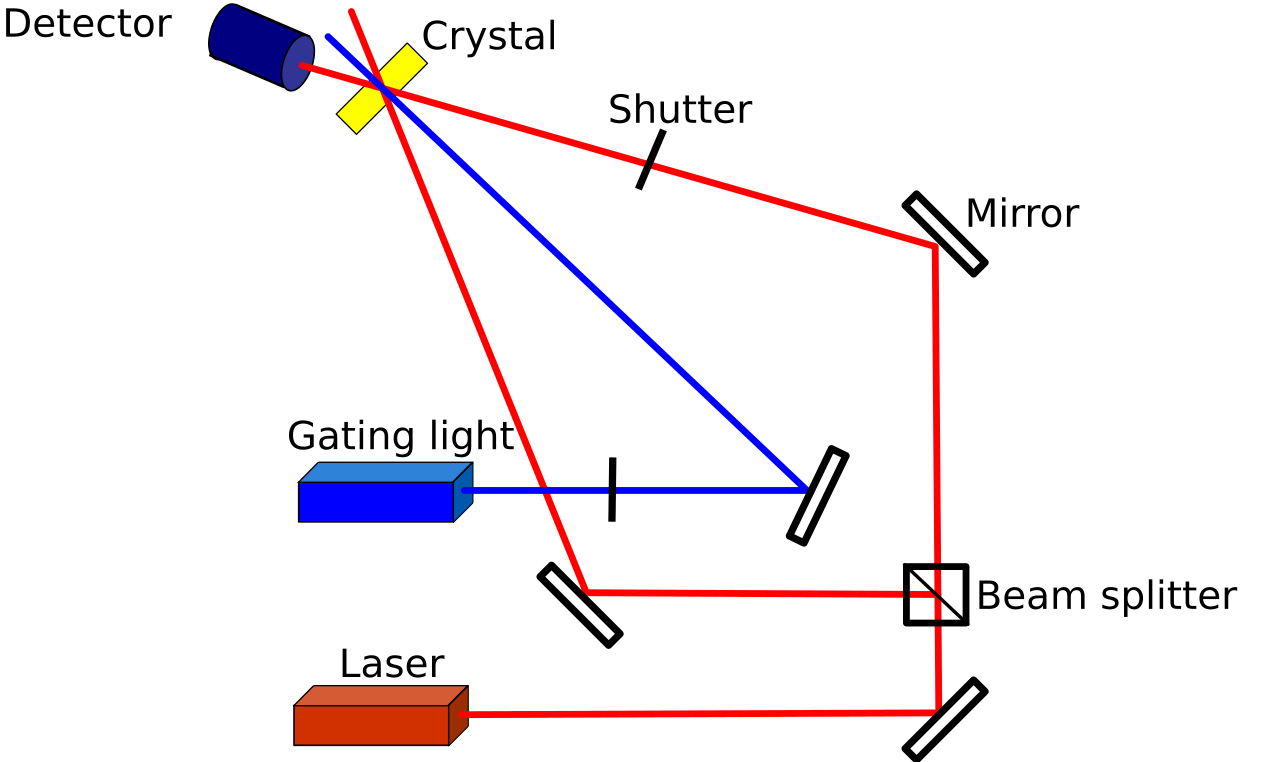
A hologram records the interference pattern of two coherent light beams: one that carries an image (the signal beam) and one that does not (the reference beam). Shine the reference beam on the recording again and the image reappears. In a thick medium the recording is not a surface pattern but a three-dimensional grating, and such gratings are selective: a slightly different reference angle, wavelength or phase reads a different hologram. Many holograms can therefore be stored in the same volume, each called up by its own reference beam. This is multiplexing, and it is the reason for the density promises.
Pieter J. van Heerden, working at Polaroid, laid out the theory in two papers in Applied Optics in 1963. He proposed storing information in three dimensions in transparent crystals such as alkali halides with colour centres, and argued that every cube of the material about one wavelength of light on a side could serve as an independent storage cell. That put the theoretical limit at roughly one bit per cubic wavelength: at visible wavelengths, on the order of a terabit per cubic centimetre. He also noticed a property that kept the idea alive in neuroscience and AI for decades: a partial input could recall the whole stored image, which made a holographic store a natural associative memory.
The second attraction was speed. A disk or tape reads one bit after another. A holographic memory reads a whole page in parallel, a million bits or more in a single flash of the reference beam, and has no head to move, only a beam to steer.
The First Wave
The laser had been demonstrated in 1960, and holography with lasers took off after Emmett Leith and Juris Upatnieks published their work in 1962 to 1964. In the late 1960s researchers at Bell Laboratories in Murray Hill stored holograms in a crystal of lithium niobate, a photorefractive material in which light moves charges and changes the refractive index. The recording faded after about ten minutes of illumination by the reading beam: reading erased the data. At RCA Laboratories, Juan Amodei, William Phillips, and David Staebler recorded 500 holograms in one crystal in the early 1970s. Leith and colleagues published on holographic data storage in three-dimensional media in 1966, and the first attempts to store many holograms in one medium date from the early 1970s.
None reached a product. A team of IBM researchers summed up the reason in Physics World in 2000: research “all but died out” in the mid-1970s, mainly because there were no devices to put a two-dimensional page of pixels into the beam and to read one out. A holographic memory needs a spatial light modulator (a fast, addressable grid of shutters) to write the page and a large detector array to read it. In the 1970s neither existed at usable size, speed or price. The storage materials were also unsatisfactory: photorefractive crystals were expensive, slow to write, and lost their data on readout, and photographic materials could not be rewritten.
The Revival
The missing parts arrived from consumer electronics. By the early 1990s camcorders and digital cameras had made CCD image sensors cheap, and video projectors had produced small liquid-crystal panels that could serve as spatial light modulators. Semiconductor lasers had become small and reliable. Researchers took up holographic storage again.
In the United States the effort was organised in two consortia funded half by DARPA and half by industry, administered by the National Storage Industry Consortium. PRISM (Photorefractive Information Storage Materials), started in 1994, worked on materials; HDSS (Holographic Data Storage System), a five-year, $32 million programme announced in November 1995, was to build the components and integrate them into systems with 100 GB of capacity and data rates above one gigabit per second. Lambertus Hesselink of Stanford was principal investigator of both, with Glenn Sincerbox of the University of Arizona; IBM’s Almaden Research Center, Rockwell, Kodak, and others took part.
The results were real. IBM Almaden built a test bench called DEMON around a lithium niobate crystal to test spatial light modulators and cameras together, and its successor DEMON II reached about 390 bits per square micrometre, twenty times the density of a DVD. Others stored as many as 10,000 holograms in a cubic centimetre using angle multiplexing. Demetri Psaltis’s group at Caltech showed holographic memories for neural networks and image correlation. Lucent, Sony, Hitachi, Optware in Japan, and the Polaroid spin-off Aprilis all had holographic programmes.
The engineering problems, however, turned out to be the old ones with better instruments. The IBM team’s 2000 list: photorefractive crystals recorded about fifty times more slowly than they read, could not erase a single hologram without disturbing the others, faded in the dark, and were erased by reading unless “fixed” by a slow, cumbersome process. Photopolymers, which could be fixed permanently by the recording itself, shrank as they cured and distorted the stored pages. Every additional hologram in a volume reduced the signal of each, so more capacity meant more noise and stronger error correction. High densities needed expensive short-focal-length optics and very good material, so the practical density was far below the theoretical one.
InPhase and Tapestry
The commercial attempt came from Bell Labs. Lucent’s researchers had spent about a decade on photopolymers for holographic storage when, in December 2000, Lucent spun the work out as InPhase Technologies in Longmont, Colorado. InPhase chose a write-once photopolymer disc and aimed not at the hard disk but at professional archiving, where a medium that lasted fifty years without rewriting was an advantage. Hitachi Maxell became its media partner, and in 2008 InPhase and Nintendo jointly received a patent for a scanner used in angle multiplexing.
The product was announced repeatedly. InPhase demonstrated a prototype at the NAB broadcasting convention in Las Vegas in 2005, at the Maxell booth, and showed working drives at NAB in 2006, the year it also brought one to the Consumer Electronics Show; the 300 GB disc was three times the capacity of the Blu-ray discs then being launched. Beta units went to a few users from December 2006; announced release dates passed, and the company cut staff. Turner Network Television, Maxell, and InPhase staged a demonstration in which a programme was played out to air from a holographic disc. In February 2007 InPhase said bulk shipments of the Tapestry 300r had begun and named Turner Broadcasting, the US Geological Survey, and Lockheed Martin as customers; the product was formally introduced in May 2008. It was a write-once drive storing 300 GB per 13 cm disc in a cartridge, at 20 megabytes per second. It cost about $18,000; a disc cost about $180. The roadmap promised 1.6 TB discs by 2010.
At the time, a 1 TB hard disk cost a few hundred dollars and an LTO-4 tape cartridge held 800 GB, both readable by equipment every data centre already owned. InPhase had raised about $100 million in venture capital over its life, including $20 million in January 2009, and could not raise more. In early February 2010 its 60 remaining employees picked up their final paychecks, and days later the Colorado Department of Revenue seized its premises for unpaid taxes of $10,337.
The company did not quite die. Signal Lake Venture Capital bought a majority of what was left in March 2010, acquired Maxell’s media equipment and a German library maker’s assets, and kept the technology going until InPhase filed for Chapter 11 bankruptcy on 17 October 2011. Its assets were auctioned in March 2012 to a new company, Akonia Holographics, which raised $10.8 million that August and turned from data storage to holographic optics for augmented-reality displays. Apple bought Akonia in August 2018.
The Others
InPhase was the furthest along, not the only one. Optware in Japan proposed the Holographic Versatile Disc (HVD), a CD-sized disc with a collinear beam arrangement intended to hold several terabytes; Ecma International published standards for HVD cartridges and read-only discs in 2007, and no product followed. Optware also announced a Holographic Versatile Card without moving parts. In April 2009 General Electric Global Research announced a material for “micro-holographic” recording, in which tiny holograms about a micrometre across were written in layers in a DVD-sized disc, enough for 500 GB, and said it would offer it first for commercial archiving and then to consumers. GE planned to sample media to licensees; no drive reached the market.
By then the destination had moved again. The consumer market for optical discs was shrinking as video went to streaming, flash cards filled cameras, and hard disks and tape absorbed archival data at falling cost per gigabyte (see Dead End: HD-DVD and The Storage Revolution).
Dead End
Holographic storage failed for three reasons that reinforced one another. First, the components it needed did not exist until the 1990s, so the technology lost its first twenty years. Second, its theoretical density was far from its practical one: noise from many overlapping holograms, material shrinkage, and the cost of precise optics brought real systems down to densities that magnetic recording reached on its own. Third, every time holographic storage approached a product, its competitors had moved. In 1975 the target was the disk drive of 1975; in 2008 it was a terabyte disk for a few hundred dollars and an LTO tape cartridge that every archive could already read. A new medium for archives has to promise readability for decades, and a drive from a start-up that may not survive its next financing round cannot.
The physics was sound and the parts did work. Holography found its commercial uses elsewhere, in security marks on banknotes and cards, in optical components, and in waveguides for augmented-reality glasses, which is where InPhase’s patents ended up. The page-at-a-time idea of reading a million bits in parallel remains a research topic.
📚 Sources
- van Heerden, P. J.: “Theory of Optical Information Storage in Solids,” Applied Optics 2(4), 393–400, 1963
- Burr, Geoffrey W., Coufal, Hans et al. (IBM Holographic Storage Team): “Optical data storage enters a new dimension,” Physics World, 1 July 2000 (bit-per-cubic-wavelength limit, mid-1970s lull and its cause, 1990s revival, 10,000 holograms per cm³, DEMON II at 390 bits/µm², material problems)
- “Holographic Data Storage System (HDSS),” Stanford University News Service, 13 November 1995 (five-year, $32 million programme, half government-funded, NSIC administration)
- Holographic Data Storage System, Wikipedia (PRISM 1994, HDSS, Hesselink and Sincerbox)
- “Holographic optical data storage: Component tester allows flexible analysis,” Laser Focus World, 1996 (IBM Almaden DEMON)
- Nature 422, 556, 2003, news feature on holographic storage (Bell Labs lithium niobate holograms of the 1960s fading after ten minutes)
- Psaltis, Demetri & Mok, Fai: “Holographic Memories,” Scientific American, November 1995 (early-1970s RCA work by Amodei, Phillips, and Staebler, 500 holograms)
- Holographic data storage, Wikipedia (2002 developers InPhase, Aprilis, and Optware, NAB 2005, CES 2006, InPhase delays, GE 2009, density limits)
- InPhase Technologies, Wikipedia (2000 spin-off from Bell Labs, missed release dates, Nintendo patent 2008, Tapestry 300r 300 GB at 20 MB/s, Signal Lake 2010, Chapter 11 on 17 October 2011, Akonia, Apple 2018)
- “Holographic Storage Firm InPhase Technologies Shuts Down,” TV Technology, February 2010 (assets seized by the Colorado Department of Revenue, about $100 million raised, $20 million in January 2009)
- Williams, Christopher: “InPhase begins shipping holographic storage,” The Register, 13 February 2007 (bulk shipping, $18,000 drive, $180 discs, named customers, 1.6 TB roadmap)
- “Holographic Storage System Ships in July,” CDRinfo, 2007 (beta units shipped December 2006)
- “InPhase Filed for Chapter XI,” StorageNewsletter, 21 October 2011 (with links to its February 2010 reports: final paychecks for 60 employees, seizure over $10,337 in unpaid taxes)
- Modine, Austin: “InPhase seized,” The Register, 8 February 2010
- “Turner Network, InPhase, Hitachi Maxell Make History On First Play-Out-To-Air From Holographic System,” Phys.org
- “First OEM holographic storage systems on the way,” Tom’s Hardware (Tapestry price of about $18,000, $180 discs)
- Holographic Versatile Disc, Wikipedia (Optware, Ecma standards of 2007, no product)
- “GE Technology to Enable 500-Gigabyte Disc,” Hot Hardware, April 2009
- Image: Holographic Data Storage.svg by Surachit (CC BY-SA 3.0), via Wikimedia Commons