The Storage Revolution: From Magnetic Tape to Silicon
Abstract
The history of data storage is a story of relentless compression, not just of physical size, but of access time, cost per byte, and the architectural assumptions that shaped operating systems, databases, and software design for decades. From magnetic drums and punched cards to spinning hard disks and flash-based NVMe drives, each storage generation did not merely replace the last; it redefined what software could assume about persistence.
The Age of Magnetic Tape and Drums (1940s–1960s)

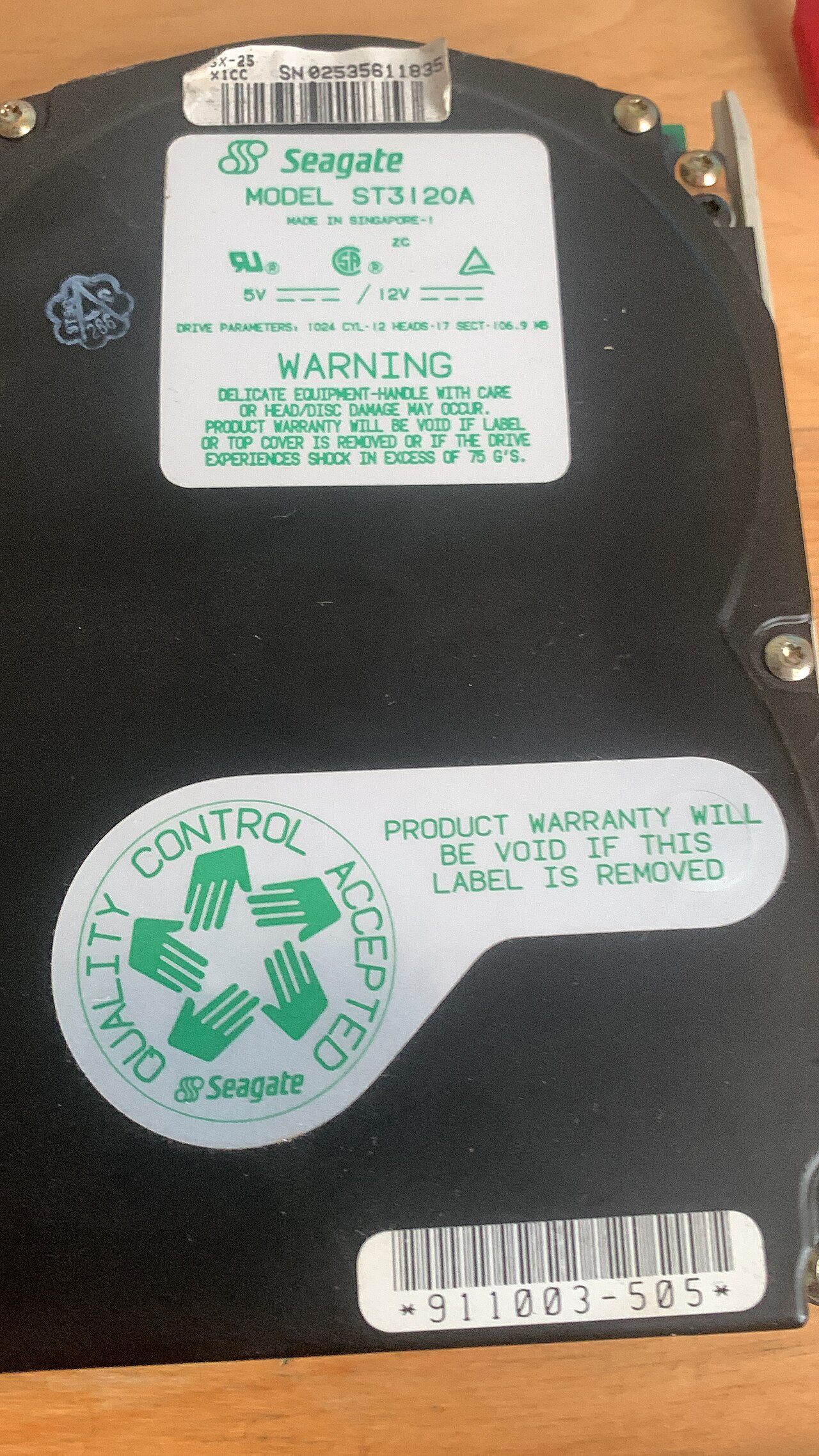
Early computers had no persistent storage in the modern sense. Programs were loaded by toggling switches or feeding punched cards. The first form of reusable storage was the magnetic drum, a rotating metal cylinder coated with ferromagnetic material, invented in 1932 by the Viennese autodidact Gustav Tauschek, years before any electronic computer existed to use it. The IBM 650 (1954), one of the most widely sold early computers, used a drum as its primary working memory, with a capacity of roughly 2,000 ten-digit numbers.
Magnetic tape provided bulk storage from the early 1950s onward. The IBM 726 (1952) wrote 100 characters per inch onto a 1,200-foot half-inch reel, about 1.4 MB. Tape was sequential: to reach record 10,000, the machine had to read past records 1 through 9,999. This constraint fundamentally shaped early database design, batch processing, sorted sequential files, and the entire notion of “runs” in external sorting algorithms were all direct responses to tape’s limitations.
Storage as Architecture
Tape’s sequential constraint was not just an inconvenience; it drove entire paradigms. COBOL’s sequential file model, the batch processing model of 1960s mainframes, and the “sort-merge” pattern of early data processing all reflect software adapting to the physics of spinning reels.
The Hard Disk Drive: Random Access Changes Everything
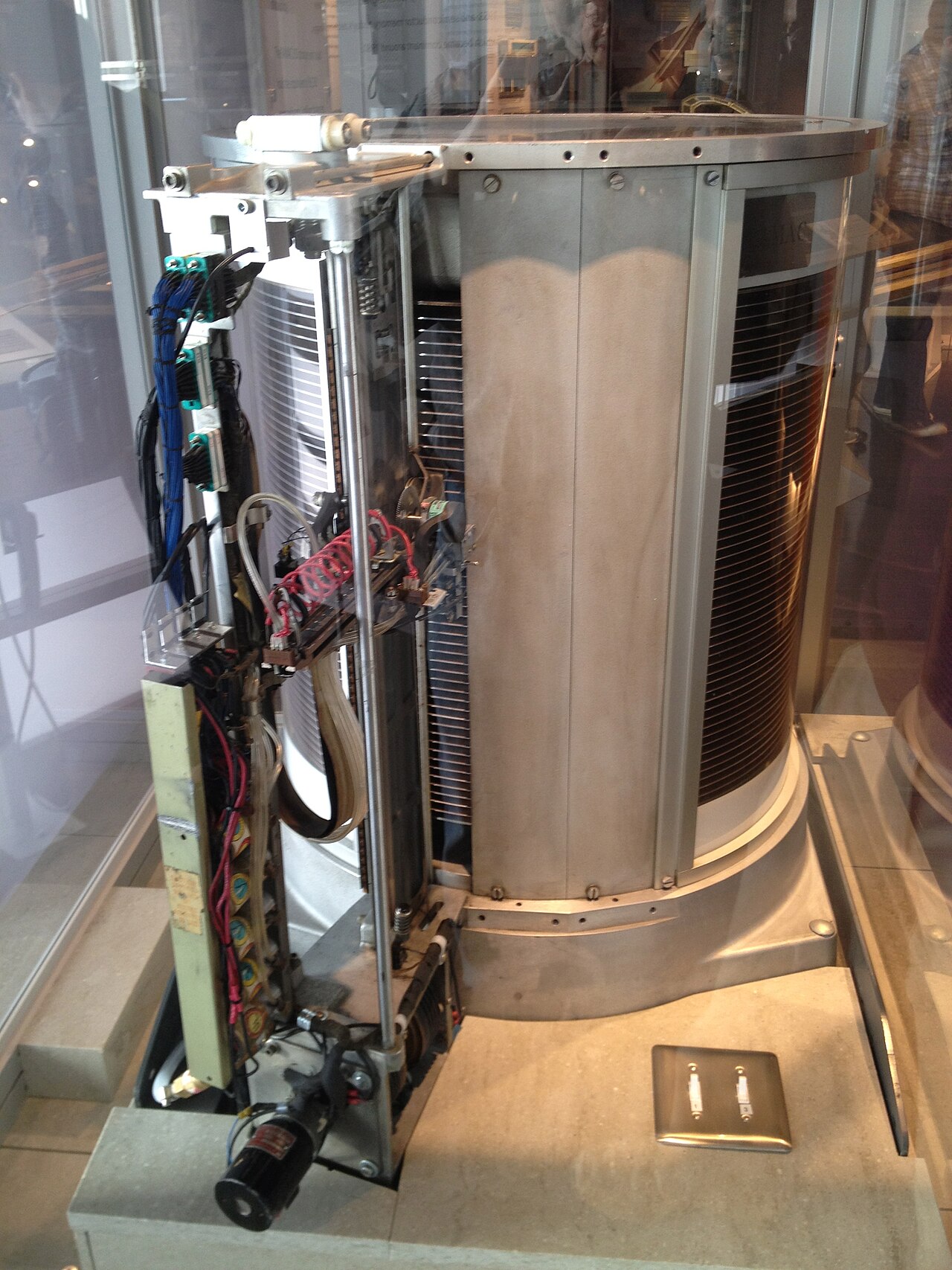
In 1956, IBM shipped the IBM 350 RAMAC (Random Access Method of Accounting and Control), the first commercial hard disk drive. It stored 5 MB across 50 spinning 24-inch platters, weighed over a ton, and leased for $3,200 per month. Its revolutionary property was random access, any record could be reached in under 600 milliseconds without sequential traversal.
The consequences were profound. Random access made relational databases thinkable: Codd’s relational model (1970) assumed that rows in a table could be addressed independently. It made file systems as we know them possible. It made interactive computing economically viable.
The HDD industry scaled through a series of form-factor reductions:
- 14-inch platters dominated mainframes through the 1960s.
- 5.25-inch drives entered the PC market with Seagate’s ST-506 (1980, 5 MB, $1,500); the IBM PC/XT (1983) made a 10 MB drive standard equipment.
- 3.5-inch drives became standard by the late 1980s, led by Seagate and Western Digital.
- 2.5-inch drives powered laptops through the 2000s.
By 2010, a 1 TB 3.5-inch drive cost under $100, a price-per-byte reduction of roughly 50 million times since the RAMAC.
The march toward smaller platters saw one notable counter-move: Quantum’s Bigfoot series (1996–1999) revived the 5.25-inch format to deliver more capacity per dollar for budget PCs, and it shipped in consumer machines from Compaq, HP, and IBM. But physics doomed the throwback, larger platters flex under centrifugal force at high rotation speeds, capping the original Bigfoot at 3,600 RPM and roughly 813 KB/s of throughput while 3.5-inch rivals already delivered around 1,170 KB/s. As areal density gains let small platters match Bigfoot’s capacity at lower cost and higher speed, Quantum discontinued the line in late 1999. The lesson stuck: areal density, not platter size, drives storage economics, no manufacturer has attempted a larger form factor since.
The Areal Density Arms Race
HDD capacity growth was driven by areal density, the number of bits per square inch of platter surface. Key innovations:
- Thin-film heads (1979) replaced ferrite-core heads, enabling finer track widths.
- Magneto-resistive (MR) heads (IBM, 1991) read via resistance change rather than induction, enabling much smaller track widths.
- Giant Magneto-Resistance (GMR) heads (1997, commercialized from Albert Fert and Peter Grünberg’s Nobel Prize-winning research) enabled another order-of-magnitude density jump.
- Perpendicular recording (first commercial drive: Toshiba, 2005; Seagate converted its lineup from 2006) oriented magnetic domains vertically rather than horizontally, allowing continued scaling past the superparamagnetic limit.
The Floppy Disk: Portability Over Capacity
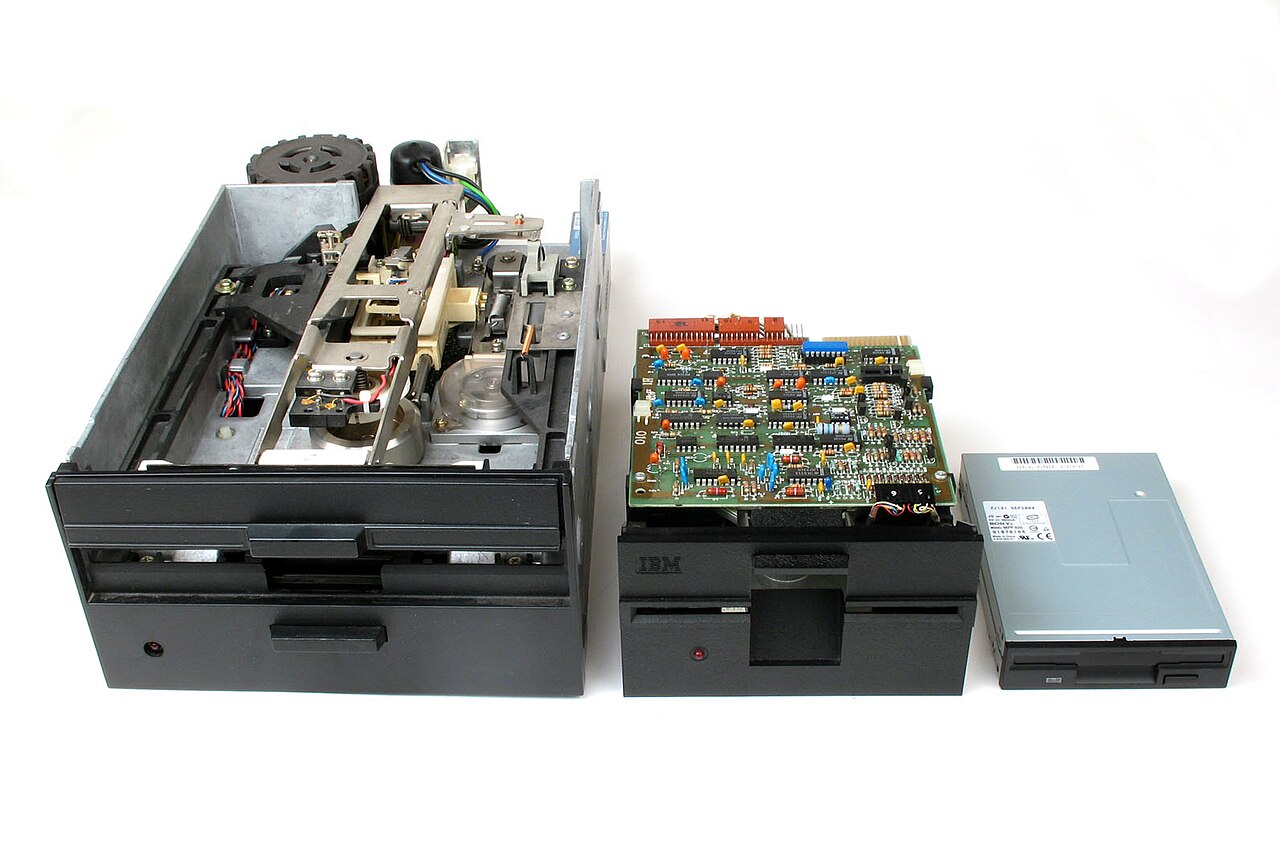
The floppy disk, developed at IBM from 1967 by a team under Alan Shugart and commercialized in 1971, solved a different problem: removability. The original 8-inch floppy held 80 KB (read-only); the 5.25-inch format (Shugart Associates, 1976) started below 90 KB and reached its ubiquitous DOS-era 360 KB by the early 1980s; the Sony-developed 3.5-inch format held 1.44 MB in its final standard incarnation, shipping from 1986.
The floppy’s importance was never capacity; it was the ability to walk software from one machine to another. Software distribution, backups, and the entire shareware industry depended on it. The floppy drive outlasted its usefulness by a decade because it was a universal interoperability standard, not because the technology was competitive.
The Flash Revolution: No Moving Parts
Flash memory (non-volatile storage using floating-gate transistors) was invented by Fujio Masuoka at Toshiba in 1980 and commercialized by Intel in 1988. Its initial applications were embedded systems and early digital cameras. The critical transition came with two developments:
- USB flash drives (2000): Trek Technology’s ThumbDrive and IBM’s DiskOnKey shipped almost simultaneously. A device the size of a thumb that held 8 MB, plugged into any computer, and required no driver; it killed the floppy market within five years.
- NAND flash density scaling: As NAND flash moved from single-level cell (SLC, 1 bit per cell) to multi-level cell (MLC, 2 bits) and triple-level cell (TLC, 3 bits), cost per gigabyte fell far enough that SSDs displaced HDDs across mainstream laptops by the mid-2010s.
The SSD Takes Over
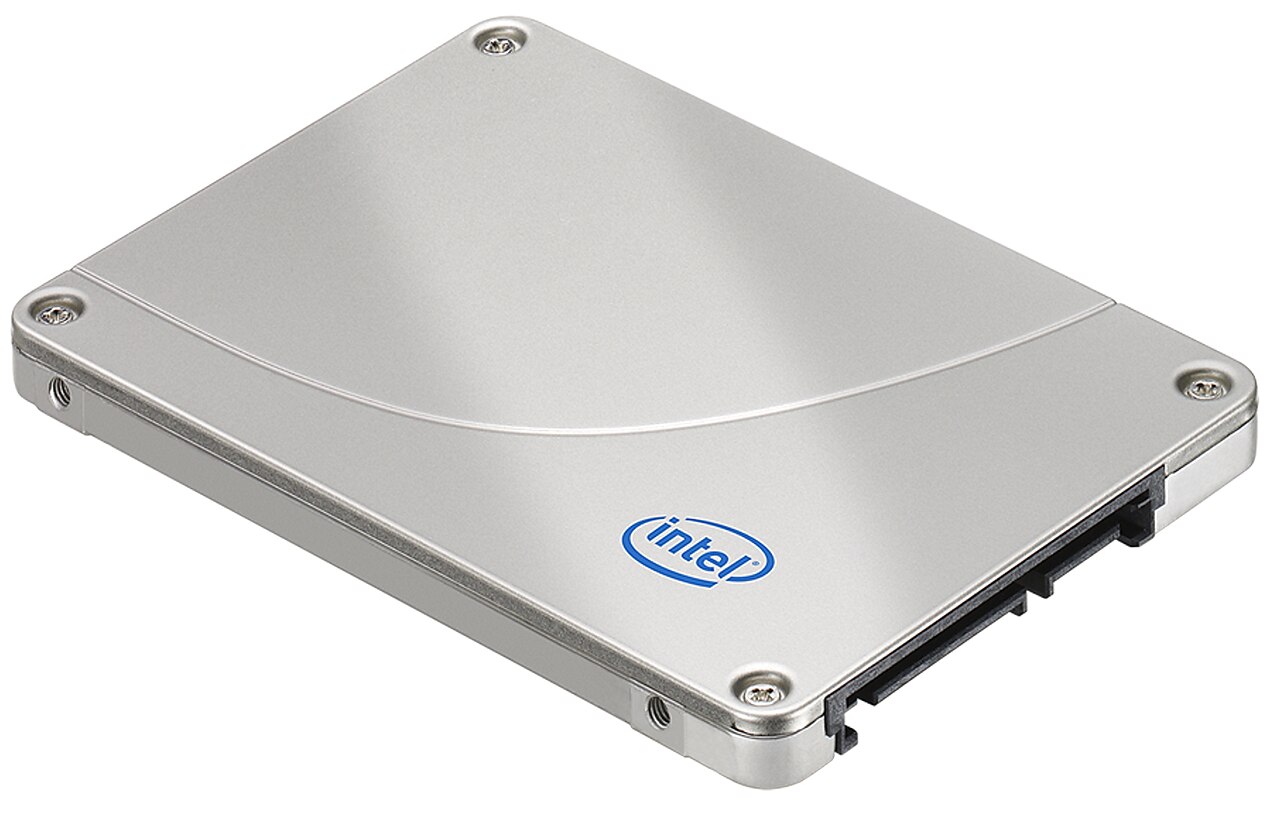
The Solid State Drive arrived in its modern form with Samsung’s 32 GB SSD (2006) and gained mainstream traction with Intel’s X25-M (2008), which delivered 250 MB/s sequential reads, roughly 5× faster than contemporary HDDs for sequential access and 100× faster for random 4K reads. Laptop and then desktop computing shifted decisively to SSDs through the 2010s.
NVMe (Non-Volatile Memory Express, specification 2011) replaced the SATA interface designed for spinning disks with one designed for flash, eliminating the protocol overhead of AHCI/SATA. An NVMe SSD over PCIe 4.0 delivers 7 GB/s sequential reads; the original RAMAC delivered its five megabytes at a few kilobytes per second.
The Latency Cliff
The gap between DRAM (nanoseconds), NVMe SSD (microseconds), and HDD (milliseconds) is not linear; it is orders of magnitude. Database engines, operating system page caches, and programming language runtimes are all deeply shaped by this hierarchy. Optane (Intel’s 3D XPoint technology) briefly promised to fill the DRAM/SSD gap with byte-addressable persistent memory, but was discontinued in 2022 due to market failure.
Dead End: Optical Storage as Primary Medium
CD-ROM (1985), DVD (1997), and Blu-ray (2006) achieved mass distribution of software and media but failed to displace magnetic storage as primary working storage. Optical drives are read-mostly (writable variants are slower and more expensive), seek times are high, and physical media requires manual handling. The industry’s bet that optical storage would become the universal medium for both distribution and backup did not survive the combination of broadband internet (for distribution) and cheap HDD/SSD (for backup). The format war fought over the last optical generation is covered in Dead End: HD DVD.
Iomega’s Zip drive (1994) represents a parallel failure: a 100 MB removable magnetic cartridge that commanded the late-1990s backup market, then collapsed almost overnight when CD-R drives fell below $50 in 2000. The Zip’s proprietary format offered no path to the open standards that USB flash drives and cloud storage would later provide. It also suffered a self-inflicted wound: a head-misalignment fault that users named the “Click of Death,” in which a bad drive could scar a cartridge that then damaged the next drive. See the Click of Death.
Legacy: Storage Assumptions Embedded in Software
Every generation of storage has left sediment in software architecture. The assumption that disk writes are slow explains the persistence of write-ahead logs, B-trees, and LSM-trees. The assumption that HDDs have seek time explains why database row sizes matter. The shift to NVMe is slowly forcing a rethink: RocksDB, io_uring, and storage-class memory architectures are all attempts to take advantage of flash characteristics that traditional I/O stacks were not designed for.
Storage evolution is not just hardware history; it is the hidden variable behind half a century of systems software design.
📚 Sources
- IBM 350 RAMAC — first commercial hard disk drive (Computer History Museum, The Storage Engine)
- Toshiba NAND Flash Memory (Fujio Masuoka) — IEEE Spectrum, Chip Hall of Fame
- Albert Fert, Peter Grünberg - Nobel Prize in Physics 2007
- NVM Express — Wikipedia
- Harker, J. M. et al.: “A Quarter Century of Disk File Innovation” — IBM Journal of Research and Development 25(5): 677–690 (1981)
- Als Festplatten noch riesig waren: Die Quantum Bigfoot wird 30 Jahre alt — heise online
- History of hard disk drives — Wikipedia (ST-506, PC/XT)
- Floppy disk — Wikipedia (IBM 1971, formats and capacities)
- Perpendicular recording — Wikipedia (Toshiba 2005)
- Image: CHM Artifacts ERA magnetic drum memory (2632660527).jpg by Marcin Wichary from San Francisco, Calif. (CC BY 2.0), via Wikimedia Commons
- Image: IBM 350 RAMAC disk mechanism.agr.jpg by ArnoldReinhold (CC BY-SA 3.0), via Wikimedia Commons
- Image: Intel X25-M Solid-State Drive.jpg by Intel Free Press (CC BY 2.0), via Wikimedia Commons