Dead End: Novell and NetWare
Abstract
Around 1993 NetWare held about two-thirds of the market for network operating systems. Novell, a company from Utah that had been failing ten years earlier, had more than half a million networks and some 55 million users on its software, and revenue heading for $2 billion. Its chief executive, Ray Noorda, spent the next eighteen months buying a Unix, a DOS, a word processor, and a spreadsheet to fight Microsoft on every front at once. Microsoft meanwhile put networking inside Windows NT and sold it on the same server that ran the customer’s applications. By 1998 NT outsold NetWare by three licences to two. Novell sold the acquisitions for a fraction of their price, moved its services onto Linux in 2005, and was bought in 2011 for $2.2 billion, with 882 of its patents sold separately for $450 million.
Orem
Novell Data Systems was founded in Orem, Utah, by George Canova and Jack Davis, in August 1980 by contemporary accounts. It made a microcomputer called the Nexus and a printer, and it was failing. Davis was fired in November 1981 and Canova early in 1982, and in July 1982 the staff was cut from 50 to 30.
What survived was a consulting job. In 1981 the company had hired a group of Brigham Young University students, Drew Major, Dale Neibaur, and Kyle Powell, who called themselves SuperSet Software, to make its machines share a hard disk. Competing products of the time shared the disk itself, handing each PC a slice of raw storage. SuperSet built a file server: one machine that owned the files, understood who was allowed to open which, and answered requests from the others. The first version ran on a Novell-built server with a Motorola 68000 processor. The team privately concluded that CP/M was finished and rewrote the system for the new IBM PC.
Ray Noorda, a 58-year-old engineer who had worked at General Electric until 1971, saw the product at COMDEX in November 1982. The company was reincorporated as Novell, Inc. on 25 January 1983, and Noorda was announced as president and chief executive that April. NetWare went on sale the same year.
NetWare
Noorda built the company on that one product. He called his way of dealing with rivals “coopetition”: competitors agreeing on common standards so that the whole market grew. Bob Metcalfe, whose company 3Com was the main rival, remembered it after Noorda’s death: “During the 1980s, 3Com and Novell were in what Ray Noorda famously called ‘coopetition,’ and it was fierce.”
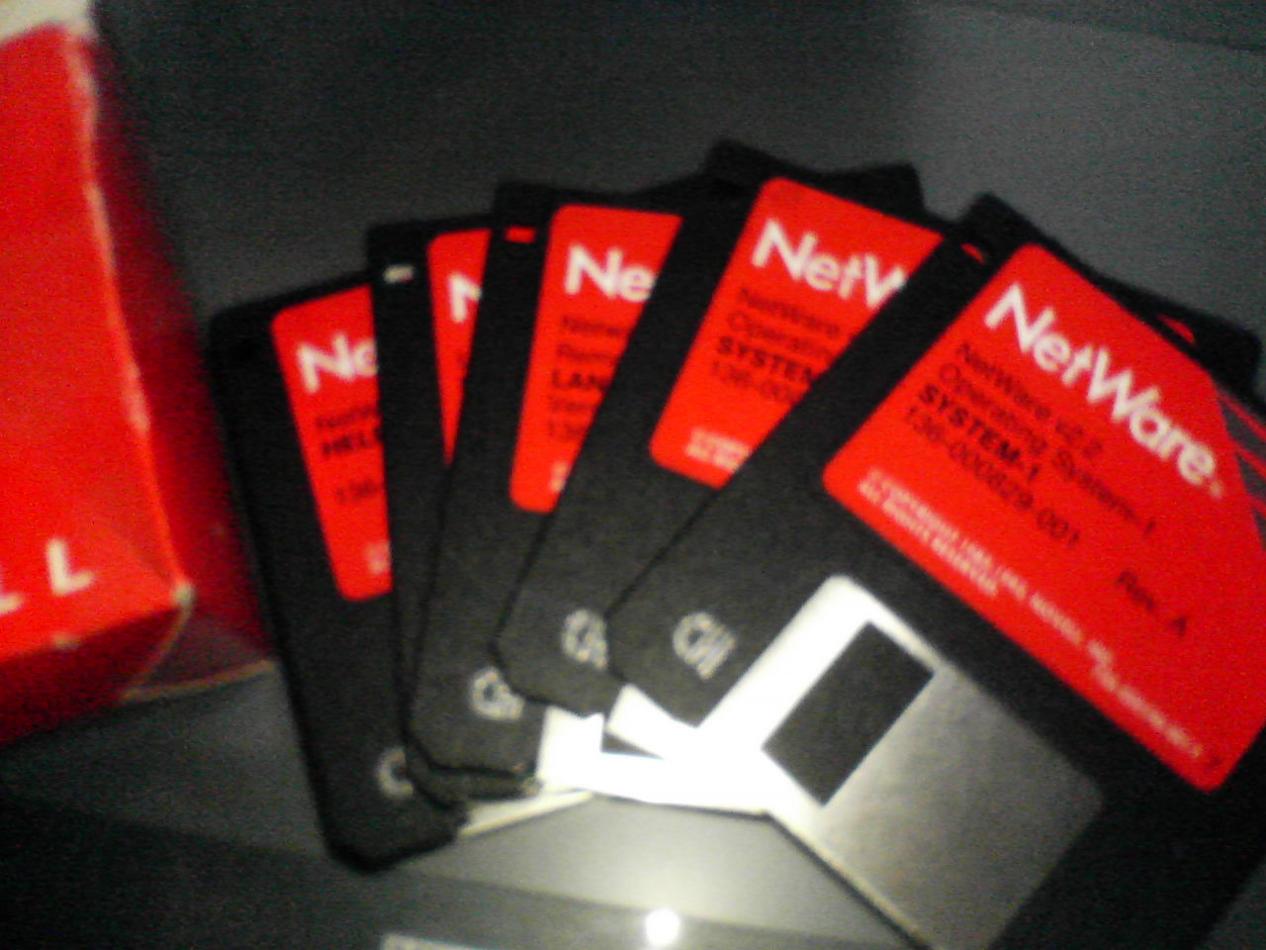
NetWare used its own protocols, IPX and SPX, and its file and print sharing were fast and reliable (see Early Networking Failures). NetWare 386 arrived in 1989, when estimates of Novell’s share of the network operating system market ranged from 40% to 60%. Revenue was $281 million that year and $933 million in 1992. At the high point around 1993, one analysis put the share at 63%.
The Shopping List
Noorda set out to compete with Microsoft on the desktop as well as the server. A $1.5 billion merger with Lotus was announced in April 1990 and collapsed the next month. After that he bought:
- Digital Research, the maker of DR DOS and heir to Gary Kildall’s CP/M, in 1991 for $80 million.
- Unix System Laboratories, the owner of the Unix source code, from AT&T, announced in December 1992 and closed in June 1993 (see Commercial Unix and the Unix Wars).
- WordPerfect for $1.4 billion in stock and Borland’s Quattro Pro spreadsheet for $145 million in cash, both announced in March 1994.
The WordPerfect purchase was Noorda’s. Robert Frankenberg was named as his successor in April 1994, a month after the announcement, and was in office when the deals closed on 24 June. By then Novell’s share price had fallen so far that the stock handed over was worth $855 million. Noorda gave up the chairmanship and left the company in November 1994.
Revenue peaked at $2.04 billion in 1995, with the workforce at about 10,150 the year before. Frankenberg spent his two years selling what Noorda had bought. UnixWare went to the Santa Cruz Operation in 1995. WordPerfect and Quattro Pro went to Corel in 1996 for less than $200 million, a story told in Dead End: WordPerfect. The Digital Research assets went to Caldera in July 1996 for $400,000 plus royalties. Frankenberg left in August 1996.
Windows NT
While Novell was assembling an office suite, the ground under NetWare moved in two places.
The first was the protocol. IPX had been designed for a building. Companies were now connecting buildings to each other and to the internet, which spoke TCP/IP. Novell added partial TCP/IP support to NetWare 3 and 4 and sold a product that wrapped IPX inside IP, but NetWare’s core file and print services did not run natively over TCP/IP until NetWare 5 in October 1998.
The second was the server itself. NetWare was a separate product that a company bought to serve files and printers. Windows NT included networking as a core component, used the same system on the server as on the desktop, and needed no third-party client software. A department that bought an NT machine for another purpose got a file server with it.
NetWare 4, released in 1993, answered with Novell Directory Services, a directory of every user and resource in a company that Microsoft did not match until Active Directory six years later. Customers did not move. A Forrester survey in mid-1996 found that 90% of corporate users owned NetWare and only 20% had upgraded to the current version.
In 1998, by IDC’s count, Windows NT Server took 36% of new server operating system shipments and NetWare 24.1%; Microsoft shipped 1.56 million licences, nearly half again as many as Novell. Linux took 17.2%.
Linux and the Patents
Eric Schmidt became chief executive in April 1997, cut about 18% of the staff, and shipped NetWare 5. He left in 2001 for Google. Under his successors Novell bought the Linux companies Ximian and SUSE in 2003 and in March 2005 released Open Enterprise Server, which offered NetWare’s services on top of SUSE Linux. NetWare 6.5 was the last version of the original system.
Two assets from the shopping spree turned out to matter. When the SCO Group claimed that Linux infringed Unix copyrights, Novell replied that the copyrights had never been transferred to SCO, and a jury in Utah agreed in 2010. And in November 2006 Microsoft paid Novell $348 million up front in a patent and interoperability agreement covering SUSE Linux.
Attachmate agreed in November 2010 to buy Novell for $2.2 billion, or $6.10 a share, and completed the purchase in April 2011. Immediately before closing, 882 Novell patents were sold for $450 million to CPTN Holdings, a consortium led by Microsoft with Apple, EMC, and Oracle. Attachmate was itself bought by Micro Focus in 2014, which was bought by OpenText in 2023.
Noorda did not see the end. He had founded the Canopy Group to fund Utah start-ups, Caldera among them, and died at home in Orem on 9 October 2006, aged 82.
Dead End: The Separate Network Operating System
NetWare was a product category that stopped existing. In 1985 an operating system for a PC did not know what a network was, so a company could make a good living selling the part that did. Once Windows NT, and then every Unix and Linux, shipped with file sharing, a directory, and TCP/IP as standard parts, the network operating system became a feature of the operating system.
Noorda saw the threat earlier than most and answered it by trying to become a second Microsoft, with a DOS, a Unix, and an office suite, bought within three years. The purchases cost more than $1.5 billion at their announced prices, and they were made in the years when NetWare needed to learn TCP/IP. It learned TCP/IP in 1998.
📚 Sources
- Novell — Wikipedia (founding in Orem, the firings of 1981 and 1982, SuperSet, incorporation on 25 January 1983, Noorda’s appointment, revenue 1989 to 1995, share estimates of 40 to 60% in 1989 and 63% around 1993, the Lotus merger, Digital Research, USL, WordPerfect and Quattro Pro, Frankenberg, the $855 million closing value, the sales to SCO, Corel, and Caldera, the 1996 Forrester survey, Schmidt, Ximian and SUSE, the 2006 Microsoft agreement, SCO v. Novell, Attachmate, CPTN, Micro Focus, OpenText)
- NetWare — Wikipedia (SuperSet and the file-server design, the 68000-based first server, IPX/SPX, NetWare Directory Services in 1993, native TCP/IP in NetWare 5, Open Enterprise Server in March 2005)
- “Remembering Novell’s Ray Noorda” — Network World, October 2006 (coopetition, Metcalfe’s recollection, the acquisitions, the Canopy Group)
- Ray Noorda — Wikipedia (General Electric until 1971, death on 9 October 2006)
- “Linux drives growth of server OS market” — The Register, 20 January 1999 (IDC’s 1998 shipment shares: Windows NT Server 36%, NetWare 24.1%, Linux 17.2%)
- Microsoft: “Microsoft Windows NT Server Outpaces UNIX and NetWare in 1998” — press release, 13 January 1999 (1.56 million licences by IDC’s count)
- Image: Novell NetWare 2.2 floppies.jpg by Rick Duff (CC BY-SA 2.0), via Wikimedia Commons