Commercial Unix and the Unix Wars: System V, Xenix, Solaris, AIX, HP-UX
Abstract
For its first decade Unix could not be sold: a 1956 antitrust settlement kept AT&T out of every business except telecommunications, so Bell Labs shipped tapes to universities for the cost of the media. In 1981 AT&T began treating Unix as a product, and after the break-up of the Bell System took effect in 1984 it marketed System V as the standard. By then dozens of companies had their own versions. Microsoft’s Xenix was the most widely installed Unix of the 1980s; Sun, HP, IBM, DEC and Silicon Graphics each sold a Unix tied to their own workstations. When AT&T bought into Sun in 1988 and the two set out to merge their systems, the other vendors formed the Open Software Foundation, and the industry split into two camps that spent the following years fighting over standards, trademarks and licences. The Unix Wars ended in the mid-1990s with a truce, a jointly owned trademark and a common specification. By then Linux on cheap PC hardware had begun taking the market from all of them. The last chapter was a lawsuit: in 2003 the SCO Group, which had bought the remains of AT&T’s Unix business, sued IBM for $1 billion, claiming that Linux contained Unix code. It lost the copyright case on which its claims depended and went bankrupt.
From Research Tapes to a Product
The 1956 consent decree that settled the U.S. government’s antitrust case against AT&T barred the Bell System from any business except “common carrier communications services” and required it to license its patents on request. Unix, written at Bell Labs from 1969, was therefore not a product. AT&T licensed Version 5 to universities in 1973 for little more than the cost of shipping, and in 1975 it began licensing Version 6 to companies, starting with the consulting firm Yourdon, Inc. A commercial licence cost $20,000. It bought source code “as-is”, with no support and no promise of updates. The licensees had to maintain and extend the system themselves, and they did, each in its own direction.
In 1981 AT&T announced UNIX System III, the first version it treated as a commercial product: licensees could now sell binary sublicences for as little as $100. The antitrust settlement that broke up the Bell System, effective 1 January 1984, also lifted the old restrictions. AT&T could now sell computers and software, and it pushed Unix hard. System V Release 1 appeared in January 1983. At a Usenix conference AT&T staff wore buttons reading “System V: Consider it Standard.” Release 2 (1984) brought the System V Interface Definition (SVID), AT&T’s own specification of what a System V had to provide; Release 3 (1987) added the STREAMS framework for network drivers, Remote File Sharing and the TLI network interface.
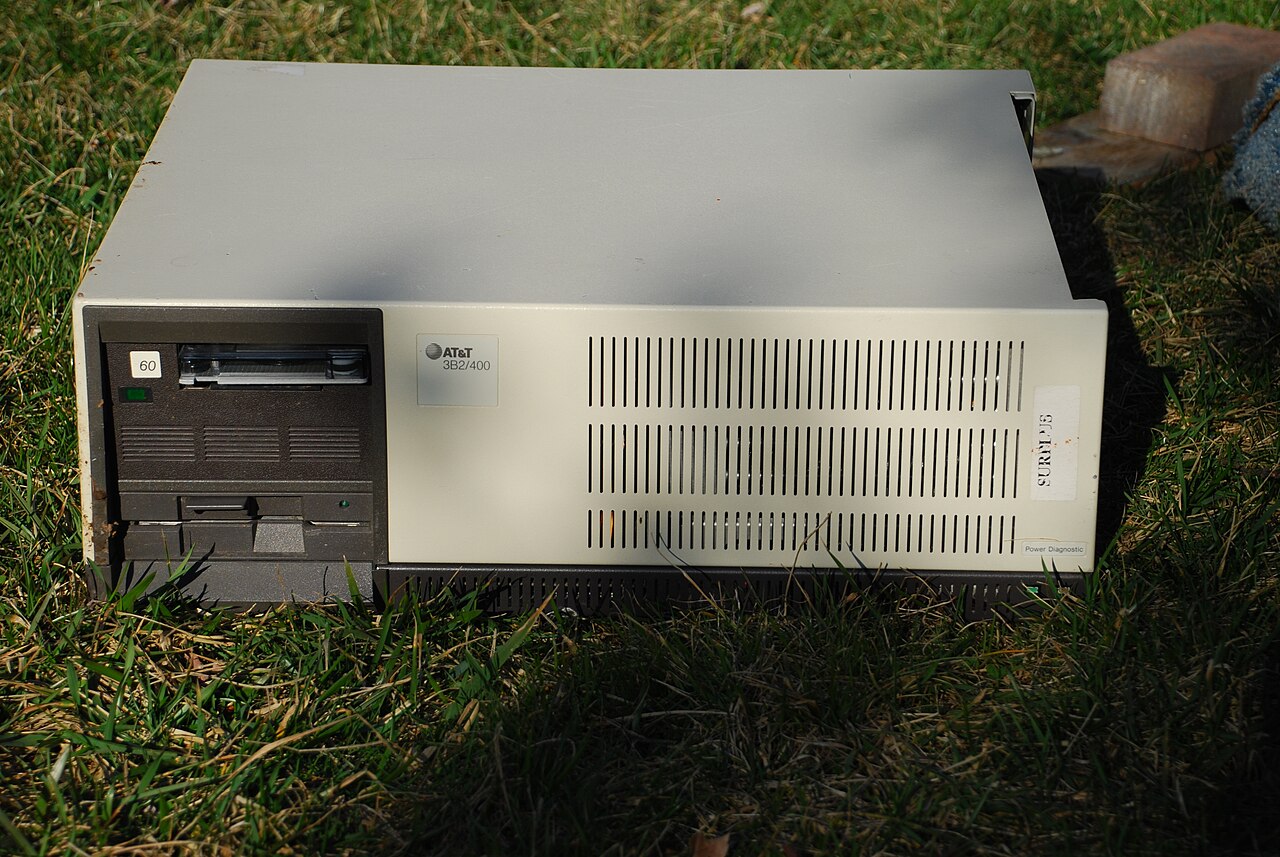
AT&T also tried to sell the hardware. Its 3B series began in 1982 with machines for the regional telephone companies, and the 3B2 of 1983 was a desktop-sized 32-bit Unix minicomputer. The UNIX PC (also called the 3B1) followed in 1985 and did not sell. In 1991 AT&T bought the computer maker NCR, produced the last 3B2 in Oklahoma City on 16 December 1993 and shut down its computer systems division at the end of 1995. AT&T owned the most famous operating system in the industry and never found a way to make money selling machines to run it.
Xenix: Microsoft’s Unix
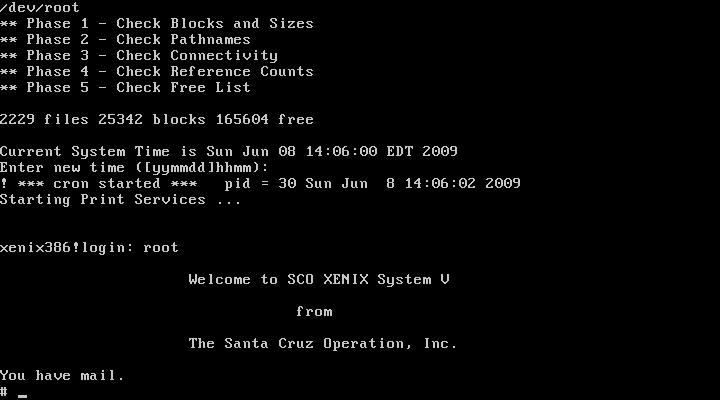
The largest Unix vendor of the early 1980s was Microsoft. It licensed Version 7 from AT&T in 1978 and on 25 August 1980 announced that it would bring Unix to 16-bit microcomputers. Since it could not license the name, Microsoft called its version Xenix. The first customer shipment, a port for the Zilog Z8001, went to Central Data Corporation in January 1981. Microsoft did not sell Xenix to end users; it licensed it to hardware makers, who adapted it to their machines.
The Santa Cruz Operation (SCO), a consulting firm founded in 1979 by Larry Michels and his son Doug in Santa Cruz, California, did much of the porting. In 1983 it completed a Xenix for the Intel 8086 and 8088, and Tandy made TRS-Xenix the standard system for its TRS-80 Model 16, a step that more than doubled the Xenix installed base. In 1984 Tandy was the largest Unix vendor in the world. Xenix was probably the most commonly installed Unix of the 1980s: in 1988 AT&T reported that Xenix accounted for about half of the 500,000 Unix licences worldwide. Microsoft itself ran its internal email on Xenix machines, 60,000 megabytes a week by 1987, and did not move the mail to its own Exchange Server until 1996.
Microsoft had meanwhile found a better business. After MS-DOS became the operating system of the IBM PC, Xenix was a sideline, and in 1987 Microsoft handed it to SCO in exchange for a stake of slightly under 20 percent in the company. SCO went on to sell its own System V for 386 PCs from 1989, later called OpenServer, typically on a single PC serving a few serial terminals in a small business.
The Workstation Unixes
The engineering workstation, a single-user machine powerful enough for chip design, CAD or scientific computing, made Unix the operating system of the technical market. Every vendor shipped its own:
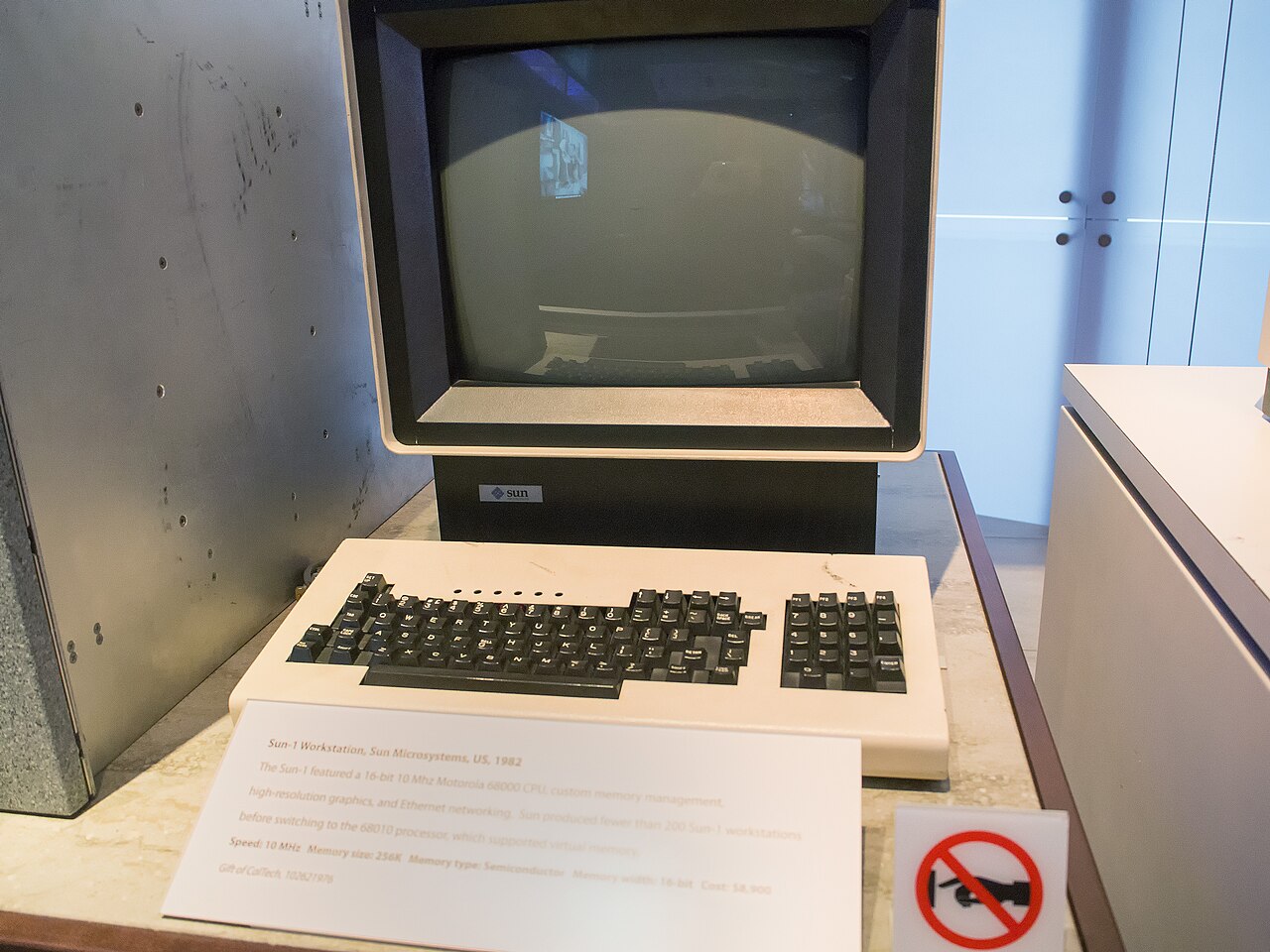
- SunOS (Sun Microsystems), first released in November 1983 and based on 4.2BSD. SunOS 2.0 (May 1985) introduced NFS, the Network File System, whose protocol Sun published and licensed to everyone. Sun’s slogan, coined by John Gage in 1984, was “The Network is the Computer.”
- HP-UX (Hewlett-Packard), first released in 1984, based first on System III and then on System V, running on Motorola 68000 machines and from 1986 on HP’s own PA-RISC processors.
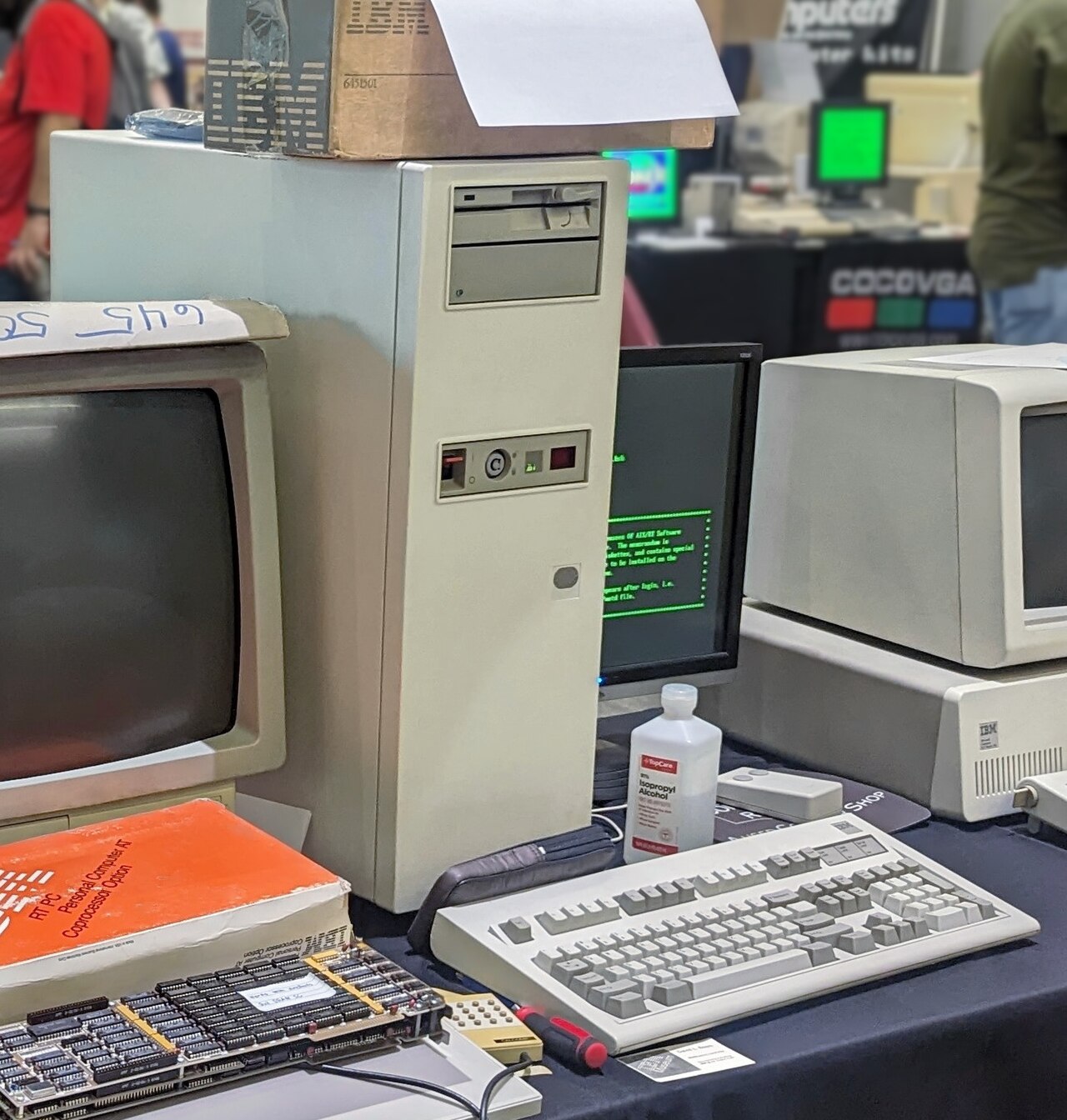
- AIX (IBM), “Advanced Interactive eXecutive”, introduced in early 1986 on the IBM RT PC, IBM’s first RISC workstation. The RT sold about 23,000 units; AIX version 3 on the POWER-based RS/6000 in 1990 was the success.
- Ultrix (Digital Equipment Corporation), a BSD-based Unix for the VAX and later for MIPS-based DECstations.
- IRIX (Silicon Graphics), named with release 3.0 in 1988 for SGI’s MIPS-based IRIS 4D graphics workstations; its XFS file system arrived with IRIX 5.3.
- A/UX (Apple), announced in February 1988 for the Macintosh II, a System V with BSD extensions under the Mac interface. It ran only about 10 percent of existing Mac software at first, never found a market and was abandoned in the mid-1990s.
Each of these systems derived from AT&T or Berkeley code, each added its own extensions, and each ran only on its maker’s hardware. That was the point: the operating system tied customers to the vendor’s machines. It also meant that software companies had to port and test their products for every one of them. In the late 1980s the database vendor Informix supported more than 100 Unix systems, with over 1,000 product versions; its rival Ingres supported more than 40.
The Unix Wars
In 1987 AT&T and Sun began work on merging System V, BSD and Xenix into a single system, and in January 1988 AT&T announced that it would buy up to 20 percent of Sun, at a premium, with a seat on Sun’s board. The merged system was announced as System V Release 4 (SVR4) on 18 October 1988 and went into commercial products in 1989.
To the rest of the industry the deal looked like AT&T, the owner of the Unix source code, choosing one competitor as its partner. Executives from DEC, HP, IBM, Apollo and others met at DEC’s offices on Hamilton Avenue in Palo Alto; the “Hamilton Group” became the Open Software Foundation (OSF), founded on 17 May 1988 by seven sponsors: Apollo Computer, Groupe Bull, DEC, Hewlett-Packard, IBM, Nixdorf Computer and Siemens. Each pledged $4.5 million a year for three years. The OSF announced that it would base its operating system on IBM’s AIX, a condition IBM had reportedly set for joining. AT&T refused to join on those terms. Sun’s chief executive Scott McNealy said the initials stood for “Oppose Sun Forever.” AT&T, Sun and their allies answered in 1988 with an organisation of their own, Unix International.
The OSF did not end up using AIX. Its own Unix, OSF/1, delivered by the foundation to its members from December 1990 (DEC’s first product release followed in January 1992), combined Carnegie Mellon’s Mach kernel with BSD code. Only DEC used it on a large scale, as the operating system of its Alpha processors, under the names DEC OSF/1, Digital UNIX (from 1995) and Tru64 UNIX (from 1999). On the other side, Sun announced on 4 September 1991 that it would replace its BSD-based SunOS with an SVR4-based system. Solaris 2.0 shipped in June 1992 and a version for Intel PCs followed in 1993.
The two camps also produced competing graphical desktops (OSF’s Motif against Sun and AT&T’s OPEN LOOK, see The History of Desktop Environments), competing distributed-computing environments and competing claims to be the true open standard. An analyst quoted in InfoWorld in February 1989 found something good in it all: “Two Unixes are a lot better than 225, which is what we have had until now.”
Standards, the Trademark and the Truce
The standards bodies worked in parallel with the vendors’ war. The trade association /usr/group published a standard in 1984 that became the starting point of the IEEE’s POSIX project; Richard Stallman suggested the name, which the committee preferred to “IEEE-IX”. POSIX.1 (IEEE 1003.1-1988), approved on 22 August 1988, defined the core system interface in terms of C library functions. Because the U.S. government soon required POSIX conformance in its purchasing, even systems that were not Unix gained a POSIX layer: Windows NT shipped a POSIX subsystem up to Windows 2000. In Europe, several manufacturers founded X/Open in 1984 to define a common application environment based on Unix.
AT&T moved its Unix business into a separate unit in 1989, renamed Unix System Laboratories (USL) in 1990, and in 1991 sold about 22 percent of it to eleven other companies. In December 1991 USL and Novell set up a joint venture, Univel, which announced the desktop Unix UnixWare in October 1992. On 21 December 1992 Novell announced that it would buy USL outright, for about $335 million in stock; the deal closed in June 1993. Novell, then the leading network-software company, now owned the Unix source code, and it was USL’s lawsuit against Berkeley that it inherited and settled in 1994 (see The BSD Family).
The truce came in 1993. In March the main vendors of both camps formed the Common Open Software Environment (COSE) and agreed on a common desktop, CDE, and a list of interfaces every Unix should support, called Spec 1170 after the number of interfaces originally counted. In October 1993 Novell gave the UNIX trademark to X/Open, which made the name a certification mark: a system may be called UNIX if it passes X/Open’s tests, regardless of whose code it contains. The first Single UNIX Specification, with 1,168 interfaces, followed in 1994 as the basis of the “UNIX 95” brand. Unix International merged into the OSF in 1994, and in February 1996 the OSF and X/Open merged into The Open Group, which still holds the trademark. The systems still registered under the current marks (UNIX 03 or UNIX V7) are IBM’s AIX, HPE’s HP-UX and Apple’s macOS, the last registered as UNIX 03 since Mac OS X 10.5 Leopard in October 2007 (see The macOS Lineage).
Novell sold its Unix business to SCO in September 1995. SCO now sold both UnixWare and its own OpenServer. In 1998 it joined IBM, Sequent and Intel in Project Monterey, a plan to merge AIX and UnixWare into one Unix for Intel’s coming 64-bit Itanium. It was abandoned by 2002.
SCO Against Linux
In 2000 and 2001 the Linux company Caldera (see The Linux Distributions) bought the Santa Cruz Operation’s Unix divisions and rights; the Santa Cruz company kept its remaining products and renamed itself Tarantella. In June 2002 Darl McBride became Caldera’s chief executive, and in August it renamed itself The SCO Group.
On 6 March 2003 SCO sued IBM for $1 billion, alleging that IBM had moved Unix trade secrets into Linux as part of its work on the kernel; the claim later grew to $3 billion and then $5 billion. SCO offered companies using Linux a licence at $699 per processor. In May 2003 Microsoft paid SCO about $6 million for a licence to “Unix and Unix-related patents”; in October 2003 BayStar Capital and the Royal Bank of Canada invested $50 million in the company. On 16 May 2003 the paralegal Pamela Jones began following the case daily on her website Groklaw, where volunteers collected and transcribed the court filings and examined each piece of code SCO pointed to.
SCO’s case depended on its owning the Unix copyrights. In May 2003 Novell stated that it had never transferred them. On 10 August 2007 Judge Dale Kimball ruled that “Novell is the owner of the UNIX and UnixWare Copyrights.” SCO filed for Chapter 11 bankruptcy protection on 14 September 2007. An appeals court sent the copyright question to a jury, which on 30 March 2010 again found for Novell, and the Tenth Circuit affirmed in August 2011. The case against IBM was dismissed in 2016; in 2021 IBM paid SCO’s bankruptcy trustee $14.25 million to settle the remaining claims, against IBM and Red Hat alike, for good. Xinuos, which had bought SCO’s Unix products in 2011, filed a new suit against IBM and Red Hat the same year.
⚠️ Dead End: The Proprietary Unix Market
The commercial Unix vendors lost their market to a system none of them owned. In the 1990s Intel’s PC processors caught up with the RISC chips the workstation vendors designed for themselves, and Linux and the BSDs ran on those PCs for the cost of the hardware. The vendors’ business model, an operating system that only ran on their own expensive machines, became the reason to leave them.
The systems ended one by one. SGI announced the end of MIPS and IRIX on 6 September 2006, released the last version, IRIX 6.5.30, in August 2006, and ended support in December 2013. HP supported Tru64 until 31 December 2012. Oracle bought Sun in 2010 and discontinued OpenSolaris; it laid off most of the Solaris engineers in September 2017, released Solaris 11.4 on 28 August 2018 and promises support for it until 2037. HP-UX, tied to Intel’s Itanium, reached the end of standard support on 31 December 2025. By 2012, when IDC measured the remaining Unix server market, three companies shared almost all of it: IBM with 56 percent, Oracle with 19.2 percent and HP with 18.6 percent. On the TOP500 list of supercomputers, Unix fell to 1.2 percent in November 2015, and from November 2017 every system on the list ran Linux.
AIX survives on IBM’s POWER servers, with version 7.3 released in December 2021 and no announced end of support. The interfaces the vendors fought over, written down as POSIX and the Single UNIX Specification, are what Linux, the BSDs and macOS implement today.
📚 Sources
- History of Unix, Wikipedia (1956 consent decree, Version 5 and 6 licensing, Yourdon, $20,000 licence, System III and $100 sublicences)
- UNIX System V, Wikipedia (release dates, SVID, STREAMS, SVR4 announcement 18 October 1988, Project Monterey, IDC 2012 market shares, TOP500)
- Unix wars, Wikipedia (“Consider it Standard” buttons, X/Open 1984, Informix and Ingres, the 1989 InfoWorld quote, COSE, the Novell sale, trademark to X/Open, The Open Group)
- AT&T Computer Systems, Wikipedia (3B series, 3B2, UNIX PC, NCR, last 3B2 16 December 1993, shutdown 1995, Sun stake January 1988)
- Xenix, Wikipedia (1978 licence, 25 August 1980 announcement, name, Central Data, Tandy, licence share in 1988, internal email, transfer to SCO 1987)
- Santa Cruz Operation, Wikipedia (founding 1979, Xenix ports, OpenServer, UnixWare purchase 1995, sale to Caldera and Tarantella)
- SunOS, Wikipedia (SunOS 1.0 November 1983, NFS in SunOS 2.0, 4 September 1991 announcement)
- The Network is the Computer, Wikipedia (John Gage, 1984)
- HP-UX, Wikipedia (1984, System III and V base, architectures, end of support 31 December 2025)
- IBM RT PC, Wikipedia (announced 21 January 1986, about 23,000 units)
- IBM AIX, Wikipedia (RT PC 1986, name, RS/6000 1990, Project Monterey, AIX 7.3)
- IRIX, Wikipedia (release 3.0 in 1988, XFS in 5.3, 6.5.30 August 2006, end of support December 2013, SGI announcement 6 September 2006)
- A/UX, Wikipedia (February 1988, 10 percent compatibility, final release 1995)
- Dr. Dobb’s Journal, “UNIX vs. UNIX” (December 1988) (AT&T–Sun deal terms, Hamilton Group, OSF founding 17 May 1988, sponsors and funding, AIX as base, POSIX approval 22 August 1988)
- Open Software Foundation, Wikipedia (Hamilton Avenue, “Gang of Seven”, “Oppose Sun Forever”, OSF/1 December 1990, merger February 1996)
- OSF/1, Wikipedia (Mach 2.5 and 4.3BSD, DEC’s Release 1.0 in January 1992, DEC Alpha)
- Tru64 UNIX, Wikipedia (DEC OSF/1 AXP, Digital UNIX 1995, Tru64 1999, support until 31 December 2012)
- Unix International, Wikipedia (founding 1988, merger into OSF 1994)
- Oracle Solaris, Wikipedia (Solaris 2.0 June 1992, x86 1993, OpenSolaris, 2017 layoffs, Solaris 11.4, support dates)
- POSIX, Wikipedia (/usr/group 1984, Stallman’s name, IEEE 1003.1-1988, Windows NT POSIX subsystem)
- Single UNIX Specification, Wikipedia (Spec 1170, SUS 1994 with 1,168 interfaces, UNIX 03, certified systems, Leopard 26 October 2007)
- Unix System Laboratories, Wikipedia (Unix Software Operation 1989, renamed USL June 1990, 1991 share sale, Univel, UnixWare, Novell purchase for $335 million in stock, sale to SCO 1995)
- SCO–Linux disputes, Wikipedia (claims, Microsoft licence, BayStar, $699 licence, Novell’s copyright claim, Kimball ruling, 2010 jury, Tenth Circuit 2011)
- SCO Group, Inc. v. International Business Machines Corp., Wikipedia (filing 6 March 2003, damages, bankruptcy 14 September 2007, Groklaw from 16 May 2003)
- Caldera OpenLinux, Wikipedia (McBride June 2002, rename August 2002)
- The Register, “SCO, IBM settle” (30 August 2021) and Timeline of SCO–Linux disputes, Wikipedia ($14.25 million, Xinuos)
- Image: SUN-1 workstation - Computer History Museum (25320304519).jpg by Ik T from Kanagawa, Japan (CC BY 2.0), via Wikimedia Commons
- Image: 3B2 model 400 sitting on grass.jpg by Steve Sanbeg (CC BY-SA 3.0), via Wikimedia Commons
- Image: SCO Xenix System V boot-up screen.png by Bill Bradford (CC BY 2.0), via Wikimedia Commons
- Image: IBM RT PC at Vintage Computer Festival Soutwest (1).jpg by Patrick Finnegan (CC BY 2.0), via Wikimedia Commons