Dead End: The Floppy Successor Wars
Abstract
By the early 1990s the 3.5-inch floppy disk held 1.44 MB, and files were outgrowing it: a scanned photograph, a page layout, or a program installer needed a stack of disks. A dozen companies set out to replace it. Insite’s Floptical (21 MB), SyQuest’s EZ135 and SyJet, Iomega’s Zip (100 MB) and Jaz, Imation’s LS-120 SuperDisk, Sony’s HiFD, and Caleb’s UHD144 all promised to be the next universal removable disk. Iomega won the round: it sold tens of millions of Zip drives, its sales nearly quadrupled in 1996 to about $1.2 billion, and its drive gave the language the “click of death.” None of the contenders became the next floppy. Recordable CDs, the internet, and finally the USB flash drive took the job, and the floppy itself, which none of them had replaced, outlived most of them.
The Problem
The floppy disk had shrunk from 8 inches to 5.25 and then to 3.5 inches, and its capacity had grown from 80 KB to 1.44 MB in the high-density version (see The Storage Revolution). Then it stopped. Hard disks went from tens to hundreds of megabytes in the early 1990s, and the files on them grew with them. A desktop-publishing job, a colour scan, or a multimedia project filled dozens of floppies; backing up a hard disk took a box of them and an afternoon. Software publishers shipped programs on ten or twenty disks until CD-ROM drives became common.
A floppy had three properties that a successor had to keep: it was cheap, every computer could read it, and a disk written on one machine could be read on any other. Every successor had to pick which of these it would give up.
SyQuest and the Cartridges
The first answer came from the hard disk. SyQuest Technology, founded in Fremont, California, on 27 January 1982 by Syed Iftikar, a co-founder of Seagate, and four others, put a hard disk platter in a removable cartridge. Its 5.25-inch drives used 44 MB cartridges, later 88 and 200 MB, and became a common way of carrying page layouts and scanned images to printers and service bureaus. The cartridges were expensive and the drives sensitive, but for a decade nothing else carried as much.
In the mid-1990s SyQuest moved to 3.5-inch cartridges aimed at the consumer market: the EZ135 (135 MB), the EZFlyer (230 MB), the SyJet (1.5 GB) and the SparQ (1 GB). It was losing money while it did so. In the first quarter of 1996 it lost $33.8 million on revenue of $78.7 million and cut 60 percent of its workforce; in August 1998 it cut half of what remained. In November 1998 SyQuest suspended operations, and it filed for bankruptcy by the end of the year. In January 1999 its rival Iomega bought parts of the company.
The Floptical
A second approach kept the floppy and improved the head positioning. Insite Peripherals, co-founded by Jim Adkisson, who had been a key engineer on Shugart Associates’ original 5.25-inch drive of 1976, announced the Floptical in 1988 and brought it to market in late 1991. Its disks carried optical servo grooves, read by an infrared LED and sensor, which guided an otherwise ordinary magnetic head. That raised the track density from about 135 to 1,250 tracks per inch and the capacity to 21 MB, and the drive could still read and write ordinary 720 KB and 1.44 MB disks. Maxell, Iomega, and 3M were among Insite’s shareholders, and Silicon Graphics built Flopticals into its Indigo and Indy workstations. About 70,000 Insite drives are believed to have been sold. Twenty megabytes was a lot in 1988 and not much by 1993, and the format had no successor of its own. Its servo principle survived in the LS-120.
Iomega and the Zip
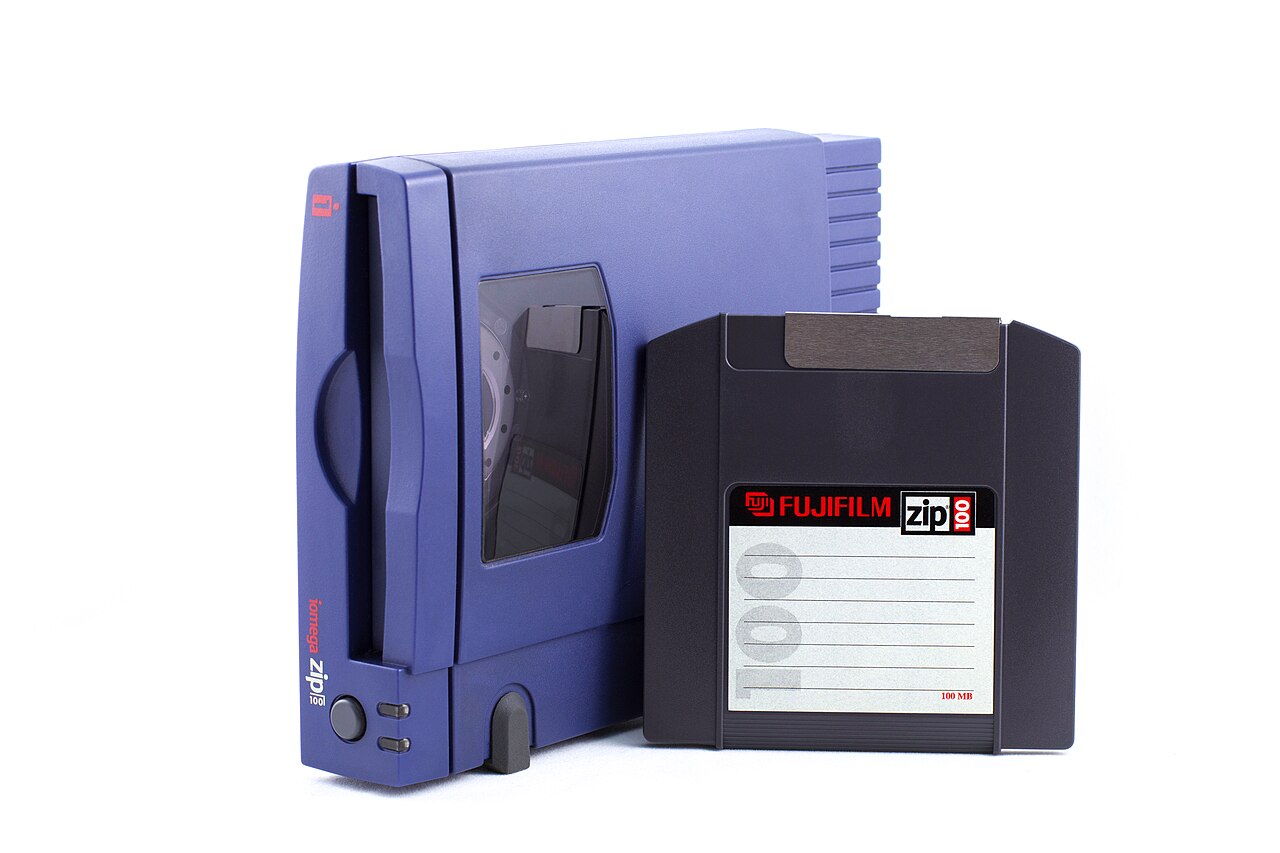
Iomega, founded on 1 April 1980 in Roy, Utah, by former IBM engineers, had made removable storage since its Bernoulli Box of 1982, a 10 MB cartridge drive in which a flexible disk spinning at high speed was pulled by air pressure close to the head. In late 1994 it announced the Zip drive, and it shipped it from March 1995: 100 MB cartridges a little larger and twice as thick as a floppy, a drive for just under $200 including one cartridge, and further cartridges at $20. The Zip peaked at about 1.4 MB per second with an average seek time of 28 milliseconds, against roughly 16 KB per second and 200 milliseconds for a floppy drive. It came in versions for the parallel port, which needed no installation inside the computer, and for SCSI.
The Zip was the first floppy successor that was cheap enough for home users and was sold as a consumer product. Iomega’s 1996 sales grew by $886.5 million, or 272 percent, over 1995. The company passed $1.2 billion in revenue, and Zip and Jaz together accounted for $1.1 billion of it, 87 percent of the total. Iomega split its stock three for one in January 1996 and two for one in May 1996, and its shares became a favourite of the first generation of online investment forums. The Jaz drive, shipped from December 1995, offered 1 GB cartridges and from 1998 2 GB. Computer makers built Zip drives into PCs and Macintoshes, and for a few years a Zip disk was the way to carry a large file from one office to another.
The drives also failed in a memorable way. A misaligned head could fail to find its track, retreat, and try again, with a repetitive click, and a damaged cartridge could damage the next drive it was put into. Users called it the “click of death,” a class action was filed in September 1998, and the settlement of 2001 gave buyers rebates on Iomega products (see The Zip Drive’s “Click of Death”). By 1998 Zip sales had stopped growing for the first time. Iomega added 250 MB and finally 750 MB models, and in November 1997 unveiled the Clik!, a 40 MB miniature disk for cameras and handheld devices, which flash cards undercut.
The Floppy-Compatible Challengers
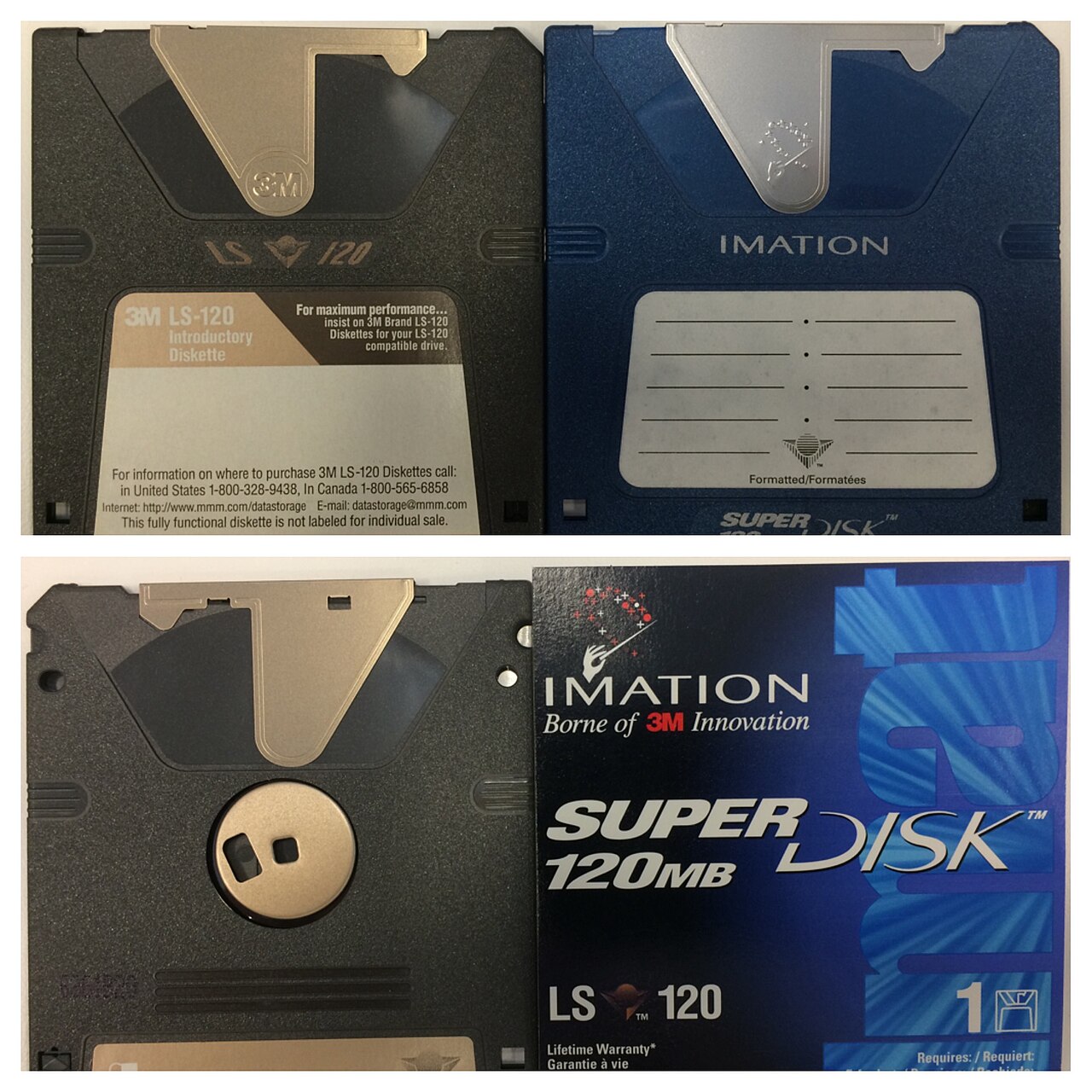
The Zip’s weakness was that it could not read a floppy. A PC with a Zip drive still needed a floppy drive, and the ideal successor would replace both. Imation, the storage spin-off of 3M, developed a floptical-style drive with Matsushita, Compaq, and OR Technology and released it in 1996 as the LS-120 SuperDisk. Its cartridges held 120 MB, and the drive read and wrote ordinary 1.44 MB and 720 KB floppies, faster than a floppy drive did. Compaq, Gateway, and Dell offered it in some computers. It arrived, however, when the Zip had been on sale for more than a year and had an installed base, and it never won North America. Matsushita’s LS-240 of 2001 doubled the capacity and could format an ordinary floppy to 32 MB. Manufacture ceased worldwide in 2003.
Sony, which had introduced the 3.5-inch floppy in 1981, launched its own successor, the HiFD, in 1998, with 200 MB disks and floppy compatibility. Soon after launch the drives began failing with head-alignment problems, and Sony recalled them in 1999. It relaunched the HiFD with a USB connection in November 1999 and stopped development and sale by early 2001. Caleb Technology’s UHD144, a 144 MB floppy-compatible drive, appeared in the same years and disappeared as quietly.
What Replaced the Floppy
None of these drives replaced the floppy, because the job was done by something else. Recordable CDs held 650 MB on media that cost a fraction of a Zip cartridge and could be read by every computer with a CD-ROM drive, which by the late 1990s was nearly every computer. CD writers fell steeply in price around 2000, and CD-RW made the disc rewritable. Networks took over the rest: e-mail attachments, office file servers and, later, internet storage carried files that had once travelled on cartridges. Apple’s iMac of 1998 shipped with no floppy drive at all, a decision widely mocked at the time.
The last step came in 2000 with the USB flash drive, which Trek Technology and IBM began selling almost simultaneously: no moving parts, no special drive, readable by any computer with a USB port, and soon larger than any Zip disk. Iomega itself sold flash drives and network storage in the 2000s. Zip sales declined steadily from 1999, and the 50 millionth Zip drive shipped in June 2003. EMC bought Iomega in 2008 for $213 million; the business passed in 2013 into a joint venture with Lenovo, and the last products under its name were discontinued in 2018.
The 1.44 MB floppy survived its would-be successors: computer makers kept selling floppy drives into the 2000s, and its picture is still the icon for “save” (see The Save Icon Is a Floppy Disk Nobody Has Seen).
Dead End
The floppy successors fought one another for a market that was being taken from them by formats outside the fight. Each drive was proprietary: a Zip disk needed a Zip drive, a SuperDisk a SuperDisk drive, and an EZ135 an EZ135 drive, so each format’s value depended on how many other people had the same drive. The Zip won that contest because it came first at a consumer price, and SuperDisk and HiFD, which had the better technical answer to compatibility, arrived after the network effect had formed. The winner’s prize, however, was small, because a universal removable medium had to be readable everywhere, and only a format built into every computer could be that. The CD-ROM drive already was, and the USB port soon was.
Reliability made it worse. The Zip’s click of death, the HiFD’s recall and SyQuest’s sensitive cartridges taught buyers that a removable magnetic disk could lose their data, which made a write-once CD or a solid-state stick more attractive than its capacity alone would suggest. And the cartridges were expensive per megabyte from the start: a $20 Zip disk held 100 MB, while a blank CD-R that held six times as much cost a dollar or two by the end of the decade.
📚 Sources
- SyQuest Technology, Wikipedia (founding 27 January 1982, Iftikar, cartridge capacities, EZ135, EZFlyer, SyJet, SparQ, 1996 losses and layoffs, suspension of operations reported by The New York Times on 4 November 1998, Iomega purchase of parts in January 1999)
- Floptical, Wikipedia (Insite Peripherals, Adkisson, 1988 announcement, 21 MB, optical servo, 1,250 tpi, shareholders, SGI, about 70,000 sold)
- Iomega, Wikipedia (founding 1 April 1980 in Roy, Bernoulli Box 1982, Zip March 1995, Jaz December 1995 and February 1998, Clik! November 1997, 50 millionth Zip drive June 2003, EMC 2008 for $213 million, LenovoEMC 2013, discontinued 2018)
- Zip drive, Wikipedia (capacities, launch price, cartridge price, speed, and seek time against a floppy, decline from 1999)
- Iomega Corporation, Form 10-K for fiscal 1996 (sales increase of $886.5 million or 272%, Zip and Jaz sales of $1.1 billion, 87% of total)
- Iomega Corporation, Form 10-Q, 1996 (three-for-one split paid 31 January 1996, two-for-one split May 1996)
- “Iomega” feature, The Motley Fool, 3 April 1998 (stagnant Zip sales growth for the first time)
- SuperDisk, Wikipedia (Imation, Matsushita, Compaq, and OR Technology, 1996 release, 120 MB, floppy compatibility, OEMs, LS-240 and FD32MB, end of manufacture in 2003, CD-R competition)
- Sony HiFD, Wikipedia (1998 launch, recall, November 1999 USB relaunch, discontinued by early 2001)
- “History 1998: Sony HiFD high-capacity floppy disk,” StorageNewsletter, 2 October 2018 (recall for head misalignment)
- “Iomega proposes settlement to end suit,” Deseret News, 13 April 2001 (click-of-death class action, rebates for Zip buyers)
- Legacy-free PC, Wikipedia (iMac G3 of 1998 without a floppy drive)
- Image: Iomega Zip 100 drive with a disk.jpg by Yuri Litvinenko / 30pin (CC BY 2.0), via Wikimedia Commons