Ken Kutaragi and the PlayStation
Abstract
Ken Kutaragi (born 1950) was a Sony engineer who designed the sound chip of Nintendo’s Super Famicom without telling his superiors, and nearly lost his job over it. When Nintendo publicly dropped its CD-ROM partnership with Sony in 1991, he persuaded Sony’s president to build a console of its own. The PlayStation, launched in December 1994, was the first games console to sell a hundred million units, and its successor sold more. His third machine, the PlayStation 3, was built around a processor so ambitious and expensive that it cost Sony its lead and Kutaragi his position.
A Sound Chip in Secret
Kutaragi was born in Tokyo on 2 August 1950. His parents ran a small printing plant, where he worked after school. He took a degree in electronics at the University of Electro-Communications and joined Sony’s research laboratories in the mid-1970s, working on liquid-crystal displays and digital cameras.
In the 1980s he watched his young daughter play with a Nintendo Famicom and was struck by two things: how absorbed she was, and how poor the sound was. When Nintendo began work on a 16-bit successor, he saw a use for Sony’s digital audio expertise and designed a sound processor for it, the SPC700, which played sampled instruments where older consoles had beeped. He did it without approval. Sony’s management regarded games as toys, beneath a company that made Trinitrons and Walkmans, and when the project came to light the executives were furious. Norio Ohga, Sony’s president, a trained opera singer who understood what better sound was worth, approved the work and so kept him in his job. The Super Famicom shipped in 1990 with a Sony chip inside.
June 1991
The chip led to a larger deal. Under a 1988 contract, Sony was to develop a CD-ROM drive for the Super Famicom and to build its own combined machine, to be called the Play Station. The terms gave Sony control of the disc format and of the licensing of software published on it.
Nintendo’s president, Hiroshi Yamauchi, reread the contract and concluded that it handed Sony the part of the business where the money was made. He sent his American executives to Amsterdam to negotiate quietly with Philips. On 1 June 1991, at the Summer Consumer Electronics Show in Chicago, Sony announced the Play Station. The next morning Nintendo’s Howard Lincoln announced, at the same show, that Nintendo would work with Philips (see The Video Game Console Wars and Nintendo: A Century of Play).
Sony tried for almost a year to rescue some form of the partnership and broke off for good in May 1992. In June 1992 Ohga chaired a meeting to decide what to do with the project. Most of the executives present wanted to drop it. Kutaragi showed a prototype of a CD-ROM system that drew three-dimensional graphics in real time, which he had been developing in parallel, and reminded Ohga of what Nintendo had done to Sony in public. Ohga decided to go ahead.
A Console from a Record Company
To keep the project away from its opponents inside Sony, Ohga moved Kutaragi and nine engineers to Sony Music’s offices, where the executive Shigeo Maruyama looked after them. The move had a second effect. Sony Music knew how to sign artists, press discs cheaply, and market to teenagers and adults, and the new console business took its habits from there and not from the electronics divisions. Sony Computer Entertainment was founded in November 1993 as a joint venture of the two.
Kutaragi’s design decisions followed from the Nintendo experience. The machine was built for 3D polygons from the start, at a time when Sega’s competing Saturn was conceived around 2D sprites. Games came on CD-ROMs, which cost about a dollar to press and could be reordered in days, where Nintendo’s cartridges cost many times more, had to be ordered months ahead, and were manufactured by Nintendo. Licence terms for outside developers were lenient and the programming tools were good. The arcade company Namco committed early, with Ridge Racer as the first game.
The PlayStation went on sale in Japan on 3 December 1994 for ¥39,800. At the first E3 trade show in Los Angeles, on 11 May 1995, Sega announced that the Saturn would cost $399. Sony’s American head, Steve Race, walked to the podium, said “Two ninety-nine”, and sat down. The American launch followed on 9 September 1995. When Square moved Final Fantasy VII from Nintendo to the PlayStation because the game needed the space of three CDs, the pattern for the generation was set. The PlayStation sold 102.49 million units before it was discontinued in March 2006.
PlayStation 2
For the PlayStation 2, launched in March 2000, Kutaragi commissioned a custom processor with Toshiba, the Emotion Engine, and added a DVD drive at a time when stand-alone DVD players cost about as much as the console. It could also run PlayStation games. More than 150 million were sold, the highest figure for any home console. At its peak the games division produced a large share of Sony’s operating profit while the television and audio businesses were losing money.
Kutaragi rose with it. In 2003 he became a deputy president of Sony and was spoken of as a possible chief executive. He was also by then the company’s most quotable executive, impatient with colleagues and blunt in public. He described a rival’s new machine in 2005 as “just an Xbox 1.5”.
The Cell
His plan for the third console was larger than a console. With IBM and Toshiba, Sony spent several years and a very large sum developing the Cell, a processor with one conventional core and eight specialized ones, which Kutaragi expected to put into televisions, servers, and home appliances as well, networked into a kind of distributed supercomputer. The PlayStation 3 would also carry a Blu-ray drive, to win the format war over the successor to DVD.
The parts made the machine very expensive. It launched in November 2006, a year after Microsoft’s Xbox 360, at $499 and $599, and Sony still lost money on each one. The Cell was hard to program, and games written for both consoles often ran better on the cheaper one. The Blu-ray drive was in short supply, so the European launch slipped to 2007. Nintendo’s Wii, built from modest parts on the principle of Gunpei Yokoi, outsold both. Kutaragi’s remarks did not help; in 2005 he had told the business magazine Toyo Keizai that he wanted consumers to think “I will work more hours to buy one”.
Blu-ray did win its format war, and the PlayStation 3 recovered in its later years. Cell did not spread to other products, and Sony’s next console used an ordinary PC-style processor. Kutaragi was not there to choose it. He had been passed over for the leadership of Sony in 2005, when Howard Stringer became chief executive and Kutaragi left the board; on 30 November 2006, three weeks after the launch, Kazuo Hirai replaced him as president of Sony Computer Entertainment, and in April 2007 he announced his retirement. He remained honorary chairman until 2011.
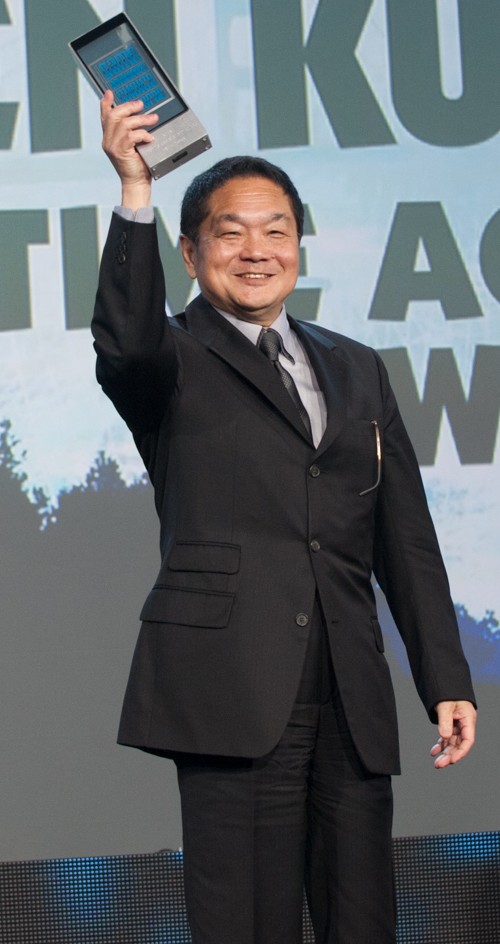
He has since taught, sat on company boards, and in 2020 became chief executive of the Tokyo robotics start-up Ascent Robotics. He received the Lifetime Achievement Award of the Game Developers Choice Awards in 2014.
📚 Sources
- Wikipedia: Ken Kutaragi (finding aid: birth, the printing plant, University of Electro-Communications, the daughter and the Famicom, SPC700 in secret and Ohga’s protection, deputy president in 2003, “Xbox 1.5”, Hirai on 30 November 2006, retirement announced 26 April 2007, honorary chairman until 2011, Ascent Robotics, 2014 award)
- Wikipedia: PlayStation (console) (finding aid: the 1988 contract and its terms, Yamauchi’s reading of it, the Philips announcement, break in May 1992, the June 1992 meeting, the move to Sony Music and Maruyama, Namco and Ridge Racer, launch dates and prices, Steve Race at E3 on 11 May 1995, 102.49 million, discontinued 23 March 2006)
- Asakura, Reiji: Revolutionaries at Sony: The Making of the Sony PlayStation and the Visionaries Who Conquered the World of Video Games (McGraw-Hill, 2000)
- Engadget: “Sony wants you to earn that PlayStation 3” (6 July 2005) (the Toyo Keizai interview)
- The Japan Times: “Sony passes over brash star Kutaragi” (4 April 2005)
- Nikkei Asia: “PlayStation ‘father’ Ken Kutaragi becomes CEO of AI startup” (2020)
- The date and place of the 1991 announcements follow The Video Game Console Wars and the sources cited there.
- Image: Ken Kutaragi - Game Developers Choice Awards 2014 (cropped).jpg by Official GDC (CC BY 2.0), via Wikimedia Commons