Luis von Ahn and Human Computation
Abstract
Luis von Ahn built a career on one observation: billions of people spend small moments of brainpower online, and those moments can be aggregated into work no computer can do. As Manuel Blum’s student at Carnegie Mellon he co-created the CAPTCHA, then felt guilty about the wasted seconds and built reCAPTCHA, which turned 200 million daily “are you human?” tests into the digitization of old books and newspapers. Google bought it in 2009. His second act applied the same aggregation idea to education: Duolingo, founded with Severin Hacker so that people in countries like his native Guatemala could learn languages without paying, became the world’s most-used education app, with 130 million monthly users by 2025.
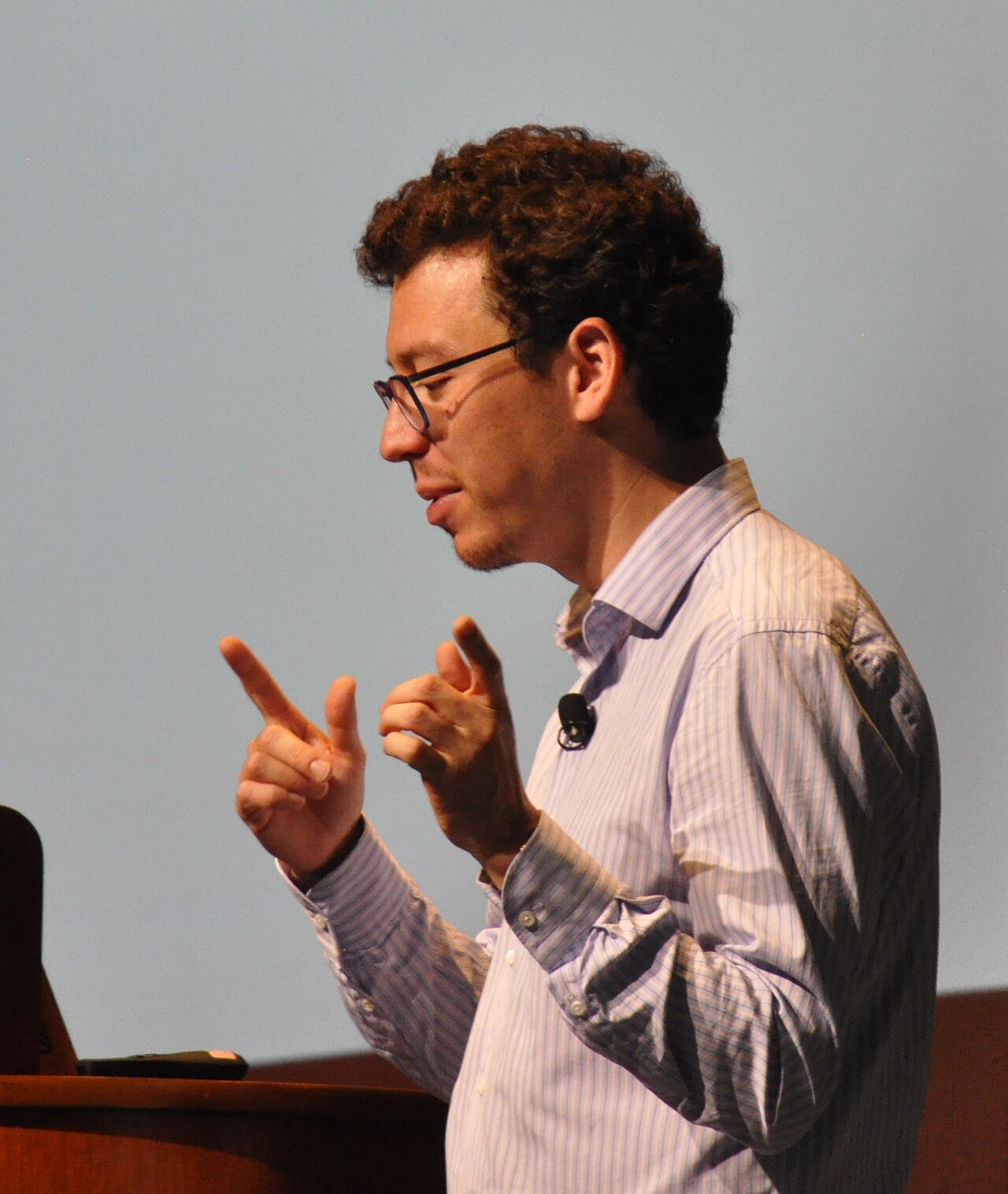
Guatemala City to Pittsburgh
Luis von Ahn was born on August 19, 1978, in Guatemala City, of partly German descent, and was raised by his mother, one of Guatemala’s early female physicians. Growing up in a country where good education was a paid privilege left him with the conviction that later became a company mission statement. He left for Duke University, took a mathematics degree summa cum laude in 2000, and went to Carnegie Mellon for a PhD under Manuel Blum, the complexity theorist whose advising tree already included three future Turing laureates. He joined the CMU faculty himself in 2006.
CAPTCHA and the ESP Game
In 2000, Blum and von Ahn, with Nicholas Hopper and John Langford, answered an industry complaint about bots mass-registering email accounts with the CAPTCHA: a test a machine administers, humans pass, and machines fail, mangled text being at the time a reliably human skill. The theory and the acronym (Completely Automated Public Turing test to tell Computers and Humans Apart) were published at EUROCRYPT 2003; the full story, including the test’s engineered obsolescence, is in Manuel Blum: From Complexity to CAPTCHA and its accessibility cost in The Accessibility Revolution in Computing.
Von Ahn’s dissertation (2005) generalized the trick and named the field: human computation, the design of systems that harvest human cognitive effort, preferably effort people enjoy spending. His flagship demonstration was the ESP Game (2004), an online game in which two strangers, shown the same image, earn points by independently typing the same word. The players experience telepathy; the system collects verified image labels. Google licensed it in 2006 as the Google Image Labeler to improve image search, and von Ahn won a MacArthur Fellowship the same year, at 27.
reCAPTCHA
The CAPTCHA’s success produced an accounting that bothered its co-inventor: by the late 2000s, people were solving around 200 million of them a day, roughly ten seconds each, about 500,000 human-hours daily burned on proving humanity. reCAPTCHA (2007) recycled the effort. Each challenge showed two words: one the system knew (the actual test) and one that optical character recognition had failed to read in a real scanned text. Type both, and the second answer, cross-checked across users, digitized a sliver of an old book or a page of the New York Times archive. More than 100,000 websites adopted it, and by von Ahn’s count its users were digitizing on the order of 100 million words a day. Google acquired reCAPTCHA in September 2009 and pointed it at Google Books.
Duolingo
Von Ahn and his PhD student Severin Hacker began work on Duolingo in 2009, with a founding constraint drawn from Guatemala: language education had to be free, because the people who most need English cannot buy it. The launch model was human computation again: students would learn a language while translating real web documents, and media companies like CNN and BuzzFeed would pay for the translations. The private beta opened on November 30, 2011, had a waiting list over 100,000 within two weeks, and the app launched publicly on June 19, 2012.
What made Duolingo grow was less the translation engine than the packaging: lessons compressed into game mechanics, streaks, leagues, hearts, and Duo, the green owl mascot whose passive-aggressive push notifications (“These reminders don’t seem to be working…”) became an internet joke the company embraced. A/B testing on a scale unusual for education tuned every screen for retention.
The company went public on NASDAQ on July 28, 2021, priced at $102 a share and closing 36% up at a market value near $5 billion. For 2024 it reported $748 million in revenue and $88.6 million in profit; by mid-2025 it counted about 130 million monthly active users, of whom 10.9 million paid for the ad-free subscription. The Duolingo English Test, a cheap online alternative to TOEFL taken from home, became a second business when COVID-19 closed physical test centers and universities began accepting it at scale. In 2025 von Ahn announced Duolingo would become an “AI-first” company and phase out contractors whose work AI could do; the backlash from users was loud enough that he publicly walked the framing back within weeks. He received the Lemelson-MIT Prize in 2018 and the IEEE Frances E. Allen Medal in 2026, and his foundation (2021) funds programs for women and girls in Guatemala.
Dead End: Learning by Translating
Duolingo’s original business model is the forgotten casualty of its success. Translate-while-learning was elegant on paper: students get free lessons, publishers get cheap translations, human computation pays for education the way it had paid for book digitization. In practice the two sides pulled apart. Beginners produce poor translations of real-world text, the documents worth paying for are rarely at learner level, and the pedagogy suffered when lesson content was dictated by whatever CNN needed translated. Duolingo quietly dropped the translation business in the mid-2010s and switched to the model it had avoided at launch, ads plus subscriptions, which turned out to fund free education far better than crowdsourced piecework did. The human-computation idea survived intact in one place: every learner’s answer is still an experiment in the company’s A/B machine.
📚 Sources
- Luis von Ahn — Wikipedia
- Duolingo — Wikipedia
- von Ahn, Blum, Hopper & Langford: CAPTCHA — Using Hard AI Problems for Security (EUROCRYPT 2003, PDF)
- Luis von Ahn: Massive-scale online collaboration — TED (2011)
- Duolingo closes up 36% in Nasdaq debut, valuing company at nearly $5 billion — CNBC (2021)
- Image: Wikimania 2015 - Luis von Ahn - 1.JPG by Jarek Tuszyński (CC BY 4.0), via Wikimedia Commons