Google: From Dorm Room to Digital Infrastructure
Abstract
Google began as a Stanford PhD research project in 1996, a clever new way to rank web pages by counting the links pointing at them. Within a decade it had become the most-used software system in human history. Within two decades it had become a near-monopoly controlling how the world finds information, a global advertising empire generating over $300 billion in annual revenue, and a technology conglomerate whose products touch nearly every aspect of digital life. The story of Google is the story of how a single algorithmic insight, combined with extraordinary execution and a permissive regulatory environment, produced a company that rewired the architecture of the internet.
BackRub and the PageRank Insight
In 1996, Larry Page was a first-year PhD student at Stanford University, working under advisor Terry Winograd on the mathematical properties of the World Wide Web. The web was young (a few million pages) but already suffering from a fundamental problem: it was impossible to find anything reliably. The existing search engines (AltaVista, Excite, Lycos) ranked pages largely by keyword frequency, a method easily gamed by stuffing pages with repeated terms.
Page’s insight was to treat the web as a graph and to use its link structure as a proxy for authority. Academic papers had long used citation counts to measure importance; Page reasoned the same principle applied to web pages. A page linked to by many other pages was probably important. A link from an important page was worth more than a link from an unimportant one. The algorithm (recursive, iterative, and mathematically elegant) could calculate the relative importance of every page on the web simultaneously.
Page named the project BackRub (it analyzed back-links) and recruited fellow PhD student Sergey Brin to help build it. Their working system, cramming Stanford’s network with crawling traffic, became the subject of their 1998 paper, “The Anatomy of a Large-Scale Hypertextual Web Search Engine.” The algorithm was renamed PageRank, a double pun, after Larry Page and after the concept of ranking web pages.
The paper identified, prophetically, a danger they could not then anticipate: “we expect that advertising funded search engines will be inherently biased towards the advertisers and away from the needs of the consumers.” Within three years, their company would be built on exactly the advertising model they warned against.
The Garage and the Investment
Page and Brin incorporated Google Inc. on September 4, 1998, in a Menlo Park garage rented from Susan Wojcicki (later CEO of YouTube, then a Stanford graduate student). The name derived from “googol” (the number 1 followed by 100 zeros) misspelled on the original domain registration. The misspelling stuck.
Their first investor was Andy Bechtolsheim, co-founder of Sun Microsystems, who wrote a check for $100,000 to “Google Inc.” before the company was formally incorporated, before there was even a bank account to deposit it in. He later said he wrote it because he wanted to get back to his breakfast.
In June 1999, venture capital firms Kleiner Perkins and Sequoia Capital jointly invested $25 million in Series A funding, the two firms overcoming their usual rivalry to co-invest. At a formative moment, Page and Brin adopted an informal corporate motto that would define Google’s public identity for years: “Don’t Be Evil.” The phrase originated with engineer Paul Buchheit (later creator of Gmail) at an early company values meeting. It was intended seriously, a repudiation of the advertising-driven, relevance-compromising search engines they were displacing.
The Business Model That Changed Everything
Google’s search was better, but better search did not automatically generate revenue. The company ran at a loss through 1999 while Page and Brin resisted cluttering their interface with the intrusive banner advertising that defined the web at the time.
The solution arrived from an unexpected direction. GoTo.com (later Overture) had pioneered paid placement, companies bid for top positions in search results. Page and Brin found the explicit mixing of paid results and organic results ethically objectionable. But a modified version, introduced in 2000 as AdWords, showed text advertisements clearly labeled and placed alongside (not above) organic results, with placement determined by both bid price and relevance score.
AdWords was profitable immediately. In 2003, Google extended the model with AdSense, which placed contextually relevant ads on third-party websites and split the revenue with site owners. This transformed Google from a search engine into an advertising network that happened to operate a search engine, the most profitable advertising business in history. By 2023, Google’s parent company Alphabet reported revenue of approximately $307 billion (up from $283 billion in 2022), with roughly 77% derived from advertising.
The AdWords Auction
AdWords’ pricing mechanism was a generalized second-price auction designed by Google economist Hal Varian: advertisers bid for keyword placements, but winners pay the second-highest bid plus one cent, not their own bid. This reduced incentives for strategic bidding and created a stable, high-revenue auction mechanism. The elegance of the design helped justify Google’s claim that its advertising model aligned advertiser interests with user interests, even as critics noted that relevance scoring could itself be manipulated.
Products, Acquisitions, and Platform Control
Google’s expansion beyond search was relentless and strategically coherent: each product acquired behavioral data, extended the advertising network’s reach, or controlled a platform through which users accessed the internet.
Gmail (launched April 1, 2004, initially assumed to be an April Fool’s joke given its 1-gigabyte storage offer, fifty times competitors) introduced contextual advertising in email and gave Google access to the content of users’ personal communications. Google Maps (2005), built partly from an Australian startup acquisition, became the world’s dominant mapping service.
The YouTube acquisition in October 2006 for $1.65 billion in stock was widely mocked at the time as overpriced for a two-year-old startup with no clear monetization path. It became one of the most profitable acquisitions in technology history: YouTube is now the second most-visited website in the world, with over 2 billion monthly users.
Android, acquired in 2005 for approximately $50 million, was an even more consequential bet. When the iPhone launched in 2007 and made clear that computing was moving to mobile, Google had a ready platform. Android was open-sourced in 2007 and licensed free to manufacturers; it now runs on approximately 70% of the world’s smartphones. The strategic logic was transparent: controlling the mobile operating system meant controlling which search engine, browser, and apps ran on billions of devices.
Chrome (2008) gave Google control of the browser layer. Google App Engine (2008) established a presence in cloud computing. Each piece of the stack reinforced the others and collectively ensured that regardless of how people accessed the internet, Google was involved.
The Google Books project, begun in 2004, attempted to digitize the world’s library collections and was sued by the Authors Guild and publishers over copyright. A 2011 class-action settlement was rejected by a court as unfair to authors; Google continued scanning under a fair-use argument ultimately upheld by courts in 2015. The project scanned over 25 million books, though most remain inaccessible behind copyright restrictions.
Google+ (2011) was Google’s attempt to compete with Facebook’s social graph. It failed to attract sustained engagement despite being forcibly integrated into other Google products, and was shut down for consumers in 2019 after a data exposure vulnerability was concealed from the public for six months.
Alphabet and the Reorganization of Ambition
By 2015, Google had become simultaneously a search company, an advertising network, a mobile operating system, a browser, a cloud platform, a video network, a mapping service, and a research organization working on self-driving cars, life extension, and internet-beaming balloons. The diversity of projects strained coherent management.
In August 2015, Larry Page announced the creation of Alphabet Inc. as a holding company. Google became a subsidiary of Alphabet; Page became Alphabet CEO; Sundar Pichai, the Indian-born engineer who had overseen Chrome and Android, became CEO of Google. The restructuring was designed to give subsidiary companies such as Waymo (self-driving cars, spun off from the Google X moonshot lab), Verily (life sciences), DeepMind (artificial intelligence) independent management and clearer financial reporting.
DeepMind, acquired in January 2014 for approximately $500 million, was the most strategically significant purchase. The London-based AI research lab, founded by Demis Hassabis, Shane Legg, and Mustafa Suleyman in 2010, had produced the DQN system (2015, superhuman performance on Atari games) and would go on to create AlphaGo (2016, defeating world Go champion Lee Sedol) and AlphaFold (2020, solving the protein-folding problem). For the AlphaGo story, see DeepMind and AlphaGo.
Antitrust: The Reckoning
Google’s dominance attracted regulatory attention from multiple jurisdictions simultaneously.
The European Commission delivered three major fines between 2017 and 2019: €2.42 billion for favoring its own Google Shopping service in search results (2017); €4.34 billion for illegal restrictions in Android licensing agreements requiring manufacturers to pre-install Google Search and Chrome (2018); and €1.49 billion for restricting rival advertising services on third-party websites (2019). The Android fine was the largest competition fine in EU history at the time of its imposition.
In the United States, the Department of Justice filed an antitrust lawsuit in October 2020 alleging that Google had illegally maintained its search monopoly through exclusive dealing arrangements, paying Apple approximately $18–20 billion per year (by 2022 estimates) to be the default search engine in Safari, paying mobile manufacturers and carriers to pre-install Google Search, and using its Android ecosystem to foreclose competition.
In August 2024, US District Judge Amit Mehta ruled that Google had violated Section 2 of the Sherman Antitrust Act: that it had illegally maintained a monopoly in general search and general search advertising through its distribution agreements. It was the most significant antitrust ruling against a technology company since the Microsoft case of 2001. Remedies proceedings continued into 2025, with the DOJ proposing that Google be required to divest Chrome and potentially Android.
The Monopoly Paradox
Google’s antitrust situation reflects a paradox of platform competition: the company achieved dominance partly because its search engine genuinely was better than the alternatives, a fact acknowledged even in the DOJ’s legal arguments. The question was not whether Google had earned its dominance through quality, but whether it then used its financial resources to pay for distribution arrangements that prevented any alternative from gaining the scale needed to compete. Paying $18+ billion annually to remain the default on Apple devices is not a quality argument; it is a barrier to entry.
The AI Pivot
The November 2022 launch of ChatGPT by OpenAI triggered what Google insiders described as a “code red.” Google had pioneered transformer architecture (the “Attention Is All You Need” paper, Google Brain, 2017), had built large language models before OpenAI, and had deployed AI extensively in Search. But it had not launched a consumer-facing conversational AI product, fearing it would cannibalize search advertising revenue and surface factual errors that would damage trust.
Sergey Brin, who had stepped back from day-to-day involvement after the Alphabet restructuring, reportedly returned to the office to help with the AI response. Google rushed Bard to launch in February 2023, and it immediately demonstrated a factual error in its announcement demo, wiping $100 billion from Alphabet’s market capitalization in a day. Bard was subsequently renamed Gemini, rebranded around Google’s most capable language model family.
The AI competition forced Google to integrate generative AI features into Search (“AI Overviews”) at a pace that caused quality problems, including recommendations to put glue on pizza and eat rocks. The integration represented an existential challenge: if AI could answer questions directly, the link-based web that PageRank ranked might become irrelevant, taking Google’s advertising model with it.
For the broader context of the generative AI revolution, see The Generative AI Revolution and Sam Altman and OpenAI. For the founders’ stories, see Larry Page and Sergey Brin.
See also: Killed by Google: The Product Graveyard; Tech Labor Movements.
📚 Sources
- Brin, Sergey & Page, Lawrence: “The Anatomy of a Large-Scale Hypertextual Web Search Engine” (1998), Stanford University
- Auletta, Ken: Googled: The End of the World as We Know It (2009), Penguin Press
- Vise, David A. & Malseed, Mark: The Google Story (2005, updated 2008), Bantam Dell
- Schmidt, Eric & Rosenberg, Jonathan: How Google Works (2014), Grand Central Publishing
- European Commission: Google Shopping antitrust decision, Case AT.39740 (June 2017)
- European Commission: Google Android antitrust decision, Case AT.40099 (July 2018)
- US v. Google LLC, Case No. 1:20-cv-03010, US District Court for the District of Columbia (filed October 20, 2020)
- Judge Mehta ruling, US v. Google LLC: Memorandum Opinion (August 5, 2024)
- Alphabet Inc.: Annual Report (Form 10-K) for fiscal year 2023
- Levy, Steven: In the Plex: How Google Thinks, Works, and Shapes Our Lives (2011), Simon & Schuster
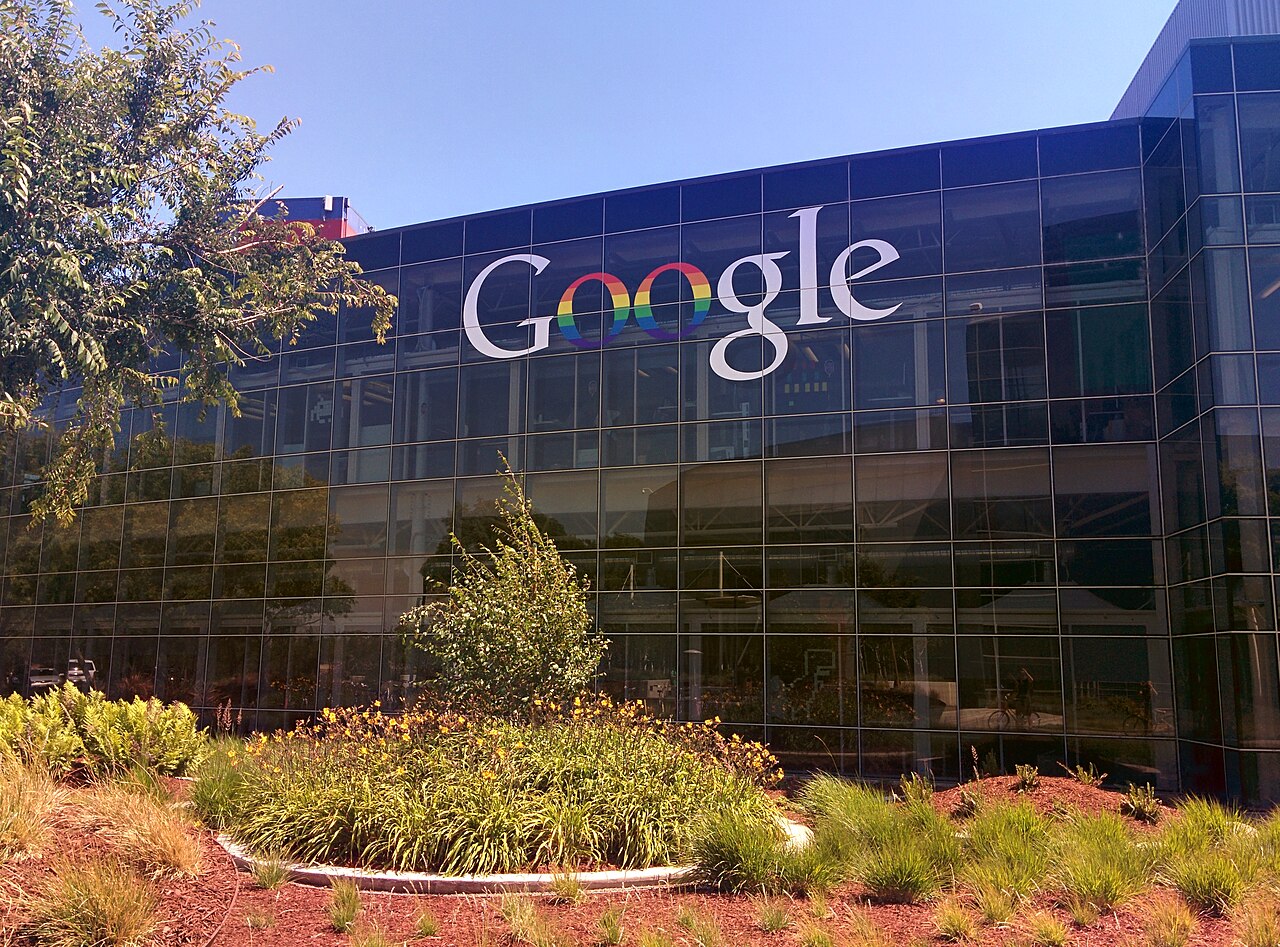
- Image: Googleplex with Pride colors 2015.gk.jpg by Grendelkhan (CC BY-SA 3.0), via Wikimedia Commons