The History of CAD: From Sketchpad to AutoCAD
Abstract
Computer-aided design (CAD) began as a research demonstration on a military computer, became a business of $125,000 workstations sold to aircraft and car makers, and reached everyone else in 1982 on a floppy disk that cost about $1,000. The mathematics of its curves was worked out twice in the French car industry: at Citroën, where Paul de Casteljau was forbidden to publish, and at Renault, where Pierre Bézier published and got his name on the result. Dassault’s CATIA carried the Boeing 777 from first sketch to assembly without a full physical mock-up. AutoCAD, bought in from a consultant in Arizona by a group of programmers who had not planned to be a CAD company, put drafting on the PC and outsold the entire turnkey industry that had ignored it.
Drawing on a Screen
In 1963 Ivan Sutherland finished Sketchpad at MIT: a light pen, a display, and a program that understood a drawing as geometry with constraints instead of a pattern of dots. Industry was working on the same idea with larger budgets. General Motors and IBM showed their DAC-1 system for car body design in 1964. Lockheed’s plant in Burbank started an internal mainframe drafting program called “Project Design” in 1965, which became CADAM.
The first attempt to sell such a machine came before Sketchpad was finished. Itek, an optics firm in Lexington, Massachusetts, funded an “Electronic Drafting Machine” in August 1960, built it around a DEC PDP-1 and a 25-inch display, and began marketing it in early 1962. Itek then sold the technology and its patents to Control Data, which offered it as Digigraphics. The PDP-1 alone cost about $120,000, and graphics hardware stayed too expensive for an ordinary drafting room for most of the decade.
Two Car Makers and One Curve
A car body is a set of free-form surfaces, and a stylist’s clay model does not come with equations. Numerically controlled milling machines needed them.
Paul de Casteljau, a mathematician trained at the École Normale Supérieure, joined Citroën in 1958. In 1959 he devised a way to describe a curve by a small set of control points and to compute any point on it by repeated linear interpolation between them, a procedure that is numerically stable and simple to program. He recorded it in internal Citroën documents in 1959 and 1963. Citroën’s policy kept the method in-house, and he was not allowed to publish.
Pierre Bézier had worked at Renault since 1933, starting as a tool setter and rising to run its machine-tool division. He began CAD research in 1960 and built UNISURF, a system for designing body surfaces and milling them, which was first shown in 1968 and in full production use at Renault by 1975. Bézier arrived at the same family of curves in a different formulation, and he published. The curves carry his name; the evaluation procedure is called de Casteljau’s algorithm.
Bézier himself wrote the fairest summary: “Due to Citroën’s policy, the results obtained by de Casteljau were not published until 1974, and this excellent mathematician was deprived of part of the well deserved fame that his discoveries and inventions should have earned him.” The curves later left the car industry altogether. PostScript adopted them for font outlines, which is how they ended up in Adobe’s software and in most type on a screen today. De Casteljau died on 24 March 2022, having received the Solid Modeling Association’s Bézier Award ten years earlier.
The Turnkey Industry
The commercial CAD industry dates from 1969, when Applicon and Computervision were founded. Philippe Villers, an MIT-trained engineer, decided to start Computervision after a sermon on Martin Luther King in the days following King’s murder in April 1968; he reasoned that he could become an activist or start a company, get rich, and use the money.
The product was a turnkey system: a minicomputer, graphics terminals, a plotter, and the vendor’s own software, sold as a unit. At the start of the 1980s five companies dominated the market: Applicon, Auto-trol Technology, Calma, Computervision, and M&S Computing (later Intergraph). David Weisberg, who worked in the industry, puts the typical price around 1980 at about $125,000 per seat. They were hardware manufacturers that happened to write software, and their customers were companies that could afford a CAD department with its own room and its own operators.
CATIA and the 777
Avions Marcel Dassault had licensed Lockheed’s CADAM in 1974 for two-dimensional drafting and wanted three-dimensional surfaces as well. In 1977 its CAD department wrote a program called CATI (Conception Assistée Tridimensionnelle Interactive). With it the company designed and machined a wind-tunnel wing in four weeks; the job had taken six months before.
Francis Bernard, who led the work, persuaded the aircraft maker to sell the software. The subsidiary Dassault Systèmes was set up on 5 June 1981, the program was renamed CATIA, and IBM, which had sold CADAM for Lockheed since 1978, took on the marketing. CATIA ran on IBM mainframes, which suited both partners (see France’s Tech Industry).
The largest customer came in the late 1980s, when Boeing’s commercial aircraft division moved from VAX-based Intergraph systems to mainframe CATIA for the project that became the Boeing 777. At the peak of the design work more than 2,200 CATIA workstations were connected to a cluster of eight IBM mainframes. Engineers assembled the aircraft on screen and checked parts for interference before any metal was cut. Boeing described the 777 as “the first airplane to be 100-percent digitally designed and preassembled on a computer,” The only engineering mock-up built was a section of the nose, made to confirm that digital pre-assembly could be trusted.
AutoCAD
Mike Riddle, a self-employed computer consultant in Arizona, had used a Computervision system at a steel fabricator and thought the same work could be done on a microcomputer. From 1977 he wrote a drafting program he called Interact.
In California, John Walker ran Marinchip Systems, a small maker of computers built around the TI 9900 processor. Early in 1982 he gathered a group of programmers to start a software company. By Weisberg’s count eighteen people took part and put up $59,000 between them, much of it from Marinchip. None drew a salary. The company was incorporated as Autodesk on 26 April 1982, and it did not yet know what it would sell: Walker’s first information letter to the partners listed fifteen possible programs, among them a screen editor, a spreadsheet, and a BASIC compiler. Riddle licensed Interact to the company, non-exclusively, for a 10% royalty.
COMDEX in Las Vegas in November 1982 settled the question. Autodesk showed its CP/M version, AutoCAD-80; other vendors demonstrated the program in their own booths; and it was named best of show. The screen editor attracted little interest. A favoured machine in the first year was the Victor 9000, which had an 800 by 400 pixel screen, the sharpest of any personal computer then on sale.
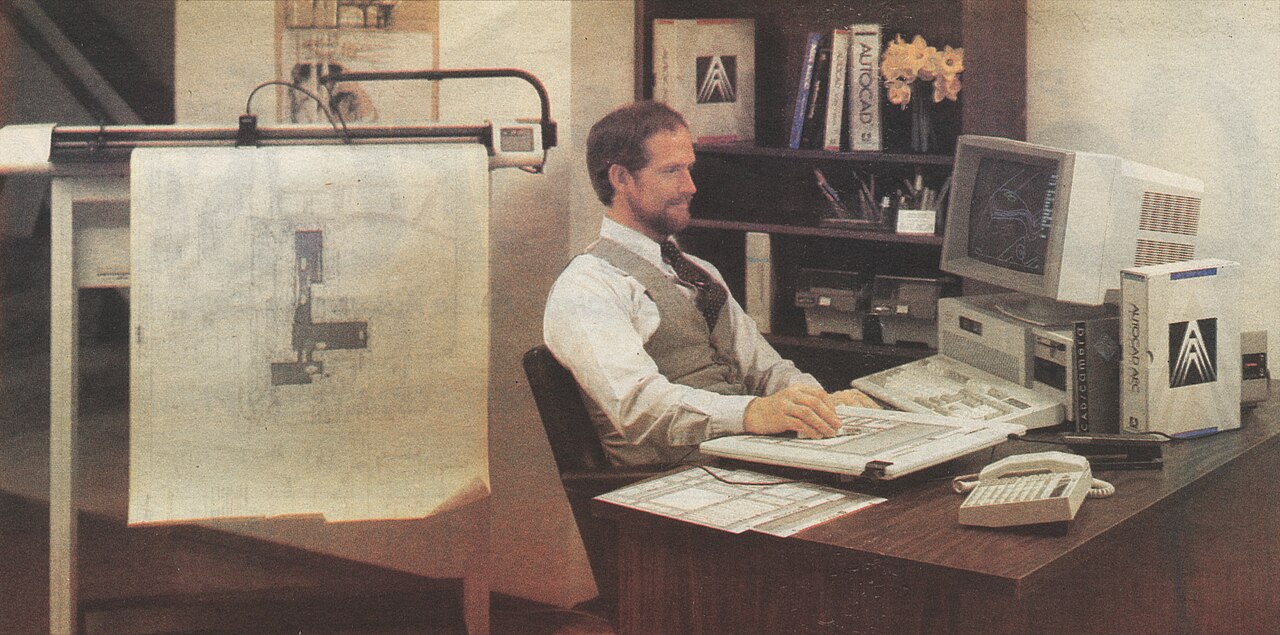
Revenue was under $15,000 in the first fiscal year and over $1 million in the second. By 1985 AutoCAD listed at $2,000, with its two drafting extensions at $500 each, against the six-figure price of a turnkey seat. Autodesk went public in June 1985 without ever having taken venture capital, and in fiscal 1987 it reported revenue of more than $54 million and earnings of $11.6 million. The royalty that had looked nominal on a few thousand copies became a large sum, and the relationship between Riddle and Autodesk ended in a dispute.
Walker wrote the company’s internal history himself and published it as The Autodesk File. He moved to Switzerland in 1991, left Autodesk in 1994, and died there on 2 February 2024.
Solids and Parameters
AutoCAD automated the drawing board. The next change was to replace the drawing with a model. Samuel Geisberg, a mathematician born in Leningrad in 1936 who had worked at both Computervision and Applicon, founded Parametric Technology Corporation in May 1985 after neither employer took up his proposal. Pro/ENGINEER shipped in 1988. A part was a solid built from features (a hole, a rib, a fillet) whose dimensions were parameters, so changing one number rebuilt the part and every drawing derived from it.
The same idea reached the Windows PC with SolidWorks in the mid-1990s. Dassault Systèmes announced on 24 June 1997 that it would buy SolidWorks for $310 million, at a time when the younger company had sold about 6,000 copies and had annual revenue of roughly $25 million.
Dead End: The Turnkey Vendors
The five turnkey companies had the customers, the engineers, and a fifteen-year head start, and through the mid-1980s they treated the PC as a toy they hoped would go away. Some ported a cut-down version of their software; others attached Unix coprocessor boards to PCs so their workstation code would run unchanged. Meanwhile seat prices fell from about $125,000 to $75,000 and then below $50,000 as engineering workstations and PCs took over the hardware.
Their business depended on selling the computer along with the program. Once customers could buy the computer anywhere, a vendor’s margin had to come from software alone, and companies organised around manufacturing could not make that change quickly enough. In Weisberg’s account Applicon, Computervision, and Auto-trol “soon faded from the scene.” The survivors were software houses: Dassault, Autodesk, PTC, and the descendants of Unigraphics.
📚 Sources
- Weisberg, David E.: The Engineering Design Revolution: The People, Companies and Computer Systems That Changed Forever the Practice of Engineering (2008), chapter “Autodesk and AutoCAD” (Riddle and Interact, Marinchip, the eighteen founders and $59,000, incorporation on 26 April 1982, COMDEX 1982 and the other vendors’ booths, the Victor 9000, the 10% royalty, launch price of $1,000 and 1985 price of $2,000, revenue figures, the June 1985 IPO)
- Weisberg: chapter “IBM, Lockheed and Dassault Systèmes” (CADAM from 1965, IBM’s 1978 agreement, Dassault’s CADAM licence of 1974, the wind-tunnel wing, Dassault Systèmes founded 5 June 1981, Boeing’s move to CATIA, the SolidWorks purchase)
- Weisberg: chapter “The First Commercial CAD System” (Itek’s Electronic Drafting Machine, 1960 to 1962, and its sale to Control Data)
- Weisberg: chapter “Computervision” (Villers and the founding in 1969)
- Weisberg: chapter “Parametric Technology Corporation” (Geisberg, the May 1985 founding, Pro/ENGINEER shipping in 1988)
- Weisberg: chapter “Brief Overview of the History of CAD” (the five turnkey vendors, $125,000 per seat around 1980, the vendors’ response to the PC)
- Walker, John (ed.): The Autodesk File: Bits of History, Words of Experience (the company’s internal documents from 1982 on)
- Solid Modeling Association: Bézier Award 2012, Paul de Faget de Casteljau (the award citation and Bézier’s statement on Citroën’s publication policy)
- Paul de Casteljau — Wikipedia (Citroën from 1958, the internal documents of 1959 and 1963, death on 24 March 2022)
- Pierre Bézier — Wikipedia (Renault 1933 to 1975, UNISURF from 1960, first shown 1968, in full use by 1975)
- History of CAD software — Wikipedia (DAC-1 at General Motors and IBM)
- “Boeing’s seventh wonder” — IEEE Spectrum, 1995 (more than 2,200 CATIA workstations on eight IBM 3090 mainframes; the nose section as the only mock-up)
- Boeing: “Exhibit Gives First-Hand Look at How Computers Were Used to Build the 777 Airplane” — press release, 11 July 1997
- John Walker (programmer) — Wikipedia (move to Switzerland in 1991, departure in 1994, death on 2 February 2024)