Adobe: The Creative Software Empire
Abstract
Adobe was founded in 1982 to sell one thing (a language for describing printed pages) and ended up owning the tools of an entire profession. From PostScript it built a portfolio that the world’s designers, photographers, and publishers could not work without: Illustrator, Photoshop, Acrobat, Premiere, After Effects. Twice Adobe remade itself: in 2013, when it abandoned boxed software for a subscription “Creative Cloud” that doubled its revenue and infuriated its users; and continuously, by acquiring or out-competing every rival that threatened its grip. Its founders’ page-description ideas are covered under John Warnock and PostScript; this article is about the company those ideas built.
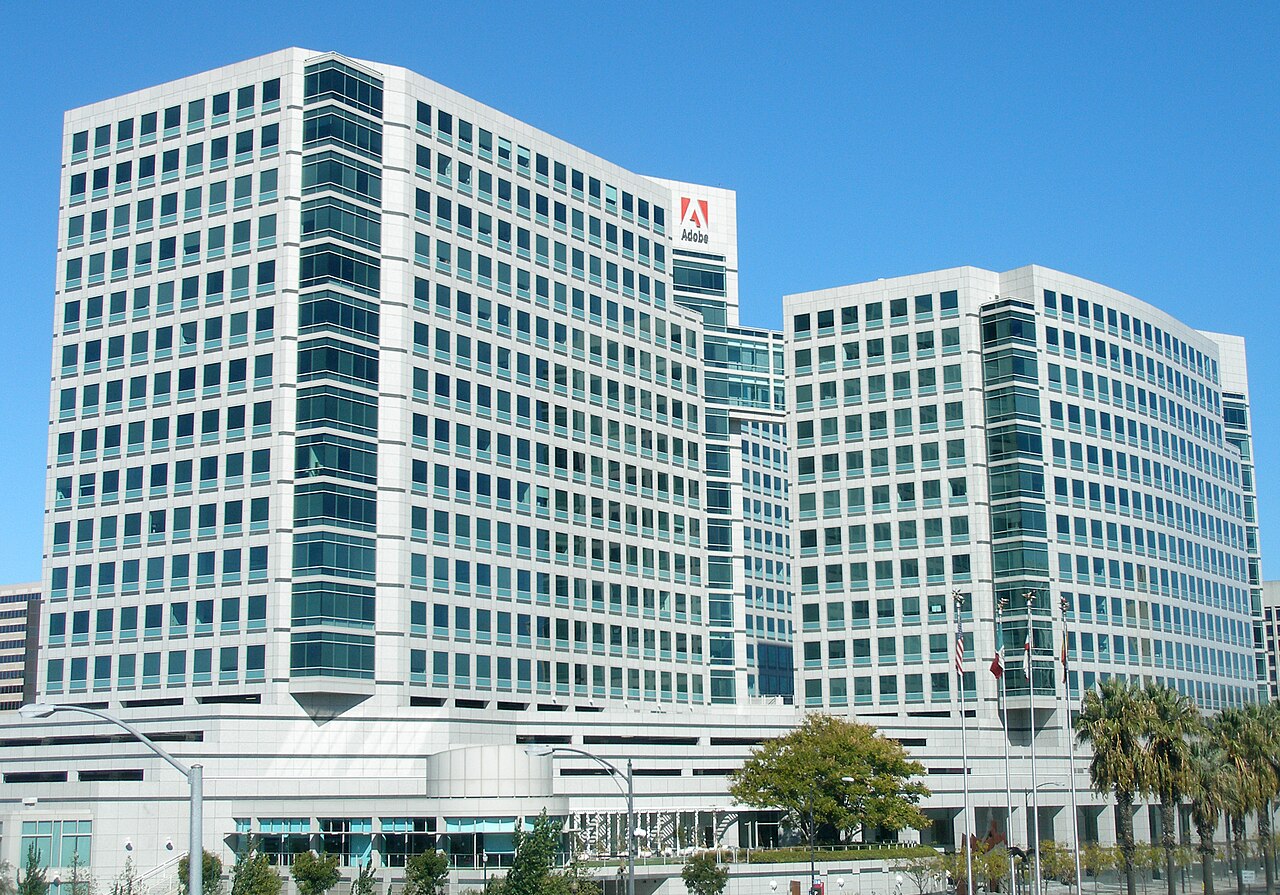
From a Page Language to a Product Company
Adobe Systems was founded in December 1982 by John Warnock and Chuck Geschke, two Xerox PARC researchers who left when Xerox declined to commercialize their page-description work. Their first business was licensing PostScript to printer makers, most decisively to Apple’s 1985 LaserWriter, which together with Aldus PageMaker launched desktop publishing.
Selling a language to hardware vendors was a good business, but a narrow one. Adobe’s lasting move was to start making applications of its own, software that ordinary professionals would buy directly, year after year.
The first was Adobe Illustrator, shipped in 1987. Built to exploit PostScript’s resolution-independent curves, it let designers draw with vector paths, shapes defined by math rather than pixels, sharp at any size. Illustrator became the standard tool for logos, typography, and technical illustration, and it is still shipping nearly four decades later.
Photoshop: The Verb
Adobe did not invent its most famous product. Photoshop was written by two brothers: Thomas Knoll, a graduate student, and John Knoll, who worked at Industrial Light & Magic. Adobe licensed it in 1988 and shipped Photoshop 1.0 for Macintosh in February 1990; it bought the program outright in 1995 for $34.5 million.
Photoshop defined raster (pixel-based) image editing the way Illustrator defined vector drawing. It became so dominant that its name turned into a verb (“to photoshop” an image) and into a cultural anxiety about whether any photograph could still be trusted. Together, Illustrator and Photoshop covered the two halves of digital graphics, and owning both gave Adobe a position no competitor could flank.
Buying the Rivals
Adobe’s strategy through the 1990s and 2000s was as much acquisition as invention.
- Aldus (1994): Adobe absorbed the maker of PageMaker, its old desktop-publishing partner. The deal also brought After Effects, which became the standard motion-graphics tool. Adobe later replaced PageMaker with its own InDesign (1999), which displaced QuarkXPress as the layout standard.
- Macromedia (2005): In its largest deal yet, Adobe bought rival Macromedia for $3.4 billion, acquiring Dreamweaver, Flash, and ColdFusion. The purchase eliminated Adobe’s main competitor in web and multimedia tools in a single stroke.
By bundling these tools into the Creative Suite (launched 2003), Adobe sold designers a single integrated kit rather than separate programs, and locked them into an ecosystem where everything assumed everything else.
The Subscription Gamble
In 2013, Adobe made the bet that defines it today. It stopped selling the Creative Suite as a boxed, buy-once product and replaced it with Creative Cloud, software available only by monthly or annual subscription. There would be no more perpetual licenses; stop paying, and the tools stop working.
Users revolted. A petition against the change drew tens of thousands of signatures, and critics called it rent-seeking on tools people had bought outright for decades. Adobe held the line, and it worked spectacularly. Subscriptions converted a lumpy, upgrade-driven business into smooth recurring revenue, smoothed piracy out of the numbers, and funded continuous updates. Adobe’s revenue and market value climbed several-fold over the following decade. The subscription pivot is now a standard business-school example, copied across the software industry.
The Figma Bid
By the 2020s, Adobe’s flank was finally exposed, not by a desktop rival but by Figma, a browser-based, collaborative interface-design tool that a generation of product designers adopted instead of Adobe’s own XD. In September 2022, Adobe agreed to buy Figma for about $20 billion, one of the largest software acquisitions ever.
Regulators killed it. The UK’s Competition and Markets Authority and the European Commission both concluded the deal would eliminate competition between the two biggest design-tool makers. On December 18, 2023, Adobe and Figma abandoned the merger, with Adobe paying a $1 billion termination fee. The episode marked a turn: the company that had spent forty years buying its rivals could no longer simply buy the one that threatened it.
⚠️ Dead End: Flash
Adobe’s clearest dead end arrived inside the Macromedia purchase. Flash was, for a decade, how the web did animation, games, and video, installed on nearly every desktop browser. But Flash was proprietary, a notorious sink of security holes, and a battery killer on mobile.
In 2010, Steve Jobs published “Thoughts on Flash,” an open letter refusing to allow it on the iPhone and iPad and arguing that open web standards (HTML5) would replace it. He was right. As the mobile web grew and HTML5 matured, Flash’s reason to exist evaporated. Adobe announced its end in 2017 and discontinued Flash Player on December 31, 2020, with the company itself urging users to uninstall it. A technology that once defined the interactive web became a cautionary tale about betting the open platform on a single vendor’s plugin, and Adobe, having paid billions for it, had to preside over its funeral. The rise and fall of the plugin web is covered in Dead End: Flash and the Plugin Web.
The Kidnapping
Adobe’s history holds one genuinely harrowing chapter. In May 1992, co-founder Chuck Geschke was kidnapped at gunpoint from the company parking lot and held for ransom for four days before the FBI rescued him and arrested the kidnappers. Geschke returned to lead the company and remained co-chairman, with Warnock, until 2017. He died in 2021; Warnock died in 2023.
📚 Sources
- Computerworld: Adobe Creative Suite — The History
- History of Information: Thomas & John Knoll Create Adobe Photoshop
- Wikipedia: Macromedia · Adobe Inc. · Adobe Flash
- Apple: Steve Jobs, “Thoughts on Flash” (2010)
- Adobe: Flash Player End of Life
- TechCrunch: Adobe and Figma end $20B acquisition
- CNBC: Adobe and Figma call off $20 billion merger
- Image: Adobe World Headquarters.jpg by Coolcaesar (CC BY-SA 4.0), via Wikimedia Commons