The Manchester Baby: The First Stored-Program Computer
Abstract
On 21 June 1948, in a laboratory at the University of Manchester, a machine that its builders called the “Baby” ran a program held in electronic memory and produced the right answer. It was the first time any computer executed a stored program, the idea at the heart of every computer since. The Baby was built to prove something narrower: that a modified radar tube could store data reliably. It did, and in doing so it made the stored-program concept real hardware rather than a paper proposal. Freddie Williams and Tom Kilburn ran it for 52 minutes to find the highest factor of a number, then spent the next four years turning the demonstration into working computers.
The Storage Problem
By 1947 the stored-program idea was written down and agreed on. Von Neumann’s EDVAC report had described a machine that kept both data and instructions in the same fast memory. The missing piece was the memory itself. Cambridge’s EDSAC used mercury delay lines, which stored data as sound pulses circulating through tubes of liquid mercury and forced the processor to wait for the data to come around again.
Frederic C. Williams had spent the war at the Telecommunications Research Establishment working on radar. He knew cathode-ray tubes, and he noticed that the charge an electron beam left on a CRT screen could be read back before it faded. A screen full of charge spots could hold bits, and any spot could be reached directly rather than waited for. Working with Tom Kilburn, Williams turned this into the Williams-Kilburn tube, the first random-access digital memory. They filed the first patent in December 1946.
The tube worked, but the claim that it could hold data reliably needed proof under real conditions: continuous reading, writing, and refreshing while a machine computed. So Williams and Kilburn, joined by Geoff Tootill, built the smallest computer that would exercise the memory properly.
The Baby
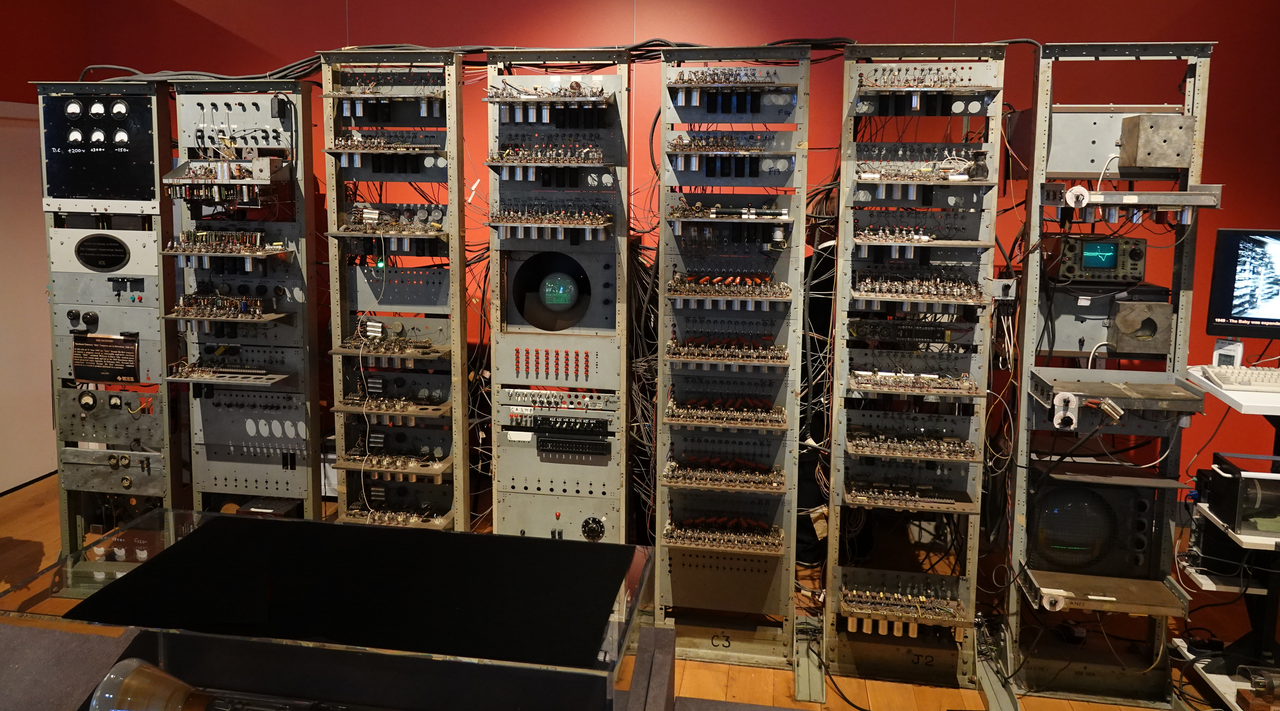
The Small-Scale Experimental Machine, nicknamed the Baby, was deliberately minimal. Its store was a single Williams tube holding 32 words of 32 bits, 1,024 bits in total. It had 550 vacuum tubes, drew 3,500 watts, ran about 700 instructions per second, and stretched 17 feet along one wall of the lab. Its instruction set had seven operations. It could subtract but not add directly, a shortcut that saved hardware.
The first program was written by Kilburn to find the highest proper factor of a number, chosen because it needed no clever mathematics, only long grinding division by repeated subtraction. On 21 June 1948 it ran against 2^18 and, after roughly 3.5 million operations over 52 minutes, returned 131,072, the correct answer.
Williams described the moment in a recollection quoted ever since:
A program was laboriously inserted and the start switch pressed. Immediately the spots on the display tube entered a mad dance. In early trials it was a dance of death leading to no useful result… But one day it stopped, and there, shining brightly in the expected place, was the expected answer.
Turing Arrives
Word of a working stored-program machine reached the people who had been theorizing about them. Alan Turing (see Alan Turing and the Enigma) submitted the Baby’s third program, a long-division routine, in mid-July 1948, and in September he was appointed Deputy Director of the Computing Machine Laboratory. He was recruited by Max Newman, his old Cambridge mentor, who had run the Colossus section at Bletchley Park, held the Fielden Chair of Pure Mathematics at Manchester, and had obtained the Royal Society grant that funded the laboratory. Turing had described a universal computing machine on paper in 1936; Manchester now had one he could program.
The Baby itself was never meant to do useful work, and it did not survive as a machine. It grew. By April 1949 it had become the Manchester Mark 1, with a magnetic drum backing store and a proper instruction set. Ferranti, the Manchester electrical-engineering firm founded by Sebastian Ziani de Ferranti in 1882 and chaired at the time by his son Sir Vincent de Ferranti (a third generation ran it into the 1980s), built a commercial version, and the Ferranti Mark 1 shipped in February 1951 as the first commercially available general-purpose computer, ahead of the UNIVAC delivery in the United States. The line ran on to the Atlas of 1962, one of the first machines with virtual memory. The wider story sits in The UK Computing Industry.
⚠️ Dead End: The Williams Tube
The Baby proved the Williams tube, and for a few years it was the fastest memory available and the reason Manchester and several early American machines could run at all. Then it lost.
Williams tubes needed constant refreshing because the charge spots faded within a fraction of a second. They aged badly, drifted out of tune, and had to be adjusted by hand. They were sensitive enough to electrical noise that, in one often-told case, someone opening a door or a nearby elevator could corrupt the store. Jay Forrester’s magnetic-core memory, demonstrated at MIT in the early 1950s, held data without refreshing, did not drift, and did not degrade. Within a few years core memory displaced the Williams tube completely and stayed dominant until semiconductors arrived in the 1970s.
The physical storage was a dead end. What ran on it was not. The Baby’s 52-minute factoring run was the first demonstration that a machine could hold its own instructions in memory and change them as it worked, and every computer built since has been a version of that idea.
📚 Sources
- University of Manchester: History and Heritage
- Manchester Baby — Wikipedia
- Williams tube — Wikipedia
- Manchester Mark 1 — Wikipedia
- Ferranti Mark 1 — Wikipedia
- Ferranti — Wikipedia (the family firm: Sebastian Ziani de Ferranti, Sir Vincent de Ferranti)
- Max Newman — Wikipedia (Manchester chair, Royal Society Computing Machine Laboratory, recruiting Turing)
- Computer Conservation Society: The Manchester Small-Scale Experimental Machine
- Image: Manchester Baby Replica (Alt).webp by Logg Tandy (CC BY 4.0), via Wikimedia Commons