Whirlwind, SAGE, and Core Memory
Abstract
Whirlwind, built at MIT under Jay Forrester, was the first computer designed to run in real time: it answered as events happened, not hours later in a batch printout. Conceived in 1944 as a Navy flight simulator, it became the prototype for SAGE, the continent-spanning air defense system whose AN/FSQ-7 machines remain the largest computers ever built. Along the way, Forrester’s team invented magnetic-core memory, the technology that stored the world’s data for two decades and triggered the largest patent settlement of its time. SAGE cost more than the Manhattan Project and was strategically obsolete before the first center went live. It was also the school where IBM learned to mass-produce memory, where thousands of the first programmers were trained, and where operators first pointed at a screen and had a computer respond.
A Flight Simulator for the Navy
The project began in 1944 with no computer in it at all. The US Navy asked MIT’s Servomechanisms Laboratory for a universal flight trainer, the Airplane Stability and Control Analyzer: a cockpit whose instruments would respond to the pilot like any aircraft whose equations were dialed in. The lab put a 26-year-old engineer named Jay Forrester in charge. The team started down the conventional road of a large analog computer and found it too slow, too inaccurate, and too rigid; every new aircraft meant new hardware.
The turn came in 1945, when team member Perry Crawford saw a demonstration of ENIAC and argued that the simulator should compute digitally: change the aircraft by changing the code. The Navy agreed to fund the digital machine, now called Project Whirlwind. The cockpit quietly disappeared from the plans; the computer had become the point.
Real Time
Every other early computer was a calculator: you delivered a problem, it delivered an answer. Whirlwind had to keep up with the physical world, updating a simulation many times per second, forever. That requirement drove every design decision. Where contemporaries processed one bit at a time (bit-serial), Whirlwind processed all 16 bits of a word in parallel, and at roughly 20,000 operations per second it was among the fastest machines in the world when it began operating in 1951.
Speed made Whirlwind expensive, about a million dollars a year, and by 1949 the Navy’s interest in a simulator this costly was fading. What saved the project was the Soviet atomic bomb, tested in August 1949. Suddenly the United States needed to defend its airspace against nuclear-armed bombers, and the Air Force needed exactly what Whirlwind had been built to do: track fast-moving objects and respond in real time. MIT organized Lincoln Laboratory in 1951 to build air defense around the machine. On 20 April 1951, Whirlwind computed an interception course from live radar data, directing a fighter onto a target aircraft.
Core Memory
Whirlwind’s weak point was its memory. Its electrostatic storage tubes cost around $1,000 apiece, held little, and wore out in weeks; memory alone dominated the maintenance budget. Forrester had been hunting for an alternative since 1949, when an advertisement for a new magnetic material set him experimenting with tiny ferrite rings.
The idea became magnetic-core memory: thread each ring (core) on a grid of wires; a core magnetized one way is a 0, the other way a 1. Forrester’s decisive contribution was the coincident-current trick that made large arrays practical, addressing one core out of thousands by sending half the switching current down one row wire and half down one column wire; only the core at the intersection flips. Graduate student William Papian built and tested the arrays, and in the summer of 1953 core memory replaced Whirlwind’s storage tubes. Speed doubled, maintenance collapsed, and the machine became reliable enough to bet a defense system on. Core memory had no moving parts, needed no power to remember, and scaled; it remained the world’s dominant computer memory until semiconductor RAM displaced it in the 1970s.
The patent bill
Core memory made fortunes for lawyers before it made computers reliable. An Wang of Harvard had filed a patent on magnetic-core storage in 1949; IBM bought it for $500,000 in 1956, and Wang used the money to build Wang Laboratories (see Dead End: Wang Labs). Forrester’s broader coincident-current patent, filed 1951 and granted 1956, IBM fought for years, until it settled with MIT in 1964 for $13 million, the largest patent settlement to that date. Forrester’s personal share was $1.5 million.
From Cape Cod to SAGE
Defending a continent meant more than one radar and one fighter. In 1953 Lincoln Laboratory’s Cape Cod System demonstrated the full concept: a network of radars across southern New England feeding their data over telephone lines to Whirlwind, which fused them into a single picture of the sky. Scaled nationwide, this became SAGE, the Semi-Automatic Ground Environment, approved in 1954 with IBM contracted to build the computers to Lincoln Laboratory’s design.
The production machine, the AN/FSQ-7, was the largest discrete computer system ever built, a record unlikely to fall. Each direction center housed a duplexed pair (one side live, one in standby or maintenance) totaling about 60,000 vacuum tubes, weighing 250 tons, occupying roughly 22,000 square feet of building floor, and drawing up to three megawatts. The first center went operational at McGuire Air Force Base in New Jersey in mid-1958 (sources give 26 June or 1 July); by 1963, when the network was complete, twenty-four AN/FSQ-7 machines stood watch, each in a windowless concrete blockhouse with the computer filling an entire floor.
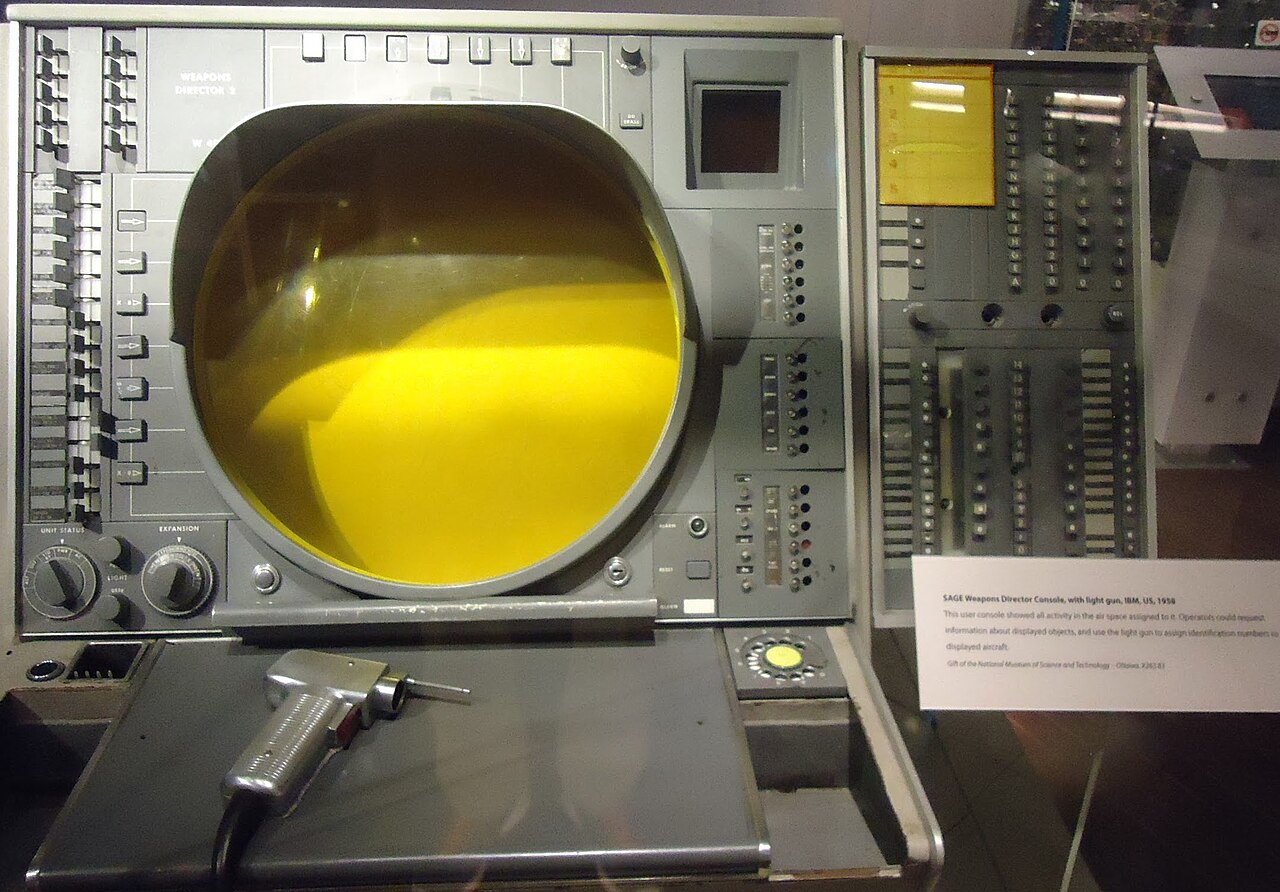
SAGE joined technologies that had never been joined. More than a hundred radar stations streamed digitized data over ordinary telephone lines, work that produced the first mass-produced modems. Operators watched the fused air picture on large vector displays and selected targets with a light gun pointed at the screen, the earliest large-scale interactive graphics (see The History of Displays). The consoles, built for airmen on long shifts, included integrated cigarette lighters and ashtrays.
Software at Scale
Nobody had ever written a program the size of SAGE’s, and the effort created the software industry’s first labor crisis. RAND Corporation took on the programming and spun the work out in 1957 as the System Development Corporation (SDC). The control program grew into the hundreds of thousands of instructions, on the order of a quarter of a million lines, the largest software project of its time, and its cost overruns taught the industry lessons it keeps relearning. Because almost nobody on Earth knew how to program in 1955, SDC hired and trained by the thousands; it became known as “the university for programmers,” and its alumni seeded software shops across the country for a generation. Among those who passed through SAGE programming was Margaret Hamilton, who wrote AN/FSQ-7 software at Lincoln Laboratory before leading the Apollo flight software.
Dead End
SAGE cost somewhere between $8 and $12 billion in 1950s dollars, several times the roughly $2 billion Manhattan Project. As a weapon, it aged out before it was finished. Sputnik flew in October 1957, eight months before the first SAGE center went operational, and the intercontinental ballistic missile it announced flew far too fast for any bomber-interception system to matter. SAGE also assumed its radar picture would survive jamming, an assumption its own tests strained. The system it was built for, mass Soviet bomber raids, never came; the threat had moved on before the concrete cured. The centers stood watch anyway for a quarter century, and the last AN/FSQ-7 ran until 1983.
As an industrial investment, the money bought a different continent-spanning system: the computer industry. IBM’s SAGE contracts brought in around half a billion dollars and, more valuably, taught the company to mass-produce core memory and to manage computer projects of arbitrary scale, capabilities that carried it through the mainframe era (see also IBM: The Company). IBM and American Airlines applied the SAGE recipe of terminals, telephone lines, and a duplexed central computer to airline seats, and the result, SABRE (operational from 1960), became the template for every online transaction system since. Whirlwind veteran Ken Olsen left Lincoln Laboratory to found DEC (see DEC and the Minicomputer Era), and the psychologist J.C.R. Licklider drew on the SAGE-era human-factors world for his vision of interactive computing. The bomber defense failed at its job; its parts became the industry.
📚 Sources
- Whirlwind I — Wikipedia
- Semi-Automatic Ground Environment — Wikipedia
- Magnetic-core memory — Wikipedia
- Computer History Museum: “Magnetic Core Memory” — CHM Revolution exhibit
- The Harvard Crimson: “IBM Paying MIT In Patent Dispute” (April 15, 1964)
- IBM History: SAGE
- Computer History Museum: “How Big Was SAGE?” — CHM Revolution exhibit
- AN/FSQ-7 Combat Direction Central — Wikipedia