William Shockley
Abstract
William Bradford Shockley (1910–1989) led the Bell Labs group that produced the transistor, invented the junction transistor that made the device manufacturable, and shared the 1956 Nobel Prize in Physics for it. He then moved to Mountain View, California and founded the semiconductor company that put silicon in Silicon Valley. Within eighteen months his eight best engineers had walked out and founded Fairchild Semiconductor; his own company never shipped a successful product. From the mid-1960s until his death he devoted himself to arguing that Black Americans were genetically less intelligent than white Americans and that people with low IQs should be paid to be sterilized. The industry he seeded is worth trillions. He died estranged from his children, who learned of his death from the newspapers.
Palo Alto, Caltech, MIT
Shockley was born in London on February 13, 1910, to American parents; his father was a mining engineer, his mother a deputy mineral surveyor in Nevada. The family returned to the United States in 1913 and he was raised in Palo Alto, California, home-schooled until he was eight. He took a B.S. at Caltech in 1932 and a Ph.D. at MIT in 1936 with a thesis on the electronic band structure of sodium chloride. Mervin Kelly recruited him to Bell Telephone Laboratories the same year, into the group led by Clinton Davisson.
From 1942 to 1944 he was research director of the Anti-Submarine Warfare Operations Research Group at Columbia University, working on convoy tactics and depth-charge patterns, then served as expert consultant in the office of the Secretary of War, where he set up a training program for B-29 crews using radar bomb sights. In July 1945 the War Department asked him to estimate the casualties of an invasion of the Japanese mainland. His report concluded that “we shall probably have to kill at least 5 to 10 million Japanese”, at a cost of 1.7 to 4 million American casualties including 400,000 to 800,000 dead. How much weight it carried with the men deciding on the atomic bomb is disputed; the numbers themselves are his.
The Group and the Grudge
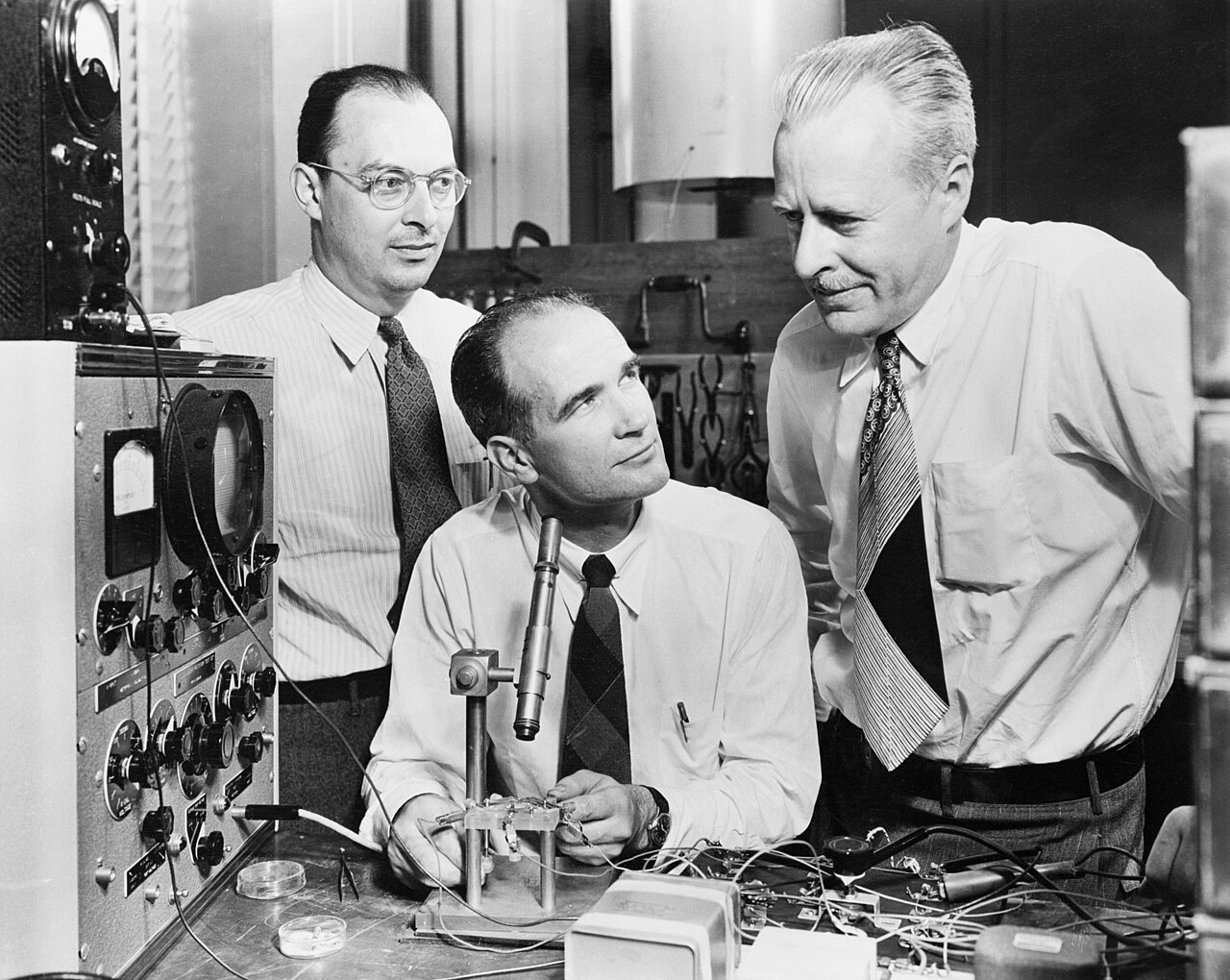
Kelly put Shockley and the chemist Stanley Morgan in charge of a solid-state physics group in 1945, aimed at replacing the vacuum-tube amplifiers that AT&T maintained by the million across its long-distance network. Shockley recruited John Bardeen as theorist and Walter Brattain as experimentalist. His own field-effect proposals failed repeatedly: charge trapped in surface states screened out the applied field, an effect Bardeen explained theoretically in 1947.
On December 16, 1947, Bardeen and Brattain got amplification out of two gold contacts pressed against a germanium crystal. Shockley was not present, and his name did not appear on the point-contact patent. He took it badly. Working alone in a Chicago hotel over the New Year, he worked out the theory of the junction transistor, a sandwich of differently doped semiconductor layers with no fragile metal points, and filed the patent on June 26, 1948. Bell Labs demonstrated a working junction transistor in 1951, and it, rather than the point-contact device, became the thing industry actually built. Shockley’s 1950 textbook Electrons and Holes in Semiconductors taught a generation of engineers how the physics worked. The full technical story is in The Transistor.
He also spent the following years pressing his claim to the invention, excluding colleagues from meetings, and managing by intimidation. Both Bardeen and Brattain transferred away from him. Bardeen left Bell Labs for the University of Illinois in 1951. When the three collected the Nobel Prize in Stockholm in 1956, they were barely on speaking terms.
391 San Antonio Road
Shockley left Bell Labs in 1955, and Arnold Beckman agreed to fund Shockley Semiconductor Laboratory as a division of Beckman Instruments. It opened in early 1956 in a Quonset-style former apricot packing shed at 391 San Antonio Road in Mountain View, California. He picked the area partly because his mother lived in Palo Alto. It was the first silicon device company on the peninsula, and the reason the region is named for the element rather than for the fruit orchards it replaced. See Silicon Valley: How a Place Became a Myth.
He tried to hire his old Bell Labs colleagues. None of them came. So he recruited young physicists and engineers instead, and, being a Nobel laureate with a talent for spotting ability, got an exceptional set: Julius Blank, Victor Grinich, Jean Hoerni, Eugene Kleiner, Jay Last, Gordon Moore, Robert Noyce, and Sheldon Roberts.
Then he managed them. He recorded phone calls. He posted employees’ salaries. When a secretary cut her finger on a drawing pin, he ordered the staff to submit to lie-detector tests to find the culprit; they refused. He kept his own technical work secret from the people he had hired to do it.
The technical break came over the four-layer diode, a switching device that latches on without a continuing control signal. Shockley believed it was the company’s future and directed the program toward it. His engineers thought a startup should first ship something simple and reliable, and that the obvious product was the silicon transistor nobody was yet manufacturing well. He overruled them.
On May 29, 1957, a group led by Moore put an ultimatum to Beckman: replace Shockley with a professional manager, or they would leave. Beckman refused, and later said he regretted it. Arthur Rock and Alfred Coyle of the brokerage Hayden, Stone & Co. had already been shopping the group to investors, and in August they found a backer in Sherman Fairchild, whose Fairchild Camera and Instrument put up a $1.38 million loan. Noyce, who had defended Shockley through the whole dispute, joined the others at the last minute. All eight resigned on September 18, 1957, and Fairchild Semiconductor started that autumn as a Fairchild Camera division. Shockley called the departure a betrayal; who first said “traitorous eight” is not known.
Fairchild produced the planar process, the silicon integrated circuit, and a diaspora of companies (Intel, AMD, and the venture firm Kleiner Perkins among them) that built the modern industry. Shockley Semiconductor never had a commercial success. Beckman sold it to Clevite in 1960; Clevite sold it to ITT in 1968, which closed it. The packing shed went on to house a stereo store and a produce market, and was demolished in 2015. The site is now The Village at San Antonio Center, where an IEEE Milestone plaque reads “Birthplace of Silicon Valley, 1956”. The sequels are covered in Robert Noyce and Fairchild Semiconductor, Gordon Moore and Moore’s Law, The Integrated Circuit Revolution, and Venture Capital and Silicon Valley.
Stanford and the Second Career
Shockley had been teaching at Stanford since 1958, and in 1963 was appointed Alexander M. Poniatoff Professor of Engineering and Applied Science. He held the chair until he became emeritus in 1975, but from about 1965 his working attention went elsewhere.
Shockley began publishing and lecturing on what he called dysgenics: the claim that welfare and differential birth rates were lowering the genetic quality of the American population, and that measured IQ gaps between Black and white Americans were principally hereditary. He had no training in genetics, population biology, or psychometrics. He proposed a voluntary sterilization bonus plan paying $1,000 for each IQ point below 100 to anyone who agreed to be sterilized. He founded the Foundation for Research and Education on Eugenics and Dysgenics in 1970 and took research funding from the Pioneer Fund, an organization created in 1937 to promote eugenics.
He pursued the argument with the same appetite for confrontation he had brought to the transistor priority dispute. He demanded televised debates. He sued Cox Enterprises and the writer Roger Witherspoon over a 1980 Atlanta Constitution article that compared his sterilization proposal to Nazi genetic experiments, asking $1.25 million; on September 14, 1984, the federal jury in Atlanta found for him and awarded one dollar in damages and nothing in punitive damages. He donated to Robert Graham’s Repository for Germinal Choice, the so-called Nobel Prize sperm bank, and was the only donor to say so publicly. In 1982 he ran in the California Republican primary for the U.S. Senate seat of the retiring S. I. Hayakawa, on a platform of voluntary sterilization for anyone with an IQ below 100. He finished eighth.
Stanford colleagues, geneticists, and the National Academy of Sciences rejected the work; the Academy declined his repeated requests that it study the question. Students shouted him down. He kept going, and later said he considered the race and intelligence work the most important of his career, more important than the transistor.
⚠️ Dead End
Shockley Semiconductor is the cleanest example in computing history of a company killed by its founder rather than by its market. Everything a startup could want was present: the world’s leading authority on the technology, a well-capitalized corporate parent, first-mover position in silicon, and a staff that would go on to invent the integrated circuit and found Intel. It shipped nothing that mattered.
Three failures compounded. Shockley bet the company on the four-layer diode, a device that was harder to manufacture than the silicon transistor and had no waiting market; the technology was real, and it did eventually matter as an ancestor of the thyristor, but it was the wrong first product for a company with no revenue. He kept his research secret from his own engineers, which meant the people best placed to catch the error could not see it. And he ran the lab on suspicion, which converted an ordinary technical disagreement into a mass resignation.
The four-layer diode failure was recoverable. The management was not. When his staff asked Beckman to remove him, Shockley had already spent the political capital that a Nobel Prize buys, and the eight left with no offer to stay.
The second dead end was his own. Shockley’s race and intelligence work did not merely fail to persuade; it rested on a category error he was equipped to recognize. His argument moved from population-level statistics to claims about heritability across groups, a step that requires evidence about gene frequencies he never had and never sought. The physicist who had insisted for a decade that Bardeen and Brattain’s device could not be understood without the underlying theory spent his last twenty-five years asserting a mechanism he had not demonstrated. His scientific reputation did not survive it, and neither did his family relationships.
The Estate
Shockley died of prostate cancer in Stanford, California on August 12, 1989, aged 79. His second wife Emmy was with him. His three children from his first marriage, William, Richard and Alison, were not; they had been estranged for years and learned of his death from the newspapers. His papers went to Stanford.
His name is on the transistor patents that made electronics possible, on the founding of the region that dominates the industry, and on a body of pseudoscientific advocacy that his own university spent decades apologizing for. All three are accurate.
📚 Sources
- William Shockley — Wikipedia
- Shockley Semiconductor Laboratory — Wikipedia
- Traitorous eight — Wikipedia
- The Nobel Prize in Physics 1956 — Bardeen, Brattain, Shockley
- Shurkin, Joel N. — Broken Genius: The Rise and Fall of William Shockley, Creator of the Electronic Age (2006)
- Riordan, Michael & Hoddeson, Lillian — Crystal Fire: The Invention of the Transistor and the Birth of the Information Age (1997)
- Computer History Museum — Who Invented the Transistor?
- Computer History Museum — Beckman, Shockley, and the 60th Anniversary of the Birth of Silicon Valley, on the Beckman funding agreement, the apricot packing shed at 391 San Antonio Road, and the building’s later tenants and 2015 demolition
- IEEE Milestone — Birthplace of Silicon Valley, 1956 (ETHW), plaque citation and location
- The Nobel Prize — William B. Shockley, Biographical, his own career chronology: Bell Labs 1936–1955, ASWORG, the Beckman laboratory, the Poniatoff chair
- Serpico, Davide: “The Cyclical Return of the IQ Controversy: Revisiting the Lessons of the Resolution on Genetics, Race and Intelligence” — Journal of the History of Biology 54(2): 199–228 (2021), on Shockley’s pressure on the National Academy of Sciences and the discipline’s response
- National Academy of Sciences — Biographical Memoirs: William Shockley (PDF)
- William Bradford Shockley papers, SC0222 — Archival Collections at Stanford
- William Bradford Shockley papers, 1860–2002 — Online Archive of California finding aid
- UPI Archives — “Shockley gets $1 in damages in libel case” (September 14, 1984)
- Palo Alto Historical Association — William Shockley