Yugoslavia's Computing Industry: CER, Iskra Delta, and the Computer Broadcast on the Radio
Abstract
Yugoslavia stood outside Comecon and outside CoCom’s favour, and its computing shows both. Belgrade’s Vinča institute built the country’s first digital computer, the CER-10, between 1956 and 1960, and the Mihajlo Pupin Institute that grew from it sold small series of bookkeeping and banking machines into the 1980s. Slovenia’s Iskra Delta, which began in 1974 as DEC’s Ljubljana agent and was assembling PDP-11s by 1978, grew to 2,000 employees as the largest computer maker in the country and collapsed in 1988. And when import rules kept foreign home computers out in 1983, the engineer Voja Antonić published the plans for the Galaksija in a magazine, 8,000 readers built one from a kit, and Radio Belgrade broadcast the software as sound for three years. The article is short because the industry was; its dead end is the state that dissolved under it.
CER
The first Yugoslav digital computer was built for the nuclear institute. Tihomir Aleksić and his colleagues at the Vinča institute outside Belgrade developed the CER-10 between 1956 and 1960, a hybrid of valves, transistors and electronic relays with magnetic-core memory, paper-tape input and a teleprinter; it stayed in use until 1966. Aleksić and Nedeljko Parezanović followed it with the CER-20 and CER-30 programmable calculators of 1963 to 1966, used at the institute, at the Elektronska Industrija works in Niš and at RIZ in Zagreb, and the group became the computing arm of the Mihajlo Pupin Institute in Belgrade. Its products were small machines for the domestic market: the CER-200 series of 1966, eighteen “electronic bookkeeping computers” on transistors and medium-scale integrated circuits for banks and enterprises, some in service until 1989, and the CER-22 of 1967, designed by Dušan Hristović, a series of three banking and data-processing machines with punched cards, tape and a line printer, retired in 1975. Nothing in the line was built in hundreds, and nothing was exported; it was an institute making computers for a country that, unusually for a socialist state, could buy Western machines.
Iskra Delta
Yugoslavia’s industrial computer maker came from the DEC dealership. Iskra Delta began in 1974 as Elektrotehna, the Ljubljana representative of Digital Equipment Corporation, and in 1978 started assembling PDP-11 minicomputers in Ljubljana, a route open to Yugoslavia because it stood outside the Warsaw Pact and Comecon (compare Comecon Computing, where the same machines had to be cloned). It merged with the computer divisions of the Iskra electronics combine and the Gorenje appliance maker, reached 2,000 employees, ran a joint venture with Energoinvest in Sarajevo and a terminal plant at Paka near Slovenj Gradec, and sold the PDP-11-compatible Delta 800 and the Partner business computer across the federation. It was one of the largest computer producers in the country, and the only one with a Western partner and a Western product line.
It lasted fourteen years. Iskra Delta was late to microcomputers, and when import rules loosened in the late 1980s its customers bought the originals; the company collapsed in 1988, bankruptcy proceedings opened on 5 February 1990, and, in a detail that says something about what followed, they were not completed until February 2021, thirty-one years later, in a country that no longer existed when they began.
Galaksija
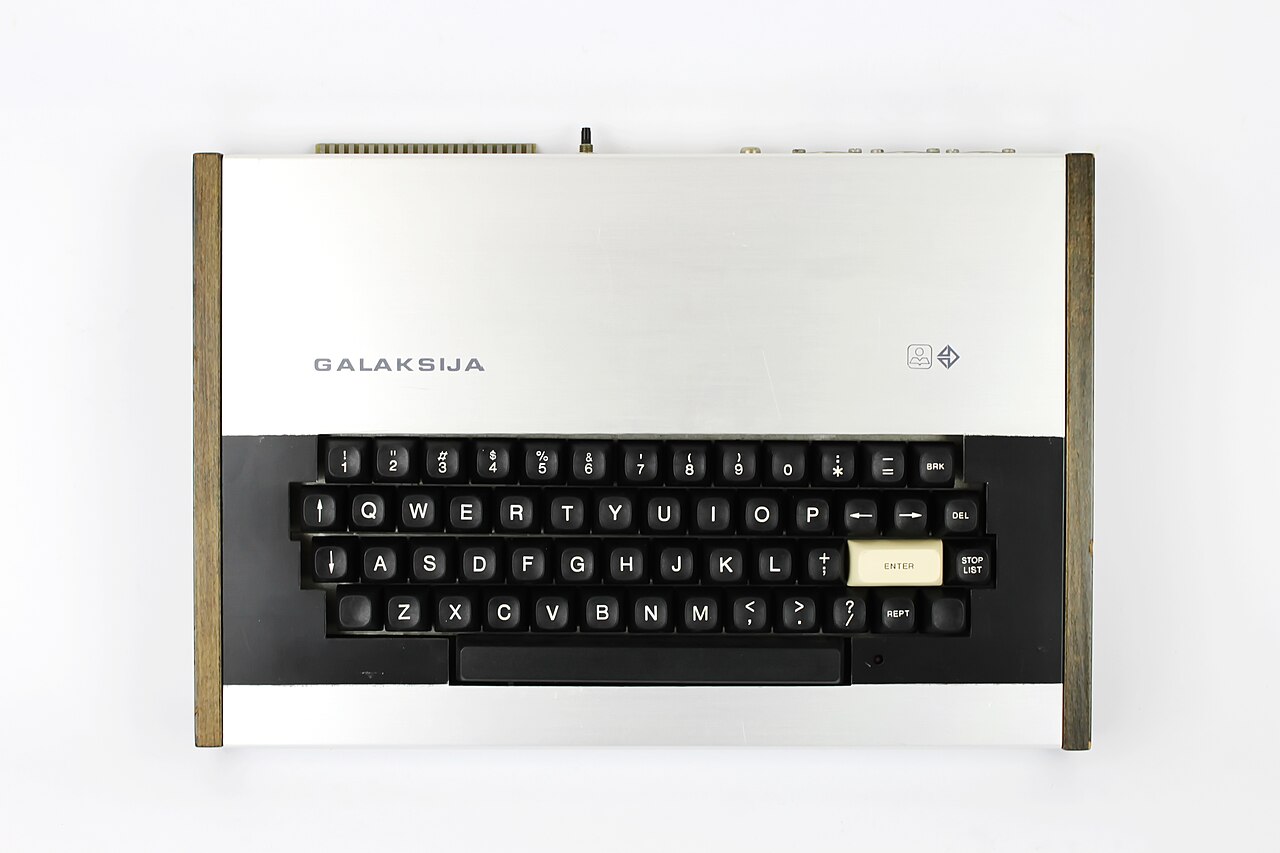
The best-known Yugoslav computer was never sold as a product. In the early 1980s import restrictions kept Western home computers out of the country, and Voja Antonić, a Belgrade engineer, designed a machine that could be built at home: the Galaksija, a Z80A at 3.072 MHz with 2 to 6 KB of RAM. He gave the design away. With the journalist Dejan Ristanović he published the full plans in a special issue of the magazine Računari u vašoj kući in late December 1983, in a print run of about 30,000; the editors expected perhaps a thousand readers to build one, and about 8,000 ordered the kits from Antonić. From autumn 1983 the Radio Belgrade show Ventilator 202, presented by Zoran Modli, broadcast Galaksija programs as audio for listeners to record on cassette, about 150 pieces of software over three years. It was a home-computer industry run as a public service, and the closest thing Yugoslavia had to a mass computing culture.
Dead End: An Industry Without a Country
The Yugoslav case is the only one in this section where the state, not the industry, failed first. The Pupin institute’s machines were competent and few; Iskra Delta had the rare advantage of a DEC partnership and lost it to its own slowness and the opening of imports; the Galaksija was a triumph of improvisation against a trade rule. None of them had reached the scale at which a computer industry sustains itself when the federation began to break up in 1991, and the wars that followed removed the domestic market, the Sarajevo joint venture and the institutions that had funded the work. What survived was in the people: the generation that built a Galaksija from a magazine was the one that staffed the software companies of the successor states. The machine in the Belgrade museum is the memorial of a computing culture that outlived its state by producing nothing that needed one.
📚 Sources
- CER Computers — Wikipedia
- Iskra Delta — Wikipedia
- Galaksija (computer) — Wikipedia
- Image: Desktop computer GALAKSIJA, 1983.jpg by Museum of Science and Technology Belgrade (CC BY-SA 3.0), via Wikimedia Commons