Comecon Computing: ES EVM and the Bloc That Copied IBM
Abstract
On 23 December 1968 the Comecon states signed a treaty to build one family of compatible computers, and in the second half of that year Moscow had already decided what the family would be: a reverse-engineered IBM System/360. Every satellite except East Germany objected, and every satellite except Romania signed. The result, the ES EVM or Ryad, was the largest coordinated computing programme ever run outside the West: more than 15,000 mainframes from seven countries between 1971 and 1995, a parallel minicomputer line copying DEC from 1975, and a division of labour that made Bulgaria the bloc’s disk-drive and personal-computer supplier and Hungary its terminal maker. This article is the hub for the bloc’s national stories, and its argument is the one the objectors made in 1968: standardising on someone else’s architecture bought compatibility at the price of ever catching up.
The Decision
By the mid-1960s the Soviet Union had a computing tradition of its own, from Lebedev’s MESM of 1950 to the BESM-6 that went into production in 1968, and the satellites had scattered efforts: Poland’s Odra line, Hungary’s PDP-8 clone at KFKI, the GDR’s R 300 (see Soviet and Russian Computing, Poland’s Computing Industry and Computing in East Germany). What none of them had was software, or a machine that could run anyone else’s. In 1966 Soviet economists proposed a unified series of mutually compatible computers; on 22 February 1967 the Ministry of Radio Industry ordered a preliminary design for the project, codenamed Ryad (“row” or “series”), and a new Scientific Research Centre for Electronic Computing Technology, NITsEVT, was set up in Moscow to run it. In January 1968 Kosygin, chairman of the Council of Ministers, invited Bulgaria, Czechoslovakia, the GDR, Hungary, Poland and Romania to join. All but Romania accepted.
The choice of what to build came in the second half of 1968. The Soviet leadership of the project decided to use the IBM System/360 as the “prototype”, which meant reverse-engineering the most successful computer on the world market rather than developing the BESM and Elbrus lines. Every satellite except the GDR opposed it, on the argument that a copying programme would kill their national designs and their research; the GDR, which had obtained IBM 360/30 and /40 machines through West Germany and had already begun taking them apart, supported it. Leading Soviet computer scientists said the same as the satellites, and were overruled. The intergovernmental treaty followed on 23 December 1968, and an Intergovernmental Commission on Computing Machinery was created to run the programme through a Council of Chief Designers on which each country had a seat.
The Division of Labour
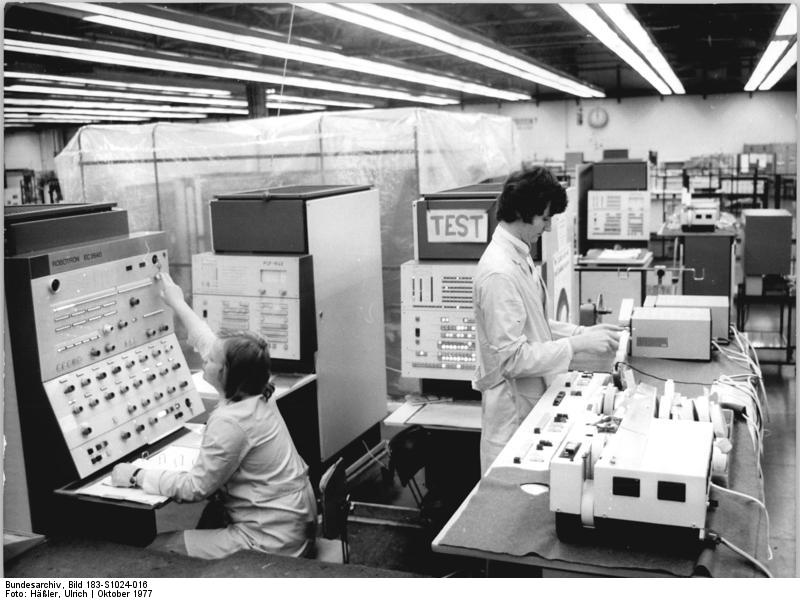
The first Ryad generation appeared in 1971 and each model had a home. Hungary’s Videoton in Székesfehérvár built the smallest, the ES-1010; the Soviet plant in Minsk built the ES-1020 and Bulgaria built it too; Czechoslovakia built the ES-1021; Kazan built the ES-1030 and Poland was assigned the same R-30 class; the GDR’s Robotron built the EC 1040; Moscow and Penza built the top model, the ES-1050. Cuba made peripherals. The machines ran OS ES, a modified OS/360, and the point of the exercise was that a program written for one would run on the others and that IBM’s software, obtained by purchase where possible and otherwise, would run on all of them.
The second generation from 1977, headed by the ES-1060, and the third from 1984 (ES-1046 in 1984, ES-1066 in 1986) followed IBM’s System/370 as the first had followed the /360; the last models, the ES-1130 of 1994 and the ES-1220 of 1995, came after the state that had ordered them had ceased to exist. Over the whole run more than 15,000 ES EVM mainframes were built. In 1974 the same commission launched a second programme, SM EVM, for minicomputers: the SM-1 and SM-2 copied Hewlett-Packard’s 2100 series, the SM-3, SM-4, SM-1420 and SM-1600 copied DEC’s PDP-11, and the SM-1700 series copied the VAX, with operating systems that were translations of RT-11 and RSX-11 and a Unix clone for the top models. Production ran from 1975 through the 1980s in Bulgaria, Czechoslovakia, Cuba, the GDR, Hungary, Poland and Romania; Robotron’s K 1600 and its VAX re-implementation, the K 1840 of 1985, were the GDR’s contributions to the DEC side of the ledger.
The programme was slower than its plan. By 1972 the Comecon countries had produced about 7,500 computers of all kinds against 120,000 in the rest of the world, and a CIA assessment in 1975 put the bloc at 10 to 15 percent of the number of ES machines it had expected to have by then. The Ryad machines were nonetheless the computers that Soviet ministries, banks, railways and research institutes ran on into the 1990s, and in the former GDR the ESER systems stayed in service until 1995.
Hungary and the Mitra Licence
Hungary’s part of the programme shows how much room a small country could find inside it. The country had fewer than fifty computers in 1965; its physics institute KFKI cloned the PDP-8 as the TPA 1001 between 1966 and 1968, joined the DEC user group in 1969 and sold about 600 TPAs across Comecon. The technology committee OMFB wanted a Western licence and, from early 1968, negotiated with France’s CII, then being built up under the Plan Calcul (see France’s Tech Industry). Hungary offered Ryad a small machine below the smallest System/360, got the offer accepted, and only then closed the CII deal, for the 10010 and its successor, the Mitra 15, which was not IBM-compatible at all. Forty percent of the licence fee was paid in engineering services, so Hungarian programmers helped install the Mitra 15 at the 1971 SICOB show in Paris. The licence was transferred in December 1970 to Videoton, the country’s television maker, which had never built a computer, founded a computer factory in 1971, hired whole graduating classes from the Budapest technical university, and showed the ES-1010, known at home as the R10, at the Budapest fair in 1972. Almost 500 were sold in Comecon. Videoton’s VT 340 graphics terminal sold across Eastern Europe, and by the end of the 1970s the company was the second-largest computer maker among the satellites after Robotron, marketing its products on their Western origins and pricing them above the usual Comecon level. Its liquidation began in 1991 when the Eastern orders vanished; the reorganised firm is today a contract electronics manufacturer, third-largest in the EU by the 2021 ranking, with about 9,000 employees.
Bulgaria, Disks and Apples
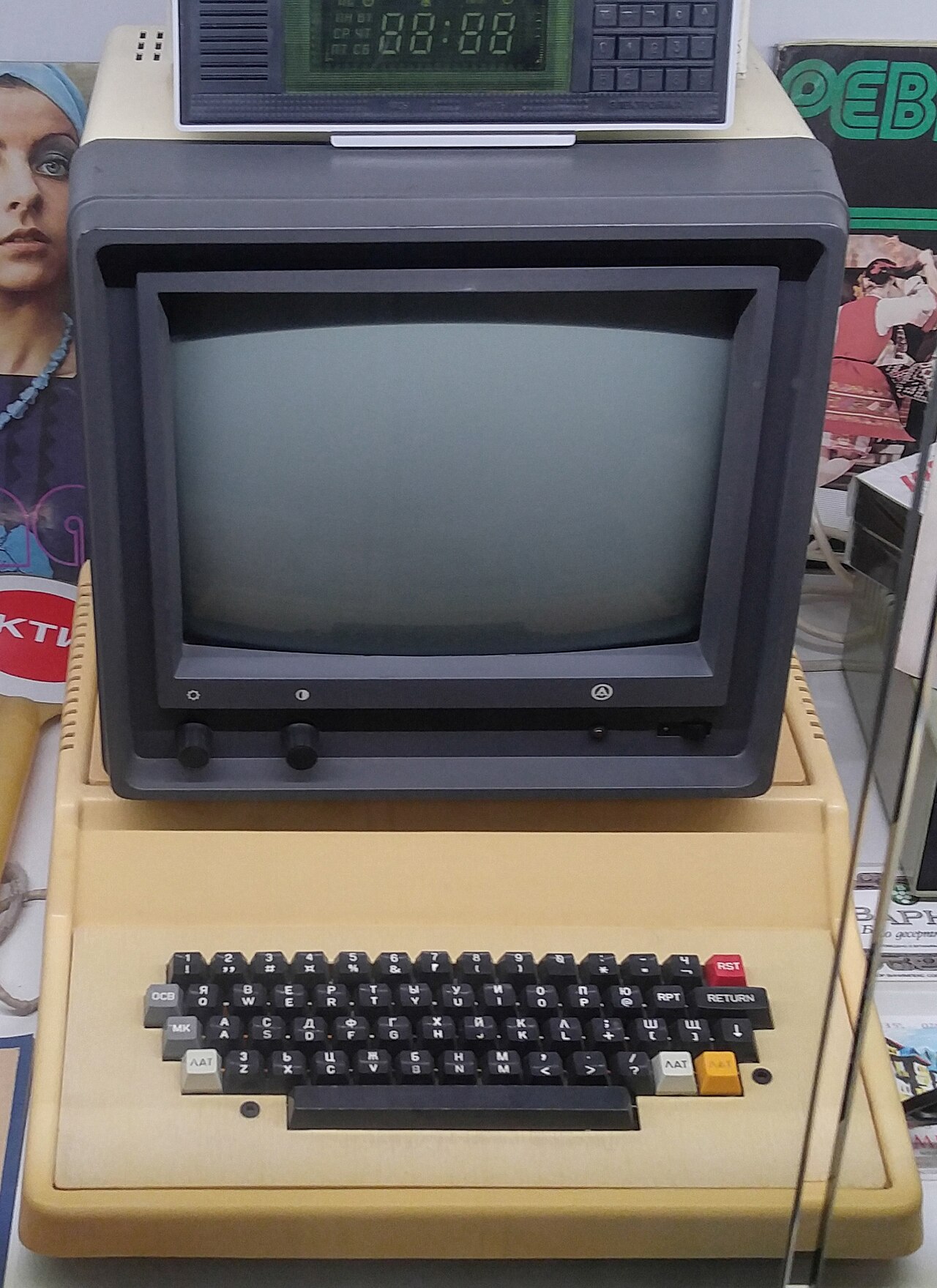
Bulgaria had built one computer of its own, the valve machine Vitosha at the Institute of Mathematics in 1963, when the Comecon division of labour assigned it electronics as a national specialisation. The government’s first five-year plan centred on computing came in 1967, the country joined ES EVM in 1969 and built ES-1020-class mainframes, and it took on the part of the programme nobody else wanted: magnetic storage. Two plants equipped largely with Western machinery went up, at Stara Zagora for disk drives, producing from October 1972, and at Pazardzhik for disk packs from early 1973, and for the next two decades the bloc’s mainframes spun Bulgarian disks. After Todor Zhivkov visited Japan in 1978 and came back impressed by its microelectronics, the emphasis shifted to small machines. Ivan Marangozov’s IMKO-1 prototype of 1979 at the Academy of Sciences became the IMKO-2, an Apple II Plus clone, and in 1982 the Pravetz 82, a 6502 machine with 48 KB of RAM, went into mass production in the town of Pravetz, Zhivkov’s birthplace, sixty kilometres from Sofia. The 8-bit line (82, 8M, 8A, 8C, 8D) was followed by the Pravetz 16, an IBM PC clone on the Intel 8088, and 386 and 486 models. The machines were sold only to institutions, schools, ministries and the army, never to individuals. Output went from a few hundred personal computers in 1980 to about 60,000 a year in 1986 to 1989.
By the end of the decade Bulgaria’s electronics industry employed 300,000 people and supplied, by the usual estimate, 40 percent of the computers traded within Comecon, with over four-fifths of its exports going to the bloc and roughly 60 to 65 percent to the Soviet Union alone. That dependence was the industry’s death. Zhivkov fell in November 1989, Comecon trade collapsed in 1990 and 1991, the Pravetz plant stopped production at the end of 1990, and a national output of 60,000 computers a year fell to nearly zero by 1991.
Dead End: Compatibility Without a Future
The objection of 1968 turned out to be correct in a way its authors did not fully anticipate. The Ryad programme did deliver what it promised: a common architecture, a shared software base, a bloc-wide market, and in Hungary and Bulgaria the first sustained state backing that computing had ever had. What it could not deliver was a second act. Each ES generation reproduced an IBM generation that was already several years old when the copy was certified, so the best engineers of seven countries spent two decades reaching a target that moved every time they arrived. The Soviet Union’s own designers, who had been competitive in the 1950s, were reassigned to reproduction, and the institutional capacity to design a new architecture withered (see the Dead End in Soviet and Russian Computing). The satellites’ independent lines, Poland’s Odra and Karpiński’s K-202, Hungary’s EMG 830, Czechoslovakia’s own designs, were run down or killed in favour of the assigned model. The CoCom embargo did the rest: by forbidding the sale of the originals, it ensured that the copies had a captive market and no competition, which hid how far behind they were until 1989 removed the wall and the market at once. Two roads not taken are in the vault as their own articles: OGAS, the national network that the same planners declined to fund, and Setun, the ternary machine from the decade when Soviet design still went its own way.
The bloc’s last computers were made in 1995, four years after the bloc. What survived was the people: the Hungarian software houses that had learned to sell to the West through the SZKI, the Bulgarian engineers who went into the country’s later software industry, and the Robotron alumni of Dresden, whose city became the centre of Germany’s semiconductor industry (see Estonia and Eastern Europe’s Tech Industry).
📚 Sources
- ES EVM — Wikipedia
- ЕС ЭВМ — Russian Wikipedia (22 February 1967 ministry order, NITsEVT, model-to-plant allocation, generations to 1995)
- ESER — Wikipedia (23 December 1968 treaty, Robotron and Videoton models, service until 1995)
- SM EVM — Wikipedia
- History of computer hardware in Eastern Bloc countries — Wikipedia
- Szabó, Máté: “From The West To The East And Back Again: Hungary And The Ryad” — SoRuCom 2020
- Videoton (company) — Wikipedia
- Pravetz computers — Wikipedia
- History of computer hardware in Bulgaria — Wikipedia
- “The Rise and Fall of Bulgaria’s Electronics Industry 70s to 90s” — GuideBG
- “Production of Computer Disc Drives in the USSR and Eastern Europe” — CIA, declassified (Stara Zagora from October 1972, Pazardzhik from early 1973)
- Image: Bundesarchiv Bild 183-S1024-016, VEB Robotron Elektronik Dresden, Computer EC 1040.jpg by Ulrich Haessler (CC BY-SA 3.0 de), via Wikimedia Commons
- Image: Pravetz-8-82.jpg by Scroch (CC BY-SA 4.0), via Wikimedia Commons