Camillo and Adriano Olivetti
Abstract
Camillo Olivetti founded Italy’s first typewriter factory in Ivrea in 1908. His son Adriano turned it into two things at once: Europe’s most admired industrial-design company and a laboratory for the idea that a factory owes its workers housing, libraries, and dignity. Under Adriano, Olivetti built the Elea 9003 (1959), one of the world’s first fully transistorized commercial computers, with a team led by the Chinese-Italian engineer Mario Tchou. Then Adriano died in 1960, Tchou died in 1961, and in 1964 the company sold its electronics division to General Electric, the great what-if of European computing. A handful of engineers hidden from the sale answered with the Programma 101 (1965), the machine many call the first desktop computer.
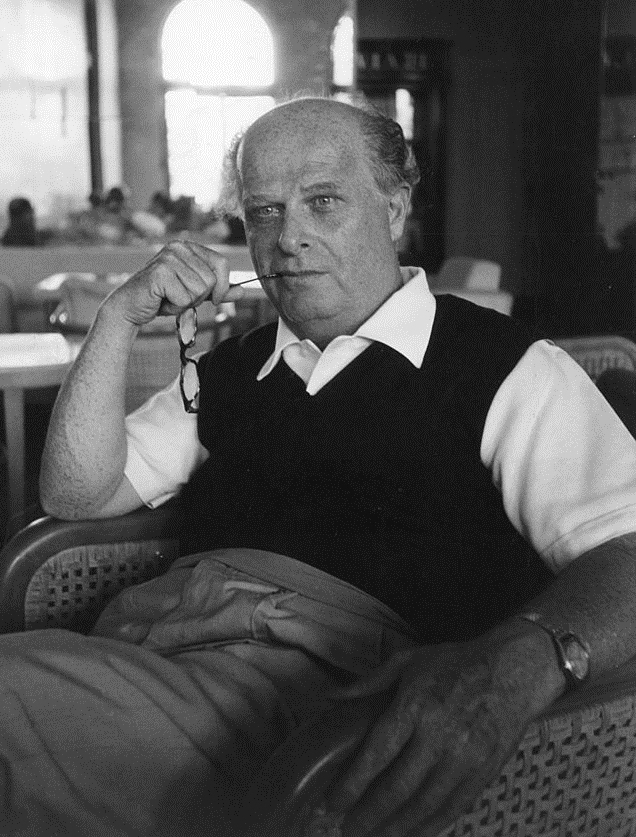
The Engineer from Ivrea
Camillo Olivetti was born in 1868 in Ivrea, a small town in Piedmont, into a Jewish merchant family. He studied electrical engineering in Turin under the physicist Galileo Ferraris, accompanied Ferraris to the 1893 International Electrical Congress in Chicago, and stayed on in the United States, working for several months as an assistant in electrical engineering at Stanford. What he brought back was less any particular technology than an American conviction: precision manufacturing at scale was a craft Italy could learn.
In 1908 he founded Ing. C. Olivetti & C. in Ivrea, the first Italian typewriter factory, and presented its first machine, the M1, at the Turin World’s Fair of 1911. Camillo wrote its advertising himself and ran the firm as a paternalist in the old style: he knew his workers by name, trained them in his own factory school, and held that an industrialist who enriched himself while his town stayed poor had failed at his job. He died in December 1943, months after the German occupation of northern Italy made life for a Jewish industrialist acutely dangerous.
Adriano and the Factory as Community
Adriano Olivetti, born in 1901, took a degree in chemical engineering at the Turin Polytechnic in 1924 and joined the firm in 1926, bringing a temperament his father distrusted (too many ideas, too little patience for machines). A study trip through American factories in 1925 convinced him that Taylorist production methods could multiply output; unusually, he concluded that the gains should be spent on the workers. He became director general in 1932 and president in 1938. His anti-fascist record was concrete: in 1926 he helped the socialist leader Filippo Turati escape Italy by car, and during the war he fled to Switzerland after involvement in contacts seeking a separate peace.
Postwar Ivrea became the built expression of his politics. The glass-walled factory buildings along Via Jervis came with subsidized worker housing, a company kindergarten and health service, a factory library of tens of thousands of volumes, wages above the national contracts, and a shorter working day. Adriano founded a publishing house and a political-cultural movement, Comunità, served as mayor of Ivrea, and entered parliament in 1958. Colleagues in Italian industry considered him a dreamer; the dream was audited annually and turned a profit. UNESCO listed Ivrea as a World Heritage Site in 2018, as “industrial city of the 20th century.”
The same aesthetic seriousness went into the products. The Lettera 22 portable typewriter (1950, designed by Marcello Nizzoli) entered the Museum of Modern Art’s collection; the Divisumma mechanical calculators funded the company’s adventures; Olivetti showrooms from New York to Venice were commissioned from the era’s leading architects.
Elea: An Italian Mainframe
In 1952 Olivetti opened a research office in New Haven, Connecticut, and in 1955 an electronics laboratory in Barbaricina near Pisa, working alongside the University of Pisa’s own computer project, the CEP (see AICA: Italy’s Computing Society). To lead the effort Adriano recruited Mario Tchou, a 31-year-old engineer born in Rome to Chinese diplomat parents, then teaching at Columbia University, in 1955.
Tchou’s team designed the Elea 9003, presented in 1959: a mainframe built entirely with transistors rather than vacuum tubes, among the first such commercial machines anywhere. Its console and cabinets were designed by Ettore Sottsass, who won the Compasso d’Oro industrial design prize for it in 1959. Roughly forty Elea 9003 systems were built and installed, mostly at Italian banks and industrial firms. Italy, a country with no prior computer industry, briefly had a machine competitive with IBM’s newest, wrapped in better furniture.
Two Deaths and a Sale
The whole construction rested on two men, and both died within twenty months. Adriano Olivetti died suddenly on a train to Lausanne on February 27, 1960, at 58 (a heart attack by most accounts; no autopsy was performed). Mario Tchou died in a car crash on the Milan–Turin road on November 9, 1961, at 37.
The company they left behind was financially overstretched, in part from Adriano’s last big bet: the 1959 takeover of the Underwood typewriter company in the United States, whose plants turned out to be far more decrepit than due diligence had shown. By 1964 Olivetti needed rescue, and an “intervention group” of FIAT, Pirelli, and Italy’s major financial institutions recapitalized it. The new masters wanted no part of computers. FIAT’s chairman Vittorio Valletta reportedly told the 1964 shareholders’ meeting that the electronics division was a “mole” to be excised. That year Olivetti sold 75 percent of the division to General Electric; GE took full control soon after.
⚠️ Dead End: The What-If of 1964
The GE sale is the standard exhibit in every discussion of why Europe lost the computer industry. The judgment error is easier to see than it was to avoid: in 1964 the division was losing money, mainframes devoured capital on a scale Italian finance had never funded (IBM was then betting $5 billion, twice its annual revenue, on the System/360), and the men whose conviction might have carried the argument were dead. The buyers of Olivetti’s rescue saw a prestige project bleeding a typewriter company; they cut it out. What was actually sold was the only credible European challenger at the systems level: Italy never built another mainframe industry, and GE itself abandoned computing six years later, selling the business to Honeywell. The engineers dispersed, many into Honeywell’s Italian operations. The counterfactual (an Olivetti that held on until the minicomputer era it was temperamentally suited for) remains one of the most argued in European computing history.
One team escaped the sale. The engineer Pier Giorgio Perotto and a handful of colleagues were left out of the GE transfer because their project was classified, on paper, as a calculator. The Programma 101, unveiled in New York in October 1965, was a programmable desktop machine with magnetic-card storage, printed output, and a price of $3,200: many historians call it the first desktop computer. Olivetti sold about 44,000 of them, mostly in the United States; NASA bought several and used them in calculations for the Apollo 11 mission, and when Hewlett-Packard’s 9100A was found to infringe the P101’s patents, HP paid Olivetti roughly $900,000 in royalties. The company that had just sold its computer division owned the desk-sized future for a moment, and it, too, was not followed up at scale.
Olivetti had one more computing act: under Carlo De Benedetti it became Europe’s largest PC maker, for a time the world’s third largest (the M24 of 1984 sold worldwide, rebadged as the AT&T PC 6300), before losing the clone wars and exiting computers in the 1990s. The firm survives today as a digital unit of Telecom Italia, still headquartered in Ivrea. The wider national story, from the Pisa CEP to STMicroelectronics and Arduino, is in Italy’s Computing Industry.
📚 Sources
- Camillo Olivetti — Wikipedia
- Adriano Olivetti — Wikipedia
- Olivetti — Wikipedia (company history, Underwood, GE sale, M24)
- Mario Tchou — Wikipedia
- Elea 9003 — Wikipedia
- Programma 101 — Wikipedia (New York 1965, NASA use, HP royalties)
- Ivrea, industrial city of the 20th century (UNESCO World Heritage Site, 2018) — Wikipedia