Pier Giorgio Perotto
Abstract
Pier Giorgio Perotto (1930–2002) was the Olivetti engineer whose project was too small to be sold. When Olivetti gave up its computer division to General Electric in 1964, Perotto’s four-man team in Ivrea stayed behind because the machine they were building was classified, on paper, as a calculator. The Programma 101, shown in New York in October 1965, was a programmable computer that sat on a desk, ran from a wall socket, stored its programs on magnetic cards, and cost $3,200 at a time when a computer cost the price of a house and lived in its own room. Olivetti sold 44,000, NASA used them to plan Apollo 11, and Hewlett-Packard paid $900,000 in royalties when its 9100A copied the design. Perotto spent the rest of his career at Olivetti and the rest of his life arguing, correctly, that he had built the first personal computer.
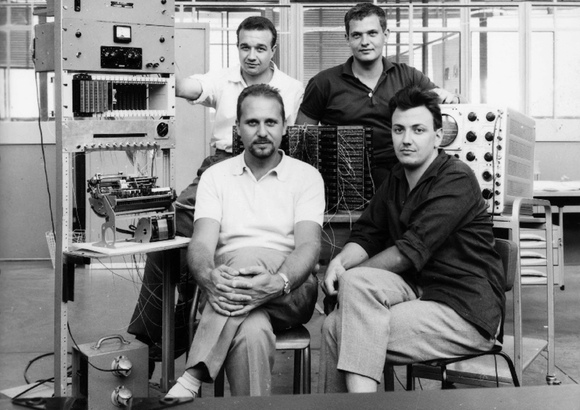
Turin and Ivrea
Perotto was born in Turin on December 24, 1930, and took his engineering degree at the Politecnico di Torino in 1954, then worked at Fiat before joining Olivetti in 1957. The company was Italy’s typewriter and calculator maker, run from Ivrea by Adriano Olivetti as an experiment in industrial humanism, and it had just decided to build computers: the ELEA 9003, delivered in 1959, was among the first transistorised commercial computers in the world (see Camillo and Adriano Olivetti). Perotto worked in the electronics division at Borgolombardo, near Milan, on the ELEA line.
Adriano Olivetti died on a train in February 1960, and the company that had been his lost its nerve. Banks and the Fiat-led group that rescued it in 1964 regarded the computer division as a drain, and sold it to General Electric that year. Perotto had by then moved back to Ivrea with a small team and a project of his own, and because that project was described as a calculator, it was not in the deal.
The Programma 101
The idea was a machine for a person rather than an institution: a computer that an engineer or an accountant could put on a desk, switch on, and program without a staff. Between 1962 and 1964 Perotto, Giovanni De Sandre and Gastone Garziera, joined by Giancarlo Toppi, designed it from discrete transistors and diodes, with a memory of 240 bytes on a magnetostrictive delay line, a wire in which data circulated as acoustic pulses, a keyboard of 36 keys, and a printer that put results on a paper roll. A program of up to 120 instructions was typed in, could branch on conditions, and could be saved to a plastic card with a magnetic stripe and reloaded by pushing the card into a slot, which made the machine reusable by someone who had never written the program. Mario Bellini designed the case, and it looked like nothing else in the building.
The Programma 101 was shown at the BEMA office-equipment show in New York on October 15, 1965, and sold from 1966 at $3,200. About 44,000 were made, nine in ten of them sold in the United States, where the first customers were engineers, surveyors and universities, and where NASA bought about ten and used them for calculations on the Apollo 11 mission. When Hewlett-Packard introduced its 9100A desktop calculator in 1968, Olivetti’s patents on the magnetic-card program storage were found to cover it and HP reportedly paid about $900,000 in royalties, the sum that told the industry which machine had come first. HP’s own account of the 9100A was that it was the first personal computer; Perotto’s was that it had been the second, and the money agreed with him. The Italian story around the machine, and why Olivetti did not build on it at scale, is in Italy’s Computing Industry.
After the P101
Perotto rose to general director of projects and research at Ivrea and led the machines that followed, among them the P6060 (1975), a desktop computer with a built-in floppy-disk drive, a screen and BASIC, which was a personal computer by anyone’s definition and arrived two years before the Apple II. Olivetti under Carlo De Benedetti became Europe’s largest PC maker in the 1980s on the M24, but the personal computer as a category was named and sold from California, and the company’s own history of having built one first stayed in Italian. Perotto received the Leonardo da Vinci Prize in 1991, co-founded the consultancy Finsa in 1997, and wrote books on management and one, in 1995, on the Programma 101, whose subtitle called it the invention of the personal computer. He died in Genoa on January 23, 2002. Asteroid 12222 Perotto is named for him, and Garziera, the last of the team, spent his later years giving the demonstration Perotto had given in New York.
📚 Sources
- Pier Giorgio Perotto — Wikipedia
- Programma 101 — Wikipedia (the 1962–64 design, the team and Bellini, the 240-byte delay-line memory, the $3,200 price, 44,000 sold with 90 percent in the United States, the NASA units, the HP 9100A royalties)
- Perotto, Pier Giorgio — Programma 101: L’invenzione del personal computer. Una storia appassionante mai raccontata, Sperling & Kupfer, Milan, 1995
- “The Calculator That Helped Land Men on the Moon”, IEEE Spectrum
- Olivetti Programma 101: the first personal computer that changed the world — Opportunitaly (the October 15, 1965 BEMA presentation, the HP royalties)
- Olivetti Programma 101 — Museo Nazionale Scienza e Tecnologia Leonardo da Vinci, Milan
- Laboratorio-Museo Tecnologic@mente, Ivrea — Perotto and his group
- Image: P101 team photograph, 1962–64, Laboratorio-Museo Tecnologic@mente, public domain in Italy (photographs older than 20 years), via Wikimedia Commons