Computing in East Germany: Robotron and the Kombinate
Abstract
East Germany built the largest computer industry of the Eastern Bloc outside the Soviet Union: the Kombinat Robotron employed 68,000 people, the country produced its own mainframes, minicomputers, and microchips, and in 1988 it presented a self-developed 1-megabit memory chip to party leader Erich Honecker. Almost all of it was cloned from Western designs that the CoCom embargo forbade the East to buy, re-engineered at enormous cost, years behind the originals. When the embargo and the state disappeared in 1990, the industry disappeared with them, in months. What remained was engineering talent in Dresden, and on that foundation grew the largest microelectronics cluster in Europe.
Pioneers Without a Market
East German computing began where West German computing did: with capable scientists and no industry to absorb them. At Carl Zeiss Jena, Wilhelm Kämmerer and Herbert Kortum built the relay calculator OPREMA in 1955 for the optics works’ lens computations, then developed the ZRA 1, the first serially produced programmable digital computer in the GDR. It was shown at the Leipzig spring fair in 1960, and about 30 machines were built at the Zeiss branch plant in Saalfeld before production ended in 1963 in favor of transistorized successors. Fifteen went to academy and research institutes, ten to universities, the rest into industry.
At the TU Dresden, the mathematician Nikolaus Joachim Lehmann built the D-series machines (D1 and D2 with tubes and relays, D3 and D4 with semiconductors) at his Institut für Maschinelle Rechentechnik. His D4a, patented in 1960, was a transistor computer small enough to be, in his words, a “work device for the desk”, one of the earliest desk-sized universal computers anywhere. Industry officials doubted both its feasibility and its market against established mechanical office equipment. Lehmann also pushed the GDR into IFIP and formal computer science education; TU Dresden’s supercomputing center today carries his name.
Robotron
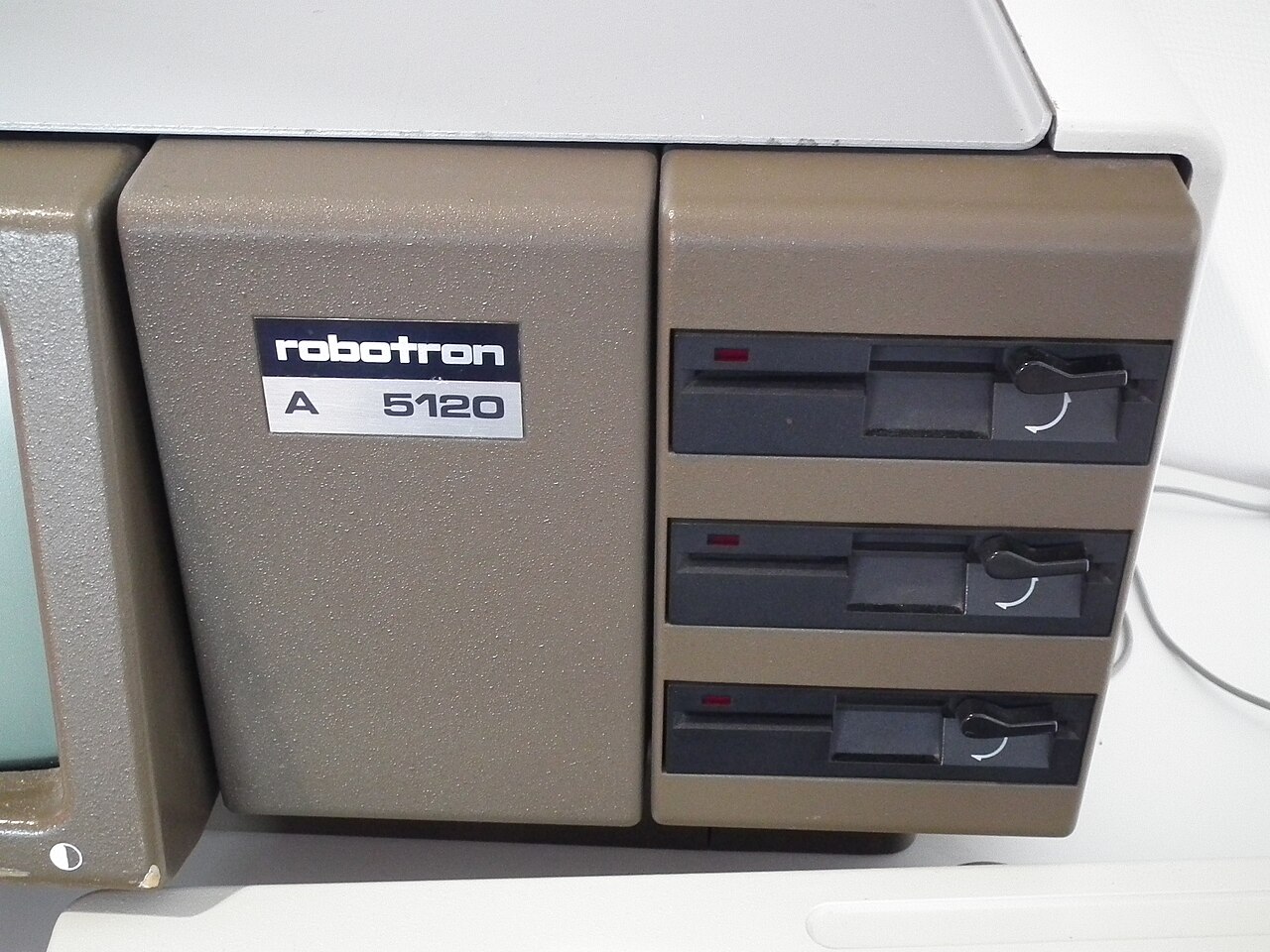
On April 1, 1969, the state consolidated its computer industry into the VEB Kombinat Robotron, headquartered in Dresden. It became the largest industrial Kombinat in the GDR: by 1989, roughly 68,000 employees in 21 plants and an annual revenue of 12.8 billion East German marks. Robotron built the country’s workhorse mainframe (the R 300, from the mid-1960s), the GDR’s contributions to the Soviet-led ESER program of IBM System/360 and /370 clones (see Comecon Computing for the 1968 decision that committed the entire Eastern Bloc to copying IBM), the K 1600 minicomputer line based on DEC’s PDP-11, office computers such as the PC 1715 and A 5120, printers, and the Erika typewriters that earned much of the Kombinat’s hard currency.
The organizational form was the point. A Kombinat bundled research institutes, component suppliers, and final assembly under one general director and one plan target. It could concentrate resources on a state priority; what it could not do was kill a failing product line, price anything at market value, or buy the best available part from abroad.
Cloning Under Embargo
The CoCom embargo barred the export of advanced Western computers and chipmaking equipment to the Eastern Bloc. The GDR’s answer was systematic re-engineering. The standard microprocessor of East German computing, the U880 from Mikroelektronik Erfurt, was an unlicensed copy of the Zilog Z80. The ESER mainframes copied IBM. The K 1600 copied DEC. The high end followed the same pattern: from August 1985, Robotron-Elektronik Dresden developed the K 1840, a 32-bit re-implementation of DEC’s VAX-11/780, precisely because CoCom forbade selling superminis to Comecon countries. It reached series production in 1988, ran at 1.1 MIPS with up to 16 MB of memory, won the National Prize First Class, and 217 systems were delivered by 1990 at 1.9 million marks apiece.
The engineering was genuine; the economics were not. Every clone required the original first, obtained through intermediaries, smuggling networks run by the foreign-currency apparatus, and the Stasi’s scientific-technical intelligence arm, which systematically collected Western documentation and hardware. The copies arrived years after the originals and cost multiples of the world market price, paid in a currency nobody wanted.
The Megabit Chip
The showpiece of the GDR’s last years was microelectronics. After a 1986 party decision, the Zentrum Mikroelektronik Dresden (ZMD) developed a 1-megabit DRAM, the U61000. The first fault-free samples were verified on August 10, 1988, and on September 12, 1988, a chip was ceremonially presented to Erich Honecker, celebrated as proof that socialism could hold pace at the technological frontier. The pilot line produced about 5,000 sample chips in 1988 and some 30,000 in 1989, at yields of at most 20 percent. Volume production was planned for a newly built plant at Mikroelektronik Erfurt; it never started. When the embargo fell in 1990, anyone could buy equivalent chips on the world market, in quantity, for a fraction of the cost. Development was halted in spring 1990.
Info
The megabit program illustrates the embargo’s double edge. CoCom denied the GDR machines and chips, which forced an indigenous capability that a small country could not economically sustain; the same embargo shielded that capability from competition, hiding its true cost until the day the wall fell. The chip worked. The business never existed.
Home Computers That Weren’t at Home
The GDR also built microcomputers for people, in principle. The KC 85 series from VEB Mikroelektronik “Wilhelm Pieck” Mühlhausen (HC 900/KC 85/2 in 1984/85, KC 85/3 in 1986, KC 85/4 in 1988) ran on the U880 at 1.75 MHz. About 45,000 units were built in six years, and although they were nominally home computers, private customers rarely got one: most machines went to schools, organizations, and enterprises. A KC 85/3 cost 1,700 marks, roughly two average monthly wages; the KC 85/4 cost 4,100. Robotron’s own KC 87 and the Z 1013 kit computer served the same starved hobbyist market, and in 1989 the Bildungscomputer A 5105 arrived for the school system, just in time to become obsolete with the state that ordered it. The country’s sole arcade machine, the Poly-Play, appeared in 1985 in FDGB holiday homes and youth clubs.
Scarcity shaped the culture. Western home computers came in through relatives and the intershop economy; a Commodore 64 was a status object, and East German computer clubs debugged and extended the KC machines with a thoroughness born of having nothing else. When the border opened, the first purchases of many East German engineers were the machines they had spent a decade re-implementing.
Dead End: The Reckoning of 1990
Currency union and open markets did to the Kombinate in months what no plan review had done in decades. The Kombinat Robotron was dissolved on July 1, 1990. Its productivity was far below Western competitors; its products, priced honestly for the first time, had no buyers. K 1840 production stopped in mid-1990. Fewer than five percent of Robotron’s 68,000 employees found places in successor companies, among them Robotron Datenbank-Software GmbH in Dresden; pieces of the expertise were absorbed by IBM and SAP. Even the GDR’s country domain vanished without ever having existed: .dd had never been delegated to the internet’s root zone (see The Domain Name System).
The epilogue is in Dresden. The chip expertise assembled for the megabit program did not evaporate: ZMD survived in privatized form, and in the mid-1990s Siemens and then AMD chose Dresden for new semiconductor fabs, drawing on the region’s engineers. Around those plants grew “Silicon Saxony”, today the largest microelectronics cluster in Europe, with Infineon, GlobalFoundries, Bosch, and TSMC, whose first European fab broke ground there in 2024. The GDR’s computer industry died in 1990. The reason there are chip factories in Saxony is, in part, that it existed.