DEC and the Minicomputer Era
Abstract
In 1957 two engineers from MIT’s Lincoln Laboratory rented space in a Civil War-era woolen mill and, on a $70,000 investment, built the company that would invent an entire class of computer. Digital Equipment Corporation’s minicomputers (the PDP-8, the PDP-11, the VAX) broke the mainframe monopoly by putting interactive, affordable computing in laboratories, factories, and university departments. DEC grew into the world’s second-largest computer company, employing over 120,000 people, then missed the personal-computer wave it had helped make inevitable. In 1998 it was bought by Compaq, a PC maker a fraction of its age. DEC is the bridge between the mainframe and the microcomputer, and a textbook case of a giant disrupted from below.
Two Engineers and a Mill
Kenneth Olsen (1926–2011) and Harlan Anderson met at MIT’s Lincoln Laboratory, where Olsen had worked on the TX-0 and TX-2, transistorized research computers that demonstrated something the commercial world had not yet accepted: a computer could be interactive, driven directly by one user at a console rather than fed batch jobs through an operating staff.
In 1957 the two left to start their own firm. The venture-capital pioneer American Research and Development Corporation (ARDC), run by Georges Doriot, invested $70,000 for a 70% stake, a deal that, by DEC’s peak, would be worth hundreds of millions and is often cited as the first great venture-capital success. Wary that investors thought “computers” too risky, they named the company Digital Equipment Corporation and at first sold not computers but laboratory logic modules. They set up in the Assabet Woolen Mill in Maynard, Massachusetts (“the Mill”) which remained DEC’s headquarters until 1992.
The Minicomputer
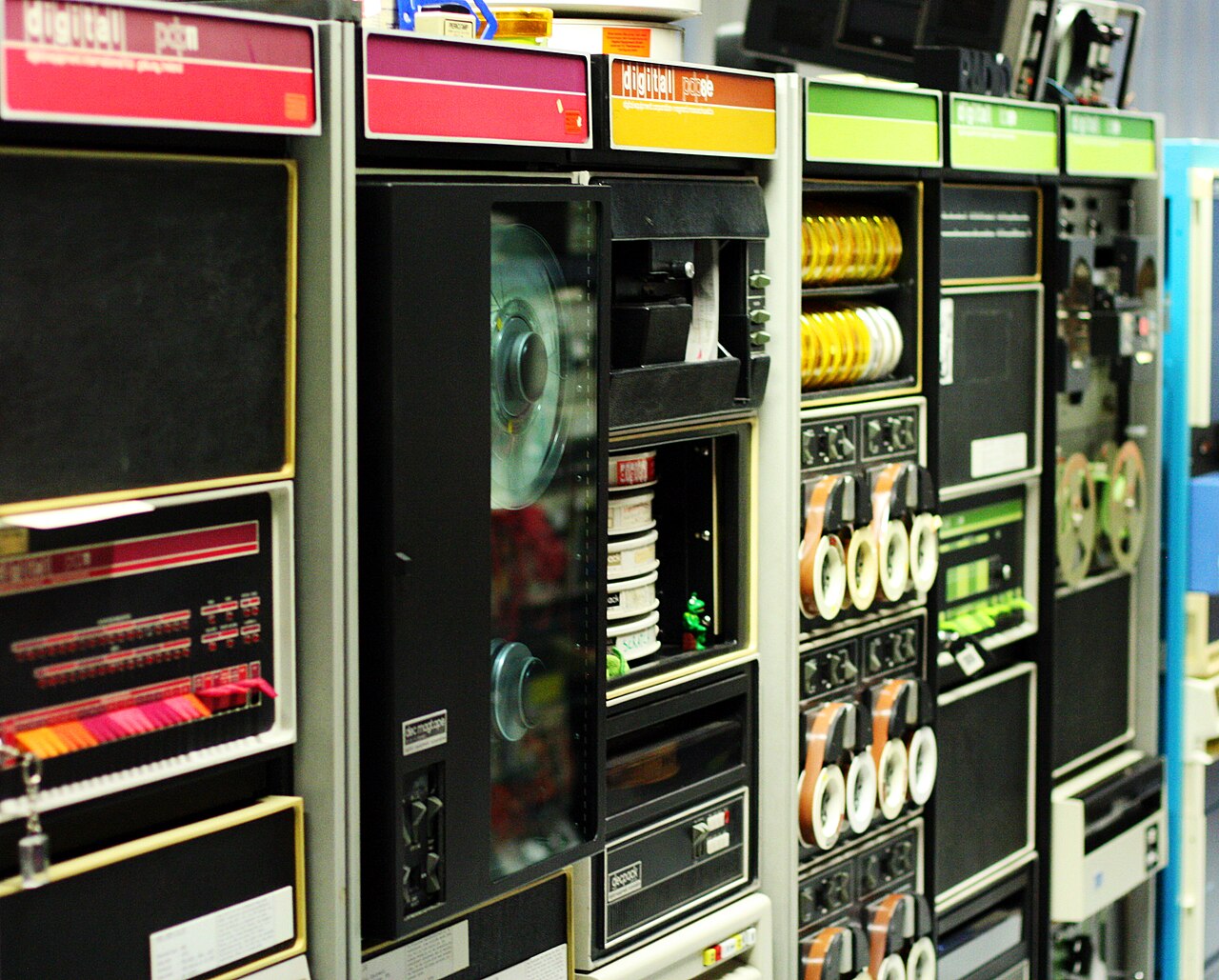
In 1960 DEC shipped the PDP-1 (Programmed Data Processor, the word “computer” was still avoided). It cost about $120,000 against the millions a mainframe commanded, and it came with a screen. At MIT a PDP-1 became the host for Spacewar!, one of the first video games, written by students who could do something impossible on a mainframe: sit at the machine and play.
The breakthrough product was the PDP-8, introduced March 22, 1965, at $18,000, the first computer cheap enough and small enough to be called a minicomputer, and widely regarded as the first commercially successful one. It sat on a benchtop, embedded in lab instruments and industrial machinery, and sold in tens of thousands. Computing no longer required a raised floor and a priesthood; a department could simply buy one.
The PDP-11 and the VAX
The PDP-11, launched in 1970, became one of the best-selling computer architectures in history, roughly 600,000 units across its lifetime. Its clean, orthogonal instruction set and memory-mapped I/O made it a favorite of programmers and a standard teaching machine. It also became the cradle of modern software: Unix and the C language were developed and matured on PDP-11s at Bell Labs, and Unix’s portability was first proven by moving it off DEC hardware.
DEC announced the VAX architecture in October 1977, shipping the VAX-11/780 in 1978. The VAX extended the PDP-11 world to a 32-bit virtual-memory “superminicomputer,” and its operating system, VMS (architected by Dave Cutler), set a standard for reliability and clustering. Through the 1980s the VAX/VMS combination ran much of the world’s engineering, science, and early networking; DEC’s own DECnet and its role in the early Internet made the VAX a backbone machine. By 1988 DEC was the second-largest computer company in the world after IBM, with over 120,000 employees.
The Culture and the Alpha
DEC’s engineering culture was famously decentralized, competing project teams, engineers given wide latitude, a faith that good technology would win on merit. It produced brilliant hardware, including, in 1992, the Alpha (DECchip 21064), one of the first 64-bit RISC microprocessors and for years among the fastest chips on Earth (see RISC vs CISC).
But the same culture struggled to make decisions about products that did not interest its engineers, above all the cheap personal computer.
⚠️ Dead End: Missing the PC
Myth: Ken Olsen said “there is no reason anyone would want a computer in their home” (1977)
He said it, but meant a single computer controlling the whole home (lights, heat, meals), the science-fiction “home of the future,” not the personal computer. The PC-dismissing reading is a later misinterpretation. See Myths and Misconceptions.
DEC had every ingredient to own the personal-computer era and used almost none of them. Founder Ken Olsen is endlessly quoted as saying in 1977, “There is no reason for any individual to have a computer in his home.” The line is real but routinely stripped of context; he was talking about a computer controlling the home, not the personal computer. Yet the quote stuck because it captured something true about DEC: the company that democratized computing for the department could not imagine, or did not want, computing for the individual.
DEC’s 1982 home-computer line (the Rainbow and its siblings) was incompatible, overpriced, and launched against the IBM PC; it failed. More deeply, minicomputers were a business of selling whole proprietary systems (hardware, OS, and software bundled) and that model was exactly what the commodity microprocessor and the IBM-compatible PC destroyed. Olsen retired in 1992 after two years of losses; his successor cut tens of thousands of jobs. In 1998 Compaq bought DEC for $9.6 billion, a PC clone-maker founded in 1982 swallowing the firm that had defined the previous generation. In 2002 Compaq itself was absorbed by Hewlett-Packard.
DEC is the classic disruption story Clayton Christensen built much of The Innovator’s Dilemma around: a company killed not by doing things badly but by doing its existing things well, while a cheaper, “worse” technology grew up underneath it. The minicomputer had disrupted the mainframe the same way thirty years earlier. DEC dissolved, but its DNA scattered everywhere: Alpha engineers seeded AMD and Intel chip teams, VMS’s architect built Windows NT, and the interactive, affordable computer it invented became simply the computer.
📚 Sources
- Computer History Museum: Digital Equipment Corporation (DEC)
- CHM Revolution: Minicomputers — Digital Equipment Corporation
- Britannica Money: Digital Equipment Corporation
- Gordon Bell: Toward a History of (Personal) Workstations / DEC architectures
- Snopes: Did Ken Olsen Say There Was “No Reason” to Have a Home Computer?
- Wikipedia: Digital Equipment Corporation · PDP-8 · PDP-11 · VAX · DEC Alpha
- Image: Three different (coloured) minicomputers from DEC.jpg by Wolfgang Stief (CC BY 2.0), via Wikimedia Commons