David Potter
Abstract
David Potter (1943–2026) was a South African-born physicist teaching at Imperial College who made a small fortune on the stock market in the 1975 crash, part of it in a duvet manufacturer, and used it in 1980 to start a company he named after himself. Psion wrote the games bundled with the Sinclair Spectrum, then in 1984 shipped the Organiser, the first handheld computer sold in volume, and in 1991 the Series 3, the clamshell pocket computer with a real keyboard that a decade of British professionals carried. Its operating system, EPOC, became Symbian in 1998, jointly owned with Nokia, Ericsson and Motorola, and ran the first generation of smartphones; Psion’s own consumer business closed in 2001. Potter chaired the company until 2009, gave much of the proceeds to journalism and education, and died on June 28, 2026, six days short of 83.
Physicist
David Edwin Potter was born in East London, South Africa, on July 4, 1943, and left after a year at the University of Cape Town on a Beit scholarship to Trinity College, Cambridge, where he read natural sciences from 1963. A Commonwealth scholarship took him to Imperial College London for a doctorate in mathematical physics, and he stayed to teach applied physics from 1970, with a year at UCLA as an assistant professor in 1974–75. He married Elaine Goldberg, a South African journalist who later qualified as a doctor, in 1969.
The money came from reading the newspapers. In the 1975 slump he put £3,000 into six British companies whose prices he judged absurd, and they doubled; 40 percent of the stake went into E. Fogarty, a duvet maker, which tripled in eighteen months. By 1980 he had enough to buy a shell company called Red Cheer and rename it Psion, which he said stood for Potter Scientific Instruments Or Nothing.
Sinclair and the Organiser
Psion began as a software house for the machines Clive Sinclair was selling by the hundred thousand: a flight simulator for the ZX81, and Horizons, the tape of tutorials and small programs that Sinclair bundled with the ZX Spectrum in 1982, followed by the Xchange office suite for the Sinclair QL, whose spreadsheet, Abacus, was written by Potter’s half-brother Colly Myers, who also wrote much of the original EPOC32 kernel. The games paid for the hardware.
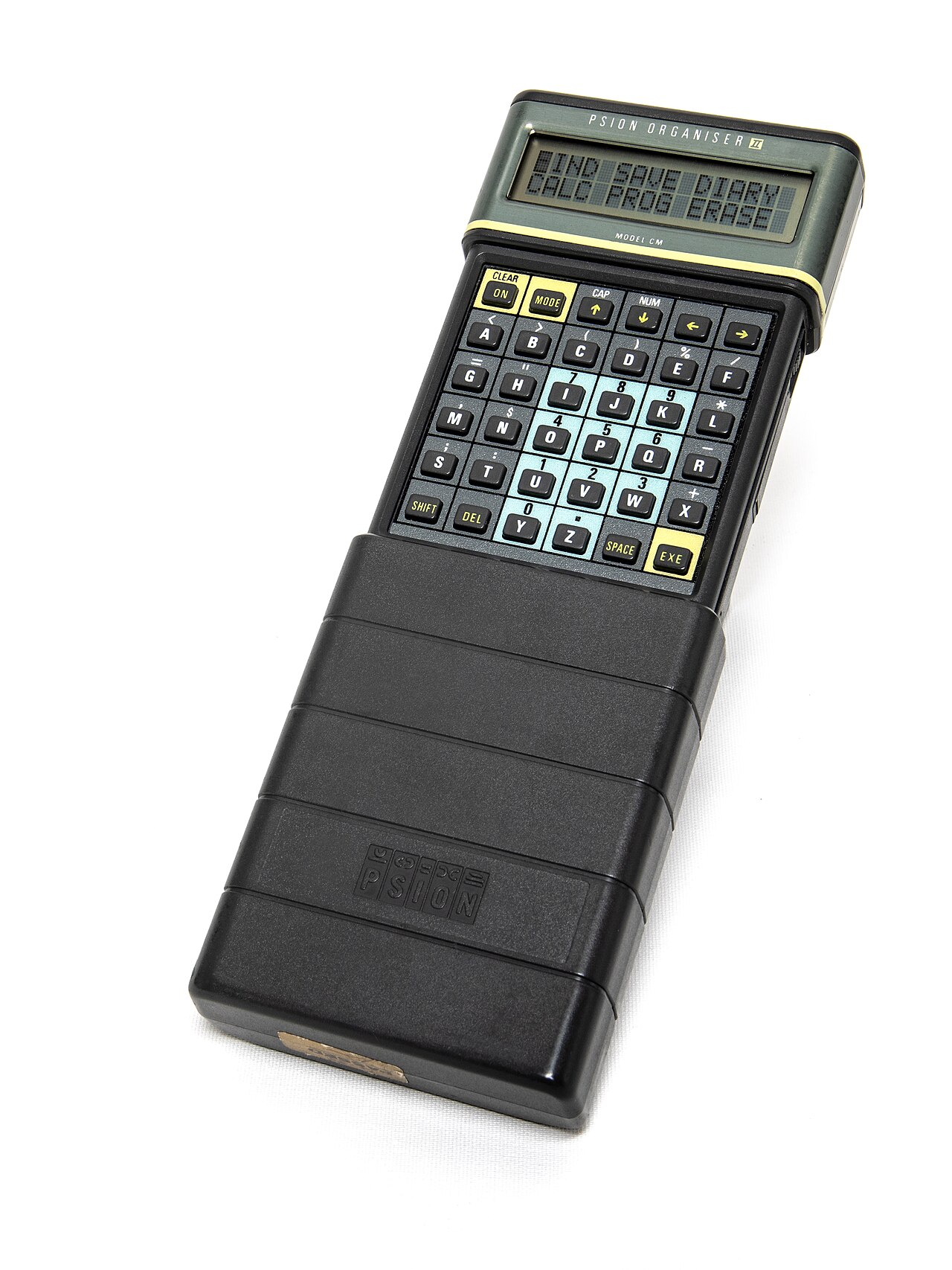
The Organiser, launched in 1984 at £99, was a slab the size of a large calculator with an alphanumeric keypad, a one-line display, an 8-bit processor and plug-in “Datapaks” of EPROM for storage, sold as a pocket database and diary. It was the first handheld computer built and sold in volume, and its main customer turned out to be industry rather than individuals: Marks & Spencer’s stock-takers and the field engineers of British utilities carried them. The Organiser II of 1986, with a proper display and a programming language, sold in the hundreds of thousands. The clamshell Series 3 (1991), with a full keyboard, a graphical screen, a word processor, spreadsheet, diary and database, and weeks of life on two AA batteries, was the device that defined the British pocket computer through the decade; the Series 5 (1997), with a keyboard good enough to touch-type on, ran a new 32-bit operating system, EPOC32, written for kilobytes of memory, instant switch-on and days of battery.
Symbian
EPOC32 was the company’s most valuable product and the one it could not keep. In June 1998 Psion and the three largest phone makers, Nokia, Ericsson and Motorola, founded Symbian Ltd in London to turn EPOC into the operating system of the coming smartphone, the industry’s joint defence against Microsoft owning phone software as it owned the PC’s; Psion transferred most of its software staff and held the largest single stake, and Myers became Symbian’s first chief executive. Symbian ran the first Nokia Communicators and, by 2007, about 125 million phones in total. Psion’s own handhelds could not compete with the phones their software had enabled, and in 2001 the company left the consumer market. It had bought the Canadian rugged-terminal maker Teklogix in 2000, and as Psion Teklogix it sold industrial handhelds until Motorola Solutions bought it in June 2012 for $200 million. The Symbian stake went to Nokia in 2004; the operating system’s rise and its collapse before the iPhone and Android are in Dead End: Symbian and, with the rest of the country’s industry, in The UK Computing Industry.
Potter’s timing as a seller was worse than his timing as a buyer, and he said so: having sold £12.6 million of Psion shares in 2000, only to watch them quadruple within months, he joked that the best buying signal for Psion shares was when he sold. He stepped down as chairman in 2009.
Philanthropy
He was appointed CBE in the 1997 New Year Honours for services to manufacturing, elected a Fellow of the Royal Academy of Engineering in 2001, and sat on the Dearing committee on higher education in 1997 and was a governor of the London Business School. The David and Elaine Potter Foundation, which the couple established, funded scholarships, human-rights and civil-society work, and investigative journalism: they rescued openDemocracy from insolvency in 2013 and in 2010 founded the Bureau of Investigative Journalism with a £2 million commitment. Colly Myers died in February 2026. David Potter died on June 28, 2026.
📚 Sources
- Psion (company) — Wikipedia (the 1980 founding, the Sinclair software, the Organiser of 1984, the Series 3 and Series 5, Symbian in 1998 and 125 million phones by 2007, the 2001 consumer exit, Teklogix, the June 2012 Motorola Solutions purchase for $200 million)
- David Potter, the man who put Psion in the palm of your hand, logs off at 82 — The Register, July 3, 2026 (the birth and education, UCLA, the 1975 investments and E. Fogarty, Red Cheer, the 2000 share sale and the quotation, Colly Myers’s Abacus, EPOC32 work and February 2026 death, the RAEng, the June 28, 2026 death)
- David Potter CBE — oral-history interview, Archives of IT, April 20, 2016, interviewed by Alan Cane (403 to scripts, loads in a browser)
- Remembering David Potter: industrialist, physicist, philanthropist — openDemocracy, 2026
- David E. Potter — Wikipedia (Trinity in 1963, the 1997 New Year Honours CBE, the London Business School)
- The Bureau of Investigative Journalism — Wikipedia (the 2010 founding with £2 million from the Potters’ foundation)
- Horizons: Software Starter Pack — Wikipedia
- Psion Organiser — Wikipedia (the 1984 launch at £99, the Datapaks, the Organiser II)
- Image: PSION Organiser II.jpg by Felix Winkelnkemper (CC BY-SA 4.0), via Wikimedia Commons