Android: The Dominant Mobile OS
Abstract
Android began in 2003 as a startup building an operating system for digital cameras. The market for that idea vanished within months, the team pivoted to phones, and in July 2005 Google bought the company for at least $50 million, a price one Google executive later called the company’s best deal ever. Google gave the system away to any manufacturer that wanted it, and the strategy that had let Windows PCs swamp the Macintosh played out again on phones: by 2021 there were more than three billion active Android devices, and in August 2026 Android ran on about two-thirds of the world’s smartphones. The same years produced a patent war with Apple, an eleven-year copyright case with Oracle, the largest antitrust fine the European Commission had ever imposed, and a jury verdict that Google’s app store was an illegal monopoly. Android’s openness is real at the level of source code and increasingly conditional everywhere else, most recently in the rule, taking effect in September 2026, that even apps installed from outside Google Play must come from a developer registered with Google.
A Camera Operating System
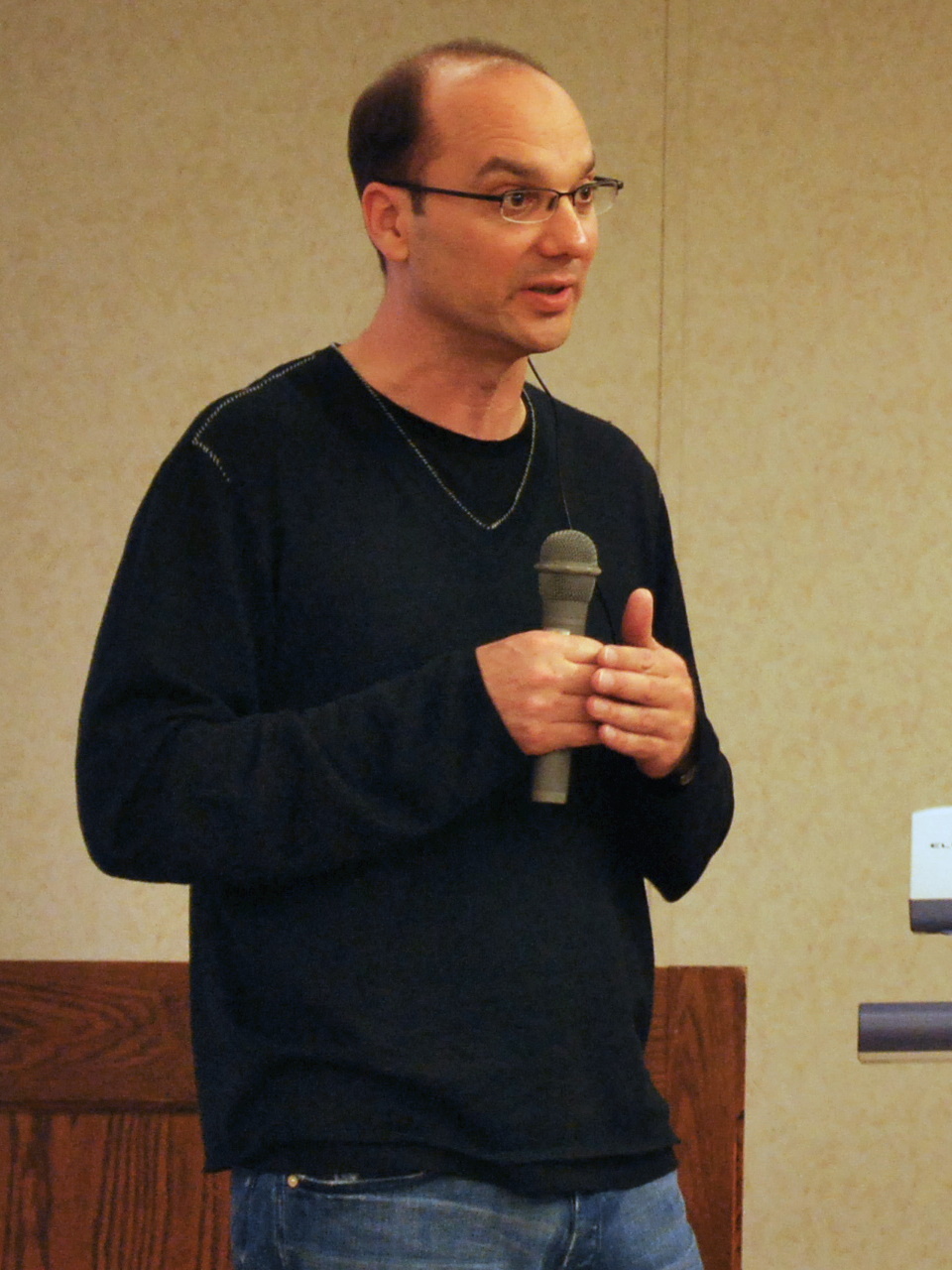
Andy Rubin was born in Chappaqua, New York, in 1963 and studied computer science at Utica College. At Apple, where he worked as a manufacturing engineer from 1989, colleagues nicknamed him “Android” for his fondness for robots. He moved on to General Magic (1992 to 1995), which tried to build a handheld communicator a decade too early, then to Steve Perlman’s WebTV. In 1999 he co-founded Danger, whose Hiptop, sold by T-Mobile as the Sidekick, put email, messaging, and a web browser on a phone whose screen swung aside to reveal a keyboard.
In October 2003 Rubin and Chris White founded Android Inc. in Palo Alto; Rich Miner and Nick Sears joined soon after and are counted among the co-founders. Rubin left Danger to work on it full time. The first plan had nothing to do with phones. In a pitch to investors in April 2004, the slides of which Rubin showed at a conference in Tokyo in 2013, Android was an operating system for “smart cameras”: a digital camera would connect to a home PC and from there to an “Android Datacenter” that stored and shared photos online. Within months the founders saw that the market for standalone cameras was about to be eaten by camera phones, and the pitch changed to “an open-source handset solution.” Nick Sears is credited with suggesting the switch.
The pivot did not bring money. Android was a handful of people, investors were uninterested, and Rubin fell behind on the rent for the office. According to an account Perlman gave to Business Insider, he went to the bank, withdrew $10,000 in $100 bills, and handed them to Rubin; the next day he wired more as seed funding and declined to take a stake. Late in 2004 Rubin flew to Seoul to pitch Samsung. Fred Vogelstein’s Dogfight (2013) reports the response from across the table: “You and what army are going to go and create this? You have six people. Are you high?” Rubin later said they “laughed me out of the boardroom.”
The Google Acquisition
In July 2005, Google bought Android Inc. for at least $50 million. Rubin, Miner, Sears, and White all joined Google, and Rubin ran the project for the next eight years. According to Vogelstein, a Samsung executive called Rubin after the deal became known, asking for another meeting about his “very, very interesting proposal.”
The purchase was not about revenue. Google’s income came from web search and the ads attached to it, and its founders worried about a future in which the mobile gateway to the internet belonged to a single company (Microsoft at the time, Apple a few years later) that could push Google aside on its own devices. A free phone operating system that carried Google’s services would make that harder. David Lawee, Google’s head of corporate development, called Android the company’s “best deal ever” in 2010.
The technical choices made in these years stayed with Android for two decades. The system ran on the Linux kernel. Applications were written in the Java language, which millions of programmers already knew, but they did not run on Sun’s Java virtual machine. Dan Bornstein wrote a separate one, Dalvik, named after a fishing village in Iceland where some of his ancestors had lived, and Google reimplemented the Java class libraries rather than license them from Sun. That decision was the root of the Oracle lawsuit six years later.
Sooner and Dream
By 2006 the team was working on two phones. Sooner resembled a BlackBerry: small screen, hardware keyboard, no touch input. Dream was a touchscreen device with a slide-out keyboard. Sooner was meant to ship first.
On 9 January 2007 Steve Jobs presented the iPhone. Chris DeSalvo, an engineer on the Android team, told Vogelstein: “As a consumer I was blown away. I wanted one immediately. But as a Google engineer, I thought ‘We’re going to have to start over.’” Rubin reportedly said: “Holy crap, I guess we’re not going to ship that phone.” In Vogelstein’s account, the team dropped Sooner, moved the Dream design to the front, rewrote the user interface for touch, and pushed the launch back by about a year.
Not everyone on the team remembers it that way. Dianne Hackborn, an Android framework engineer at Google since 2006, wrote in 2013 that Dream had been in development alongside Sooner before the iPhone appeared, and that “I believe the decision to drop Sooner was well before the iPhone announcement.” Both accounts agree on the result: the first Android phone had a touchscreen, and Sooner never shipped.
The Open Handset Alliance
On 5 November 2007, Google announced Android together with the Open Handset Alliance, 34 companies that had agreed to build on it: handset makers such as HTC, Motorola, and Samsung, chip vendors such as Qualcomm and Texas Instruments, and carriers such as T-Mobile and Sprint. No phone existed yet. A week later, on 12 November, the alliance released an early software development kit with an emulator, and Google announced the Android Developer Challenge, $10 million in prize money for the best applications.
The code was published as the Android Open Source Project (AOSP). Google chose the Apache License 2.0 for everything above the kernel; only the Linux kernel itself stayed under the GPL, which requires modifications to be published. The permissive license was aimed at the companies in the alliance. Under Apache, a manufacturer or carrier could change Android, add its own interface, and ship it without publishing its changes, which the GPL would not have allowed. The licensing that made Android attractive to Samsung and Motorola also let every manufacturer build its own variant, and much of the fragmentation that followed came from that freedom.
The G1
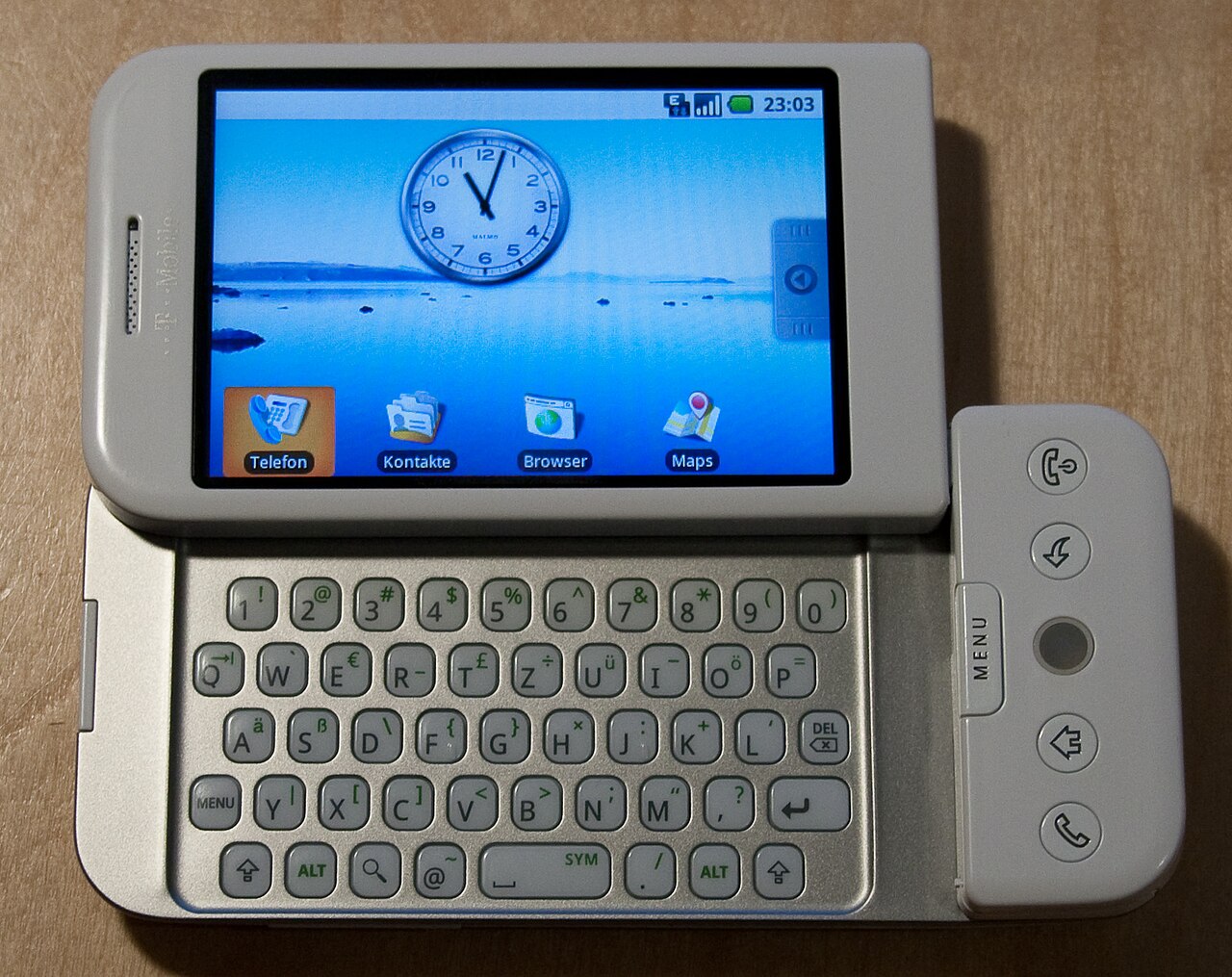
T-Mobile announced the T-Mobile G1, built by HTC as the HTC Dream, on 23 September 2008, and put it on sale in the United States on 22 October 2008 for $179 with a two-year contract. It had a 3.2-inch capacitive touchscreen at 320 × 480 pixels, a five-row keyboard that slid out sideways, a trackball below the screen, a 528 MHz Qualcomm processor, and 192 MB of RAM. It shipped with the Android Market, which had a few dozen applications at launch, and with Gmail, Google Maps with Street View, and YouTube.
Next to the iPhone it was thick and heavy, and the first software had no on-screen keyboard; typing required sliding out the hardware one until version 1.5 (April 2009). T-Mobile said in April 2009 that it had sold more than a million G1s in the United States.
Droid and the Carriers
Android’s breakthrough in the United States came from a carrier that had been shut out of the iPhone. AT&T held the iPhone exclusively, and Verizon needed an answer. On 6 November 2009 it launched the Motorola Droid, with a name licensed from Lucasfilm, which owns “droid” as a Star Wars trademark. Verizon’s “Droid Does” campaign listed the things the iPhone could not do, such as run apps in the background or offer a physical keyboard. According to estimates by the analytics firm Flurry, the Droid sold about 250,000 units in its first week and 1.05 million in 74 days, more than the first iPhone had sold in the same period.
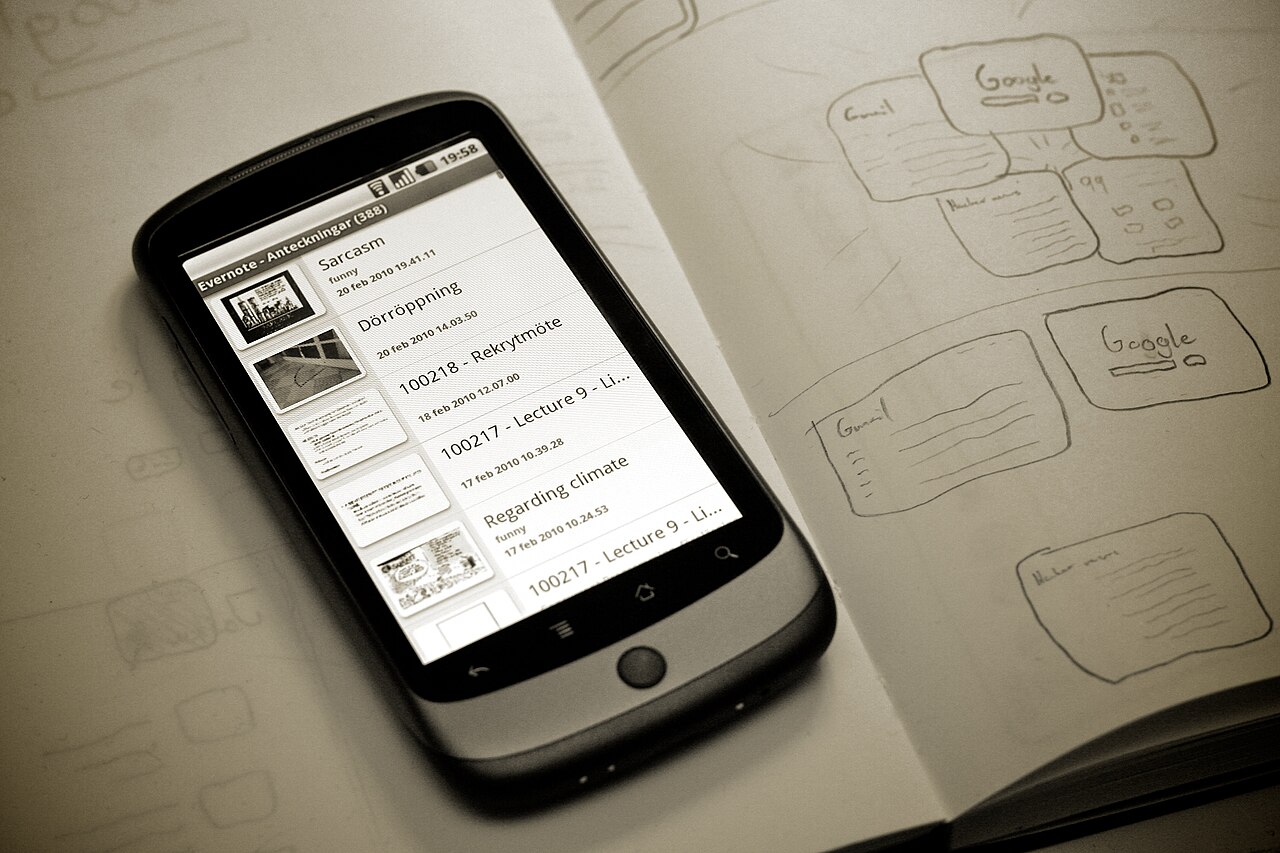
Google tried to go around the carriers once. On 5 January 2010 it began selling the Nexus One, built by HTC to Google’s specification, directly from a Google web store: $529 unlocked, or $179 with a two-year T-Mobile contract. Buyers wanted to hold a phone before paying for it, and carriers had no reason to promote a phone they did not sell. In May 2010 Google announced it would close the store, and it stopped selling the phone in July, less than seven months after launch. For the next decade, Android phones reached most customers through carriers and retailers, and each carrier added its own apps and delayed updates to suit its own schedule.
Desserts
From version 1.5 onward, Android versions carried dessert code names in alphabetical order.
| Version | Name | Released | Notable for |
|---|---|---|---|
| 1.5 | Cupcake | April 2009 | On-screen keyboard, video recording |
| 2.0 / 2.1 | Eclair | October 2009 | Launched on the Motorola Droid |
| 2.3 | Gingerbread | December 2010 | The long-lived version of the early boom |
| 3.0 | Honeycomb | February 2011 | Tablets only; source code withheld for months |
| 4.0 | Ice Cream Sandwich | October 2011 | Phone and tablet lines merged again |
| 5.0 | Lollipop | November 2014 | ART runtime replaced Dalvik; Material Design |
| 8.0 | Oreo | August 2017 | Project Treble |
| 10 | (none) | September 2019 | Dessert names dropped; Project Mainline |
| 17 | (none) | June 2026 | Current version at the time of writing |
Honeycomb was the first sign that “open source” did not mean “published when built.” In March 2011 Google withheld its source code from the public, giving it only to a few large manufacturers. Rubin explained that the team had “made some design tradeoffs” to ship the tablet on schedule and did not want developers putting it on phones and “creating a really bad user experience.” In August 2019 Google dropped the dessert names altogether, saying that they were not understood by all its users around the world, and Android 10 became the first release known only by its number.
Thermonuclear War
Google’s chief executive, Eric Schmidt, sat on Apple’s board from 2006. As Android grew into a direct competitor to the iPhone, he recused himself from more and more of the board’s discussions, and on 3 August 2009 he resigned. Jobs regarded Android as a copy of the iPhone. He told his biographer, Walter Isaacson: “I will spend my last dying breath if I need to, and I will spend every penny of Apple’s $40 billion in the bank, to right this wrong. I’m going to destroy Android, because it’s a stolen product. I’m willing to go thermonuclear war on this.”
Apple did not sue Google. It sued the companies that made Android phones: HTC in March 2010, then Samsung in April 2011. In August 2012 a jury in San Jose awarded Apple $1.049 billion against Samsung for infringing design and utility patents. Judge Lucy Koh struck about $450 million of the award and ordered a partial retrial, which in November 2013 added $290 million, for a total of about $930 million. After the Supreme Court ruled in December 2016 on how design patent damages should be calculated, a further retrial in May 2018 set the total at $539 million. Apple and Samsung settled on undisclosed terms in June 2018. The wider fight over smartphone patents is told in The Patent Wars.
Google’s answer was to buy patents. On 15 August 2011 it announced that it would acquire Motorola Mobility for $12.5 billion, which brought with it about 17,000 patents and 7,500 pending applications. The deal closed on 22 May 2012. Less than two years later, on 29 January 2014, Google agreed to sell the phone business to Lenovo for $2.91 billion, keeping all but about 2,000 of the patents.
Oracle v. Google
Oracle bought Sun Microsystems in January 2010 and sued Google in August of the same year for infringing patents and copyrights. The copyright claim was about declaring code: the roughly 11,500 lines in 37 Java API packages that name classes and methods and fix their parameters, which Google had reproduced so that Java programmers could use familiar calls on Android. Google had written its own implementations behind those declarations. Oracle eventually sought about $8.8 billion.
The case went up and down the courts for eleven years. In May 2012 a jury found no patent infringement, and Judge William Alsup ruled that the API declarations were not protected by copyright. The Federal Circuit reversed him in May 2014. A second jury found in May 2016 that Google’s use was fair use, and the Federal Circuit reversed that too, in March 2018. On 5 April 2021 the U.S. Supreme Court decided for Google, 6 to 2, in an opinion by Justice Stephen Breyer. It did not rule on whether APIs can be copyrighted and held that Google’s copying, in any case, was fair use. The 11,500 lines were 0.4 percent of the 2.86 million lines in the API, and Google, the Court wrote, had copied them “because programmers had already learned to work with” them. Justices Thomas and Alito dissented; Justice Barrett did not take part. The Java side of the story is in James Gosling and Java. In 2017, while the case was still running, Google made Kotlin an official language for Android.
Fragmentation
By giving the system away, Google gave up control over what ran on the phones. Each manufacturer adapted Android to its own hardware, added its own interface (Samsung’s TouchWiz, HTC’s Sense), and handed the result to carriers who tested it again. An update from Google had to pass through the chip vendor, the manufacturer, and the carrier before it reached a phone, and many phones never received one. In August 2015 the network-measurement company OpenSignal counted 24,093 distinct Android device models from 1,294 brands in its data, up from 18,796 a year earlier. The most common version at the time was KitKat (4.4), nearly two years old; about a third of devices still ran Jelly Bean.
The cost became visible in July 2015, when the security researcher Joshua Drake disclosed Stagefright, a set of flaws in Android’s media library that could be triggered by a multimedia text message. An estimated 950 million devices were vulnerable. Google shipped fixes for its own Nexus phones on 5 August 2015 and began publishing monthly Android Security Bulletins the same month.
The structural fixes came later. Project Treble, announced in May 2017 with Android 8.0, split the low-level, hardware-specific vendor code from the Android framework behind a stable interface, so that a manufacturer could update the system without waiting for the chip vendor to rewrite its drivers. Project Mainline (Android 10, 2019) went further and moved core components into modules that Google updates directly through the Play Store, bypassing the manufacturer.
Three Billion Devices
Android’s growth followed from its business model. Anyone could make an Android phone, so Android phones appeared at every price, from Samsung’s flagships to the cheapest handsets on the market. Android has been the most used mobile operating system worldwide since 2011. Google reported one billion monthly active users at its developer conference in June 2014, two billion in May 2017, 2.5 billion in 2019, and on 18 May 2021 more than three billion active devices, a count taken from devices using the Play Store that therefore excludes most phones sold in China. In August 2026, StatCounter measured Android at 67.6 percent of mobile operating system use worldwide, and Apple’s iOS at 32.4 percent.
The system spread beyond phones: to watches with Android Wear in 2014, to televisions and cars, and to low-cost phones with the Android One and Go programs. In July 2025, Google’s Android president Sameer Samat confirmed that ChromeOS would be merged into Android. On 12 May 2026 Google announced the Googlebook, a line of laptops from Acer, Asus, Dell, HP, and Lenovo running a desktop version of Android, with sales in the United States starting on 4 October 2026.
Android Without Google
The AOSP code is free to use, and several large companies have built phones on it without Google’s services.
In China, where Google’s services are blocked, every major manufacturer ships Android without them. Xiaomi, Oppo, Vivo, and Huawei built their own app stores, account systems, and push-notification services on top of AOSP, and there the whole Google layer is replaced. In May 2019 the U.S. government put Huawei on its Entity List, and Google stopped licensing its services for new Huawei phones outside China. Huawei responded with HarmonyOS, which for its first versions still ran on the AOSP base. HarmonyOS NEXT, launched on 22 October 2024, dropped the Android code entirely and can no longer run Android apps. The political and industrial background is in Ren Zhengfei and Huawei and China’s Tech Industry.
Outside China, the attempts went worse. Amazon built Fire OS from AOSP for its Kindle Fire tablets and in 2014 launched the Fire Phone, with no access to Google Play. It sold badly even after the price was cut to 99 cents on contract, and in October 2014 Amazon took a $170 million charge for it while holding about $83 million worth of unsold phones. Cyanogen Inc., a company built around the community firmware CyanogenMod, raised $80 million in 2015, and its chief executive Kirt McMaster told Forbes that the company was “putting a bullet through Google’s head.” Cyanogen shut down its services at the end of 2016. The community continued the code as LineageOS, which is used by enthusiasts who install it themselves on phones that manufacturers have stopped updating.
The Courts Catch Up
On 18 July 2018 the European Commission fined Google €4,342,865,000 for abusing Android’s dominance, then the largest antitrust fine the Commission had imposed. It found three kinds of restriction, in place since 2011. Manufacturers that wanted the Play Store had to pre-install Google Search and Chrome. Those that took Google’s apps had to sign “anti-fragmentation agreements” promising not to sell any device running a version of Android that Google had not approved, which closed the market to forks like Fire OS. And Google paid manufacturers and carriers a share of its advertising revenue in exchange for pre-installing Google Search exclusively. On 14 September 2022 the General Court annulled the part of the decision concerning the revenue-share payments and reduced the fine to €4.125 billion. On 2 July 2026 the Court of Justice dismissed Google’s final appeal.
In the United States, Tim Sweeney’s Epic Games sued Google in August 2020, after Google removed Fortnite from the Play Store for bypassing Google’s payment system. On 11 December 2023 a jury in San Francisco found for Epic on all counts. Unlike Apple, which Epic had lost against on most counts in 2021, Google had allowed apps to be installed from outside its store, but the jury found that Google had kept rival stores off Android through revenue-share deals with manufacturers and payments to large developers. Judge James Donato’s injunction of October 2024 required Google, for three years, to distribute rival app stores through Play and to give them access to the Play catalogue. The Ninth Circuit affirmed on 31 July 2025, and on 6 October 2025 the Supreme Court declined to halt the order. The parties announced a settlement in November 2025 with Google service fees between 9 and 20 percent, finalized in March 2026, and Fortnite returned to the Play Store on 19 March 2026. The economics of the 30 percent commission are covered in The Platform Tax.
Rubin After Android
In March 2013 Rubin handed Android to Sundar Pichai, who already ran Chrome, and later that year took over a new robotics effort at Google. He left the company in October 2014. He founded Playground Global, an incubator and venture fund, and in 2015 Essential Products, whose Essential Phone was announced in May 2017 and went on sale in August. It sold poorly, the planned successor was cancelled, and Essential shut down in February 2020.
In October 2018 The New York Times reported that Google had investigated a sexual misconduct allegation against Rubin in 2014, found it credible, asked him to resign, and paid him an exit package of $90 million in installments. Rubin denied the allegation. On 1 November 2018 Google employees in offices around the world walked out, protesting the company’s handling of harassment claims against senior executives. Pichai, Rubin’s successor at Android, had become chief executive of Google in 2015; his story is in Sundar Pichai and Google.
⚠️ Dead End: The “Open” OS That Isn’t
Android’s openness was real in 2007 and has narrowed since. AOSP remains open source, and anyone can download it and build a phone. But the Android that most people outside China use consists of AOSP plus Google Mobile Services: the Play Store, Maps, Gmail, Search, and the Play Services layer that handles location, push notifications, and much of what third-party apps rely on. These are proprietary, and Google licenses them only to manufacturers who accept its terms. As Ron Amadeo documented in Ars Technica in 2013, Google also stopped developing open AOSP apps (search, music, calendar, the keyboard) once it had closed-source versions in the Play Store, so an AOSP phone without Google became steadily barer.
The development process closed in parallel. For sixteen years Google developed Android in two branches, an internal one and the public AOSP one. In March 2025 it moved all development to its internal branch; AOSP now receives code only when a release is finished, and outside developers can no longer follow work in progress.
The most direct limit came with distribution. On 25 August 2025 Google announced developer verification: on certified Android devices, every app, including those installed from a website or a third-party store, must come from a developer who has registered with Google and provided identification. Google justified the rule with its finding of “over 50 times more malware” from sideloaded internet sources than from Google Play, and compared it to “an ID check at the airport.” The requirement takes effect on 30 September 2026 in Brazil, Indonesia, Singapore, and Thailand, with a global rollout planned from 2027. Hobbyists can register free accounts that distribute to up to 20 devices without ID. Apps from unregistered developers can still be installed, through an “advanced flow” that requires developer mode, a restart, a one-day wait, and a second authentication. F-Droid, the largest free-software app store for Android, called the plan an existential threat: many of its developers would not hand identification to Google, and F-Droid could not register their apps for them. In February 2026 it published an open letter against the rule, and a “Keep Android Open” coalition that includes the Electronic Frontier Foundation and the Free Software Foundation campaigns against it.
None of the attempts to escape Google’s layer have produced a mainstream alternative outside China: the Fire Phone was written off within months, Cyanogen closed in its third year, and LineageOS reaches the users who flash their own phones. In 2018 the European Commission described the arrangement Google built around open-source Android as an illegal restriction of competition, and in 2026 the EU’s highest court confirmed it.
📚 Sources
- Wikipedia: Android (operating system) (founding, camera plan, Perlman funding via Business Insider, Lawee quote, versions, AOSP licensing, development changes 2025)
- Wikipedia: Andy Rubin · Open Handset Alliance · Dalvik (software)
- PCWorld: Android founder: We aimed to make a camera OS (2013)
- Android Authority: Did you know: Samsung once thought Android was a joke (quoting Vogelstein, Dogfight)
- Fred Vogelstein, Dogfight: How Apple and Google Went to War and Started a Revolution (Sarah Crichton Books, 2013); excerpt in The Atlantic, December 2013, as reported by AppleInsider: Google’s reaction to Apple’s iPhone unveiling
- 9to5Mac: The iPhone forced Google to start over … or not, depending who you believe (Dianne Hackborn’s account)
- Google Press: Google Announces $10 Million Android Developer Challenge (12 November 2007)
- T-Mobile Newsroom: T-Mobile Launches the T-Mobile G1 · Wikipedia: HTC Dream
- Wikipedia: Motorola Droid · Wikipedia: Nexus One · AppleInsider: Google reveals Nexus One for T-Mobile, Verizon: $529 contract-free (January 2010)
- Apple Newsroom: Dr. Eric Schmidt Resigns from Apple’s Board of Directors (3 August 2009)
- CBS News: Jobs threatened to go “thermonuclear” against Google (from Walter Isaacson, Steve Jobs, 2011)
- AppleInsider: Google closes Android 3.0 Honeycomb source to prevent use on smartphones (March 2011)
- Engadget: Android chief Andy Rubin tackles open source qualms, says Honeycomb isn’t “one size fits all” (2011) · Wikipedia: Android Lollipop
- Wikipedia: Apple Inc. v. Samsung Electronics Co. · MacRumors: Jury Rules Samsung Must Pay Apple $290 Million in Damages Retrial (November 2013) · Wikipedia: Motorola Mobility
- Supreme Court of the United States: Google LLC v. Oracle America, Inc., No. 18-956 (5 April 2021) · Wikipedia: Google LLC v. Oracle America, Inc.
- EFF: Victory for Fair Use: Supreme Court Reverses in Oracle v. Google (2021)
- VentureBeat: Android fragmentation report: There are now 24,093 distinct devices (2015)
- SecurityWeek: Critical Stagefright Vulnerabilities Expose 950 Million Android Devices
- Android Developers Blog: Here comes Treble: A modular base for Android (May 2017)
- TechCrunch: Google now has 1B active monthly Android users (2014) · TechCrunch: Google has 2 billion users on Android (2017) · 9to5Google: Android now powers over 3 billion devices (2021)
- StatCounter: Mobile Operating System Market Share Worldwide (August 2026 figures)
- TechRepublic: Google Exec Reveals Android, ChromeOS Will Merge (2025) · Wikipedia: Googlebook
- 9to5Google: Huawei’s Android-free “HarmonyOS NEXT” will go live next week (2024) · Wikipedia: HarmonyOS 5
- GeekWire: Amazon takes $170M write-down on Fire Phone (2014)
- Forbes: Meet Cyanogen, The Startup That Wants To Steal Android From Google (2015) · Forbes: Cyanogen Wanted To Kill Google’s Android, But Instead Killed Itself (2016)
- Court of Justice of the EU: Press release No 93/26, Case C-738/22 P, Google and Alphabet v Commission (2 July 2026)
- Wikipedia: Epic Games v. Google · CNBC: U.S. Supreme Court allows order forcing Google to make app store reforms (2025)
- 9to5Google: Google will move Android AOSP development behind closed doors (2025)
- Ars Technica: Google’s iron grip on Android: Controlling open source by any means necessary (Ron Amadeo, 2013)
- Android Developers Blog: A new layer of security for certified Android devices (25 August 2025) · Android developer verification: Balancing openness and choice with safety (19 March 2026) · Android Authority: sideloading changes timeline (2026)
- F-Droid: An Open Letter Opposing Android Developer Verification (24 February 2026) · The New Stack: F-Droid says Google’s developer verification plan is an “existential” threat · Wikipedia: Keep Android Open
- Essential Products shutting down (9to5Google, 2020) · Wikipedia: Essential Phone (announced 30 May 2017, released 17 August 2017)
- Velvetech: A Brief History of Android
- Image: HTC Dream opened.jpg by Marcus Sümnick (CC BY 3.0), via Wikimedia Commons
- Image: 2008 Google Developer Day in Japan - Andy Rubin.jpg by Yoichiro Akiyama from Tokyo, Japan (CC BY-SA 2.0), via Wikimedia Commons
- Image: Google Nexus One with Evernote for Android (4375773612).jpg by Johan Larsson from Göteborg, Sweden (CC BY 2.0), via Wikimedia Commons