Dead End: Cassette Tapes and Stringy Floppies
Abstract
The home computers of the late 1970s and early 1980s stored their programs on the cheapest medium in the house: the audio cassette, read and written through an ordinary tape recorder at a few hundred bits per second. Hobbyists agreed on a common format, the Kansas City standard, at a Byte symposium in November 1975; manufacturers then ignored it and invented their own. Loading a game could take five minutes and fail at the end, and a generation learned to recognise programs by the noise they made. In between cassette and floppy disk sat the stringy floppy, an endless loop of tape in a small cartridge: Exatron’s for the TRS-80 from 1979 and Sinclair’s ZX Microdrive from 1983, announced as a revolution and delivered fifteen months late. Both lost to the same thing, the falling price of the floppy disk drive.
Storage for the Price of a Tape Recorder
The first microcomputers of 1975 had no storage at all. An Altair 8800 lost its program when it was switched off, and the owner entered it again through the front-panel switches or read it in from paper tape on a Teletype, a machine that cost more than the computer. A floppy disk drive cost several hundred dollars more than most hobbyists’ entire system. Every household, however, had or could buy a cassette recorder, and audio tape was cheap.
The method was to turn bits into tones. An interface converted each 0 and 1 into a burst of audio at one of two frequencies, which the recorder taped like music; on playback, the interface listened to the tones and turned them back into bits. Each manufacturer and each kit builder did this differently, so a tape from one machine was noise to another.
The Kansas City Standard
Byte magazine tried to fix that before it set. On 7 and 8 November 1975 it held a symposium in Kansas City, Missouri, where hobbyists and manufacturers agreed on a common format based on a design by Don Lancaster. Lee Felsenstein and Harold Mauch wrote it up, and Byte published it as the Kansas City standard, reporting on the symposium in February 1976.
The standard was deliberately conservative. A 0 was four cycles of a 1,200 Hz tone, a 1 was eight cycles of 2,400 Hz, and each byte was framed by a start bit and two stop bits. That gave 300 bits per second, or about 27 bytes per second of data. It would work with almost any recorder, including cheap ones with poor speed control, and it was slow: an 8 KB BASIC interpreter took about five minutes to load. Processor Technology’s CUTS format added a 1,200-baud mode, and the Tarbell interface used its own faster format but could also read and write Kansas City tapes.
The agreement did not last. Les Solomon of Popular Electronics recalled that “before the month ended, everyone went back to his own tape standard.” When the mass-market home computers arrived from 1977, almost every one used a scheme of its own. The BBC Micro ran a 1,200-baud variant of CUTS; MSX machines offered 2,400 baud.
The Cassette Years
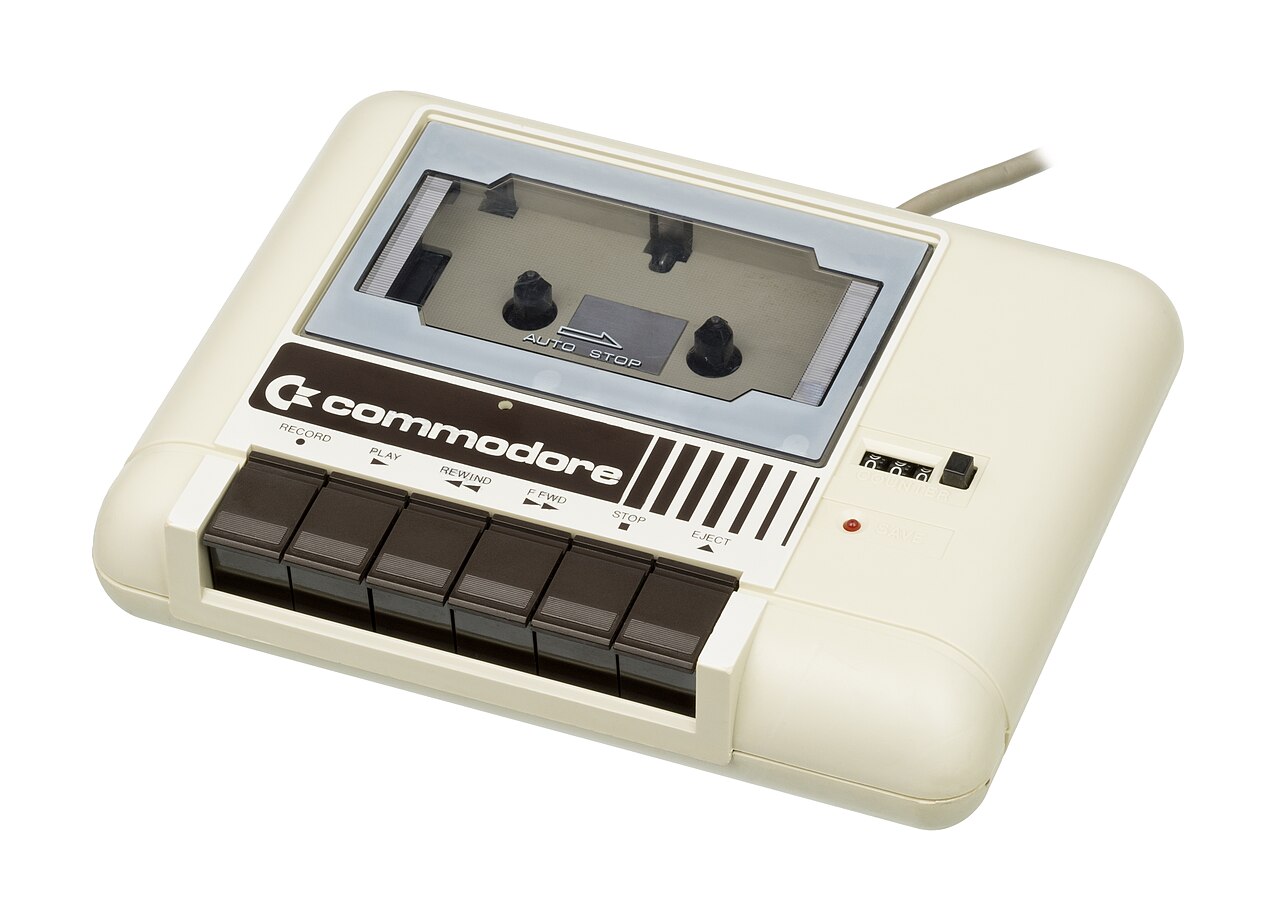
The Commodore PET of 1977 had a cassette drive built into its case, a modified Sanyo mechanism. Commodore later sold it separately as the Datasette for the VIC-20 and the Commodore 64. Commodore’s computers had no ordinary audio input, so only Commodore’s own drive could be used, but the drive sent digital pulses straight to the computer, which avoided the level and alignment problems of ordinary recorders. The encoding was cautious: every program was written twice, for error correction, and effective throughput was about 50 bytes per second. A 30-minute side held about 100 KB. A Commodore 1541 disk drive, by comparison, cost roughly five times as much as a Datasette.
Other machines plugged into a household recorder. The Sinclair ZX Spectrum loaded at about 1,500 baud, and its border flashed in coloured stripes while the tape played. Loading was a ritual: rewind, type LOAD "", press play, adjust the volume, wait. A wrong volume setting, a stretched tape, a recorder with its head slightly out of alignment, or a fridge switching on in the next room could produce an error after four minutes of waiting. Magazines printed advice on cleaning heads and turning the azimuth screw.
Software houses made a virtue of necessity. Turbo loaders replaced the computer’s built-in routine with a faster one written to tape at the start of the program: Commodore’s Turbo Tape cut out the duplicate copy and the per-byte markers, and raised the capacity of a cassette side about tenfold. On the Spectrum and the Amstrad CPC, loaders such as Speedlock (1983) combined higher speed with copy protection and became recognisable by their own border patterns. Loading screens, a picture drawn line by line while the rest of the game loaded, gave the player something to look at.
In Britain and much of Europe the cassette remained the mass-market medium long after American buyers had moved to disks. MicroProse reported that 80 percent of its British sales of the helicopter simulator Gunship were on cassette. Budget labels sold games on tape for a few pounds, and the cheapness of cassettes, which a double-deck recorder could copy in minutes, made home taping of games as common as home taping of music.
Programs by Radio
If programs were sound, they could be broadcast. The Dutch broadcaster NOS began transmitting computer programs by radio in 1979, and listeners taped them off the air. Because every computer used its own tape format and its own dialect of BASIC, its radio programme Hobbyscoop started the BASICODE project in 1980: a common tape format, fixed in 1982, and a subset of BASIC with standard subroutines for screen and sound, for which “Bascoder” programs on each machine translated the broadcast into a form it could load. BASICODE 2 (1983) supported more than twenty computers, among them the Commodore 64, the ZX Spectrum, the BBC Micro, and the Apple II. BASICODE 3 followed in 1986 and BASICODE 3C, with colour graphics, in 1991. East German radio broadcast BASICODE programs throughout the GDR from 1989, and its successor, Deutschlandsender Kultur, continued until about 1992.
The Stringy Floppy
Between the cassette and the floppy disk there was room, it seemed, for a device that was cheaper than a disk drive but faster and more convenient than a tape recorder. The answer several companies came up with was an endless loop of narrow tape in a small cartridge, running continuously past a head at high speed. Because the loop had no beginning and no end, there was no rewinding: the drive simply waited until the wanted block came round. The trade press called it the stringy floppy.
Exatron in California showed a version for S-100 computers at the West Coast Computer Faire in March 1978 and announced the Exatron Stringy Floppy for the TRS-80 Model I at the San Francisco Computer Faire in May 1979, at $249.50. Its cartridges, called “wafers,” held tape loops from 5 to 75 feet long, with capacities from 4 to 64 KB, and ran at 7,200 baud, against a few hundred baud for a cassette. About 4,000 TRS-80 drives had been sold by August 1981. Versions for the VIC-20 and Commodore 64 ($199.50 in 1983), the ZX81, and the Timex Sinclair 2068 followed, and Texas Instruments licensed the design for computers it then cancelled. The drive kept no catalogue of files and did not warn before overwriting, and a full trip round a 16 KB loop took about a minute. A 1981 study at the Naval Postgraduate School found it faster than cassette but much slower than any floppy. The Sequential Circuits Prophet-10 synthesizer used one for storing sounds and switched to a micro-cassette drive.
The ZX Microdrive
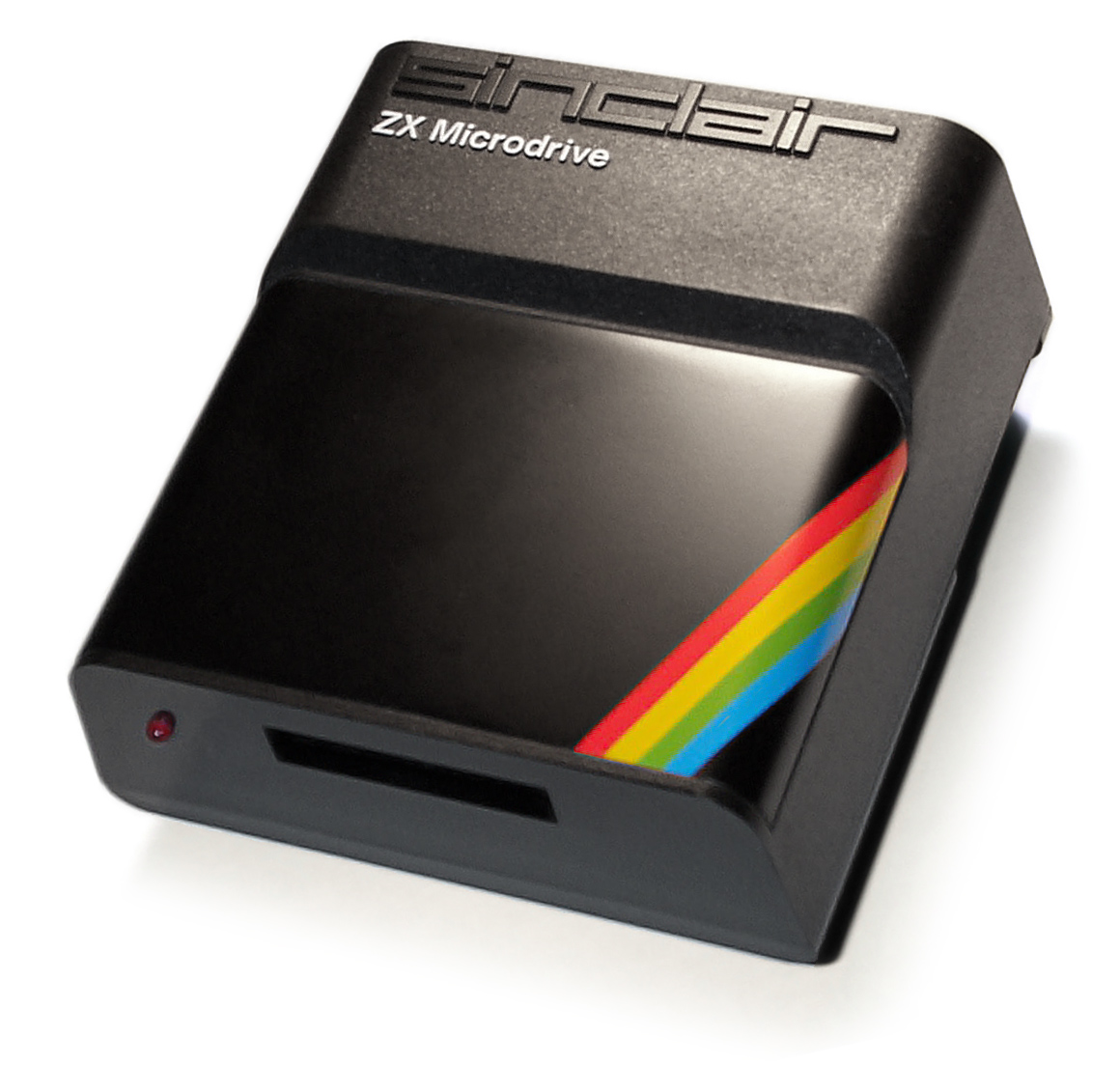
The best-known stringy floppy came from Clive Sinclair. On 23 April 1982, when Sinclair Research launched the ZX Spectrum, it also announced the ZX Microdrive, which it said would revolutionise home storage. Early advertisements spoke of a “microfloppy” and gave the impression of a disk; it was a tape loop. The engineers Jim Westwood and David Southward are credited with its design, Ben Cheese designed its analogue electronics and custom chip, and Martin Brennan the ZX Interface 1 through which it connected to the Spectrum.
The original claims were two 100 KB cartridges, 16 KB per second, and up to eight drives on one computer. The release slipped from 1982 to early 1983, and in spring 1983 Sinclair’s Nigel Searle blamed mechanical problems that “have now been solved.” Shipping was announced in July 1983, and the Microdrive went on sale in September at £49.95, with the Interface 1 at another £49.95. A cartridge, 43 by 30 by 5 millimetres, held about 85 KB in up to 200 sectors of 512 bytes, and the tape ran past the head at about 75 centimetres a second. A Commodore 1540 disk drive then cost just under £400, about eight times as much as a Microdrive; a cartridge, however, cost £4.95, about three times a 5.25-inch floppy disk.
The loop wore out. The tape stretched with use and shed oxide onto the head, so files became slower to find and eventually unreadable, and Sinclair’s own manual warned that cartridges would need replacing and that important data should be backed up. Sales were slow: Sinclair User reported fewer than 1,000 Microdrives sold by early 1984, and Sinclair said about 150,000 had been sold by early 1986. In early 1985 the cartridge price came down to £1.99.
Sinclair made the Microdrive the only built-in storage of its business computer, the Sinclair QL of 1984, which had two drives and no cassette port. The QL ran its drives about 25 percent faster than the Spectrum’s, which increased tape wear, and Byte found that 2 of 11 QL cartridges failed in testing. ICL built a reworked, more reliable Microdrive into its One Per Desk terminal. Rotronics sold a rival loop drive, the Wafadrive, for the Spectrum from 1984 at £130, slower but sturdier, with 16, 64, and 128 KB tapes. When Amstrad bought Sinclair’s computer business in 1986 for £5 million, it dropped the Microdrive and gave its Spectrum models a built-in cassette deck and, later, a 3-inch disk drive.
Dead End
The cassette was a stopgap that lasted a decade because nothing else was as cheap. Its weaknesses were obvious from the start: it was slow, sequential, and unreliable, and its formats were incompatible from one machine to the next. It lost as soon as disk drives became affordable for home buyers, in the United States by the mid-1980s and in Europe somewhat later, and it survived longest where software was cheapest and buyers were youngest. Its one lasting achievement was the sound itself, which the generation that waited through it can still recognise.
The stringy floppy was an attempt to get disk-like convenience without paying for a disk, and it found the worst of both. It was faster than a cassette but still sequential, and its moving tape loop wore out in a way that no floppy did. Its price advantage depended on floppy drives staying expensive, and floppy drives did not stay expensive: in Britain Sony’s 3.5-inch drive sold for £235 already in November 1982, and by the end of the decade every home computer that mattered had a disk drive. Like the bubble memory of the same years, the stringy floppy was priced against the incumbent’s past and not its future.
📚 Sources
- Kansas City standard, Wikipedia (Byte symposium 7–8 November 1975, Lancaster design, Felsenstein and Mauch, encoding, 300 bit/s, five-minute load, CUTS, Tarbell, BBC Micro, and MSX variants, Les Solomon quote)
- Commodore Datasette, Wikipedia (PET 1977 built-in Sanyo-based drive, digital interface, encoding, ~50 bytes/s, 100 KB per side, Turbo Tape, 1541 at five times the price, MicroProse Gunship 80% UK cassette sales)
- “Tape loading sound of a program,” ZX Spectrum museum (ROM loader at about 1,500 baud, turbo loaders and border stripes)
- Speedlock, CPCWiki (1983, encryption and fast loading, border patterns)
- BASICODE, Wikipedia (NOS radio broadcasts from 1979, Hobbyscoop project 1980, format 1982, BASICODE 2, 3, and 3C, GDR broadcasts from 1989, end about 1992)
- Exatron Stringy Floppy, Wikipedia (1978 and 1979 Computer Faires, ESF-80 at $249.50, wafers, 7,200 baud, about 4,000 sold by August 1981, Naval Postgraduate School test, Prophet-10, TI licence)
- Smith, Tony: “Infinite loop: the Sinclair ZX Microdrive story,” The Register, 13 March 2013 (announcement of 23 April 1982, delays, Searle quote, prices, cartridge specifications, wear, sales figures, QL, Wafadrive, Amstrad 1986)
- ZX Microdrive, Wikipedia (Interface 1, up to eight drives, QL, ICL One Per Desk)
- Pountain, Dick: “The Sinclair QL,” Byte, September 1984, pp. 415–419 (2 of 11 cartridges failed)
- Image: Sinclair ZX Microdrive White BG.jpg by Sinclair_ZX_Microdrive.JPG: Original uploader was Letdorf at en.wikipedia; derivative work: Ubcule (talk) (CC BY 2.5), via Wikimedia Commons