Dead End: Magnetic Bubble Memory
Abstract
Magnetic bubble memory stored bits as tiny magnetized domains in a thin film of garnet and moved them past a read head with a rotating magnetic field. It had no moving parts, kept its data without power, and survived dust, vibration and temperature extremes. Andrew Bobeck developed it at Bell Labs from the mid-1960s, and through the 1970s nearly every large electronics company in the world worked on it, expecting it to replace the disk drive. Texas Instruments shipped the first commercial chip in 1977 and Intel a one-megabit chip in 1979. In 1981 Rockwell, Texas Instruments and National Semiconductor closed their bubble operations within seven months of each other, beaten on price by semiconductor RAM and on capacity by hard disks. Bubble memory survived in laptops, telephone exchanges, military equipment and a Konami arcade system that had to warm up before every game, and Intel sold its bubble business in 1986.
Andrew Bobeck
Andrew H. Bobeck was born on 1 October 1926 in Tower Hill, Pennsylvania. After service in the US Navy’s V-12 programme he studied electrical engineering at Purdue (bachelor’s 1948, master’s 1949) and joined Bell Laboratories in 1949. From 1956 he worked on magnetic logic and memory, and in the late 1950s he invented the twistor, a memory made of thin magnetic wires woven with copper conductors. Magnetic-core memory was then the standard random-access store of computers (see Whirlwind, SAGE, and Core Memory), and the twistor was one of several attempts at a cheaper way to make it.
In the mid-1960s Bobeck was part of a Bell Labs team working on an improved twistor. In the course of the work they experimented with orthoferrites, magnetic iron oxides in which a written magnetic patch, under a uniform external field, shrank into a small, stable cylinder. Bobeck called it a bubble. In his own later account, it was his colleague Richard Sherwood who suggested at a meeting of 70 to 80 Bell scientists that orthoferrites would provide the material the idea needed. Bobeck described the properties and possible applications of these domains in the Bell System Technical Journal in October 1967. The first patent on the technique, filed on 16 September 1966 in the names of Bobeck, Sherwood, Umberto Gianola and William Shockley, issued on 5 August 1969.
What made the work practical was that the bubbles could be seen. Under an ordinary microscope with polarized light, the domains in a thin film appear as dark dots, and the researchers could watch them move. “Without being able to see what was going on, we would not have bubble memories now,” Bobeck told The New York Times in 1981. The Franklin Institute awarded him its Stuart Ballantine Medal in 1973 for the “invention of the magnetic bubble memory system,” and in 1975 he was elected to the National Academy of Engineering and received the IEEE Morris N. Liebmann Memorial Award.
How It Worked
A bubble memory chip was a thin magnetic film, by the 1970s a synthetic garnet grown on a non-magnetic substrate of gadolinium gallium garnet. A permanent magnet in the package applied a steady bias field across the film. Under that field, magnetized regions pointing the opposite way contracted into cylinders a few micrometres across: the bubbles. A bubble meant 1, no bubble meant 0.
On top of the film lay a pattern of small permalloy shapes (chevrons, T-bars or similar). Two coils around the chip produced a magnetic field in the plane of the film that rotated at roughly 100 to 200 kHz. As the field turned, it magnetized each permalloy shape in turn, and the bubbles followed the moving poles from one shape to the next, like beads on a track. A generator created bubbles from an electrical pulse, and a magnetoresistive detector, whose resistance changed when a bubble passed underneath, read them out as a signal of a few millivolts.
The chip behaved like a disk with the moving parts removed. The data travelled in loops past fixed read and write positions, so access was sequential: to read a bit, the controller waited until it came round, which took milliseconds. In the usual “major-minor loop” design, data circulated in many short storage loops and was transferred to one longer loop for reading and writing. Because the bias magnet kept the bubbles in place, nothing was lost when the power failed. Manufacturers could also tolerate defective loops: Intel’s 7110 carried spare loops and a map of the good ones, so a chip with flaws still delivered its rated 1,048,576 bits.
Against a disk drive the advantages were mechanical. There was no head to crash, no motor, nothing to wear out, and nothing that dust or vibration could disturb. Against semiconductor memory the advantage was that the data stayed put without power. The disadvantages were in the support circuitry: the coil drivers, sense amplifiers and controller needed to make a bubble chip work were bulky and power-hungry, and the chip was slower than RAM by orders of magnitude.
The Boom
AT&T followed its usual practice with Bell Labs inventions: Western Electric licensed the technology to almost any company that asked. By the mid-1970s nearly every major electronics firm was interested. In the United States these included Texas Instruments, Rockwell, National Semiconductor, IBM, Univac, Burroughs, Intel and Motorola; in Japan, Hitachi and Fujitsu; in Britain, Plessey. At Texas Instruments’ annual stockholders’ meeting in 1974, the company announced that bubble memories had “the potential of replacing the mechanical disk and drum storage systems.” Market forecasts put bubble sales at more than $1 billion a year by the mid-1980s.
Texas Instruments brought the first commercial product to market in 1977, the TIB 0103, with 92 kilobits. The German trade weekly Computerwoche reported that TI had aimed for a price of about $20 and that the chip ended up costing about $100. Bell itself put bubbles into service in 1977 in the 13A recorded-announcement machine, the device that told telephone callers that all circuits were busy, and Western Electric began production at its factories in Columbus, Ohio, and Reading, Pennsylvania, in 1979.
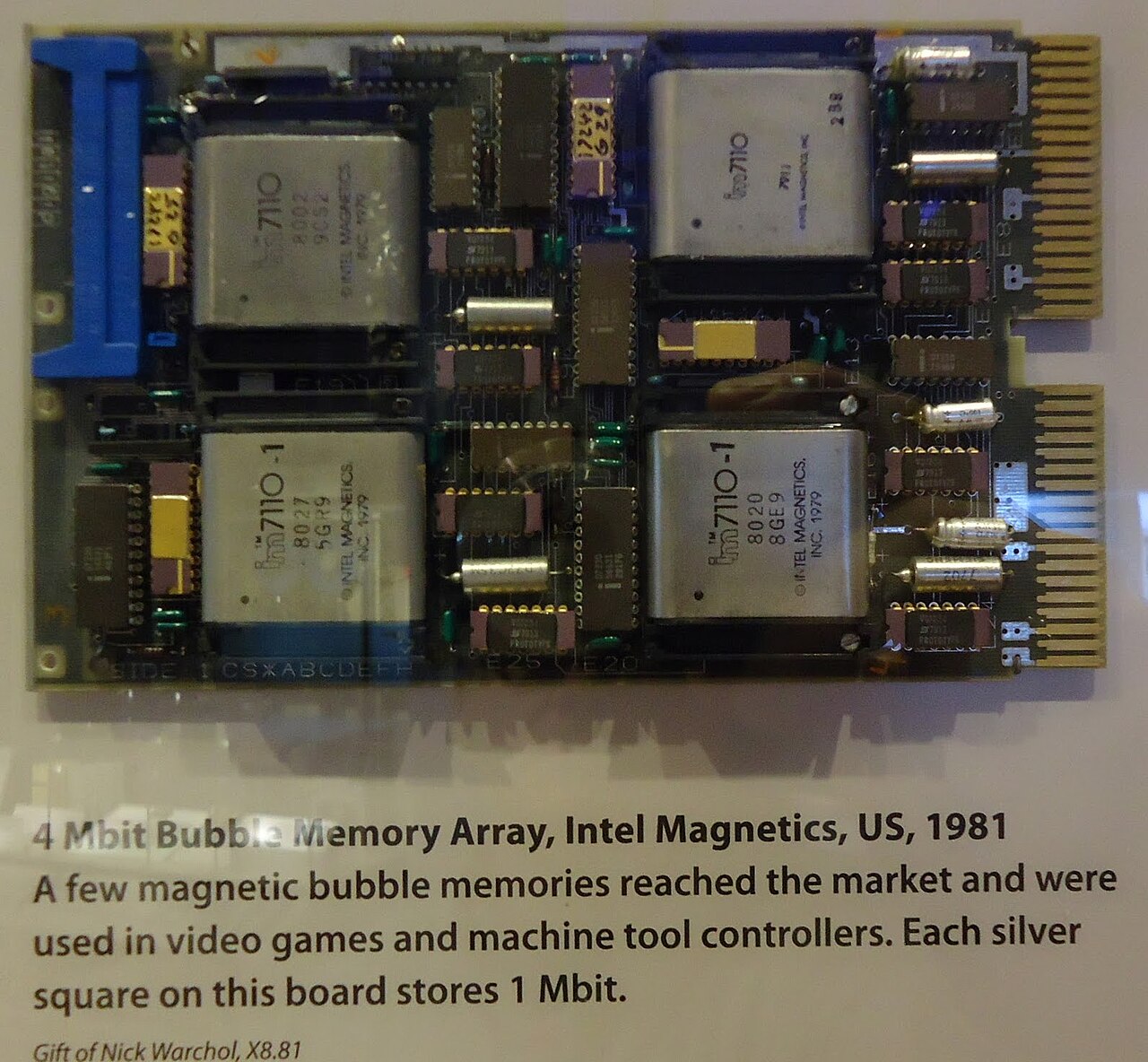
Intel formed a subsidiary, Intel Magnetics, in 1977. In 1979 it introduced the 7110, the first one-megabit bubble chip on the market, storing 128 kilobytes. Intel’s approach, which Bobeck later praised, was to sell the chip with a complete family of support chips (controller, coil drivers, sense amplifier) so that a designer could treat it as a subsystem. By the start of 1981 the one-megabit bubble chip had four times the capacity of the most advanced semiconductor RAM, then a 256-kilobit prototype, and in December 1980 the market researchers of Venture Development Corporation wrote that bubble memory was “finally ready” to meet its enthusiasts’ expectations.
1981
The collapse came within the year. Rockwell International left the bubble business in February 1981. Texas Instruments withdrew in June, a month after it also stopped making digital watches and liquid-crystal displays. National Semiconductor closed its bubble operation in August, after investing $5 million; its president, Charles Sporck, now expected the whole market to be worth $50 to $100 million by 1985 or 1986, a tenth of the earlier forecasts. Univac and Burroughs had dropped out before they reached full production. The field was left to Bell Labs and IBM, which made bubbles mainly for their own use, and to Intel, Motorola, Hitachi and Fujitsu.
The reason was price. In 1981 bubble storage cost about 100 millicents (thousandths of a cent) per bit and was expected to reach 30 millicents in 1982. Dynamic RAM already cost about 10 millicents per bit and was expected to reach 3 by 1985. Floppy disks had become much cheaper, and Winchester hard disks were growing in capacity every year. “These changes in the price of rival technologies are greater than was anticipated,” Sporck said. Manufacturing was also harder than expected: the garnet substrate was not consistently good enough for high yields, and Union Carbide, which made it, was reportedly unwilling to invest in better material for a market that had not appeared. Gadolinium gallium garnet wafers cost about $100 each in 1982.
The amount spent depends on who counts. The Computer History Museum gives an estimated $1 billion in research. In 1981 a Dataquest consultant estimated that AT&T, TI and IBM had each spent $40 to $50 million, and Fujitsu and Intel perhaps more than $30 million each, for a total of perhaps $350 million.
Intel stayed in by guaranteeing prices: $500 for a one-megabit bubble memory throughout 1981 and $300 in 1982. The Times saw no real replacement in sight in September 1981, and Bobeck argued that the longer that remained true, the more likely it was that “bubbles are not going to be displaced.”
The Products
Bubble memory went where its ruggedness counted more than its price. The GRiD Compass 1101 of 1982, the $8,150 folding portable described in The Portable Computer, had 384 KB of internal bubble memory in three modules, which kept its contents with the power off and survived being carried. NASA flew Compass machines on the Space Shuttle, among them on Discovery’s STS-51G mission in June 1985. Other buyers built bubbles into oscilloscopes, signal analysers (Hewlett-Packard offered a bubble option for its 3561A for $1,595), telephone systems, numerically controlled machine tools, flight recorders and military field equipment. Texas Instruments used them in its portable terminals. Fujitsu used bubble memory in its FM-8 personal computer in 1981.
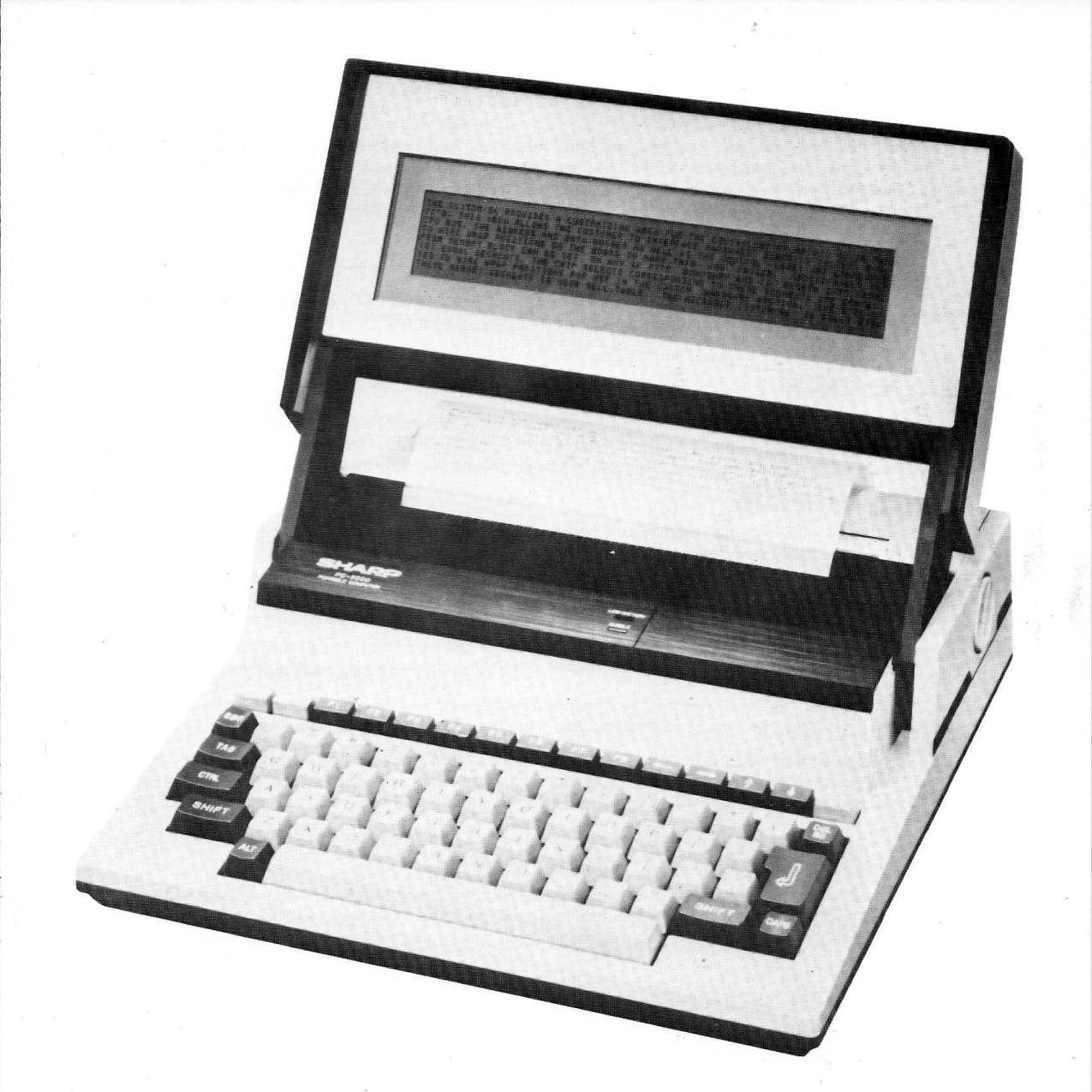
The Sharp PC-5000, a battery-powered MS-DOS portable of November 1983, made bubble memory its main storage. It took 128 KB bubble cartridges, about 2 by 2 inches, in a slot above the keyboard. MS-DOS saw each cartridge as a single-sided floppy drive, A or B. Creative Computing listed a blank cartridge at $269 and one preloaded with SuperCalc at $369, and noted that a temperature lock stopped the machine from using a cartridge below 32 or above 104 degrees Fahrenheit, and that the cartridges should be kept away from strong magnetic fields. Since a floppy drive needed mains power, the bubble cartridge was the only storage that worked on the road.
Intel kept increasing capacity. Four-megabit chips such as the Intel 7114 appeared in 1983, and 8- and later 16-megabit devices were developed. Each generation arrived to find that DRAM and hard disks had moved further.
The Bubble System
The best-known bubble product was a game machine. In January 1985 Konami announced arcade games for its Bubble System, in which each game came on a removable bubble memory cartridge that an arcade operator could swap without changing the circuit board. The games included Gradius and TwinBee.
The bubble chips worked properly only at about 30 to 40 °C, so every time the machine was switched on it first had to heat them. A synthesized voice announced “Presented by Konami. Getting ready…” and counted down while the cartridge warmed up; then the screen read “WARMING UP NOW,” and a second countdown ran while the game was copied from the bubbles into RAM, accompanied by a tune that players came to know as the “Morning Music.” The system cost considerably more than a board with ROM chips, and strong electromagnetic fields could corrupt a cartridge and make the game unplayable. Konami converted all its Bubble System games to ordinary ROM boards (Gradius was sold abroad as Nemesis) and discontinued the system (see The Video Game Industry).
The Long Tail
Intel kept Intel Magnetics until 1986, when it sold the bubble business to concentrate on newer memory technology; other accounts place the sale, a management buyout that founded the company MemTech in Santa Clara, in 1987. In October 1987 the columnist Jerry Pournelle wrote in BYTE that he had replaced a 512 KB bubble memory card in his IBM PC with a hard card, and concluded that Intel had never made bubble chips “small enough or cheap enough to be a serious contender.” John Dvorak, looking back a few years later, described MemTech as the only company still selling bubble memory in the United States, at about twice the cost per bit of flash memory or SRAM, to customers who needed storage for factory floors, satellites and military hardware. MemTech eventually dropped bubbles and became a supplier of rugged flash drives for the military.
Flash memory, invented at Toshiba in the 1980s, took the last niche: it was solid-state, non-volatile, needed no coils or bias magnets, and got cheaper on the same curve as DRAM (see The Storage Revolution). By the end of the decade bubble memory had disappeared from the market. Bobeck retired from Bell Labs in 1989, holding more than 120 patents, and died on 14 December 2017 at 91.
The idea of moving magnetic domains past a fixed sensor returned in IBM’s racetrack memory, described by Stuart Parkin and colleagues in Science in 2008, which pushes domain walls along nanowires with electric current instead of a rotating field. It has been described as a one-dimensional version of bubble memory, and it has not reached the market either.
Dead End
Bubble memory was squeezed from both sides of the memory hierarchy at once. On the fast side, semiconductor DRAM was quicker by orders of magnitude and, from about 1980, cheaper per bit. On the cheap side, floppy and hard disks offered far more capacity for the money and kept improving faster than anyone had predicted. Bubble memory’s advantages, ruggedness and non-volatility, were real, but they were worth a premium only to customers who could not use a disk, and that market was a small fraction of the billion dollars a year the forecasts had promised.
The technology also never escaped its support electronics. A bubble chip needed coils, drivers, sense amplifiers and a controller around it, which kept systems large, power-hungry and expensive, and the price war it needed to win against DRAM was fought on DRAM’s terms, in the same kind of fabrication line, on yields that the garnet material could not match. Bobeck’s 1981 argument was that nothing else offered the same combination of properties. He was right about the combination. Flash memory supplied it at the end of the decade, on silicon.
📚 Sources
- Banks, Howard: “The Computer Bubble That Burst,” The New York Times, 20 September 1981 (TI 1974 quote, 1981 exits by Rockwell, TI and National, Sporck quotes, Dataquest investment estimates, cost per bit, garnet problems, Intel price guarantee, Bobeck quotes)
- Bubble memory, Wikipedia (development history, TIB 0103 1977, Intel 7110 1979, Intel 7114 1983, GGG wafer cost, rotating field, products, Pournelle quote, racetrack memory)
- Andrew H. Bobeck, Wikipedia (birth, Purdue, Bell Labs 1949, twistor, awards, retirement, death)
- Andrew H. Bobeck, Franklin Institute laureate page (Ballantine Medal 1973)
- Bobeck, A. H.: “Properties and Device Applications of Magnetic Domains in Orthoferrites,” Bell System Technical Journal, Vol. 46, October 1967, pp. 1901–1925 (as cited in later bubble memory patents)
- Bobeck, A. H., Bonyhard, P. I. & Geusic, J. E.: “Magnetic bubbles: An emerging new memory technology,” Proceedings of the IEEE, 1975
- “Memory & Storage: Innovative Ideas & Stepping Stones,” Computer History Museum, Revolution exhibition (estimated $1 billion in research)
- “A Bubble That Won’t Break,” Intel timeline, 1977 (Intel Magnetics; business sold in 1986)
- “Bubble Memory,” Chips Etc. (Intel Magnetics 1977, 7110 1979, 13A announcement machine)
- “TI wagt sich an 256-Kbit-Magnetblasen,” Computerwoche (TI’s $20 price target and $100 actual price)
- “The basics of bubble memory,” electrickery.nl (reprint from Intel’s Memory Components Handbook Supplement, 1984)
- “7110 Functional Description,” electrickery.nl (Intel data: redundant loops, bootstrap loop, 1,048,576 usable bits)
- US Patent 3,460,116: “Magnetic domain propagation circuit,” Bobeck, Gianola, Sherwood, Shockley, filed 16 September 1966
- “GRiD Compass 1101,” OLD-COMPUTERS.COM (384 KB bubble memory, price, STS-51G)
- “The Sharp PC5000: a desk-top in a briefcase,” Creative Computing, Vol. 10, No. 1, January 1984 (cartridge size, prices, temperature lock)
- Bubble System, Wikipedia (January 1985 announcement, games, warm-up sequence, cost and field sensitivity, ROM conversions)
- Pournelle, Jerry: “Computing at Chaos Manor,” BYTE, October 1987
- Dvorak, John C.: “Whatever Happened to Bubble Memory?,” Dvorak News Blog (MemTech, cost relative to flash, uses)
- Memtech company profile, StorageSearch.com (1987 spin-off from Intel; later military flash SSDs)
- Parkin, Stuart et al.: “Magnetic Domain-Wall Racetrack Memory,” Science, 2008