Dead End: Centronics
Abstract
Centronics of Hudson, New Hampshire, built one of the first commercially successful dot matrix printers, the Model 101 of 1970, and gave it a parallel interface with a 36-pin plug that happened to be lying around in stock. The printer business did not survive the Japanese competition of the early 1980s: Centronics lost $80 million between 1980 and 1985, sold its printers to GENICOM in 1987, and turned itself into a housewares company. The interface kept the company’s name on the back of nearly every printer for another quarter-century. It was never written down as a formal standard until IEEE 1284 in 1994, two years before USB appeared to replace it.
The Casino Printer
Robert Howard, born Robert Emanuel Horowitz in Brooklyn in 1923, was a serial inventor who had already worked on rectangular television tubes, an early cable television system in Queens, and record-pressing equipment before he turned to computers. In 1968 he started Centronics in Hudson with Samuel Lang, seven employees, and backing from An Wang of Wang Laboratories. The first product had nothing to do with office printing. Howard and Wang built a computer system for casinos that tracked every chip transaction by amount, table, and dealer, to stop cashiers and dealers from skimming. The terminals needed to print receipts and reports, so Centronics developed a print head for them.
The print head used seven wires driven by solenoids, fired against a ribbon to form characters from dots. Howard saw that it was worth more than the casino business. The Model 101 was shown in May 1970, printed 165 characters per second, and weighed 118 pounds. The mechanism was developed in partnership with the US arm of the Japanese typewriter and sewing-machine maker Brother, whose president, Max Hugel, lived next door to Howard. Wang spun Centronics off as an independent company in 1971. For the wider story of the dot matrix printer see The History of Printing.
The Plug from the Parts Bin
A printer in 1970 needed some way to receive data, and there was no industry standard for it. Howard, An Wang, and engineer Prentice Robinson designed a parallel interface: eight data lines carrying one byte at a time, a Strobe line on which the computer pulsed for at least a microsecond to say “the byte is ready,” a Busy line on which the printer said “wait,” an Acknowledge line to confirm receipt, and a few status lines such as Paper Out. Serial links of the time moved one bit after another; the parallel design moved a whole character per strobe and reported the printer’s state on separate wires.
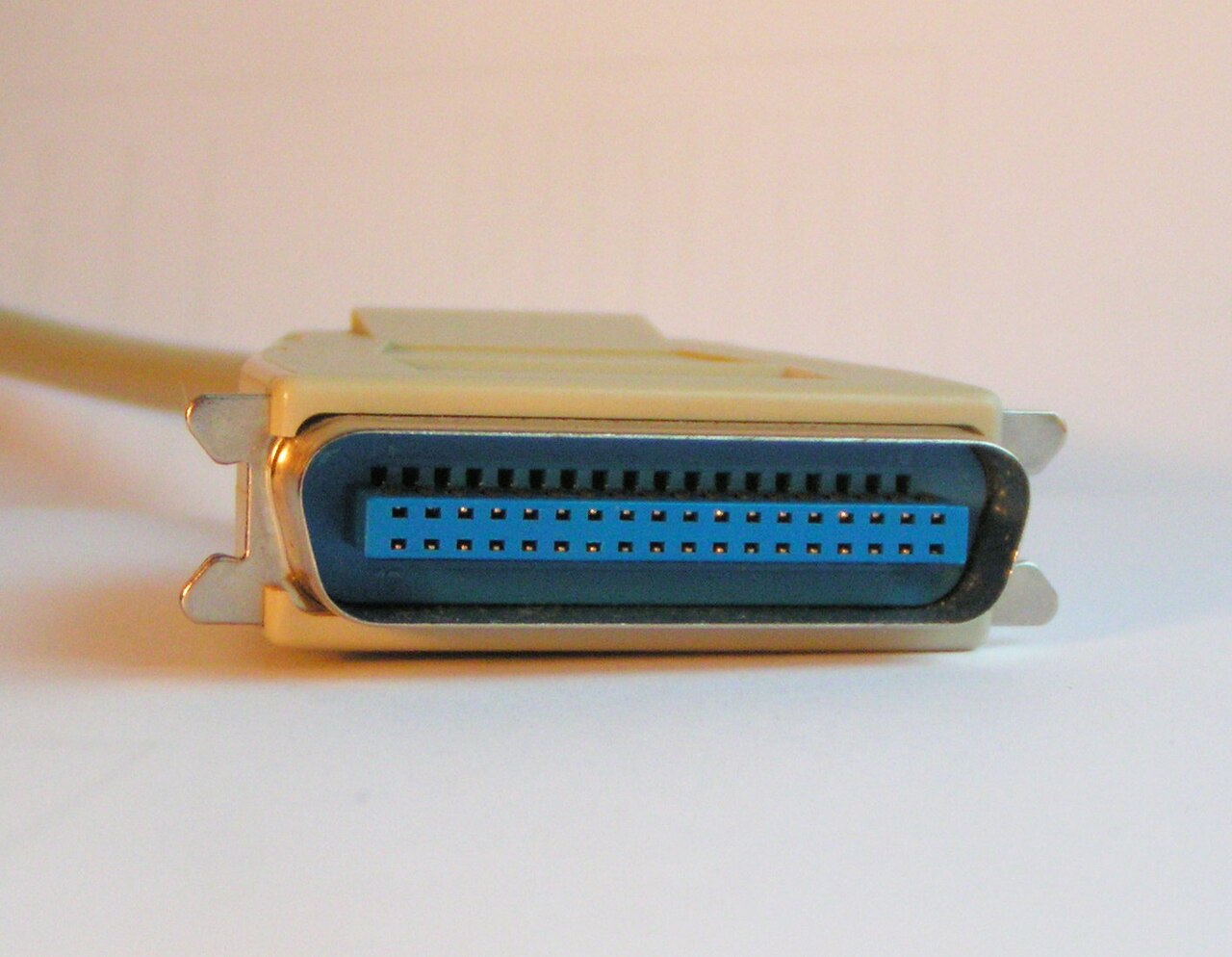
The connector was chosen on what was available. Wang had a stock of 36-pin Amphenol micro-ribbon connectors, a D-shaped plug with two rows of flat contacts, a style otherwise mostly seen in telephone equipment. Nothing about the interface required 36 pins, and nothing forbade them. The plug became known as the “Centronics connector,” and the name spread to its relatives: the 50-pin version used for SCSI-1 disks and scanners was sold as “Centronics 50,” though Centronics had nothing to do with SCSI.
A Standard Nobody Wrote Down
In the 1970s most computers still needed a dedicated printer controller, and the computer side of the cable was a zoo of proprietary interfaces. The Centronics signals spread because printer makers copied them to be able to sell to Centronics customers. Howard later said that once IBM accepted the interface, seven other major companies immediately followed.
The IBM PC of 1981 settled the matter. IBM’s parallel printer adapter used the Centronics signalling but put a 25-pin D-sub socket on the computer, which is why the classic PC printer cable has a DB-25 on one end and the 36-pin Centronics plug on the other. The original adapter could in principle read data back from the printer; the feature went unused and disappeared from later PCs until IBM reintroduced a bidirectional mode with the PS/2 in 1987.
Because the interface was a convention rather than a specification, everyone who needed more from it invented their own extension. Hewlett-Packard’s Bitronics let printers report status back through the input lines. Intel, Xircom, and Zenith defined the Enhanced Parallel Port (EPP) in 1991 for scanners and network adapters, and HP and Microsoft followed with the Extended Capability Port (ECP) in 1992, which added DMA and simple compression and reached about 2.5 MB/s. Iomega’s first Zip drives ran SCSI commands over an ECP port. The parallel port also carried copy-protection dongles and LapLink file-transfer cables, none of which the casino printer’s designers had in mind.
A printer industry group, the Network Printing Alliance, formed in 1991 to sort out the mess, and the IEEE published the result as IEEE 1284 in March 1994. It defined compatibility, nibble, byte, EPP, and ECP modes and three connectors: type A (the PC’s DB-25), type B (the 36-pin Centronics), and type C (a smaller 36-pin plug). The interface had been in use for 24 years before it was formally standardized.
The Company
Centronics grew with the printer. Around 1979 it had annual revenues of over $100 million, and at its largest it employed more than 6,000 people, about 3,000 of them in New Hampshire. Then it stumbled. The Model 770 of 1980, a small desktop printer and the first Centronics built entirely in-house, had a flawed microprocessor that forced a recall and stopped production for a year. In that year Epson, Brother, and other Japanese makers took the market share Centronics never won back. Brother, the partner of 1970, was among them. Centronics lost $80 million between 1980 and 1985. In 1982 Control Data Corporation merged its own printer unit, CPI, into Centronics and invested $25 million; it did not stop the losses.
In 1987 Centronics sold its printer business to GENICOM for $87 million. The following year the remaining company used the proceeds to buy Ekco Housewares for $125 million and renamed itself Ekco Group, a maker of bakeware and kitchen utensils. Robert Howard founded Presstek in 1986, which developed direct-imaging offset presses, and died on 19 December 2014 at 91.
USB and the Legacy-Free PC
The parallel port’s end came from the same place as its triumph, the PC platform. Seven companies published the Universal Serial Bus specification on 15 January 1996, with the parallel port on the list of connectors it was meant to replace (see USB: The Port for Almost Everything). Apple’s iMac G3 of August 1998 shipped with USB and no legacy ports at all. Microsoft and Intel’s PC 2001 System Design Guide described a “legacy-free” PC in which the operating system, devices, and users could not detect ISA slots, a floppy controller, or PS/2, serial, parallel, and game ports. Printers moved to USB and to the office network, and the Centronics socket and the PC’s DB-25 printer port gradually dropped off new machines.
Dead End
Centronics lost twice, in different ways. As a printer company it was a first mover that lost its lead in a single bad year: while the Model 770 was recalled, its Japanese competitors, one of them its own former partner, took over the dot matrix market, and the company never found a product that restored its margins. Control Data’s money and management did not change that, and within 17 years of the Model 101 the firm was out of computing altogether.
As an interface, Centronics won and then aged out. It won because it was simple, early, and adopted by IBM, and because no one owned it or charged for it. That same informality meant nobody maintained it. For two decades every vendor extended it separately, and by the time IEEE 1284 unified the modes in 1994, the industry was already designing USB, a bus with one connector, hot-plugging, power, and device identification that no amount of standardizing could add to a 1970 printer cable. The company that named the plug had been selling cake pans for six years when IEEE 1284 was published.
📚 Sources
- Centronics — Wikipedia (founders Howard and Samuel Lang, origin as a Wang division and 1971 spin-off, casino terminals, Model 101 in May 1970 at 165 cps and 118 pounds, seven-wire print head, Max Hugel of Brother International as Howard’s neighbour, the 1980 Model 770 recall and year-long production stop, Control Data’s 1982 merger of CPI and $25 million investment, $80 million lost 1980–1985, 1987 sale to GENICOM for $87 million, 1988 purchase of Ekco Housewares for $125 million)
- “Man who invented your first printer remembered” — New Hampshire Union Leader (Centronics founded in Hudson in 1968 with seven employees, more than 6,000 workers at its peak with 3,000 in New Hampshire, the casino anti-skimming system with An Wang, Howard’s death at 91)
- “Robert Howard (1923–2014): Dot matrix printer & direct imaging press” — Multimediaman blog, 31 October 2016 (birth name, dates of birth and death, earlier inventions, Howard, Wang and Robinson as designers of the interface, Howard’s remark about IBM and seven companies following, the Brother partnership, Presstek founded 1986)
- “Centronics Data Computer c1977” — Remember Hudson NH When… (1968 founding with seven employees, revenues over $100 million around 1979, the Control Data takeover, the 1987 sale and the 1988 renaming to Ekco)
- “The parallel port” — Computers Are Bad, 29 January 2023 (the casino slip printers, Brother’s president living next door, the stock of 36-pin micro-ribbon connectors, the Strobe/Busy/Acknowledge handshake, the IBM PC’s DB-25 and unused bidirectional mode, EPP 1991, ECP 1992, Iomega Zip over ECP, Ekco)
- Parallel port — Wikipedia (Howard, Wang and Robinson; the 36-pin Amphenol connector from surplus stock; IBM PC 1981 with DB-25; bidirectional mode reintroduced with the PS/2 in 1987; EPP and ECP speeds)
- IEEE 1284 — Wikipedia (Network Printing Alliance 1991, standard released March 1994, the five modes, connector types A, B and C, displacement by USB and network printing)
- Micro ribbon — Wikipedia (Amphenol’s connector, the 36-pin “Centronics” name, 50-pin telco and SCSI-1 use)
- PC System Design Guide — Wikipedia (Microsoft/Intel PC 97–PC 2001 guides; PC 2001’s definition of a legacy-free PC without parallel ports)
- Legacy-free PC — Wikipedia (iMac G3 of 1998 as the first widely known legacy-free computer)