The History of Printing
Abstract
The laser printer gets the credit, and it was never the machine most people owned. For thirty years the ordinary computer printed by hitting paper: chains of type hammering out 600 lines a minute in the data center, a spinning plastic wheel producing letters good enough for a business reply, nine pins in a moving head drawing anything the computer could describe. Then it printed by squirting ink through nozzles the width of a hair, and the printer stopped being the product. The cartridge became the product. What began as an engineering problem, how to get a computer’s output onto a page, ended as a legal one: whether the company that sold you the printer still owns what you put in it. Two of those fights reached the United States Supreme Court.
The Noise of the Data Center
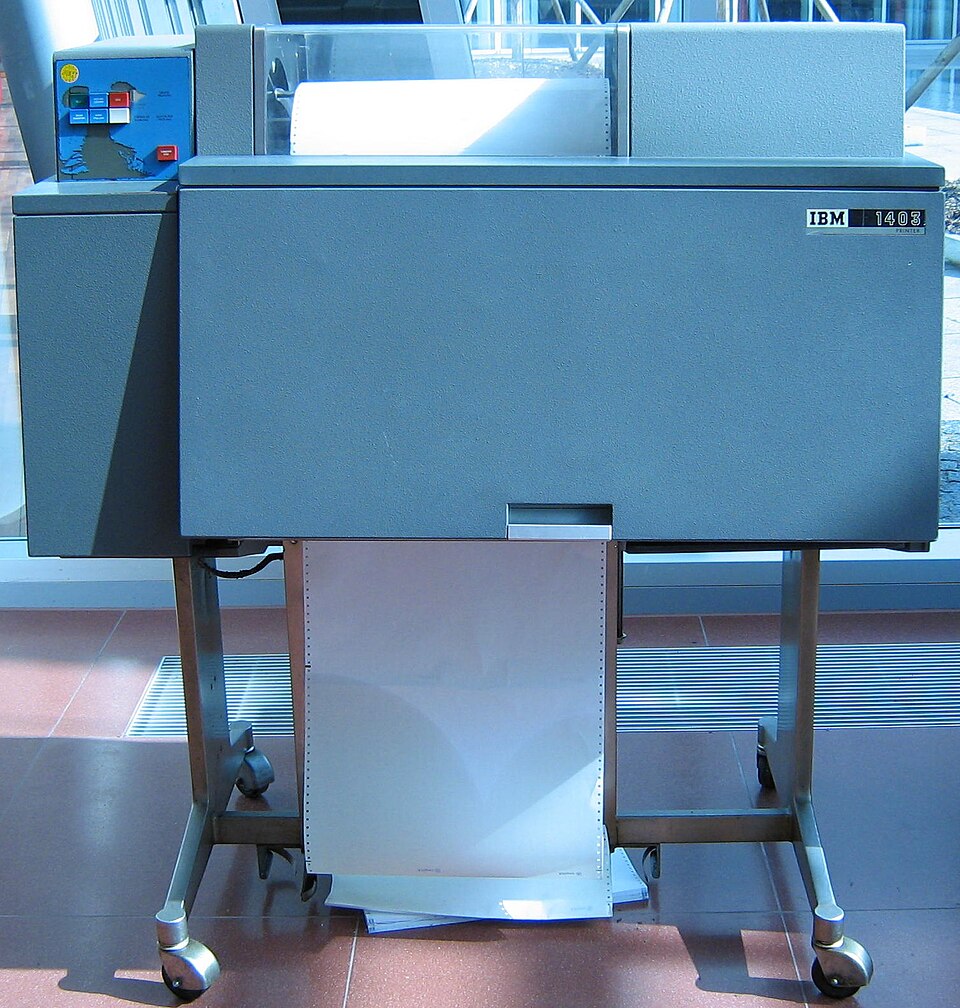
The first computer printers were not built to make one page. They were built to make a hundred thousand, and the design followed from that.
The IBM 1403 arrived in 1959 with the IBM 1401 and printed 600 lines per minute; the model 3 reached 1,400. It worked by spinning a chain carrying up to fifteen copies of the character set horizontally past the paper, with hammers striking from behind at the instant the right letter went by. Getting the timing wrong produced garbage, so the machine’s whole engineering was about hitting a moving target 600 times a minute without missing. IBM sold it until 1983, twenty-four years, a run almost nothing else in computing has matched.
It was loud. IBM eventually offered a model with a powered cover that reached the floor to cut the noise. Programmers noticed something else about a machine whose hammers fired on command: text could be composed so that the print timing produced audible frequencies, which made the 1403 play recognizable tunes. It was the first computer most people ever heard sing.
Letter Quality
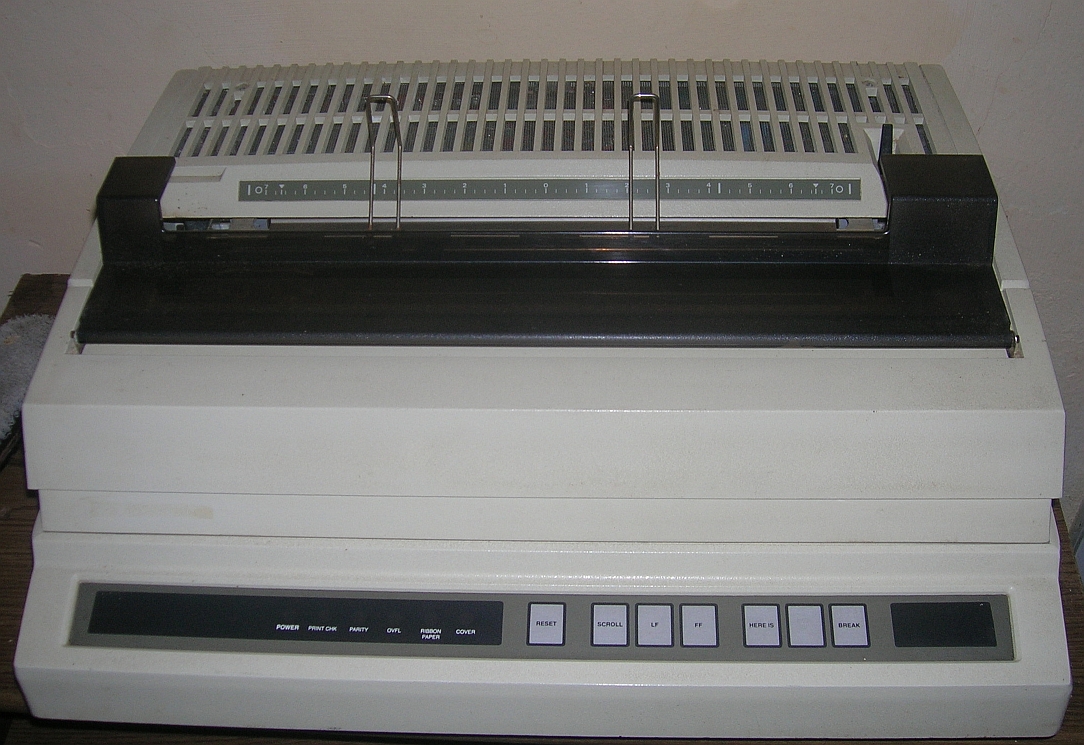
Line printers were for computers talking to computer people. A letter to a customer needed to look like a typewriter had made it, and in the 1970s that meant one thing: fully formed characters struck through a ribbon.
Andrew Gabor at Diablo Data Systems invented the daisy wheel printer in 1970: a flat plastic wheel with the characters on the ends of radiating spokes, spun to bring the right letter to the hammer. It ran at 30 characters per second against 13.4 for IBM’s Selectric typewriter mechanism, and it produced output an office could not distinguish from a typewriter’s. The Diablo 630 became the design everyone copied and everyone else’s printers pretended to be; by 1980 daisy wheels dominated high-quality text printing, and “Diablo 630 emulation” was a checkbox on competitors’ spec sheets for years.
The wheel had one limit, and it was fatal. It could print any character cast into the plastic and nothing else. No diagrams, no graphs, no typeface the wheel did not physically carry, no font you invented this morning. When the personal computer arrived with bitmap screens and software that could describe any shape, the daisy wheel could not follow, and by the mid-1980s cheap laser and inkjet machines had ended it. The technology that won the letter-quality argument lost the argument about what a page is.
Nine Pins and a Ribbon
The machine that actually sat next to most computers hit the paper with pins.
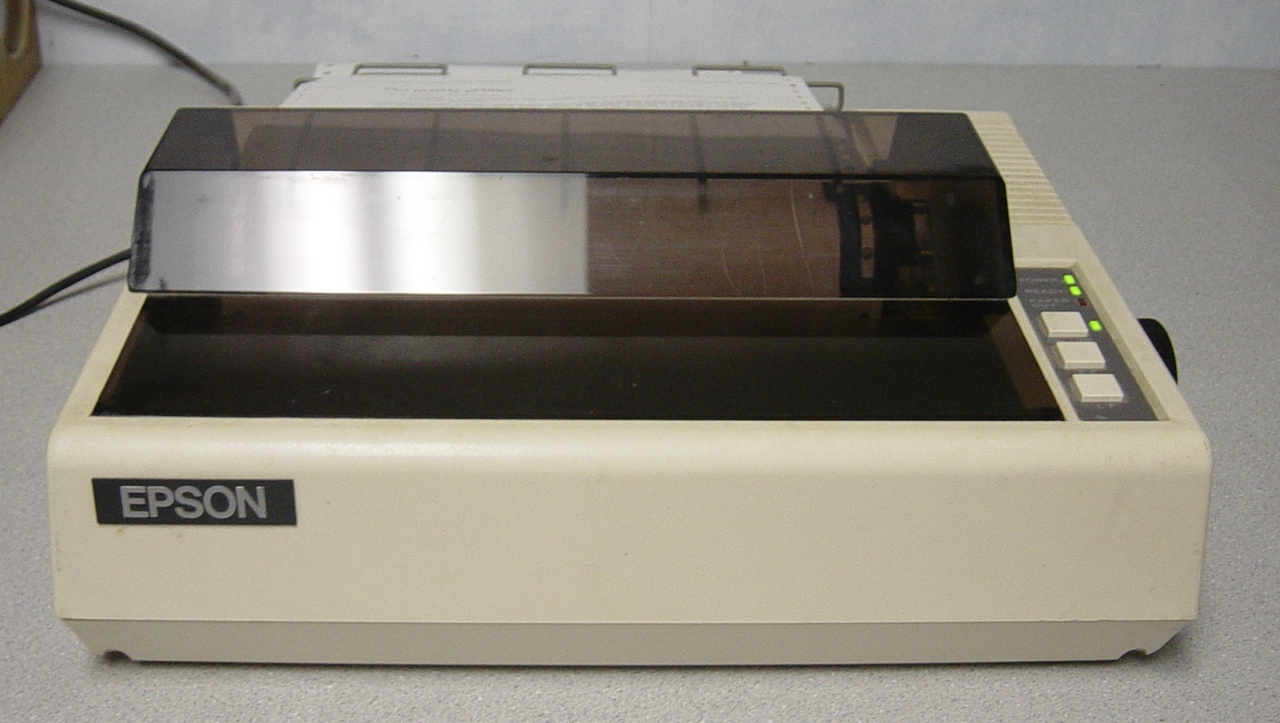
A dot matrix printer fires a column of small pins through a ribbon; move the head across the page, fire the right pins at the right moments, and any pattern of dots becomes possible. Quality is worse than a daisy wheel and the flexibility is total. OKI shipped the Wiredot in 1968 with a 7×5 matrix. In 1970 two machines defined the category: DEC’s LA30, 30 characters per second, uppercase only, and the Centronics 101, shown at the National Computer Conference that year, at 165 characters per second. Centronics gave the industry more than a printer. The connector it designed for the 101’s parallel interface became the Centronics connector, the plug on the back of printers for decades. The company itself did not last: it sold the printer business to GENICOM for 87 million dollars in 1987, and the parent bought a housewares firm the next year and renamed itself Ekco Group. The connector outlived the company by longer than the company existed. DEC’s LA36 of 1974 sold in volume and became the standard hardcopy terminal for a while.
The company that took the market was a watch manufacturer. Shinshu Seiki was founded in 1961 to supply precision parts to Suwa Seikosha. When Seiko became official timekeeper for the 1964 Tokyo Olympics, the timing equipment needed to print results, and the subsidiary that built the printing timer kept going: in September 1968 it shipped the EP-101, a miniature printer meant to be built into other machines, including calculators. It sold well enough that in June 1975 the company named its next generation after it. EP for Electronic Printer, plus son: the son of the EP-101 was the Epson.
The MX-80 shipped in October 1980, nine pins, and it took the personal computer market. Epson sold over 200,000 in 1981 alone, raising production from 10,000 units a month in January to 40,000 by October. By 1982 the MX-80 held half the world market for 80-column printers: 70 percent in Japan, 60 percent in Europe, 35 percent in the United States, where IBM sold it rebadged as the 5152. It was the best-selling dot matrix printer for much of the 1980s, peaking at 60 percent of the global market, and passed a million units by the time it was retired in the mid-1980s. For a decade the sound of computing in a home or a small office was an MX-80 or one of its imitators grinding a line of text across fanfold paper, and the tractor holes tearing off the edges were the last physical step of any document.
Printing Without Hammers
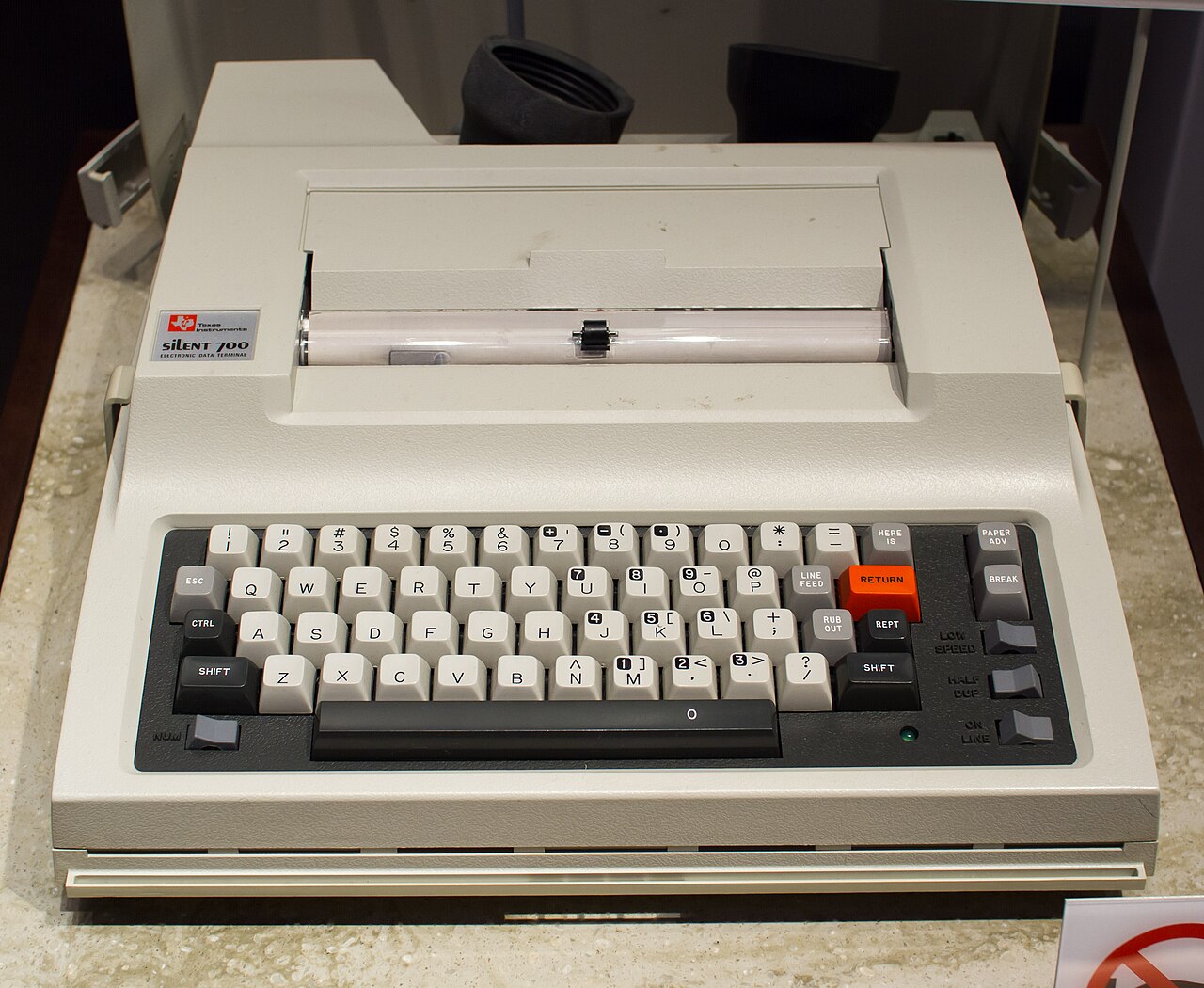
Every machine so far worked by impact, which is why they all made noise. Thermal printing removed the hammer: heat elements darken chemically treated paper directly, so nothing strikes anything.
The technique was old, used in electrocardiograph recorders in the 1930s and in 3M’s Thermofax copier in 1950, with NCR improving the chemistry with leucopigments for military communication in the 1960s. Texas Instruments turned it into a computer product with the Silent 700 in 1971, and the name was the sales pitch: a terminal with a 5×7 thermal printhead was quiet enough to sit in an ordinary office. Better, it was portable. Models with a built-in acoustic coupler let a salesperson or a student drop a telephone handset into two rubber cups and hold an interactive session with a computer from any phone in the country, at 30 characters per second, printing the conversation on a roll of paper.
Thermal printing lost the document market and won everything else. It has no ribbon, no ink, no cartridge, and almost no moving parts, so it took over the places where a printer must be small, cheap, and silent: receipts, labels, tickets, fax machines. The tradeoff is that the image is a chemical reaction and keeps reacting. A thermal receipt fades; the coating that makes it work also makes it temporary, which is why the paperwork proving what you paid turns blank in a drawer in a few years. In the 2000s studies found bisphenol A in thermal papers, which turned the cash register receipt into a consumer health argument that is still running.
The Drop on Demand
Squirting ink at paper is the idea that looks obviously right and took a century to make work. Lord Kelvin patented a syphon recorder in 1867; Siemens sold a medical chart recorder using Rune Elmqvist’s patent in 1951. These were continuous inkjets: a stream of drops flying constantly, deflected either onto the paper or into a gutter. It records a wiggling line well. It is a poor way to build an office machine.
What was needed was drop-on-demand: a nozzle that fires only when a dot is wanted. The first way to do it was to squeeze the ink. A piezoelectric crystal deforms when charged, and a chamber pinched by one will spit a measured droplet. Siemens built the first commercial drop-on-demand inkjet on that principle in Munich (see Germany’s IT Industry), largely the work of Joachim Heinzl: the PT-80 of 1977, twelve nozzles, 270 characters per second, faster and quieter than the dot matrix machines it competed with.
The second way was to boil the ink, and it was invented twice, independently, on two continents, within about eighteen months, once by accident and once on purpose.
At Canon in 1977, Ichiro Endo’s team was working on piezoelectric ejection when a soldering iron accidentally touched an ink-filled needle and the heat pushed a drop out of the tip. Heating the ink, not squeezing it, would do the job: a resistor boils a tiny volume, the vapor bubble expels a droplet, the bubble collapses and the chamber refills. Canon filed the founding patent in October 1977 and called the technique Bubble Jet. In late 1978 John Vaught at Hewlett-Packard, chasing fast low-cost printing, found the same effect with thin-film resistors. The two teams learned about each other roughly two years later, and are now credited together.
Thermal inkjet was the version that reached the desk. HP shipped first: the ThinkJet of 1984, roughly 192×96 dpi and 150 characters per second, the first mass-market thermal inkjet, and its selling point was the same one the Silent 700 had used seventeen years earlier. It was quiet. Canon’s first Bubble Jet product, the BJ-80, followed in 1985. HP put the word “Jet” on the ThinkJet and then on everything, including the LaserJet of the same year, whose print engine Canon built (see Gary Starkweather for how the laser got there, and John Warnock and PostScript and The Desktop Publishing Revolution for what happened when a page became a program).
The inkjet’s engineering problem became its business model. A thermal printhead sits in hot corrosive ink and wears out, so the cheap answer was to throw the printhead away with the ink, in one disposable part. The cartridge was born as a maintenance decision.
Razor and Blades
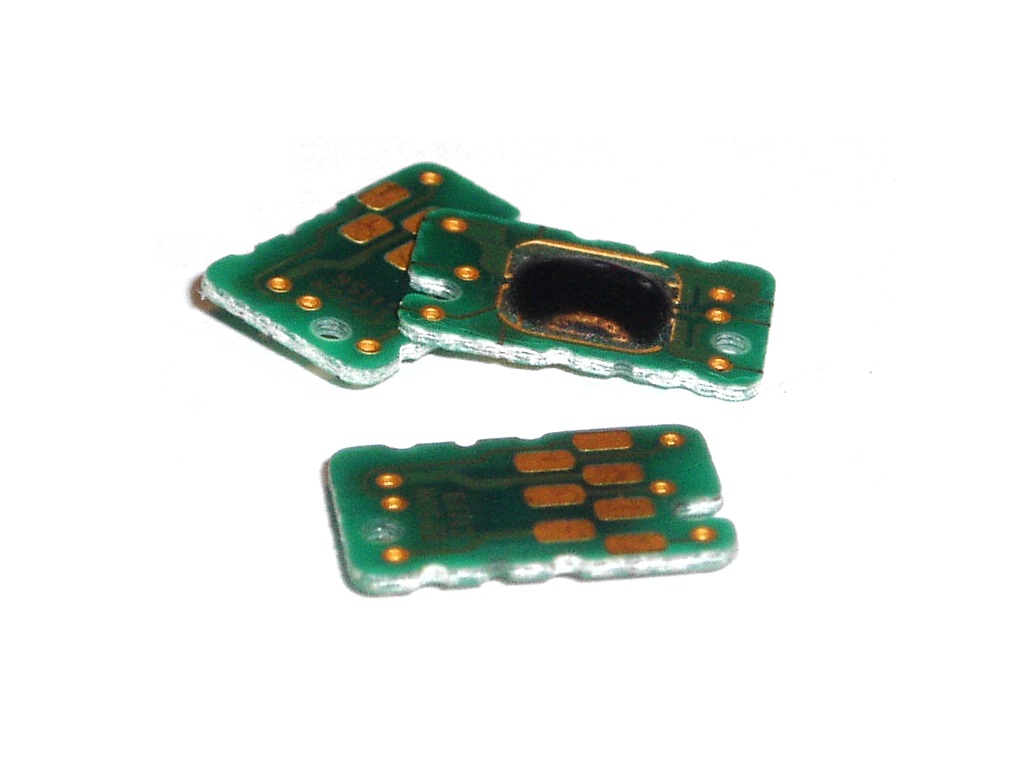
Once the ink came in a proprietary part the customer had to buy again, the printer stopped needing to make money. HP, Lexmark, Dell, Canon, Epson, and Brother converged on the same arrangement: sell the machine at or below cost, take the margin on cartridges for the life of the device. Printers appeared in shops for less than the ink inside them, and were sometimes cheaper than the replacement cartridges they shipped with.
The numbers are what make the story. Printer ink has been documented at 13 to 75 US dollars per fluid ounce, roughly 440 to 2,536 dollars per litre. In 2022 the consumer group Which? costed a set of cartridges for one Epson office printer at £111.99, which works out at £1.78 per millilitre, against roughly 24 pence per millilitre for a bottle of Dom Pérignon. Ink came out about seven times the price of vintage champagne, and Which? called it one of the most expensive liquids on Earth. The comparison became the standard joke, and the joke was arithmetic.
Defending that margin required engineering against the customer. Cartridges got microchips that report ink level and refuse service, and a chip can decide “empty” before the cartridge is. A 2007 study by TÜV Rheinland, commissioned by Epson and duly won by Epson, still found that printers taken at their word left an average of 20 percent of the ink in a single-ink cartridge unused, with individual models stranding anywhere from 9 to 64 percent. Epson settled a class action over false empty warnings in 2006 with 45-dollar coupons. HP paid roughly 5 million dollars across three class actions in 2010.
The counter-industry grew anyway. Remanufactured cartridges took about 30 percent of the market, third-party ink undercut the originals by half on average and sometimes by 95 percent, and every mechanism the manufacturers built to stop it became a court case.
Dead End: Owning the Cartridge by Copyright
Lexmark took the most ambitious swing, and it is the reason a printer company appears twice in United States Supreme Court reporting.
The first attempt used copyright law. Lexmark’s toner cartridges carried a chip running a 55-byte program that handshook with the printer’s engine program, and cartridges sold under its discounted “Prebate” scheme were meant to stop working once the chip’s calculation said the toner was gone, refilled or not. In 2002 Static Control Components built a chip that duplicated the handshake so remanufacturers could sell refills. Lexmark sued, arguing the copy circumvented an access control and violated the anti-circumvention provisions of the DMCA, the law written for copyright in the digital era. It won a preliminary injunction on 3 March 2003. On 26 October 2004 the Sixth Circuit threw the theory out: the authentication sequence did not control access to a copyrighted work in any sense the DMCA protects. A statute passed to stop movie piracy would not be allowed to lock a toner cartridge. Static Control got the last word in 2014, when a unanimous Supreme Court held it could sue Lexmark back under the Lanham Act.
The second attempt used patent law and reached the Supreme Court directly. Lexmark sold Return Program cartridges at a 20 percent discount with a contractual ban on reuse and resale, and sued Impression Products, which bought used ones, replaced the chips, refilled them, and sold them on. Decided 30 May 2017, Impression Products v. Lexmark held 7 to 1 (with Justice Gorsuch not participating) that a patent holder’s rights are exhausted at the first authorized sale, domestically or abroad. Post-sale restrictions might survive as contract terms between the parties, but they are no longer patent infringement, and they do not bind whoever buys the thing next.
Two theories, copyright and patent, both aimed at making a refill illegal rather than merely difficult, and both lost. The manufacturers were left with the tool the courts could not take away: the firmware.
HP shipped Dynamic Security in 2016, a cartridge authentication system, and activated it that September through a firmware update that made printers reject cartridges without an HP chip, including third-party cartridges already installed and working. HP said it was fighting counterfeits and protecting the integrity of its printers. Its CEO, Enrique Lores, later told CNBC that a virus could be embedded in a third-party cartridge and travel from the cartridge to the printer to the network; the evidence was research HP had funded, and security researchers who looked at it told Ars Technica they had never seen such an attack outside HP-sponsored tests. Lores also said the company’s long-term aim was to make printing a subscription.
The bills came steadily. HP settled In re HP Printer Firmware Update Litigation in the Northern District of California for a 1.5 million dollar fund in 2018, approved in April 2019, and agreed not to reinstall Dynamic Security on the printers at issue. A European settlement covering Belgium, Italy, Spain, and Portugal cost 1.35 million dollars in 2022, with payouts of 20 to 95 euros a household and no admission of fault.
Then HP did it again. A firmware update in November 2020 switched Dynamic Security on in printers that had been sold without it, and the suit filed the next month argued the update was functionally malware: it added, deleted, and altered code, and took away capabilities the owners had paid for. That case settled in August 2024 and was approved by Judge Susan Van Keulen in March 2025. The class got nothing. The three named plaintiffs got 5,000 dollars each, the lawyers got about 725,000 dollars, HP admitted no wrongdoing, and owners of the listed LaserJet models won the right to decline the update or roll it back. Every HP printer built after December 2016 and not on that list stayed exactly where it was.
The Branch That Stopped Printing Documents
One line of descent gave up on paper. If a machine can deposit a controlled amount of material at a computed coordinate, nothing says the material must be ink or the result flat. Adding a third axis and melting plastic instead of drying it turns a printer into a fabricator, which is why the vocabulary carried over intact: print head, resolution, driver, print job.
Desktop 3D printing followed the trajectory this article has been describing, then took the other fork. Key patents expired in 2009, the open-source RepRap project put the designs in public, and a technology that had cost 200,000 dollars became a 200-dollar appliance within a decade. That story, including MakerBot’s turn from open-source pioneer to cautionary tale, belongs to The Open Hardware Movement. The relevant point here is what the 3D printing world did not copy. It grew up in the shadow of the ink cartridge and largely refused it: filament is a commodity spool that anyone can make, sold by weight, from whoever you like.
📚 Sources
- Dot matrix printing (Wikipedia) — OKI Wiredot 1968, DEC LA30 and Centronics 101 (1970), LA36 (1974), Epson MX-80 and the IBM 5152 rebadge
- IBM 1403 (Wikipedia) — 1959 introduction with the IBM 1401, 600 to 1,400 lines per minute, chain and hammer mechanism, discontinued 1983, noise-reducing cover, printing music
- Daisy wheel printing (Wikipedia) — Andrew Gabor at Diablo Data Systems 1970, 30 cps against the Selectric’s 13.4 cps, the Diablo 630, dominance by 1980, obsolescence by the mid-1980s
- Epson (Wikipedia) — Shinshu Seiki founded 1961 under Suwa Seikosha, the 1964 Tokyo Olympics printing timer, EP-101 (September 1968), the Epson name (June 1975)
- EP-101 (Wikipedia) — the first electronic mini-printer, September 1968, built out of the Olympic timing work, and the “son of EP” naming
- Epson MX-80 (Wikipedia) — October 1980, over 200,000 sold in 1981, production from 10,000 to 40,000 units a month, 1982 shares (half of the global 80-column market, 35 percent US, 60 percent Europe, 70 percent Japan), best-selling dot matrix printer of the 1980s peaking at 60 percent globally, over a million units
- Centronics (Wikipedia) — the Model 101 at the 1970 National Computer Conference, 165 cps, the Centronics connector, the 1987 sale of the printer business to GENICOM for 87 million dollars, and the parent’s turn into Ekco Group
- Thermal printing (Wikipedia) — 1930s electrocardiograph recorders, 3M Thermofax 1950, NCR leucopigments in the 1960s, receipt fading, BPA findings in the 2000s
- Silent 700 (Wikipedia) — introduced 1971, 5×7 thermal printhead, portability, built-in acoustic coupler at 30 characters per second
- Inkjet printing (Wikipedia) — Kelvin’s 1867 syphon recorder, Elmqvist/Siemens 1951, Ichiro Endo’s 1977 soldering-iron discovery at Canon, John Vaught at HP in late 1978, razor-and-blades model, cartridge microchips, third-party pricing
- Siemens PT80i (second.wiki) — the PT-80 of 1977 as the first commercial drop-on-demand inkjet, developed in Siemens’s Munich data-technology laboratory with Joachim Heinzl, 12 piezoelectric nozzles, 270 cps
- The history of Canon’s intellectual property in the printing field (Canon Global) — the October 1977 founding patent application for thermal (Bubble Jet) inkjet
- Canon celebrates 30th anniversary of launch of first Bubble Jet inkjet printer (Canon Global, 2015) — the BJ-80 as Canon’s first Bubble Jet product, 1985
- HP ThinkJet (Wikipedia) — 1984, 192×96 dpi, 150 cps, quiet operation, the first mass-market thermal inkjet
- Canon Inc. (Wikipedia) — Bubble Jet in 1985 (one year after HP), the LBP-CX engine behind the first Apple LaserWriter and HP’s equivalent
- Ink cartridge (Wikipedia) — razor-and-blades economics, ink at 13 to 75 dollars per fluid ounce, Epson’s 2006 coupon settlement, HP’s 5 million dollars in 2010 class actions, 30 percent remanufactured market share, third-party discounts
- Which? wants probe into printer ink which can cost ‘seven times more than Dom Perignon’ (BerkshireLive, 24 September 2022) — £111.99 per cartridge set, £1.78 per ml against Dom Pérignon at 24p per ml, “one of the most expensive liquids on Earth”
- InkJet Printers Lying, Or Just Wrong? (Slashdot, 2007) — the TÜV Rheinland study commissioned by Epson, an average 20 percent of ink left in single-ink cartridges declared empty, range 9 to 64 percent, Epson rating highest
- HP CEO justifies blocking third-party ink cartridges by claiming they can inject malware (Tom’s Hardware) — Enrique Lores’s CNBC claim that a cartridge virus could reach the printer and the network, HP-funded 2022 research behind it, and researchers’ skepticism
- HP CEO wants to ‘make printing a subscription’ (PCWorld) — Lores on HP’s long-term subscription aim
- Lexmark Int’l v. Static Control Components (Wikipedia) — the 55-byte toner loading program, Prebate, the Smartek chip (2002), the 3 March 2003 injunction, the Sixth Circuit’s 26 October 2004 DMCA ruling, the 25 March 2014 Supreme Court Lanham Act decision
- Impression Products, Inc. v. Lexmark International, Inc. (Wikipedia) — Return Program cartridges at a 20 percent discount, argued 21 March 2017, decided 30 May 2017, patent exhaustion on first sale domestically and abroad
- HP pays $1.35m to settle dispute over printer security chip (The Register, 13 September 2022) — the 1,350,000 dollar European settlement (Belgium, Italy, Spain, Portugal), payouts of 20 to 95 euros, no admission of fault, and Dynamic Security’s activation by firmware update in September 2016
- HP Printer Firmware Case (Joseph Saveri Law Firm) — In re HP Printer Firmware Update Litigation, No. 5:16-cv-05820 (N.D. Cal.), the 1.5 million dollar fund, preliminary approval 19 November 2018 and final approval 25 April 2019, HP barred from reinstalling Dynamic Security
- HP settles lawsuit over ink-blocking printer update, with no payout or admission of wrongdoing (TechSpot, March 2025) — the November 2020 firmware update, the suit filed December 2020 alleging the update acted as malware, the August 2024 settlement approved by Judge Susan Van Keulen, 5,000 dollars to each named plaintiff, 725,000 dollars in fees, nothing for the class, and the right to decline the update on listed models
- Image: Epson MX-80.jpg by Original uploader was Nakamura2828 at us.wikipedia (CC BY-SA 3.0), via Wikimedia Commons
- Image: IBM line printer 1403.JPG by waelder (CC BY 2.5), via Wikimedia Commons
- Image: Diablo630 1981without sheet feeder.jpg by Canon650 (CC BY 3.0), via Wikimedia Commons
- Image: TI Silent 700, 1971.jpg by Michael Dunn (CC BY 2.0), via Wikimedia Commons
- Image: Inkjet Cartridge Microchips.jpg by Zephyris at English Wikipedia (CC BY-SA 3.0), via Wikimedia Commons