Steve Jobs and Apple
Abstract
Steve Jobs did not write code. He could not solder a circuit board. He understood almost nothing about the technical internals of the products he created. What he possessed instead was a violent certainty about what products should feel like, and the will to impose that certainty on everyone around him, regardless of whether they wanted to be imposed upon. He was fired from Apple, the company he co-founded. He spent eleven years building a company that almost no one wanted to buy and a studio that made one film. Then he came back and built the iPod, the iPhone, and the iPad in eight years, making Apple the most valuable company in the world. He died at fifty-six.
Adoption and Childhood
Steven Paul Jobs was born on February 24, 1955, in San Francisco, California. His biological parents (a Syrian graduate student named Abdulfattah “John” Jandali and a Wisconsin woman named Joanne Schieble) were not married and placed him for adoption. He was adopted by Paul and Clara Jobs, a machinist and an accountant, who settled in the Santa Clara Valley, which had not yet been called Silicon Valley.
Paul Jobs worked on cars in the garage, and taught his son how to take things apart and put them back together cleanly. Jobs later said that this taught him that the inside of a product mattered as much as the outside: that care and craft should be evident even in the parts no one would see.
Jobs met Steve Wozniak at Homestead High School through a mutual friend. Wozniak was five years older, already clearly a technical prodigy. Their first collaboration was a blue box, a device that generated the 2600-hertz tone used by AT&T’s switching network, giving the user access to free long-distance calls. They sold them to students at Berkeley and Stanford. Jobs was sixteen. He recognized immediately that Wozniak’s technical genius, combined with his own salesmanship, was a viable commercial enterprise.
The Apple I and the Garage
Jobs enrolled at Reed College in Portland in 1972 and dropped out after one semester; he could not justify the expense to his adoptive parents. He stayed on campus for eighteen months, sleeping on floors, auditing classes that interested him, including a calligraphy course that he later said planted the idea of multiple typefaces in the Macintosh.
In 1974, he took a job at Atari. Later that year, he left for India to seek spiritual enlightenment with his friend Dan Kottke, spent several months in the subcontinent, returned to California, and resumed working at Atari.
By 1975, Wozniak had designed a computer, not a kit, not a collection of chips on a board, but a complete, self-contained machine with a keyboard and a working BASIC interpreter on a chip. Jobs saw it and understood what it was: a product. He persuaded Wozniak to co-found a company to sell it. On April 1, 1976, Apple Computer Company was founded by Jobs, Wozniak, and Ronald Wayne, an Atari colleague who received 10% of the company to act as tiebreaker between the two Steves. Wayne withdrew twelve days later and was paid $800 for his stake, plus $1,500 a year later to waive any future claims.
About 200 Apple I boards were built; the Byte Shop in Mountain View bought the first 50. It was a hobbyist product. The Apple II, which followed in 1977, was not. The whereabouts of some 60 to 80 of the 200 boards are known today; in October 2014 the Henry Ford Museum paid $905,000 at a Bonhams auction for a working unit, at the time the highest price paid for an Apple I.
Myth: Apple was founded and built in Jobs’s garage
The garage on Crist Drive is Silicon Valley’s founding shrine, but co-founder Steve Wozniak has called the story “a bit of a myth.” In a 2014 interview he was blunt: “We did no designs there, no breadboarding, no prototyping, no planning of products. We did no manufacturing there.” Wozniak designed the Apple I at his cubicle at Hewlett-Packard; the garage was mostly used to stage finished boards before driving them to the Byte Shop. The myth endures because, as Wozniak put it, the garage “represents us better than anything else”, a good origin image, not an accurate one. See Myths and Misconceptions.
The Apple II and Real Money
The Apple II was Wozniak’s masterpiece. It used color graphics, a technically extraordinary achievement for 1977, achieved through a software trick that exploited the color burst timing of the NTSC television signal. It had eight expansion slots, a keyboard, a power supply, and a molded plastic case designed by Jerry Manock. It cost $1,298 with 4 KB of RAM; the maximum 48 KB brought the price to $2,638.
Jobs insisted on the plastic case, not a metal box, not a kit, but something that looked like a consumer appliance. He visited Cuisinart and asked Manock to model the case on the clean plastic lines of the food processor. He also insisted that the power supply fan be eliminated, hiring Rod Holt to design a switching power supply that ran cool enough without a fan. Users would never have to hear the machine.
In 1979, VisiCalc (the first spreadsheet) shipped on the Apple II. Accounting departments bought the Apple II to run VisiCalc. Apple’s revenue grew from $7.8 million in 1978 to $117 million in 1980. The company went public in December 1980. It was the largest U.S. IPO since Ford Motor Company in 1956. Jobs, at twenty-five, was worth $256 million.
Xerox PARC and the Macintosh
In December 1979, Jobs arranged for a delegation from Apple to visit Xerox PARC, the research center in Palo Alto that Xerox had built to, in PARC scientist Alan Kay’s famous dictum, “invent the future.” (The full story of what PARC created and why Xerox failed to commercialize it is told in The Xerox PARC Revolution.) Jobs had seen what PARC was doing and negotiated access in exchange for pre-IPO Apple stock.
What he saw was the Alto: a computer with a graphical interface, a mouse, overlapping windows, icons, and menus. PARC had been using this system internally for years. Xerox had no plan to commercialize it.
Jobs was famously excited. He has been quoted as saying, over the objections of the PARC engineers showing him the system, “You’re sitting on a goldmine here. Why aren’t you doing anything with this?” PARC engineers later said they felt Jobs had not understood everything he saw. What he had certainly understood was that the mouse-and-window metaphor was the future of how people would interact with computers.
He returned to Apple and redirected the team working on the Lisa computer (a $10,000 workstation) and ordered a cheaper machine built around a graphical interface. That machine was the Macintosh.
Myth: Steve Jobs (or Apple) invented the graphical user interface
Apple invented neither the GUI nor the mouse. The windows, icons, menus, and pointer Jobs saw at Xerox PARC in 1979 were built there through the 1970s, themselves descended from Douglas Engelbart’s 1968 “Mother of All Demos”, which first publicly showed the mouse, hypertext, and windowed editing. What Apple did (and did brilliantly) was commercialize and refine the idea: turn an expensive research system few could use into the affordable, coherent Macintosh (1984) that brought the GUI to the public. The contribution was productization, not invention. See Myths and Misconceptions.
The Macintosh and the Ouster
In April 1983, Jobs recruited John Sculley, the president of Pepsi-Cola, as Apple’s CEO. Apple’s board wanted professional management; Jobs wanted a marketing mind and a partner. The closing line of his pitch became famous: “Do you want to sell sugar water for the rest of your life, or do you want to come with me and change the world?” For two years the two ran Apple as self-described partners.
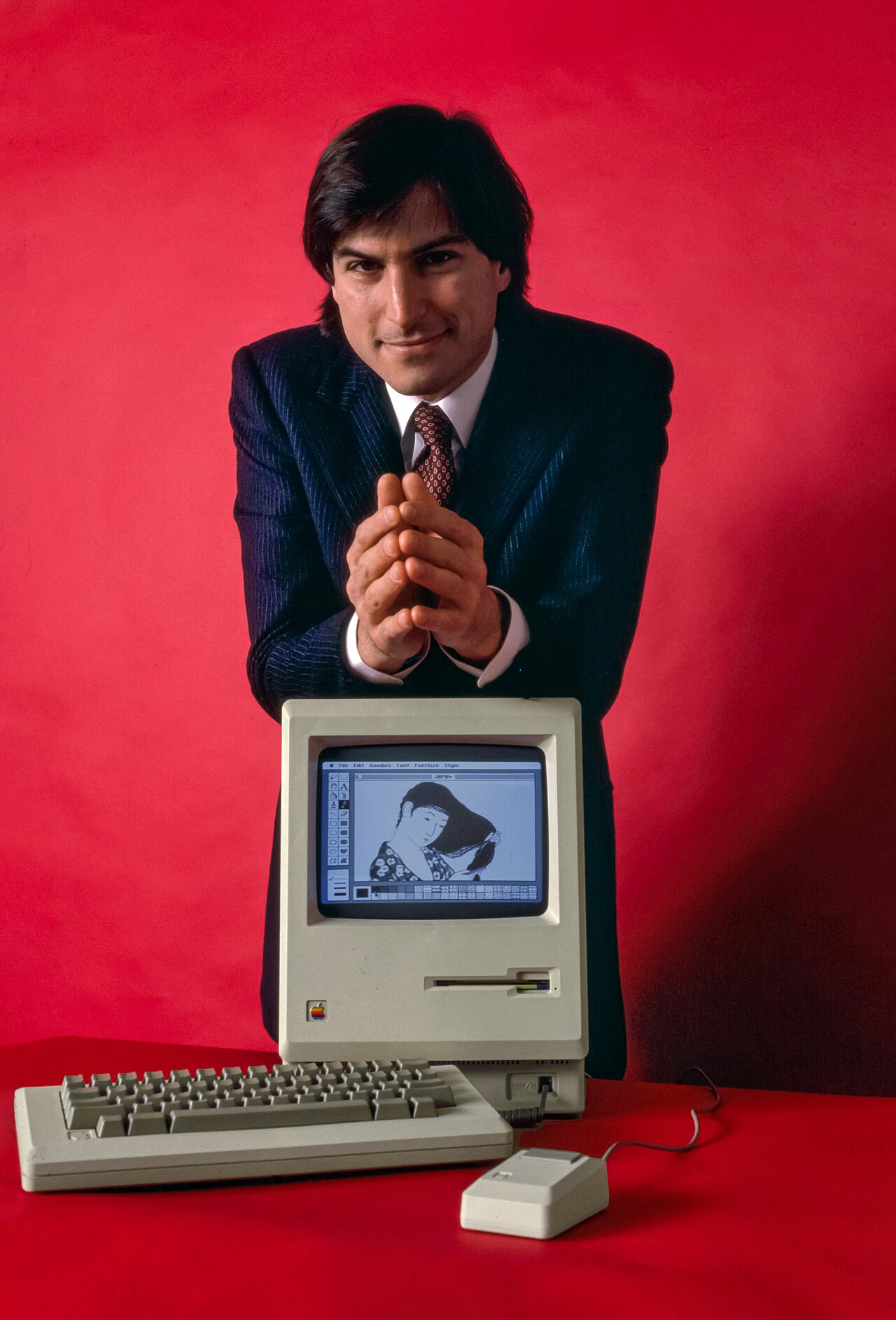
The Macintosh launched on January 24, 1984. The launch advertisement, directed by Ridley Scott and aired during Super Bowl XVIII, depicted a woman running through a grey dystopian hall to smash a screen displaying a Big Brother figure (IBM) with a hammer. The tagline: “On January 24th, Apple Computer will introduce Macintosh. And you’ll see why 1984 won’t be like 1984.”
The Macintosh itself was technically extraordinary and commercially frustrating. The interface was revelatory, smooth, consistent, logical in a way no previous computer had been. But the hardware was underpowered, the 128 kilobytes of RAM insufficient for the software’s ambitions, the single disk drive a constant obstacle. Professional users found it cute and limiting. Sales collapsed after the initial surge.
By 1985, Apple’s board had lost confidence in Jobs’s management of the Macintosh division. Jobs had alienated the Apple II team, burned through engineers with his demands, and missed sales projections. Sculley moved to take the division away from him; Jobs responded in May 1985 by trying to persuade the board to remove Sculley instead. The board and the executive staff sided with Sculley, and Jobs was stripped of his management responsibilities. He resigned in September 1985 and sold all but one of his Apple shares. Sculley ran Apple until 1993, growing revenue roughly tenfold on the strength of the Macintosh and desktop publishing before the decline that ended his tenure.
The Ouster’s Lesson
Jobs’s management style in the early 1980s was corrosive in ways he later acknowledged. He routinely humiliated engineers publicly, told people their work was “shit” without specific critique, and played favorites in ways that destroyed team cohesion. His return to Apple in 1997 featured the same intensity and perfectionism, but tempered (slightly) by experience and by the near-death of the company he had built.
NeXT and Pixar
Jobs founded NeXT Computer in 1985 with $7 million of his own money and five Apple employees. The NeXT Cube, launched in 1988, was beautiful, technically sophisticated, and expensive: $6,500 at launch for a machine with no color display and no floppy drive. Its cube shape had a model: the black, LED-studded Connection Machine (1986). According to its designer Tamiko Thiel and to Jobs’s marketing chief Joanna Hoffman, Jobs asked Hoffman to recruit Thiel to design his new machine, but she had already left for Germany to become an artist. It ran a Unix-based operating system that was years ahead of anything available on personal computers. Universities bought it. The broader market did not.
NeXT never shipped more than 50,000 units. But the software (NeXTSTEP, an operating system built on the Mach kernel with object-oriented development frameworks) was the most advanced development environment in the personal computer market. When Tim Berners-Lee invented the World Wide Web in 1990-1991, he wrote it on a NeXT machine.
In 1986, Jobs had purchased The Graphics Group from Lucasfilm for $5 million. George Lucas needed cash during his divorce settlement and sold the computer graphics division that had been working on 3D graphics for film production. Jobs renamed it Pixar.
For years, Pixar was a hardware company selling graphics workstations to studios and medical imaging firms. Jobs subsidized it through the late 1980s as it lost money consistently. The creative team (Ed Catmull, John Lasseter, and others) made animated commercials to survive. In 1991, Disney contracted Pixar to make three feature films.
The first was Toy Story, released in November 1995. It was the first entirely computer-animated feature film, a commercial and critical success, and the trigger for Pixar’s IPO. Jobs owned 80% of Pixar; the IPO made him a billionaire, wealthier, for the first time, from Pixar than from his Apple holdings.
The Return
Apple’s other candidate for that replacement operating system was Be Inc.’s, and the negotiation collapsed over price: see Dead End: BeOS.
Apple acquired NeXT in December 1996 for $429 million, ostensibly for NeXTSTEP software that would become the foundation of a new Mac operating system. The real acquisition was Jobs. He returned to Apple first as an advisor, then as interim CEO in September 1997, then (after firing the board that had ousted him) as permanent CEO in 2000.
The company he returned to was weeks from bankruptcy. Gil Amelio, the CEO Jobs replaced, had been unable to stop Apple’s market share decline. The product line was unfocused, the internal culture demoralized. When Michael Dell, asked in October 1997 what he would do with Apple, answered “I’d shut it down and give the money back to the shareholders,” Jobs called the remark rude at a company meeting and added: “We’re coming after you, buddy.”
At Macworld Boston on August 6, 1997, Jobs announced a deal with the enemy: Microsoft would invest $150 million in non-voting Apple stock, commit to releasing Microsoft Office for the Mac for five years, and settle the companies’ long-running patent disputes; Internet Explorer would become the Mac’s default browser. When Bill Gates appeared on the giant screen above the stage, the audience booed. Jobs pushed back: “We have to let go of this notion that for Apple to win, Microsoft has to lose.” The $150 million was symbolic next to Apple’s problems; the Office guarantee was not, because a Mac that could not open Word and Excel files was a Mac no business would buy.
In late September 1997 Apple launched “Think different,” its first major campaign of the Jobs restoration, created by TBWA\Chiat\Day (art director Craig Tanimoto coined the slogan; Rob Siltanen wrote the “Here’s to the crazy ones” manifesto with Lee Clow). Black-and-white footage of Einstein, Gandhi, Picasso, and other rule-breakers ran under narration by Richard Dreyfuss; Jobs had recorded a version himself and dropped it on the morning of the first broadcast, saying the ad was about Apple, not about him. Grammarians objected to “different”; Jobs wanted it colloquial, like “think big.” Apple had nothing new to sell yet, so the campaign advertised the brand itself. It ran until 2002 and won the 1998 Emmy for outstanding commercial.
Jobs cut Apple’s product line from dozens of models to four, consumer and professional, desktop and portable. He killed the Newton, the Pippin, and the Mac OS licensing program that had let clone makers undercut Apple’s own machines (Dead End: The Mac Clones). He brought Jony Ive, a British designer who had been at Apple since 1992, to lead industrial design. The iMac, launched in August 1998 in a translucent teal enclosure, demonstrated that a computer could be a desirable object. It sold 800,000 units in its first five months.
iPod, iTunes, iPhone, iPad
Jobs had a theory about transitions between paradigms. The personal computer era had been defined by productivity software. The next era, he believed, would be defined by digital media. In 2001, he articulated the “digital hub” strategy: the Mac as the center of a digital lifestyle, managing music, photos, and video.
The iPod, launched October 2001, put 1,000 songs in your pocket. The design was minimal, white, a mechanical scroll wheel, nothing unnecessary. The slogan was accurate. The supply chain management was ruthless: Apple locked up flash memory capacity before competitors could. Within three years, the iPod had over 70% of the MP3 player market.
The iTunes Music Store, launched April 2003, solved the music industry’s problem with digital distribution: 99 cents per song, legal, simple. Jobs negotiated this deal by persuading the five major labels that their alternative was continued rampant piracy. Within a week, a million songs had been purchased.
The iPhone, announced January 9, 2007, was introduced with one of the most famous product presentations in business history. Jobs began by saying he was introducing three revolutionary products: a widescreen iPod with touch controls, a revolutionary mobile phone, and a breakthrough internet communications device. He repeated the list. Then: “These are not three separate devices. This is one device. And we are calling it iPhone.”
The iPhone eliminated the hardware keyboard, the stylus, and the idea that a smartphone needed to run scaled-down software. Its multi-touch screen, its mobile Safari browser, and its fluid interface were years ahead of any competing device. When Steve Ballmer laughed at the iPhone’s $499 price in a widely quoted interview, he was working from a model of what mobile phones were that was already obsolete.
The App Store, launched July 2008, created a platform economy that had not previously existed: third-party software for a controlled device, distributed through a single curated store, with Apple taking 30% of revenue. By 2023, the App Store generated over $89 billion in annual billings.
The iPad, launched April 2010, completed the arc. Jobs had originally designed the iPad before the iPhone; he set it aside when the multi-touch screen work suggested a smaller, more personal device was possible first. The iPad redefined the tablet computer (a category that had existed for years without success) as a media and productivity device simple enough for anyone.
The Cancer and the End
Jobs was diagnosed with a rare form of pancreatic cancer (an islet cell tumor) in October 2003. He resisted surgery for nine months, trying dietary treatments and spiritual approaches that oncologists later said gave the slow-growing tumor time to spread. He eventually had the surgery in July 2004.
He took medical leaves in 2009 and 2011. His weight loss became the subject of constant press speculation; Apple’s legal obligation to disclose the CEO’s health became a source of tension between Jobs’s fierce privacy and shareholders’ right to information. He received a liver transplant in 2009.
Jobs resigned as Apple’s CEO on August 24, 2011, writing in his resignation letter: “I have always said if there ever came a day when I could no longer meet my duties and expectations as Apple’s CEO, I would be the first to let you know. Unfortunately, that day has come.” He named Tim Cook as his successor.
He died on October 5, 2011, at his home in Palo Alto. He was fifty-six.
For Apple’s hardware engineer, see Steve Wozniak: The Engineer’s Apple. For the Xerox PARC interface that shaped the Mac, see The Xerox PARC Revolution. For the personal computing context, see The Personal Computing Explosion.
📚 Sources
- Isaacson, Walter: Steve Jobs (2011), Simon & Schuster
- Kahney, Leander: Jony Ive: The Genius Behind Apple’s Greatest Products (2013), Portfolio/Penguin
- Price, David A.: The Pixar Touch: The Making of a Company (2008), Knopf
- Levy, Steven: The Perfect Thing: How the iPod Shuffles Commerce, Culture, and Coolness (2006), Simon & Schuster
- Jobs, Steve: Stanford Commencement Address (June 12, 2005)
- Young, Jeffrey S., and William L. Simon: iCon: Steve Jobs, the Greatest Second Act in the History of Business (2005), Wiley
- Steve Wozniak calls Apple’s garage ‘a bit of a myth’ — Engadget (2014) · Wozniak debunking the garage origin story
- Rekordpreis für Apple 1 — heise online (Oktober 2014) · Bonhams auction, $905,000 paid by the Henry Ford Museum
- Apple I — Wikipedia · production run and surviving units
- Ronald Wayne — Wikipedia · the 10% stake, the $800 and $1,500 payments
- Watch Steve Jobs Tell Michael Dell, “We’re Coming After You” — Slate (2014) · the October 1997 Dell exchange
- App economy recovered in 2023, with $171B in consumer spending — TechCrunch (2024) · App Store share $89.3 billion in 2023
- History of Apple Inc. — Wikipedia · Sculley recruitment and ouster, the August 1997 Microsoft deal
- Think different — Wikipedia · campaign credits, Dreyfuss narration, 1998 Emmy
- Thiel, Tamiko: “The Connection Machine CM-1/CM-2” · Jobs’s 1986 request via Joanna Hoffman and the NeXT Cube connection; also told in Geoffrey Cain, Steve Jobs in Exile (2026)