Dead End: DataPlay
Abstract
DataPlay was a recordable optical disc 32 millimetres across, about the size of a coin, in a protective cartridge, holding 500 MB on its two sides. Steve Volk founded the company in Colorado in 1998, it won Best of Show at the Consumer Electronics Show in 2001, and it raised $119 million from Intel, Toshiba, Samsung, Kodak, Olympus, and a music retailer. Its pitch to the record industry was copy protection built into the medium: albums sold on DataPlay discs could be copied at most three times, and never to a CD. BMG, Universal, and EMI released albums on it in 2002. A player cost $350 when a hard-disk MP3 player with forty times the capacity cost $300. The company filed for bankruptcy on 18 October 2002, months after its first albums reached the shops.
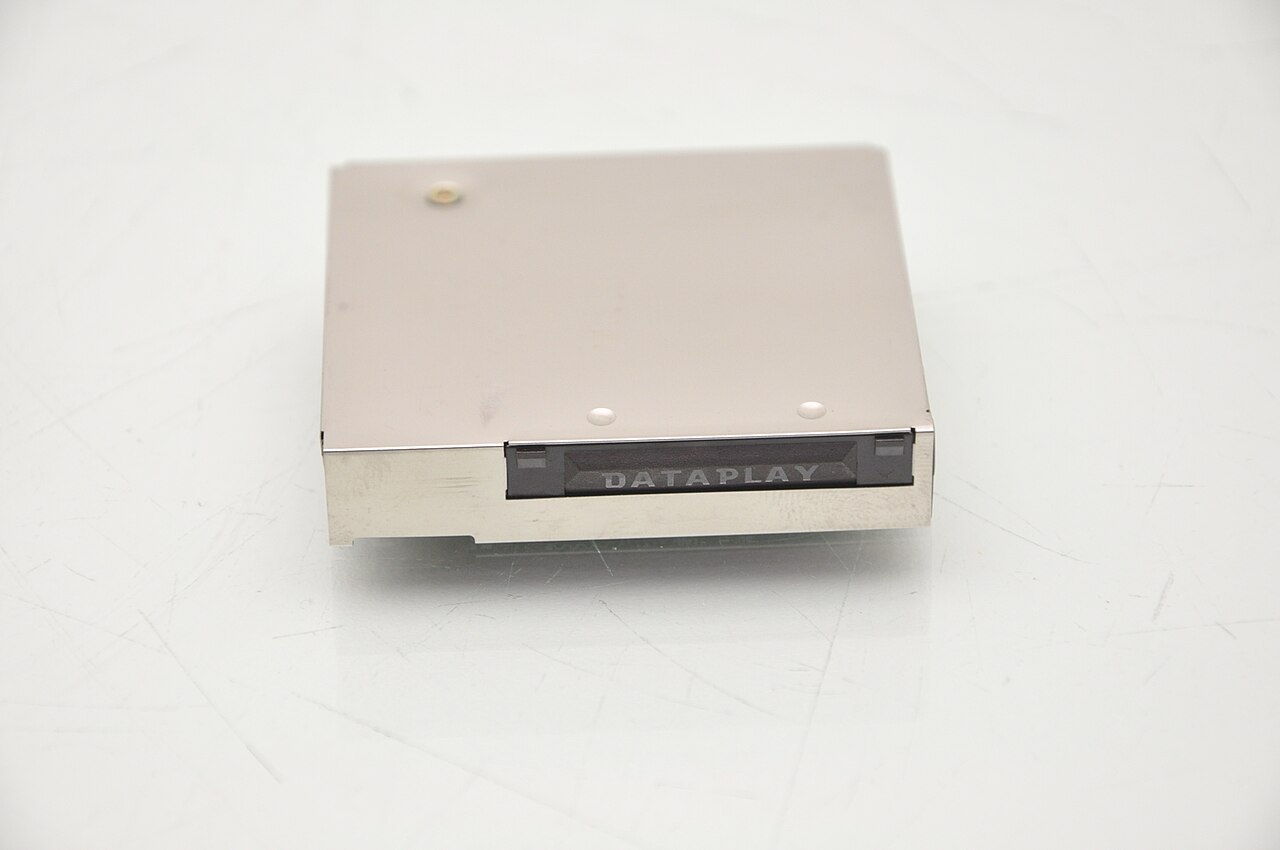
The Disc
Steve Volk came to DataPlay from hard disks. His previous company, Intégral Peripherals, had made very small drives for portable computers and had gone bankrupt in 1998. That year he founded DataPlay to make a removable medium for the devices that were about to need one: digital cameras, music players, and handheld computers.
The medium was a write-once optical disc 32 millimetres in diameter, read and written by a laser, sealed in a cartridge that protected it from fingers and dust. Each side held 250 MB, for 500 MB in all, somewhat less than a 74-minute CD-R. It transferred data at about 1 MB per second, and the company said the discs would last a hundred years. The drive mechanism was small enough for a pocket device. At the Consumer Electronics Show in January 2001 DataPlay won the Best of Show award, and camera and electronics makers lined up to try it: Toshiba showed a prototype camera with a DataPlay drive.
The company raised $119 million in three rounds from May 1999. Its investors included Intel, Toshiba, Samsung, Eastman Kodak, and Olympus, and in June 2001 the American music retailer Trans World Entertainment. The retailer’s money pointed to the business DataPlay increasingly saw as its future: selling recorded music.
The Pitch to the Labels
The record industry of 2001 was frightened. Napster had shown that music could be copied and shared by millions of people at no cost, MP3 had become the format of choice for listeners (see Karlheinz Brandenburg and MP3), and CD burners were turning every computer into a pressing plant. The industry’s response, the Secure Digital Music Initiative (SDMI), was trying to specify copy protection that every device would honour.
DataPlay offered a medium with that protection built in. Its rights-management system, based on SDMI’s work, let a label decide what a buyer could do with a pre-recorded disc. By default, the music could be copied to other DataPlay discs up to three times and not at all to a CD or a computer. The disc could also carry locked extra material, such as additional tracks or videos, which the buyer could unlock online by paying more. For labels this was the first portable format since the cassette that came with copy control from the factory.
Several labels agreed. BMG signed a deal in March 2001 to release new albums on DataPlay, and by 2002 Universal, EMI, and Zomba had announced plans to put their best-selling artists on the format. “Technology should allow the business to change and grow in so many ways it never had an opportunity to do,” said Aahmek Richards of BMG’s Arista Records. Todd Oseth, DataPlay’s vice-president of marketing, was blunter: “Money is what ends up driving everything.”
The Launch
The first player, the iRiver iDP-100, went on sale in 2002 at $350. The first releases were mostly re-issues of best-sellers: Britney Spears, ‘N Sync, Pink, Usher, OutKast, Sarah McLachlan, and Brooks & Dunn. Santana’s album Shaman came out on CD and DataPlay simultaneously, at $18 on CD and $19 on DataPlay. Pre-recorded discs cost $18 to $22, about the price of a DVD; blank discs, $5 each in packs of ten according to the New York Times, and about $10 according to other reports.
The comparison with what buyers already had was unflattering. A $350 DataPlay player held 500 MB per disc. A hard-disk MP3 player of 20 GB cost about $300 and held forty times as much music, which its owner could rip from CDs they already owned without paying again. A commentator at the time noted that a portable CD player that also played MP3 CD-Rs cost about $75, and blank CD-Rs under 50 cents; Sony’s MiniDisc recorders, already established in Japan and Europe, cost about $200, with blank discs at about $2. Industry analysts quoted by the Times in September 2002 asked whether DataPlay had arrived too late with too little for young buyers, and some retailers warned that the cost of players and media might hold back acceptance. Even BMG’s Kevin Clement, who praised the format’s “versatility and incredibly small size,” added: “I don’t think the CD is going away anytime soon.”
The Collapse
DataPlay ran out of money within weeks of that article. It had cut its workforce by half, to roughly 120 people, and still needed tens of millions of dollars, and none of its investors would put in more. On a Friday in mid-October 2002 it closed its doors and laid off its staff, and on 18 October 2002 it filed for Chapter 11 bankruptcy protection. Trans World Entertainment wrote off its investment with an after-tax charge of $5.3 million. The labels’ DataPlay albums became collectors’ items.
The technology had one more round. In 2003 a company called DPHI bought DataPlay’s intellectual property and presented the format again at CES in January 2004, without the music business. It replaced DataPlay’s own file system with the FAT format used by memory cards, planned 500 MB discs at $4.50, prototyped 750 MB discs, and announced plans for 2 and 7 GB versions, marketing the disc as a cheaper alternative to flash cards. The Taiwanese disc maker Ritek said in 2004 that it would resume development of the discs and drives. No significant product followed.
Dead End
DataPlay was a sound piece of engineering attached to the wrong business model. As a storage medium it was competing with flash memory cards, whose capacity rose and price fell every year and which had no moving parts; a write-once optical disc of 500 MB had a narrow window in which it was cheaper per megabyte, and the window closed while the company was still raising money. As a music format it asked buyers to purchase new players and buy their music again, on discs that cost as much as CDs and did less, because the copy protection that made the format attractive to the labels was the feature that made it unattractive to listeners.
The labels learned the same lesson again with Sony’s protected players (see Dead End: Sony ATRAC and MagicGate), and in 2007 and 2008 the major labels began selling MP3 files without copy protection (see Digital Rights Management). The format listeners actually adopted had no copy protection at all, and the device that carried it, the hard-disk and later flash-based music player, had already been on sale for a year when DataPlay’s first album shipped.
📚 Sources
- DataPlay, Wikipedia (Volk and Intégral Peripherals, 32 mm disc, 250 MB per side, CES Best of Show 2001, SDMI-based rights management, three copies, Britney Spears album, closure 2002, DPHI 2003, and CES 2004, FAT, $4.50 discs, 1 MB/s, 100-year claim)
- “DataPlay backed by music industry,” Taipei Times (New York Times News Service), 1 September 2002 (Volk, 500 MB, prices of discs and players, iRiver iDP-100 at $350, 20 GB players at $300, releases, Santana, label support, quotes from Richards, Oseth, and Clement, analysts and retailers)
- “BMG signs with DataPlay to support new format,” CDRinfo, March 2001
- “Santana, Whitney Houston and Avril Lavigne release albums on DataPlay,” CDRinfo, 6 August 2002 (plans of Universal, EMI, and Zomba; Arista launch in autumn 2002)
- Trans World Entertainment Corp., Form 8-K, exhibit 99.1, 28 October 2002 (DataPlay’s Chapter 11 filing on 18 October 2002, June 2001 investment, $5.3 million after-tax charge)
- MEVC Draper Fisher Jurvetson Fund I, Form 10-K for fiscal 2002 (DataPlay investment and bankruptcy)
- “DataPlay Don’t Play No More,” Techdirt, 30 September 2002 ($119 million in three rounds since May 1999, investors, workforce halved to about 120, no investor willing to add money)
- “Dead Dataplay,” Mediageek, 16 October 2002 (closure reported by the Rocky Mountain News, $350 player, $10 blank discs, comparison with CD-R and MiniDisc prices)
- Toshiba DataPlay camera prototype, Digitalkamera-Museum
- Ritek to resume development of DataPlay discs, DigiTimes, 22 October 2004