Dead End: Transmeta
Abstract
Transmeta spent almost five years in secret building an x86 processor that was mostly software. Its Crusoe chip, unveiled on 19 January 2000, had a simple low-power core that could not run a single PC instruction by itself; a layer called Code Morphing Software translated x86 programs on the fly and tuned the translations while they ran. The company employed Linus Torvalds, raised $273 million in a stock offering that November, and lost $97.7 million in the same year on revenue of $16 million. Intel shipped its own low-power laptop chip in 2003. Transmeta gave up making chips, sued Intel over its patents, and settled in 2007 for $250 million.
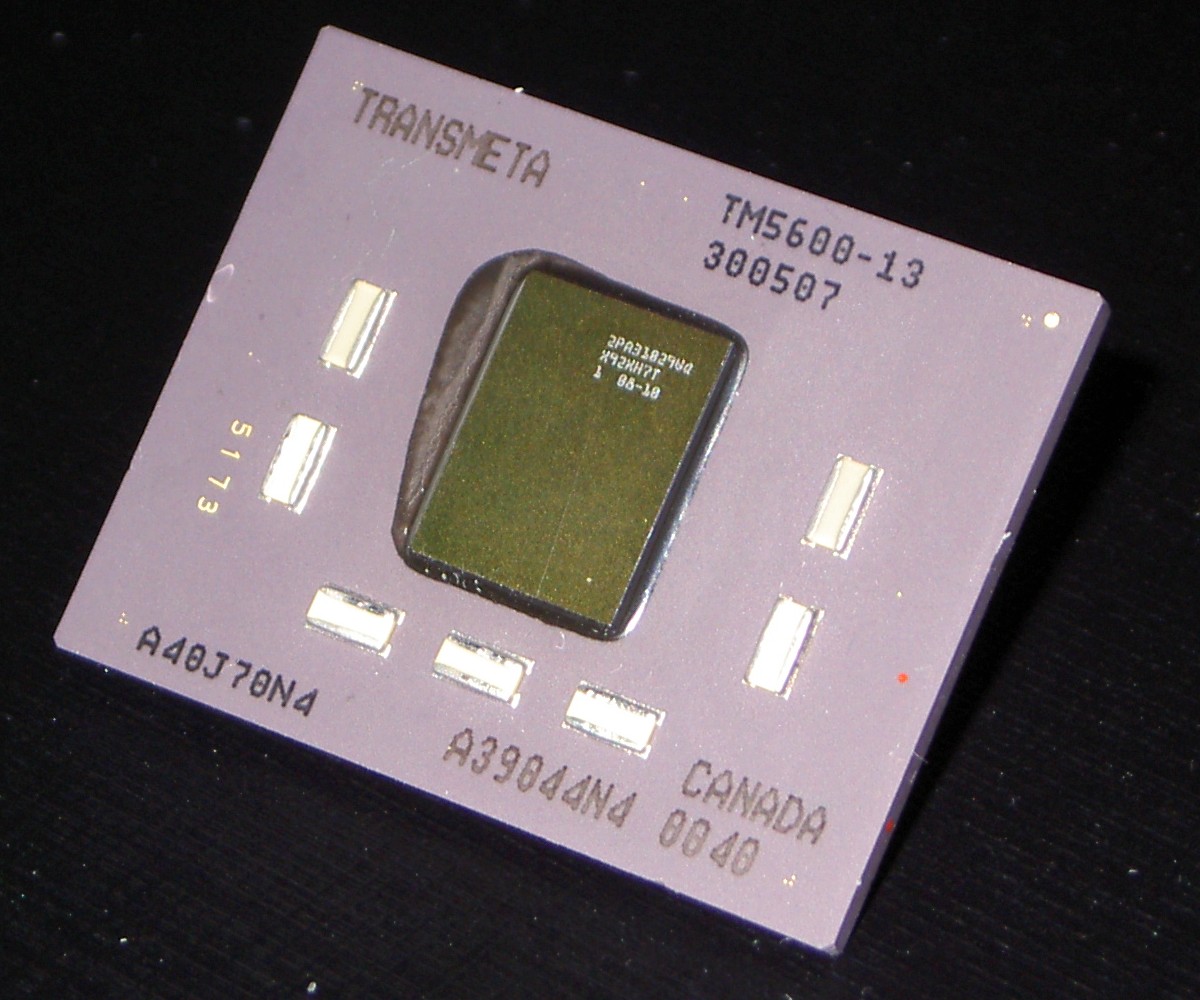
Stealth
Transmeta was incorporated in California in March 1995. Among its seven founders was David Ditzel, who as a Bell Labs researcher in 1980 had co-written with David Patterson the paper that named the reduced instruction set computer (see RISC vs. CISC). The company said nothing about what it was making. Its website went up in mid-1997 with a single line, “This web page is not yet here,” and kept it for two and a half years. More than 2,000 non-disclosure agreements were signed.
The secrecy attracted more attention in 1997, when Torvalds moved from Helsinki to Santa Clara to work there. The creator of Linux had joined a chip company that would not say what its chips did. His contract left him time for the Linux kernel, and by his own account he used a great deal of it.
Code Morphing
Transmeta kept x86 out of the silicon. The Crusoe core was a very long instruction word (VLIW) design with its own instruction set that no application ever saw. Between it and the PC’s software sat the Code Morphing Software.
The software began by interpreting x86 instructions one at a time. When a stretch of code had been executed more than a threshold number of times, the software translated the whole stretch into native VLIW code, optimised it, and kept the result in a translation cache. The hardware let the software speculate: the processor kept a shadow copy of its state, so translated code could run ahead and, if an exception occurred, roll back to the last checkpoint and repeat the work in the cautious interpreter. Code that kept causing trouble was retranslated more conservatively. Transmeta’s engineers described the system in a 2003 paper whose subtitle lists what the real world required of it: “speculation, recovery, and adaptive retranslation.” Exceptions, self-modifying code, and device input and output all had to behave exactly as on an Intel chip.
Moving work from transistors into software left a smaller, cooler chip. A second feature, LongRun, watched the workload and adjusted clock frequency and supply voltage to deliver only the performance needed.
The Launch
The unveiling took place at Villa Montalvo, an estate in Saratoga, California, on 19 January 2000. There were two chips. The TM3120, at 333 to 400 MHz, was meant for internet appliances running a compact Linux and was already in production at an IBM plant. The TM5400, at 500 to 700 MHz with LongRun, was aimed at light notebooks; Transmeta said its 700 MHz version would be the fastest mobile processor available. The company’s power figures were the headline: as little as 10 to 20 milliwatts running e-mail, 1 to 3 watts playing a DVD, and an eight-hour day on one battery.
Notebook makers in Japan signed up. Sony’s VAIO PictureBook accounted for 59.5% of Transmeta’s product revenue in 2000 and Fujitsu’s Loox notebooks for 27.8%. Hitachi and NEC announced machines, and Gateway built an internet appliance with America Online. IBM demonstrated a Crusoe version of its ThinkPad 240 at the PC Expo show in New York in June 2000.
The initial public offering of 13 million shares was priced at $21, above the expected range, and raised $273 million. On the first trading day, 7 November 2000, the shares closed above $45.
Benchmarks and IBM
A week before the offering, IBM confirmed that it had put the Crusoe ThinkPad on hold, saying the notebook did not fit its marketing plans. The Register wondered aloud whether Intel had leaned on IBM and also noted the product’s real weakness. A processor that learns a program as it runs looks bad in a benchmark that runs each test once. Transmeta’s argument was that real use, where the same code runs for hours, would favour it. Reviewers measured what they could measure, and a 700 MHz Crusoe was generally rated about level with a 500 MHz Pentium III.
Transmeta closed 2000 with 418 employees, product revenue of $16.2 million, and a net loss of $97.7 million.
Intel’s Reply
On 12 March 2003 Intel launched the Pentium M, a notebook processor designed in Haifa for low power from the start, which became the basis of Intel’s later desktop chips as well (see Dead End: Intel NetBurst).
Misconception: Transmeta forced Intel to build the Pentium M
The claim is common and the timing invites it: Intel did not announce a new low-power design until after Crusoe’s launch. Microprocessor Report put it that way in 2007, writing that Intel, “stung by Transmeta’s bold challenge,” had struck back with a core from Israel. The same newsletter had reported Intel’s version five years earlier: Mooly Eden, who ran the Israel Design Center, said the conclusion was mistaken and that the project, code-named Banias, was under way before Transmeta announced Crusoe. What the record supports is that Transmeta made battery life a selling point for notebooks and that Intel’s product, whenever it was started, removed Transmeta’s advantage. See Myths and Misconceptions.
In July 2002 Transmeta reported a quarterly loss of $35.6 million on revenue of $7.5 million, stopped work on its next chip, the TM6000, and laid off about 200 people, 40% of its staff. Torvalds took leave in June 2003, after six years, to work on Linux full time at the Open Source Development Labs. A second-generation chip, the Efficeon, was announced on 14 October 2003 with a 256-bit core and a claim of twice Crusoe’s performance at the same clock speed. It did not win enough notebook designs to matter.
Patents
In January 2005 Transmeta announced that it would stop being a chip company and license its technology instead. In February 2007 it closed its engineering services division and left hardware altogether. By the end of that year about 40 people remained.
On 11 October 2006 it had sued Intel, alleging that the Pentium III, Pentium 4, Pentium M, Core, and Core 2 infringed ten of its patents. Intel countersued, and then settled on 24 October 2007: $150 million at once and $20 million a year for five years, $250 million in all. Nvidia paid a further $25 million in August 2008 to license LongRun and related low-power technology.
Novafora, a maker of video chips, agreed on 17 November 2008 to buy the company for $255.6 million in cash and completed the purchase on 28 January 2009. The patent portfolio went to Intellectual Ventures days later. Novafora itself collapsed within the year.
Dead End: The Software Processor
Code Morphing worked. Crusoe machines booted Windows and ran ordinary PC software, and Sony and Fujitsu shipped notebooks built on them.
As a business the idea had two problems. The translator needed time to warm up and memory to keep its translations, so a Crusoe always felt slower than its clock speed suggested, and buyers compared clock speeds. And the benefit Transmeta was selling, low power, was not tied to its method. Intel could reach the same goal by conventional design, with its own factories, its existing customers, and no translation penalty. Once it did, a start-up that depended on other companies’ fabs and on a handful of Japanese notebook models had nothing left that customers could not get elsewhere.
📚 Sources
- Dehnert, James C. et al.: “The Transmeta Code Morphing Software: Using Speculation, Recovery, and Adaptive Retranslation to Address Real-Life Challenges” — Proceedings of the International Symposium on Code Generation and Optimization (CGO 2003), pp. 15–24
- “The Transmeta Code Morphing Software” — Cornell CS 6120 course blog, 2019 (a summary of the paper: interpreter, translation threshold, translation cache, commit and rollback)
- Transmeta Corporation: Annual Report on Form 10-K for fiscal 2000 — US Securities and Exchange Commission (incorporation in March 1995, product descriptions, Sony at 59.5% and Fujitsu at 27.8% of product revenue, 418 employees, revenue of $16.18 million, net loss of $97.7 million, Torvalds as an employee)
- “Transmeta Unveils Crusoe CPU” — LinuxDevices, January 2000 (the Saratoga press conference, TM3120 and TM5400 clock speeds, the company’s power and battery claims)
- Transmeta — Wikipedia (the seven founders, the website placeholder, the non-disclosure agreements, Villa Montalvo, IPO pricing, Efficeon, the move to licensing, the Nvidia licence, the Novafora and Intellectual Ventures transactions)
- Transmeta Crusoe — Wikipedia (performance of a 700 MHz Crusoe against a 500 MHz Pentium III, model variants)
- “IBM knifes Crusoe ThinkPad” — The Register, 1 November 2000
- “IBM cancels Crusoe laptop” — Computerworld, November 2000 (the June demonstration at PC Expo)
- “Transmeta soars in debut” — CNNfn, 7 November 2000 (13 million shares at $21, $273 million raised)
- “Transmeta Posts Loss; To Layoff 40 Percent” — eWEEK, 18 July 2002 (revenue of $7.5 million, the loss, 200 jobs)
- “Transmeta IPO raises $273 Million” — The Register, 7 November 2000
- “Torvalds leaves Transmeta” — The Register, 17 June 2003
- Halfhill, Tom R.: “Intel Spills the Beans About Banias” — Microprocessor Report, 25 November 2002 (Eden’s statement that Banias predated Crusoe’s announcement)
- Halfhill, Tom R.: “Transmeta’s Second Life” — Microprocessor Report, 26 December 2007 (the lawsuit and the $250 million settlement, about 40 remaining staff, the “stung” passage)
- “Transmeta finds a buyer” — CNET, November 2008 (Novafora, $255.6 million)