Linus Torvalds and Linux
Abstract
On August 25, 1991, a twenty-one-year-old Finnish computer science student posted a message to a Usenet newsgroup saying he was building a free operating system for 386 computers, “just a hobby, won’t be big and professional like gnu.” Thirty years later, that hobby runs over 96% of the world’s top one million web servers, every Android phone, every public cloud infrastructure, the International Space Station, and most supercomputers. Linus Torvalds also invented Git in 2005, in two weeks, after a licensing dispute ended his access to the version control system he had been using. He did this, he said, partly because he hated all the existing alternatives.
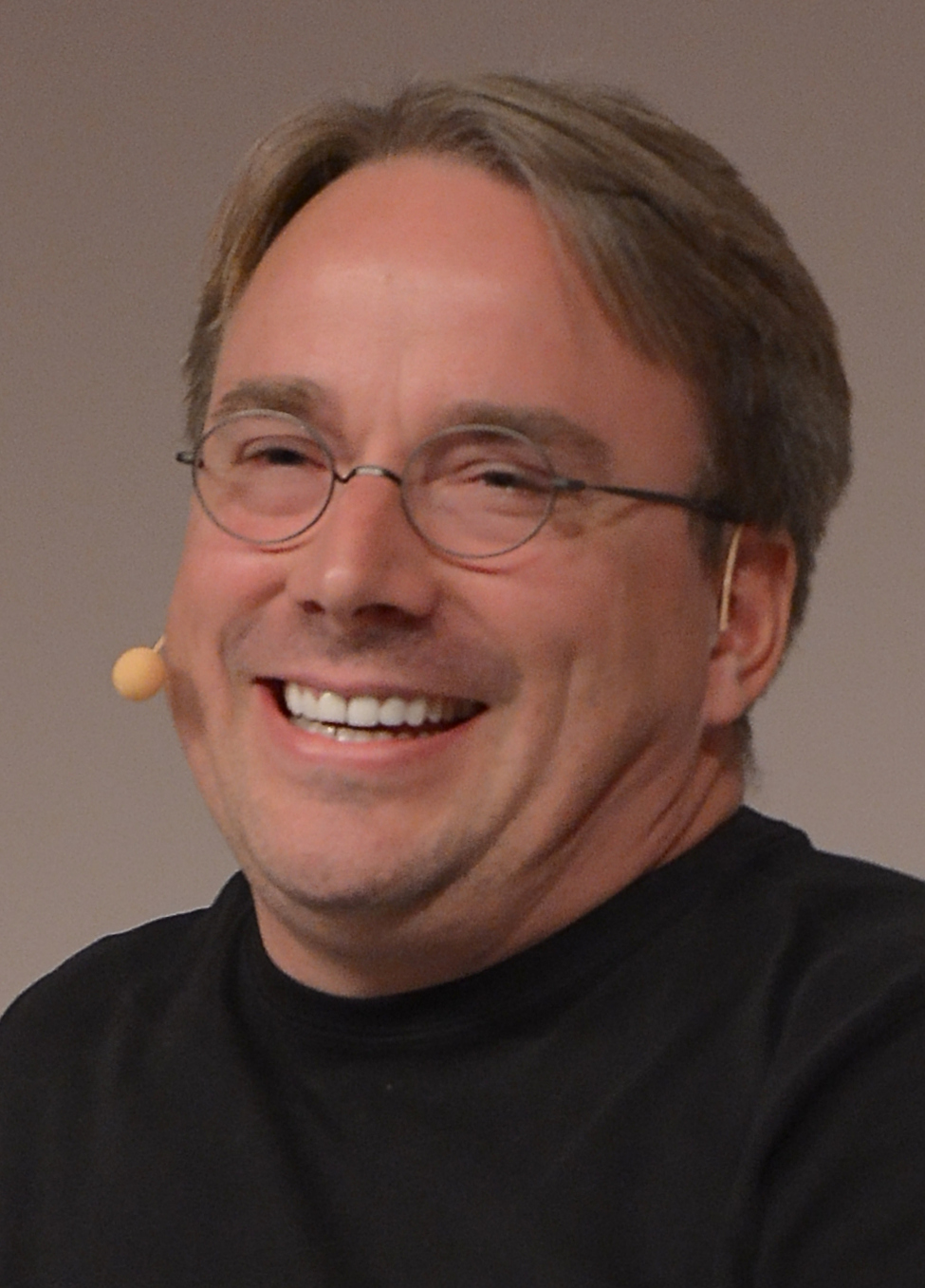
Helsinki and a Hobby Kernel
Linus Benedict Torvalds was born in Helsinki, Finland on December 28, 1969. He grew up in a family of journalists and academics; his grandfather, a statistician at the University of Helsinki, had a Commodore VIC-20 that introduced young Linus to computing. He studied computer science at the University of Helsinki.
In 1991, Torvalds wanted to use a Unix-like operating system on his new 386 PC. MINIX (a minimal Unix-like system designed by Andrew Tanenbaum for educational purposes) ran on the hardware but had deliberate restrictions: it was copyrighted, and Tanenbaum had designed it to be simple enough for teaching, not powerful enough for production use.
Torvalds wanted terminal emulation to access his university’s POSIX system. He wrote a terminal emulator, then found himself interested in the disk and file system access it required, and gradually extended the work toward a complete kernel.
On August 25, 1991, he posted to comp.os.minix:
“I’m doing a (free) operating system (just a hobby, won’t be big and professional like gnu) for 386(486) AT clones. This has been brewing since april, and is starting to get ready.”
Linux 0.01 was released September 17, 1991.
From Hobby to Infrastructure
The initial Linux kernel was rough but functional. It ran on Intel 386 hardware, supported basic multitasking and file system access, and was small enough for a programmer to understand completely. Crucially, Torvalds released the source code. Programmers who downloaded it could read it, modify it, and send back changes.
Two structural decisions proved consequential:
GPL v2 licensing (adopted in Linux 0.12, February 1992). Torvalds chose Richard Stallman’s GPL, which required that anyone who distributed modified Linux must release their modifications under the same license. This prevented companies from taking Linux, improving it, and selling it without contributing back. It also aligned Linux with the GNU Project’s tools (GCC, bash, glibc), creating a complete operating system: the GNU/Linux system.
Myth: Linus Torvalds wrote all of Linux.
Torvalds wrote (and still gatekeeps) the kernel, the core that manages hardware, memory, and processes. But the kernel alone is not a usable operating system. The shell, compiler (GCC), C library (glibc), coreutils, and most of the userland that makes a Linux system work came from Richard Stallman’s GNU Project, begun in 1983, which is why many insist on the name GNU/Linux. Beyond that, the kernel itself is now the work of thousands of contributors and hundreds of companies; Torvalds writes a small fraction of each release. His decisive contributions were starting the kernel and running its development. See Myths and Misconceptions.
Distributed development over email and Usenet. Linux had no central office, no development team, no company. Patches arrived by email from programmers worldwide. Torvalds reviewed them, accepted the good ones, rejected the bad ones, and released new versions. The development model was unlike anything in corporate software engineering, hundreds of volunteer programmers improving a system simultaneously, coordinated only through email and a shared codebase.
The model was analyzed by Eric Raymond in “The Cathedral and the Bazaar” (1997), an essay that contrasted traditional corporate software development (planned, hierarchical, “cathedral”) with Linux’s decentralized approach (“bazaar”) and argued that the bazaar model, counterintuitively, produced better software.
Torvalds vs. Tanenbaum
In January 1992, a public technical debate between Torvalds and Andrew Tanenbaum on comp.os.minix became one of computing history’s most discussed arguments. Tanenbaum wrote that Linux used a monolithic kernel architecture (all kernel code running in the same address space) which he considered obsolete. MINIX used a microkernel: the kernel itself was minimal; services ran as separate user-space processes.
Tanenbaum: “LINUX is obsolete.” His arguments were architecturally sophisticated: monolithic kernels were hard to port, hard to debug, and would become increasingly impractical as hardware diversified.
Torvalds: “you with your minix-like microkernel for everything is the wave of the past.” His argument was practical: the microkernel designs of the time (MINIX, Mach) had poor performance due to inter-process communication overhead, and Linux needed to work now on real hardware.
The technical debate was never fully resolved. Linux won commercially. Whether Linux’s architectural choices were optimal or whether a better-designed microkernel system would have outperformed it in the long run is still discussed by systems researchers. The performance problems of early microkernels were eventually addressed by research systems like L4, which achieved microkernel performance competitive with monolithic kernels, but by then, Linux’s installed base was insurmountable.
Git: Two Weeks of Necessity
For its first decade the kernel used no version control at all, contributors emailed patches and Torvalds applied them to his own tree by hand. From 2002 to 2005, the project used BitKeeper, a commercial distributed version control system whose developer, Larry McVoy, allowed Linux kernel developers to use it for free. In April 2005, Andrew Tridgell (who had written Samba) began reverse-engineering the BitKeeper protocol, apparently to develop an open-source alternative. McVoy withdrew the free license.
Torvalds was left without version control for the kernel project. He had strong opinions about what he wanted: distributed (every developer having the full repository), fast, and correct (wrong commits were not acceptable). He reviewed the existing alternatives (Subversion, CVS, Arch, Monotone) and found none of them acceptable.
He wrote Git in two weeks in April 2005, using the same principles: distributed, fast, data-integrity-focused. Git used content-addressable storage (every object in the repository identified by a cryptographic hash of its contents) which made corruption detectable and deduplication automatic.
Git 1.0 was released December 21, 2005. By 2008, GitHub had launched (Tom Preston-Werner, Chris Wanstrath), building a collaborative social platform around Git repositories. Git’s dominance over every other version control system by 2015 was essentially total. The history of that adoption is covered in The Rise of Version Control.
The Linux Foundation and Kernel Governance
Torvalds continues to maintain the Linux kernel, applying patches and making architectural decisions through a hierarchical maintainer system: subsystem maintainers (networking, filesystems, drivers) aggregate patches from their areas and submit them to Torvalds, who reviews and merges them into the main kernel tree. Each merge window (two weeks per kernel release) processes thousands of patches.
In 2018, following public criticism of his communication style (which had been blunt, sometimes cruel) Torvalds took a brief leave and adopted a new Code of Conduct. He acknowledged that his communication had been harmful and committed to changing it. The incident illustrated the tension between the individual authority that had made Linux’s early development fast and coherent, and the large distributed community the project had become.
He received the Millennium Technology Prize (Finland) in 2012. He is a Linux Foundation Fellow, supported by the foundation to continue kernel maintenance.
Dead End: Linux on the Desktop
Linux dominates servers, embedded systems, and supercomputers. It has approximately 4% share on personal desktop computers.
The Desktop Problem
The reasons are multiple: no single Linux desktop distribution has achieved the application ecosystem or OEM support needed to challenge Windows; hardware drivers have historically required more manual configuration than Windows; application availability (especially for professional creative tools, games, and enterprise software) has been limited. The open-source development model that produced an excellent server operating system has struggled to produce a desktop experience polished enough to attract non-technical users. “The year of Linux on the desktop” became a running joke in the community, perennially predicted, never arriving. Torvalds himself has said he wants Linux to win the desktop and remains frustrated that it hasn’t.
The open-source ecosystem Linux enabled is covered in The Open Source Revolution and The Open Source Business Model.
📚 Sources
- Torvalds, Linus & Diamond, David: Just for Fun: The Story of an Accidental Revolutionary (2001), HarperBusiness
- Raymond, Eric S.: “The Cathedral and the Bazaar” (1997) — first published online, later in The Cathedral and the Bazaar (1999), O’Reilly Media
- Moody, Glyn: Rebel Code: Linux and the Open Source Revolution (2001), Perseus Books
- Hamano, Junio C. & Torvalds, Linus: Git source repository and documentation (2005–present)
- Kroah-Hartman, Greg; Corbet, Jonathan & McPherson, Amanda: “Linux Kernel Development” — Linux Foundation report (2017)
- Stallman, Richard: “Linux and the GNU System” — GNU Project, the case that the usable OS is GNU plus the Linux kernel
- Image: LinuxCon Europe Linus Torvalds 03 (cropped).jpg by Krd (photo), Von Sprat (crop) (CC BY-SA 4.0), via Wikimedia Commons