Donald Bitzer
Abstract
Donald Bitzer (1934–2024) was a new PhD at the University of Illinois in 1960 when a committee of engineers, psychologists and educators failed to agree on whether a computer could teach; he wrote a proposal in a week, got it approved, and built PLATO on the university’s ILLIAC I. He ran it for the next twenty-nine years. Because the shared central computer could not afford to refresh hundreds of screens, he co-invented in 1964 a display that remembered its own picture, the plasma panel, which earned him an Emmy thirty-eight years later when it had become the flat television. Because he let anyone on the terminals, PLATO’s students built the first message boards, chat rooms and multiplayer games on it, a decade before the Internet had them. He was inducted into the National Inventors Hall of Fame in 2013 and died in Cary, North Carolina, on December 10, 2024, at 90.
East St. Louis to Urbana
Donald Lester Bitzer was born in East St. Louis, Illinois, on January 1, 1934. He took all three of his degrees in electrical engineering at the University of Illinois at Urbana-Champaign, the bachelor’s in 1955, the master’s in 1956 and the doctorate in 1960, and joined the faculty on graduating. He married Maryann Drost in 1955.
In 1959 the physicist Chalmers Sherwin, a colleague, had asked whether the university’s computer could be used to teach, and a committee drawn from engineering, psychology and education had spent months not deciding. Bitzer, who had followed an experiment in delivering lessons by closed-circuit television, wrote the proposal himself. PLATO, Programmed Logic for Automatic Teaching Operations, ran on ILLIAC I in 1960 and taught one student at a time. PLATO II served two. PLATO III (1963), on a Control Data 1604, drove twenty terminals from one machine, and set the shape the system kept for twenty years: a large central computer, cheap terminals, everything shared.
The Panel
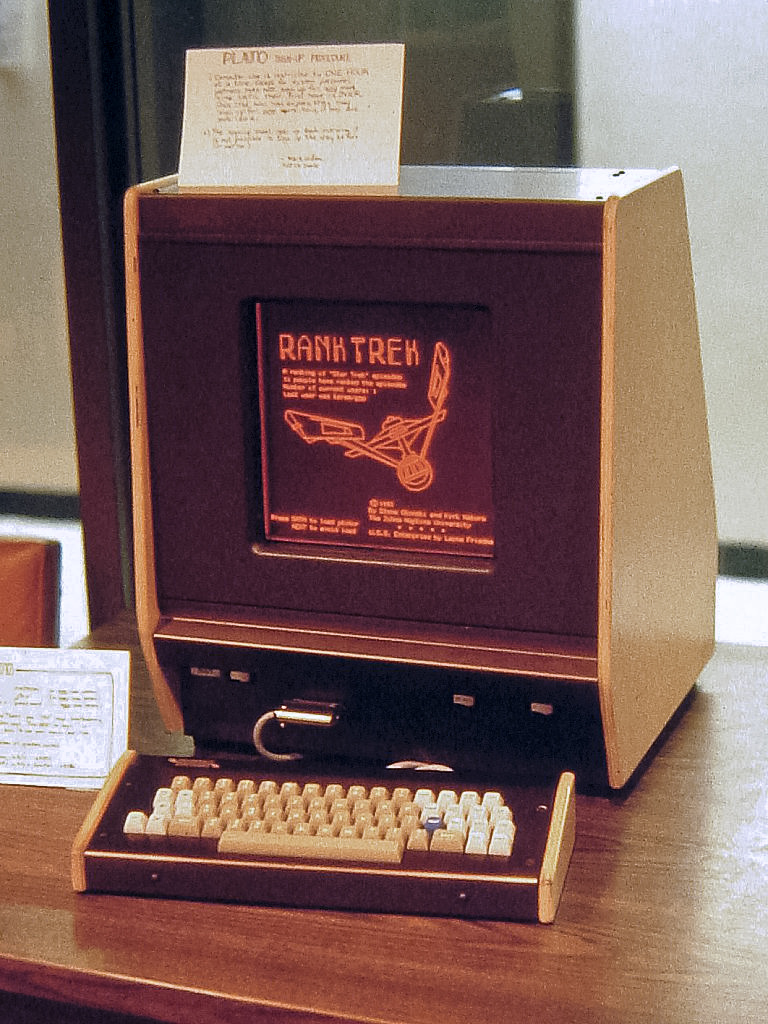
The terminal was the problem. A cathode-ray tube shows nothing unless it is redrawn many times a second, and redrawing hundreds of screens from one computer would have consumed the whole machine. Bitzer wanted a display with memory in the glass. In 1964, with the physicist H. Gene Slottow and a graduate student, Robert Willson, he built one: a sandwich of glass plates with a grid of electrodes and neon between them, in which a cell, once struck, kept glowing until told to stop. The plasma display panel needed no refresh and no frame buffer, and it glowed orange, the colour every PLATO user remembers. Owens-Illinois manufactured it for the PLATO IV terminal of 1972, which also had a touch-sensitive screen, a grid of infrared beams across the glass, so that a child could answer by pointing. Thirty years on, the same physics in colour became the plasma television, and in 2002 the National Academy of Television Arts and Sciences gave Bitzer, Slottow and Willson a technical Emmy for it. The display’s later history is in The History of Displays.
CERL
From its founding in 1967, on a National Science Foundation grant obtained by Daniel Alpert, Bitzer directed the Computer-based Education Research Laboratory, CERL, which housed PLATO. His laboratory was unusual in one respect, and the respect produced most of what PLATO is remembered for: terminal time went to anyone who could justify it, students included, at all hours. The lessons were written in TUTOR, Paul Tenczar’s authoring language, and the students found that TUTOR would write anything. On PLATO IV in the 1970s they wrote Notes, the threaded message board, Talkomatic, the chat room, Term-talk, instant messaging, and multiplayer games, Empire and Airfight and the dungeon crawls that fed into everything since. By the early 1980s the system served thousands of terminals across several mainframes, and Control Data, which had licensed it in 1976, was selling PLATO courseware to corporations and the military. The community that grew inside it, and why it did not become the Internet, is the subject of PLATO and the Birth of Online Community; one of its students, Ray Ozzie, took Notes into the corporate world as Lotus Notes.
Bitzer’s own concerns stayed with the teaching. His answer to critics who said the system was expensive was arithmetic on the cost per student-hour, which fell every year the terminals got cheaper; his answer to those who said students were playing games on it was that they were learning to program. He was elected to the National Academy of Engineering in 1974, the year after the IEEE gave him the Vladimir Zworykin Award for the panel.
Raleigh
Control Data’s PLATO business declined through the 1980s, CERL was wound down, and in 1989 Bitzer left Illinois for North Carolina State University as Distinguished University Research Professor of computer science, where he worked on learning technologies, error-correcting codes and high-performance computing and taught for the rest of his life. The National Inventors Hall of Fame inducted him in 2013, the National Academy of Inventors made him a fellow in 2018, and the Computer History Museum a fellow in 2022. Maryann Bitzer died in 2022. Donald Bitzer died of congestive heart failure in Cary, North Carolina, on December 10, 2024, aged 90.
📚 Sources
- Donald Bitzer — Wikipedia
- In Memoriam: Donald Bitzer, 1934–2024 — Computer History Museum blog (the committee and the one-week proposal, the plasma panel’s rationale, thousands of terminals by the early 1980s, NC State in 1989, the 2002 Emmy, CHM Fellow 2022)
- In memoriam: Donald L. Bitzer, father of PLATO — University of Illinois ECE
- Donald Bitzer remembered for groundbreaking career — NC State College of Engineering, December 20, 2024
- PLATO (computer system) — Wikipedia (PLATO I–IV, the CDC 1604 and twenty terminals, TUTOR, Notes and Talkomatic, the 1976 Control Data licence)
- Plasma display — Wikipedia (the 1964 invention with Slottow and Willson, Owens-Illinois, the 2002 Emmy)
- Image: Platovterm1981.jpg by Mtnman79 (CC BY 3.0), via Wikimedia Commons