PLATO and the Birth of Online Community
Abstract
PLATO began in 1960 as a teaching machine at the University of Illinois and turned into something its builders never planned: a networked community. By the mid-1970s, students at plasma-display terminals were posting to message boards, chatting in real time, sending each other notes, and playing multiplayer dungeon crawls and flight simulators, years before ARPANET grew a culture of its own. Control Data Corporation spent hundreds of millions trying to sell PLATO as courseware and lost most of it. The software the students wrote for fun outlived the business.
A Teaching Machine on the ILLIAC
In 1960 Donald Bitzer, a young electrical engineer at the University of Illinois at Urbana-Champaign, proposed a computer system that could teach. The Cold War had produced anxiety about American education, and the pitch was concrete: a machine that presented lessons, asked questions, and responded to answers. Bitzer built the first version, PLATO I, on the university’s ILLIAC I. The name stood for Programmed Logic for Automatic Teaching Operations.
PLATO I served one student. PLATO II (1961) served two. The interesting problem was scale: to teach a classroom, and then a campus, the system had to handle many terminals at once from a single central computer. PLATO III (1963) ran on a CDC 1604 and drove up to 20 terminals. The architecture set the pattern PLATO kept for two decades: a large central machine, cheap terminals, and everything shared.
Bitzer ran the effort out of the Computer-based Education Research Laboratory (CERL), which he directed. The lab was unusual for its openness. Terminal time went to anyone who could justify it, students included, and the students turned out to be the ones who found the uses nobody had specified.
The Orange Glow
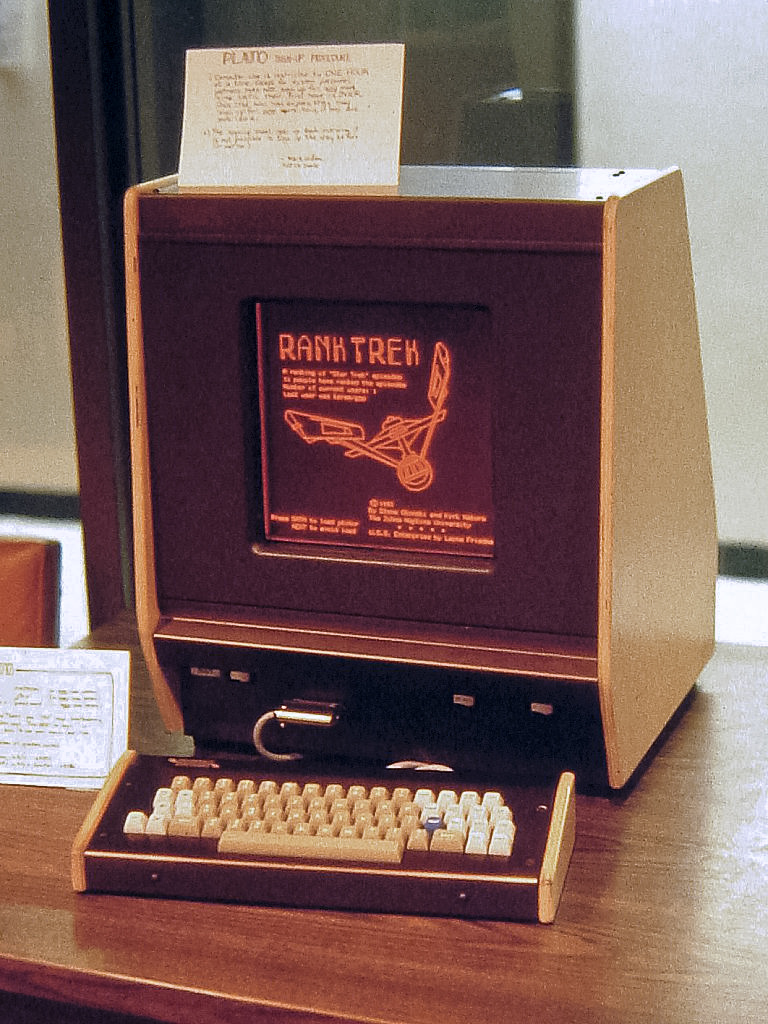
The terminals needed a display, and existing options were bad for the job. Cathode ray tubes had to be refreshed constantly from the central computer, which ate the very bandwidth PLATO needed for teaching. In 1964 Bitzer, physicist H. Gene Slottow, and graduate student Robert Willson invented a solution: the plasma display panel. A grid of cells filled with neon gas glowed orange when addressed, and, critically, each cell held its own state. The panel remembered what it showed without constant refresh, which freed the central computer and the network.
The plasma panel gave PLATO its look, an orange monochrome glow that a generation of Illinois students remembered, and gave the display industry a technology that reappeared decades later in flat-panel plasma televisions. See The History of Displays. The PLATO IV terminal (1972) added a second trick: a 16-by-16 grid of infrared beams across the screen face, so a student could answer by touching the display. It was one of the first touchscreens in regular use.
TUTOR and the Author Problem
A teaching system is only as good as its lessons, and lessons had to be written by teachers, not programmers. In 1967 Paul Tenczar, a biology graduate student, wrote TUTOR, a language for authoring PLATO courseware. TUTOR let an author lay out a screen, pose a question, and judge a typed answer against expected responses, including partial credit and rephrasing. Thousands of lessons were written in it, in physics, chemistry, foreign languages, medicine, and reading.
TUTOR did more than its designers intended. Because it was the only way to make PLATO do anything, students used it to write programs that had nothing to do with teaching. The community software that made PLATO famous, the message boards, the chat, the games, was all written in a courseware language by people who were supposed to be studying.
The Community Nobody Planned
The pivotal software was small and its consequences were large. In 1973 David R. Woolley, a student, wrote PLATO Notes. It began as a bug-reporting tool: a place to post a problem and read replies in sequence. Organized by topic, threaded, and open to all users, it was among the first online message boards anywhere. Notes grew into a network of forums covering every subject the user base cared about.
The same year, Doug Brown wrote Talkomatic, a real-time chat program, and Woolley expanded it into a system of six channels with privacy controls. Up to five people typed into a shared channel at once, each in their own region of the screen, character by character as they typed, with further users able to watch without joining. Alongside it, term-talk let two users open a direct line and type at each other, a personal instant-messaging channel with a persistent sense of who was online. These are the mechanics that Usenet, IRC, and later chat systems rebuilt for the public internet a decade or more later. See Usenet and Instant Messaging.
One student who lived inside these tools was Ray Ozzie, who worked on PLATO while earning his computer science degree at Illinois (1979). When Ozzie later designed Lotus Notes, he built it in part on his experience of PLATO Notes. The 1970s campus forum became the template for enterprise groupware in the 1990s.
Multiplayer Before It Had a Name
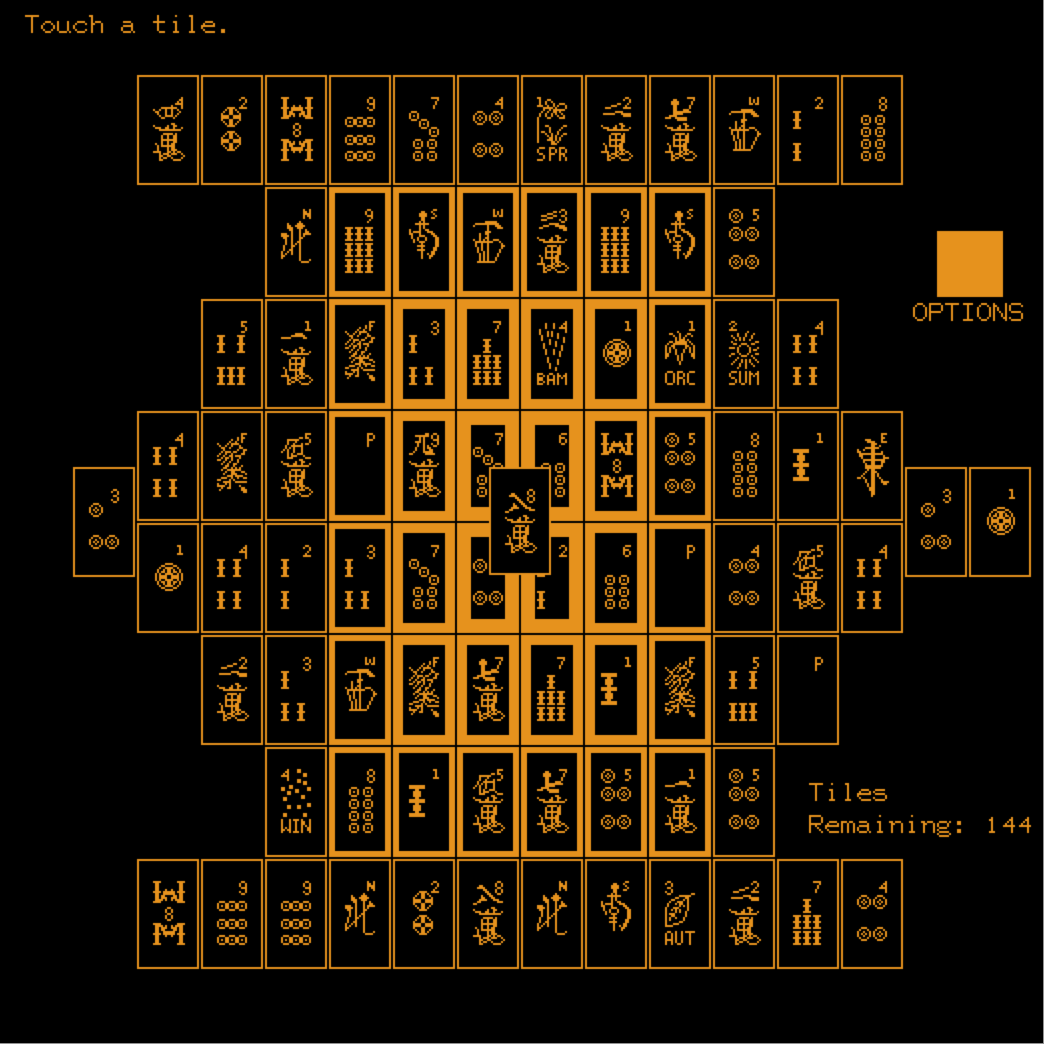
PLATO’s shared architecture, many terminals on one machine, made multiplayer games natural in a way that isolated personal computers would not for years. Students wrote them constantly and the central operators periodically deleted them, and they came back.
Empire (around 1973) put dozens of players in a shared space battle. Airfight (1974) rendered a wireframe cockpit view and let pilots dogfight, a direct ancestor of the flight-simulator genre. dnd (1975) adapted Dungeons & Dragons into one of the first computer role-playing games, with a final boss to defeat. Oubliette and Moria brought networked, first-person dungeon crawling to multiple players at once. Avatar, a graphical multi-user dungeon, logged well over a million hours of play. These were multi-user virtual worlds running years before the term MUD existed and long before the games industry treated online multiplayer as a market. See MMORPGs and Virtual Worlds and The Video Game Industry.
Dead End: Selling PLATO
The community thrived; the business did not. In the mid-1970s Control Data Corporation, the Minneapolis supercomputer maker, licensed PLATO and set out to sell it as commercial computer-based education. CDC’s founder William Norris believed in PLATO as both a product and a social good, a way to deliver training and literacy at scale, and he backed it with a conviction that outran the numbers.
The economics never worked. A PLATO terminal cost around $12,000, and connect time ran on the order of $50 an hour, at a moment when the personal computer was about to put cheap, standalone machines on every desk. Courseware that made sense on a shared university mainframe was hard to justify against an Apple II or an IBM PC that a school could simply buy. Micro-PLATO tried to move the system onto microcomputers, but by then the platform’s cost advantage was gone. CDC poured a large fortune into PLATO across the 1970s and 1980s and recovered little of it; the effort is remembered as one of the costliest bets in the company’s history and a factor in its long decline. The courseware business was sold off in 1989 and survived under later owners as PLATO Learning, eventually renamed Edmentum.
The teaching machine that Norris tried to sell had quietly become something else. What people paid attention to, and what shaped everything after it, was the part the students built for free: the forums, the chat, the games, the sense that a computer could be a place where people gathered. The last operational PLATO system, run by the Federal Aviation Administration, was retired in 2006. Volunteers preserved the software on a system called Cyber1, where the notesfiles and the dungeons still run.
📚 Sources
- PLATO (computer system) (Wikipedia): naming, version timeline, TUTOR, Notes, Talkomatic, games, CDC commercialization
- Plasma display (Wikipedia): panel co-invented 1964 by Bitzer, Slottow, and Willson for PLATO
- Ray Ozzie (Wikipedia): Lotus Notes built in part on his experience with PLATO Notes
- Donald Bitzer (Wikipedia): PLATO founder and plasma-panel co-inventor
- Talkomatic (Wikipedia): written by Doug Brown in 1973, extended by Woolley into six channels of up to five active participants
- Empire (1973 video game) (Wikipedia): John Daleske, spring 1973
- Avatar (1979 video game) (Wikipedia): over a million hours of play, about 6 percent of all PLATO usage between September 1978 and May 1985
- Edmentum (Wikipedia): CDC sold the PLATO courseware business to TRO in 1989; TRO became PLATO Learning in 2000 and Edmentum in 2012
- Brian Dear, The Friendly Orange Glow: The Untold Story of the PLATO System and the Dawn of Cyberculture (Pantheon, 2017)
- Image: Platovterm1981.jpg by Mtnman79 (CC BY 3.0), via Wikimedia Commons
- Image: PLATO Mah-Jongg screen.png by Blockard1 (CC BY-SA 4.0), via Wikimedia Commons