Electronic Design Automation (EDA)
Abstract
Electronic design automation (EDA) is the software that simulates a circuit before it exists, turns a description of its behaviour into gates, places and wires those gates, and checks the result against the factory’s rules. The field’s most widely used program, SPICE, came out of a Berkeley class project and was given away because its professor insisted on it. The commercial industry started in 1981 with three companies selling workstations, two of which did not survive the decade, and consolidated into three software vendors: Synopsys, Cadence, and Mentor Graphics (now Siemens EDA). Every advanced chip is designed with their tools, which is why Washington briefly made them an export-control weapon in 2025.
Layout by Hand
The first integrated circuits were designed by hand and laid out manually. Automation began inside the big companies. By 1966 James Koford and colleagues at IBM’s Fishkill plant were capturing circuit designs on graphical displays, checking them, and converting them into mask patterns automatically. Koford moved to Fairchild, where by 1967 a team had logic simulators, test-program generators, and place-and-route software for gate arrays and standard cells.
The first commercial tools digitised the drawing. Calma, of Sunnyvale, introduced a digitising table in 1965 and in 1971 the Graphic Design System (GDS), a minicomputer with graphics terminals on which a layout could be entered and edited. The first GDS was shipped to Intel late in 1971. Its successor, GDS II, appeared in 1978. The machines are long gone, but the file format GDS II wrote out for the mask shop became the industry’s interchange standard, and chip designers still describe their work as going “from RTL to GDSII.”
SPICE

A drawing tool records what the designer intended. It does not say whether the circuit will work, and building a chip to find out took months. The alternative was to solve the circuit’s equations numerically.
At the University of California, Berkeley, at the end of the 1960s, Professor Ronald Rohrer taught circuit simulation by having his class write a simulator. The rule, as his student Laurence Nagel remembered it, was that everyone passed if Professor Donald Pederson approved of the program. Nagel was put in charge of showing it to him. The students called it CANCER, “Computer Analysis of Nonlinear Circuits, Excluding Radiation.” Simulators funded by defence contracts had to model radiation damage; the name announced that this one never would. “It was, after all, developed at Berkeley in the sixties,” Nagel wrote. Pederson approved, the class passed, and CANCER became Nagel’s master’s project. Rohrer presented it at the 1971 International Solid-State Circuits Conference.
Rohrer left for industry and Nagel continued under Pederson. The name CANCER was unpopular with users, so his first job was to find another. SPICE, “Simulation Program with Integrated Circuit Emphasis,” went to friendly users in the fall of 1971, and Pederson presented it at a symposium in Waterloo, Ontario, on 12 April 1973. It was written in FORTRAN for Berkeley’s CDC 6400 mainframe, where the available memory limited a simulation to roughly 50 nodes and 25 bipolar transistors. Nagel’s 1975 dissertation described a rewritten SPICE2. His office mate Ellis Cohen, whom Nagel called “the unspoken hero of SPICE,” carried it to version 2G6 in 1983, the one industry standardised on.
Early users left marks in the program. One student asked for a simulation at absolute zero by entering TEMP=0, and when that failed tried TEMP=1E-10; the team switched the input to degrees Celsius. The error message “TIMESTEP REDUCED TO ZILCH” was reworded after students demanded to know what zilch meant.
The decision that mattered was about distribution. SPICE had been written at a public university, and Pederson’s position was that it therefore belonged to the public. It was distributed with its source code. Students took it with them to their employers, companies added their own device models, and commercial versions followed, among them HSPICE from Meta Software and PSpice for the PC. Nagel described the result as a cottage industry that grew to several hundred million dollars. Nearly every circuit tool since reads the SPICE 2G6 netlist format. Pederson received the IEEE Medal of Honor in 1998 and died on 25 December 2004. The IEEE named SPICE a Milestone in 2011.
Daisy, Mentor, and Valid
In 1980 Carver Mead and Lynn Conway’s textbook separated chip design from chip manufacturing and taught a generation of computer scientists to design circuits. They needed tools, and the tools inside IBM, Intel, and Hewlett-Packard were not for sale.
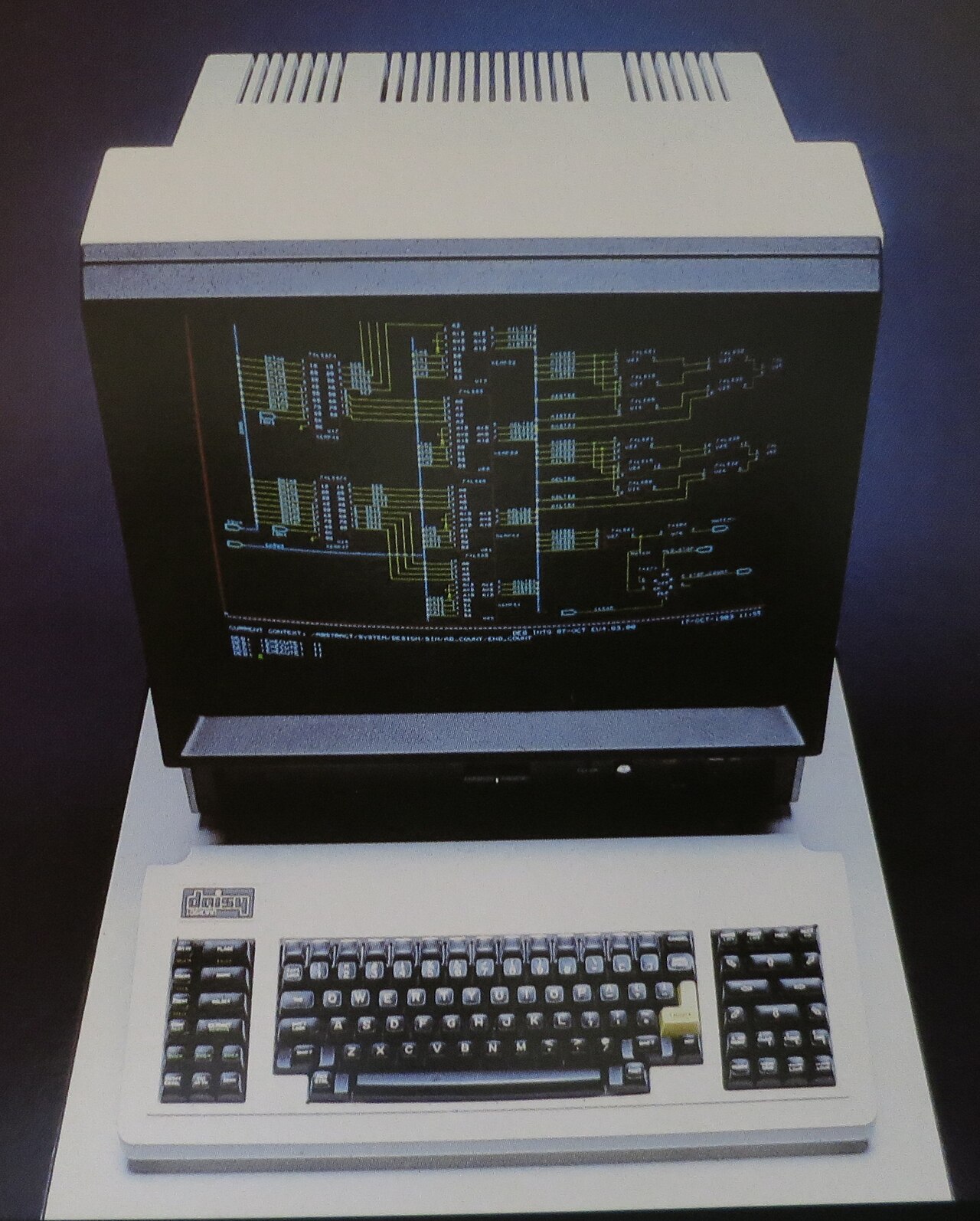
Three start-ups of 1981 are usually counted as the beginning of the industry: Daisy Systems in Mountain View, Valid Logic Systems, and Mentor Graphics, founded by Tom Bruggere, Gerry Langeler, and Dave Moffenbeier, all from Tektronix. The trade called them “DMV.” They sold computer-aided engineering stations on which an engineer could draw a schematic and simulate its logic. Daisy and Valid designed and built their own computers. Mentor’s founders, software people, wrote for the Apollo workstation and left the hardware to Apollo.
Cadence and Synopsys
Two later companies were built on software alone. Solomon Design Automation (SDA) was founded in San Jose in 1983 by James Solomon with the Berkeley professors Richard Newton and Alberto Sangiovanni-Vincentelli, among others. Its public offering was scheduled for 19 October 1987, the day the Dow Jones index fell 22.6%. SDA reached the stock market by another route: in 1988 it merged with ECAD, a company founded in 1982 whose design-rule checker Dracula was already the standard and which had gone public months before the crash. The merged firm was named Cadence Design Systems. Its chief executive, Joe Costello, was not yet 30. Cadence bought Gateway Design Automation, the owner of Verilog, in 1989, and Valid in 1991.
Synopsys started in 1986 in Research Triangle Park, North Carolina, as Optimal Solutions. Aart de Geus and his colleagues came from a General Electric group that had written a logic synthesis program, and the company was founded to sell that technology: software that takes a description of what a circuit should do and produces the gates. It renamed itself and moved to Mountain View in 1987 and went public in February 1992. Synthesis made the text description the design itself, a story told in Hardware Description Languages.
The rivalry produced the industry’s one criminal case. Former Cadence employees set up a competitor, Avant!, and Cadence accused them of taking its source code with them. In May 2001 Avant!, its chief Gerald Hsu, and several others pleaded no contest to charges including conspiracy to misappropriate trade secrets, and the company was ordered to pay Cadence $195 million in restitution. Synopsys absorbed Avant! on 6 June 2002 and paid Cadence about $265 million more to end the civil suit.
Three Vendors
Mentor Graphics stayed independent until Siemens bought it in 2017 for $4.5 billion; since 2021 it has been called Siemens EDA. Synopsys announced on 16 January 2024 that it would acquire the simulation company Ansys at an enterprise value of about $35 billion and completed the purchase on 17 July 2025.
Chip designers, and the foundries such as TSMC that build their designs, depend on these three vendors, and governments have noticed. In May 2025 the US Commerce Department told Synopsys, Cadence, and Siemens that sales of design software to China now required export licences. The requirement was withdrawn in early July 2025, after roughly forty days, in exchange for China easing its controls on rare-earth exports.
Dead End: The Workstation Vendors
Daisy and Valid believed that design software needed a special computer and that the computer was where the money was. For a few years they were right. Then general-purpose workstations from Apollo and Sun became fast enough, and by the late 1980s every EDA company had abandoned proprietary hardware. Mentor, which had never built any, was the only one of the three founders of 1981 to reach the next decade intact.
Daisy merged with Cadnetix in 1988, filed for Chapter 11 protection in 1990, and was bought by Intergraph the same year. Valid was absorbed by Cadence in 1991 for about $200 million. The same thing happened in mechanical design in the same years, where the turnkey vendors lost to software sold on standard machines (see The History of CAD: From Sketchpad to AutoCAD).
📚 Sources
- Nagel, Laurence W.: “The Origins of SPICE” (the class project, CANCER and its name, the fall 1971 release, 12 April 1973, Ellis Cohen and SPICE 2G6)
- Nagel, Laurence W.: “The Life of SPICE” — talk at the Bipolar Circuits and Technology Meeting, 30 September 1996 (public domain from the beginning, the CDC 6400 and its limits, TEMP=0, “TIMESTEP REDUCED TO ZILCH”, the cottage industry)
- Nagel, L. W. and Rohrer, R. A.: “Computer Analysis of Nonlinear Circuits, Excluding Radiation (CANCER)” — IEEE Journal of Solid-State Circuits SC-6 (1971), pp. 166–182
- Nagel, L. W. and Pederson, D. O.: “SPICE (Simulation Program with Integrated Circuit Emphasis)” — Memorandum ERL-M382, University of California, Berkeley, April 1973
- Nagel, Laurence W.: “SPICE2: A Computer Program to Simulate Semiconductor Circuits” — Memorandum ERL-M520, University of California, Berkeley, May 1975
- Computer History Museum, The Silicon Engine: “1966: Computer Aided Design Tools Developed for ICs” (Koford at IBM Fishkill and Fairchild)
- Calma — Wikipedia (the 1965 digitizer, GDS in 1971 and its first shipment to Intel, GDS II in 1978, the stream format)
- Leibson, Steven: “A Brief and Personal History of EDA, Part 4: Cadence, Synopsys, and Mentor Graphics” — EE Journal (SDA and Black Monday, ECAD and Dracula, the 1988 merger, Costello)
- Electronic design automation — Wikipedia (Daisy, Mentor, and Valid in 1981)
- Mentor Graphics — Wikipedia (the founders from Tektronix, Apollo workstations, Siemens EDA from 2021)
- Daisy Systems — Wikipedia (founding in 1981, the Cadnetix merger, Chapter 11 in 1990, Intergraph)
- Cadence Design Systems — Wikipedia (SDA’s founders, Gateway in 1989, Valid in 1991)
- Synopsys — Wikipedia (Optimal Solutions in 1986, the move to Mountain View in 1987, the February 1992 IPO, the Avant! merger on 6 June 2002 and the $265 million payment, completion of the Ansys purchase on 17 July 2025)
- “Avant! to pay $27 million for theft of source code” — Out-Law News, Pinsent Masons, 2001 (the no-contest pleas)
- Cadence Design Systems, Inc. v. Avanti Corp. — Wikipedia (the $195 million restitution order)
- “Siemens acquires Mentor Graphics for $4.5 billion” — ZDNET
- Synopsys: “Synopsys to Acquire Ansys, Creating a Leader in Silicon to Systems Design Solutions” — press release, 16 January 2024
- “Gone in 40 days: US drops ban on export of chip design tools to China” — The Register, 3 July 2025
- “White House lifts chip design export ban on China in exchange for rare earth materials compromise” — Tom’s Hardware, July 2025
- Image: Daisy Logician (51333058754).jpg by Steve Elliott from UK (CC BY-SA 2.0), via Wikimedia Commons
- Image: Laurence Nagel.jpg by Eugene Zelenko (CC BY-SA 4.0), via Wikimedia Commons