Hartmut Esslinger
Abstract
Hartmut Esslinger (born 1944) is the Black Forest industrial designer who gave the personal computer its first coherent look. His studio, founded in 1969 and renamed frog design in 1982, had made its name on Wega and Sony televisions when Steve Jobs hired him that year, at a fee Esslinger puts at $2 million a year, to give Apple a design language. The result, Snow White, ran from the Apple IIc of 1984 to the Macintosh II and defined how a computer was supposed to look until 1990: off-white then platinum, zero-draft mouldings, 2 mm grooves every 10 mm, an inlaid logo. When Jobs was pushed out in 1985 Esslinger broke his contract and followed him to NeXT, where frog designed the black magnesium cube. The firm went on to Sun, Lufthansa, SAP, Windows XP and 1,600 staff; Esslinger and his wife Patricia Roller sold it to Flextronics in 2004 and left in 2005.
Black Forest
Esslinger was born on June 5, 1944, in Beuren, a village in the Black Forest so small that his school had eight children to a class. He drew cars, ships and motorcycles from the age of five, and his mother tore the drawings up. After military service he studied engineering in Stuttgart, where around 1966 he first touched a computer (“you got five or maybe ten minutes with it”), until a mechanics professor told him his drawings were too nice for an engineer and sent him to a lecture by Herbert Lindinger of the Ulm school. He switched to the Hochschule für Gestaltung in Schwäbisch Gmünd within days; his mother fainted. The engineering stayed with him. He had interned at Siemens and AEG, and from his first client onward he asked to see the factory before he drew anything, which set him apart from designers who supplied a new front panel and went home.
He opened Esslinger Design in 1969 in Mutlangen, then Altensteig, at 25. The first client was Wega, a small radio and television maker, for which he designed the first colour television without a wooden frame and the System 3000 hi-fi; the Sony-Wega Concept 51K music system is in the Museum of Modern Art. Sony bought Wega in 1975, and Esslinger, who had been writing unsolicited letters to Sony for years telling them their technology deserved better design, was summoned to a meeting in Cologne in late 1973 and found on arrival in Tokyo that they had kept all the letters. He consulted for Sony for nearly a decade, on Trinitron televisions and later audio, and learned there the rule he later brought to Apple: “simple is best,” and a product must be light and small enough for people to love it. A 1974 royalty deal with a maker of dental equipment, one percent on a chair he redesigned to stop looking “like an electric chair,” brought in about $2 million a year for two decades and paid for the model shops and staff that made the studio unusual. The frog logo came first, because the valley was full of frogs; the name came from the Montreal Olympics scoreboard, which abbreviated the Federal Republic of Germany as FRG in a way Esslinger read as “frog.” He had to buy out his partners in 1982 before he could rename the company, and it was styled in lower case as a statement against the capitalised German noun.
Snow White
Apple came to him by accident. At a party in Fremont in January 1982, given by a former intern, an Apple designer named Rob Gemmell looked at Esslinger’s portfolio and said he had to meet Steve Jobs. Apple’s design staff, Jerry Manock and Gemmell, were at that moment running a competition among outside firms, code-named Snow White after the seven projects (the dwarfs) the winner would shape; the rival Esslinger remembers was BIB from London. He won, and his account of why is that the others were offering a Braun coffee maker translated into a computer, while Jobs wanted “the best design on earth” for a machine anyone could use, and what Esslinger proposed was not a Sony copy either: “Simple, white, innocent, sexy, and also a bit more radical, a new global brand.” A condition of the contract was an office near Apple, so in mid-1982 he moved eight of his sixteen people to Campbell, California, rotating staff between the two studios monthly so the culture would not split, and hiring in England (Steve Peart, Ross Lovegrove, Julian Brown) because the United States then had almost no freelance design culture beyond Bill Moggridge.
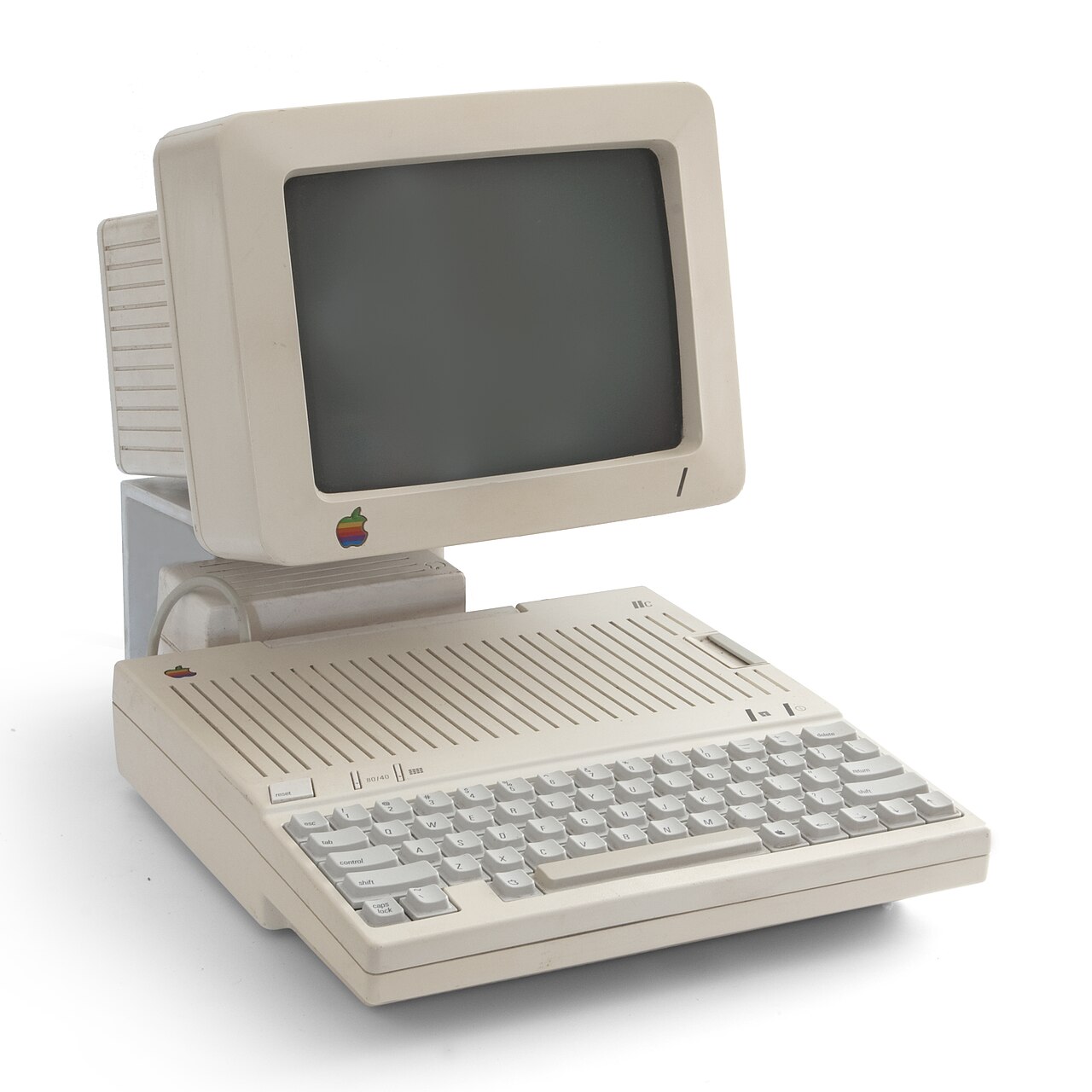
Asked in 2011 about the fee, the highest ever paid to a designer at the time, he said “It was two million a year,” and that the first years were not profitable because “you also have to prove what you can do.” Other accounts give $1.2 million. He designed some forty models to present the concept. The language that emerged was specified to the millimetre: enclosures in off-white (“Fog,” a compromise, since Esslinger wanted pure white and Manock argued fingerprints), later the warm grey “Platinum” used across the line from 1987; horizontal and vertical grooves 2 mm wide, 2 mm deep, 10 mm apart, some of them working as vents, all of them making a box look smaller; zero-draft walls, meaning the moulded plastic had none of the slight taper that lets a part slide out of its tool, achieved by building the case from many small tool pieces on a collapsible core so that it “looked like it was made from steel”; corners of 2 mm at the front and 3 mm at the back; the Apple logo inlaid three-dimensionally; the product name silk-screened. The plastic was GE’s Lexan rather than painted commodity plastic, because paint costs more and does not recycle. His argument to Apple was arithmetic: save $100 per machine on a million machines and the design fee disappears.
The Apple IIc of April 1984 was the first Snow White product; the Whitney Museum acquired one and Time named it design of the year. The language reached its complete form in the Macintosh II of 1987 and covered the LaserWriter, the ImageWriter II, the Apple IIGS and the Macintosh SE, and the recessed three-dimensional logo stayed on Apple hardware for decades. Working with Jobs, Esslinger said, was “not my way or the highway” but “‘This is shit.’ ‘This is the better way.’” When a mechanical engineer brought in a sheet-metal Macintosh part that Jobs loved and Esslinger called unproducible, Jobs turned on the engineer instead. The 1983 concepts frog produced in the same programme, a tablet, a flat-screen workstation and a telephone with a touchscreen, are the subject of a Fun Fact and, since a photograph of the phone circulates as “the 1983 iPhone,” of an entry in Myths and Misconceptions.
NeXT
Jobs lost the Macintosh group in Sculley’s reorganisation of May 1985 and resigned on September 17. Esslinger dates the end of his Apple work to a walk with Jobs in the hills on June 5, his own birthday, “a sad, stupid day.” He asked to be released from the exclusive contract in November 1985, settled out of court in January 1986, and by the end of the year frog was working for NeXT. His verdict on the Apple that remained, John Sculley and Jean-Louis Gassée, was “the regime of the morons”; theirs on frog was to cut its budget and, from 1990, phase Snow White out in favour of the in-house Apple Industrial Design Group that later produced Jony Ive. For NeXT frog designed the computer introduced in October 1988: a die-cast magnesium cube, 12 inches (30.48 cm) on each side, in black, with a matching monitor; the same case housed the 1990 NeXTcube on which Tim Berners-Lee wrote the first web server (see Tim Berners-Lee and the World Wide Web).
The Apple work brought in the rest of the industry. Kodak, Motorola, Xerox, 3M and Polaroid followed in 1984, and Japanese companies that had been Apple’s suppliers hired frog because they had seen what it did for Apple. Frog designed Sun’s SPARCstation in 1989, then Lufthansa’s global identity, SAP’s corporate identity and software interface, and in 2000 the branding of Windows XP, Internet Explorer 6 and Windows Media Player, some of it unused. In December 1990 BusinessWeek put Esslinger on its cover under the headline “Rebel with a cause,” the first living designer on it since Raymond Loewy in 1934. Patricia Roller, his wife and frog’s chief executive, ran the business side and, by his account, was what put the firm on a growth path; by 2011 it had more than 1,600 staff. In August 2004 the contract manufacturer Flextronics took a majority stake for about $25 million, and in 2005 Esslinger and Roller left. Flextronics’ software arm and frog went to KKR in 2006, then to Aricent, Altran and, in 2021, Capgemini.
After frog
Esslinger was a founding professor of the Karlsruhe University of Arts and Design, taught convergent industrial design at the University of Applied Arts in Vienna from 2006, received an honorary doctorate from Parsons in 1996 and has been a DeTao Master in Shanghai since 2012. His books are A Fine Line (2009), on design and sustainable business, and Keep It Simple (2013), on the Apple years, which reproduced the 1982–1985 concept models and gave the touchscreen-phone photograph its second life. In it he claims that when Jobs returned to Apple in 1997 he sent him six strategic recommendations, including making peace with Microsoft and moving into digital consumer electronics, and that Apple followed them; the claim is his own and has not been confirmed by anyone at Apple. His 2011 Computer History Museum interview is more useful on the earlier period, where the record is the products themselves. On Jobs he offered a comparison he clearly liked: not Henry Ford but Lorenzo de’ Medici, the patron with the judgment to know what Brunelleschi was doing and let him do it. Esslinger’s own contribution was narrower and lasts longer than the metaphor. Before 1984 personal computers were beige boxes designed by engineers; after the IIc they were products, and every company that competed with Apple had to hire a designer.
📚 Sources
- Hartmut Esslinger Oral History, interviewed by Barry Katz, Computer History Museum, April 20, 2011 (PDF) (the Black Forest childhood, Stuttgart and Schwäbisch Gmünd, the Sony letters and the 1973 Cologne meeting, the dental-chair royalty, the frog name, the Fremont party and Rob Gemmell, BIB, “simple, white, innocent, sexy,” the move to Campbell, the $2 million fee, zero draft and Lexan, the June 5 walk, “regime of the morons,” Flextronics and KKR, 1,600 staff, the Medici comparison)
- Hartmut Esslinger — Wikipedia (born June 5, 1944, Beuren; studio 1969; Wega and the Concept 51K at MoMA; the Whitney’s IIc and Time; the BusinessWeek cover; Karlsruhe, Vienna, Parsons, DeTao; A Fine Line)
- Frog Design — Wikipedia (Mutlangen and Altensteig, renamed 1982, Trinitron 1975, NeXT 1987, SPARCstation 1989, the Windows XP work, Flextronics August 2004 for about $25 million, KKR 2006, Aricent, Altran, Capgemini 2021, the 2005 departure, Patricia Roller as CEO)
- Snow White design language — Wikipedia (the 1982 search, the seven-dwarfs code name, the Apple IIc as first product, Fog and Platinum, the Manock fingerprint argument, the 2 mm / 10 mm grooves, zero draft, corner radii, the inlaid logo, the Macintosh II as complete form, the 1990 phase-out)
- The Frog, Snow White and The Apple — German Design Council (the $1.2 million figure, forty models, the November 1985 release request and January 1986 settlement, the NeXT cube’s 30.48 cm sides)
- How Apple Went from Underdog to Cult: Hartmut Esslinger’s Keep It Simple — The Marginalian, 2014 (the six 1997 recommendations as Esslinger tells them)
- Steve Jobs — Wikipedia (the May 1985 reorganisation; resignation September 17, 1985)
- NeXT Computer — Wikipedia (released October 12, 1988; die-cast magnesium cube)
- Image: Apple IIc with monitor.jpg by Bilby (CC BY 3.0), via Wikimedia Commons