The Macintosh
Abstract
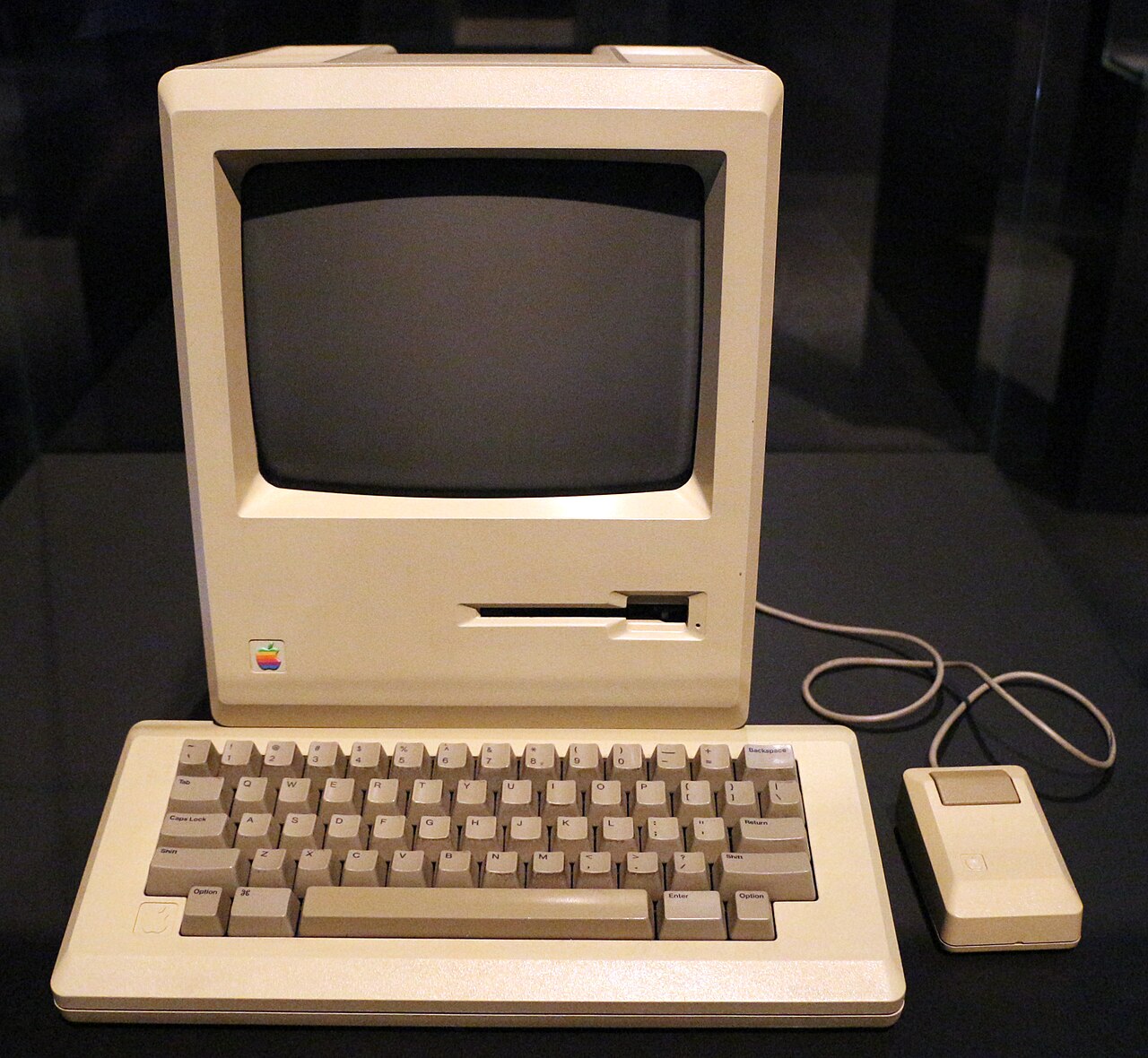
The Macintosh went on sale on 24 January 1984 for $2,495, with a 68000 processor, a 9-inch monochrome screen, one floppy drive, no hard disk, no expansion slots, no fan, and 128 KB of memory soldered to the board. It was the first graphical computer sold at a price an individual might pay, and for the first year it was also nearly unusable for serious work, because 128 KB was not enough to hold the operating system and an application at the same time. What saved it was a printer: the LaserWriter of 1985, PostScript, and PageMaker turned the Mac into the machine that the publishing industry bought. The line then survived a near-death in the mid-1990s and three complete processor changes, from 68000 to PowerPC to Intel to Apple’s own silicon, without ever breaking the shape set in 1984.
The Lisa Paid for the Prototype
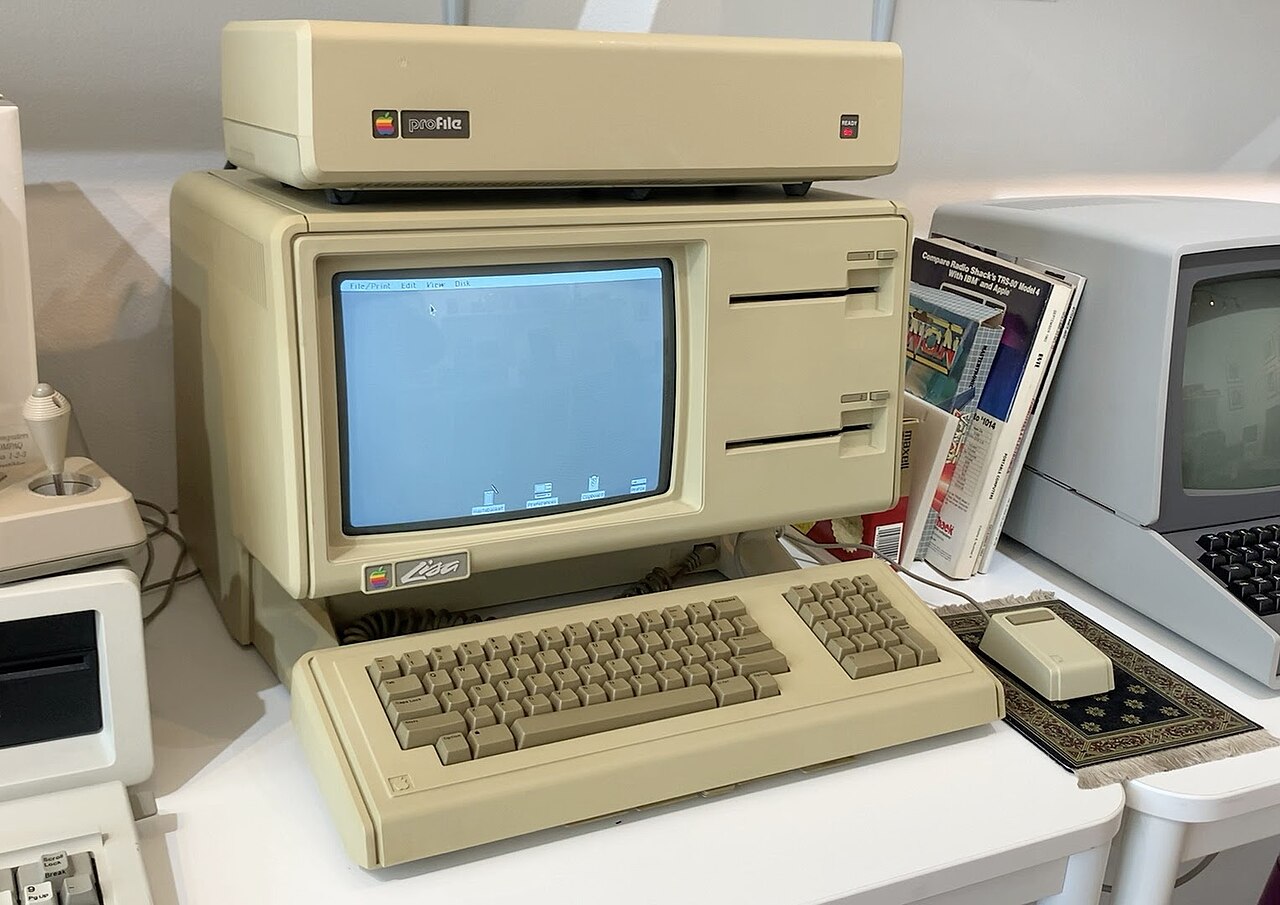
Apple unveiled the Lisa on 19 January 1983 at $9,995. It had a 5 MHz Motorola 68000, one megabyte of RAM, a 720×364 screen, a five-megabyte hard disk, protected memory, cooperative multitasking and a complete graphical interface with overlapping windows and a document model that could copy data between applications. Apple had spent more than $50 million developing it.
Two things went wrong. The price put it in competition with minicomputers rather than personal computers, and the storage did not work: the two 5.25-inch FileWare drives, known inside Apple as Twiggy, used proprietary diskettes and were unreliable enough to require replacement in the field. Estimates of how many Lisas were sold range from 10,000 to 60,000. The Lisa 2 of January 1984 dropped the Twiggy drives for a Sony 3.5-inch mechanism and the price to between $3,495 and $5,495; a year later the machine was renamed the Macintosh XL and then discontinued. In 1989 Apple sent roughly 2,700 unsold Lisas to a landfill in Logan, Utah, and took the tax write-off.
The Lisa’s interface came out of what Apple engineers had seen at Xerox PARC in December 1979 and out of several years of their own work on top of it. The Macintosh inherited all of it and sold for a quarter of the price.
Raskin’s Appliance and Jobs’s Takeover
The project began in 1979 as Jef Raskin’s. He wanted a low-cost appliance computer, sealed, with a small built-in screen, a text interface and no mouse, since he disliked anything that took the hands off the keyboard, and he named it after his favourite apple. The eventual machine kept the sealed case, the small screen and the name, and reversed everything else.
In 1981 the Lisa group removed Steve Jobs from their project and Jobs took over Raskin’s. He redirected it toward the Lisa’s graphical interface on cheaper hardware, pushed the price up from Raskin’s target and the schedule out. Raskin left Apple in 1982 and spent the next decade building the keyboard-driven appliance he had originally proposed, as the Canon Cat. The business and personal history of this period is in Steve Jobs and Apple.
24 January 1984
Two days before the machine went on sale, Apple ran Ridley Scott’s “1984” commercial during the third quarter of Super Bowl XVIII. Accounts of the production budget range from the $370,000 the New York Times reported weeks afterwards to the $900,000 later cited as an unheard-of figure for a commercial. It showed no computer, and it is still the advertisement other advertisements are compared to.
The Macintosh 128K itself was announced on 24 January 1984 at $2,495: a 68000 at 7.8336 MHz, 128 KB of RAM, 64 KB of ROM holding the graphics routines and the user interface toolbox, a single-sided 400 KB 3.5-inch Sony floppy drive, and a 9-inch monochrome screen at 512×342 pixels. It came with MacPaint and MacWrite, and it weighed 16.5 pounds with a handle moulded into the case.
Apple had sold 50,000 Macintoshes by April 1984 and 70,000 by 3 May, and ran a “Test Drive a Macintosh” promotion that let a buyer with a credit card take one home for 24 hours. Two hundred thousand people took the test drive, dealers hated it, and sales through the rest of the year fell short of the almost 250,000 the company had hoped for.
The 128 KB Problem
The graphical interface cost memory that the machine did not have. The screen buffer alone took nearly 22 KB of the 128, the system software took more, and what remained could not hold a document of any size. With one floppy drive, copying a disk meant swapping diskettes in and out dozens of times while the machine read and wrote in 400 KB fragments. The sixteen RAM chips were soldered to the logic board and Apple offered no upgrade.
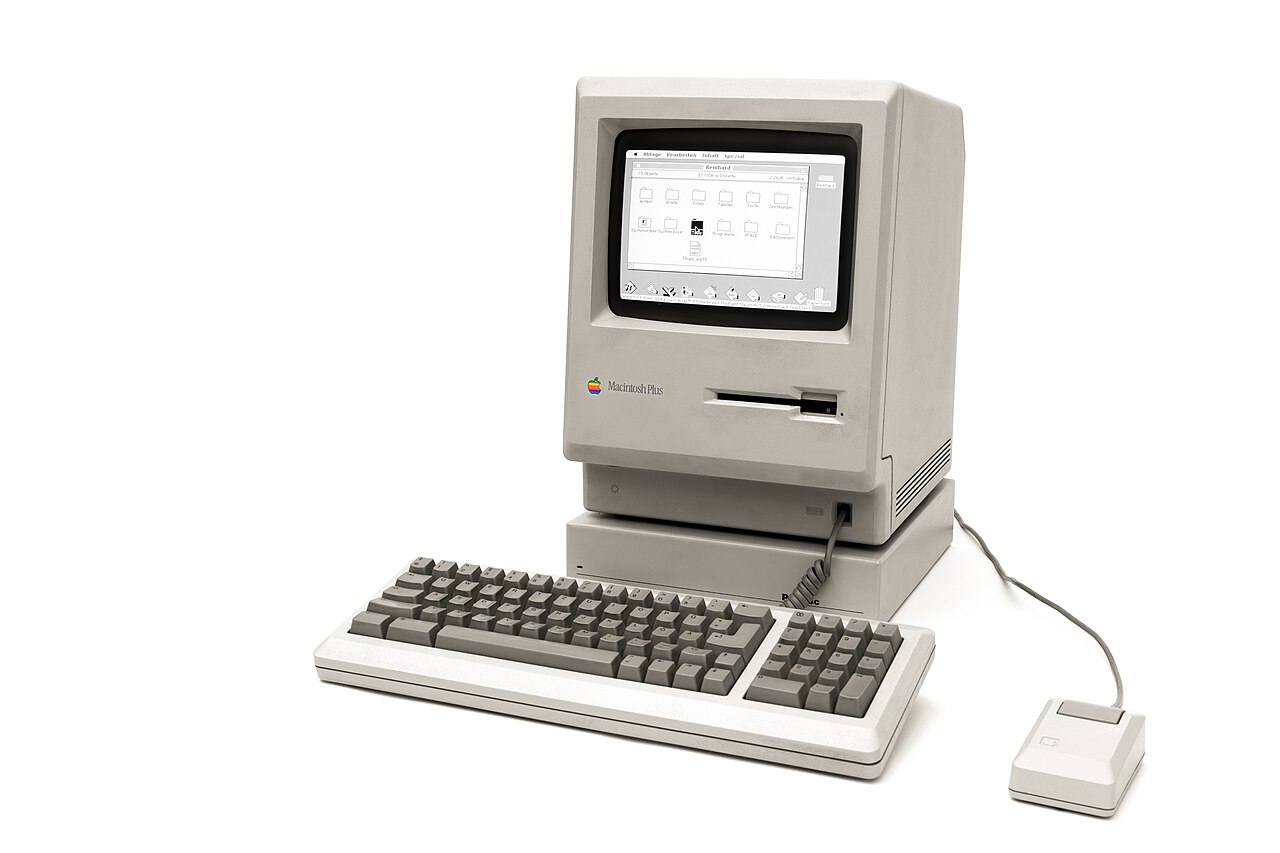
The fixes came in stages. The Macintosh 512K, the “Fat Mac”, shipped in September 1984 and made the machine usable. The Macintosh Plus of 16 January 1986, at $2,599, made it expandable: one megabyte of RAM in SIMM sockets that took up to four, an 800 KB double-sided drive, a numeric keypad, and a SCSI port, which meant hard disks and scanners from anyone. Apple sold the Plus unchanged for 1,734 days, until 15 October 1990, longer than any Macintosh before it.
The Printer That Rescued It
Apple announced the LaserWriter on 23 January 1985 at $6,995. It used the same Canon CX engine as Hewlett-Packard’s LaserJet and added two things the LaserJet did not have: an Adobe PostScript interpreter, so the page was described as a program rather than a bitmap, and AppleTalk networking, so up to sixteen Macs could share one printer and bring the cost per user below $450. Inside it ran a 68000 at 12 MHz with 512 KB of working RAM and a megabyte of frame buffer, which made the printer the most powerful computer Apple sold.
With Aldus PageMaker, released later that year, the combination produced typeset pages from a desk for about $10,000 instead of a service bureau’s rates, and it gave the Macintosh a market that cared more about what the screen could show than about the spreadsheet compatibility the office market wanted. The industry this created is covered in The Desktop Publishing Revolution.
Dead End: The Sealed Machine
Jobs had insisted the Macintosh ship without a fan, cooled by convection, and without expansion slots, on the argument that “customization really is mostly software now”. The first part gave the machine a reputation among repair technicians for cooking its own analogue board; the second part meant that any hardware a customer wanted had to come through a port or not at all.
Apple reversed both positions on 2 March 1987, three years after launch. The Macintosh SE kept the compact case, added a cooling fan and a Processor Direct Slot, and cost $2,900. The Macintosh II, announced the same day at $3,769 for the base unit, abandoned the shape entirely: a 68020 at 16 MHz in a horizontal box with six NuBus slots, colour QuickDraw in ROM, and no built-in display at all, so the buyer chose the monitor. It was the first Macintosh that a third-party hardware industry could grow around, and the design argument it settled has been re-run at Apple roughly once a decade since.
The Years of Being Almost Finished
Apple sold its first million Macintoshes between 1984 and 1989 and ten million more over the following five years, then lost the plot commercially. The Performa line, introduced in 1992 to reach mass-market retail, grew into dozens of barely distinguishable model numbers. Market share fell from 9.4% in 1993 to 3.1% in 1997 as Windows 95 took the corporate desktop, and the licensing programme meant to widen the platform instead took Apple’s own high-margin sales (see Dead End: Mac Clones).
The hardware kept moving. The first Power Macintosh models, the 6100, 7100 and 8100, were introduced on 14 March 1994 with the PowerPC 601 processor from the Apple-IBM-Motorola alliance. Existing 68k software ran under an emulator built into System 7.1.2 at roughly two-thirds the speed of a Quadra, which was slow enough to annoy and fast enough to work. Apple had 150,000 pre-orders on announcement day and passed a million Power Macintoshes by January 1995.
The iMac
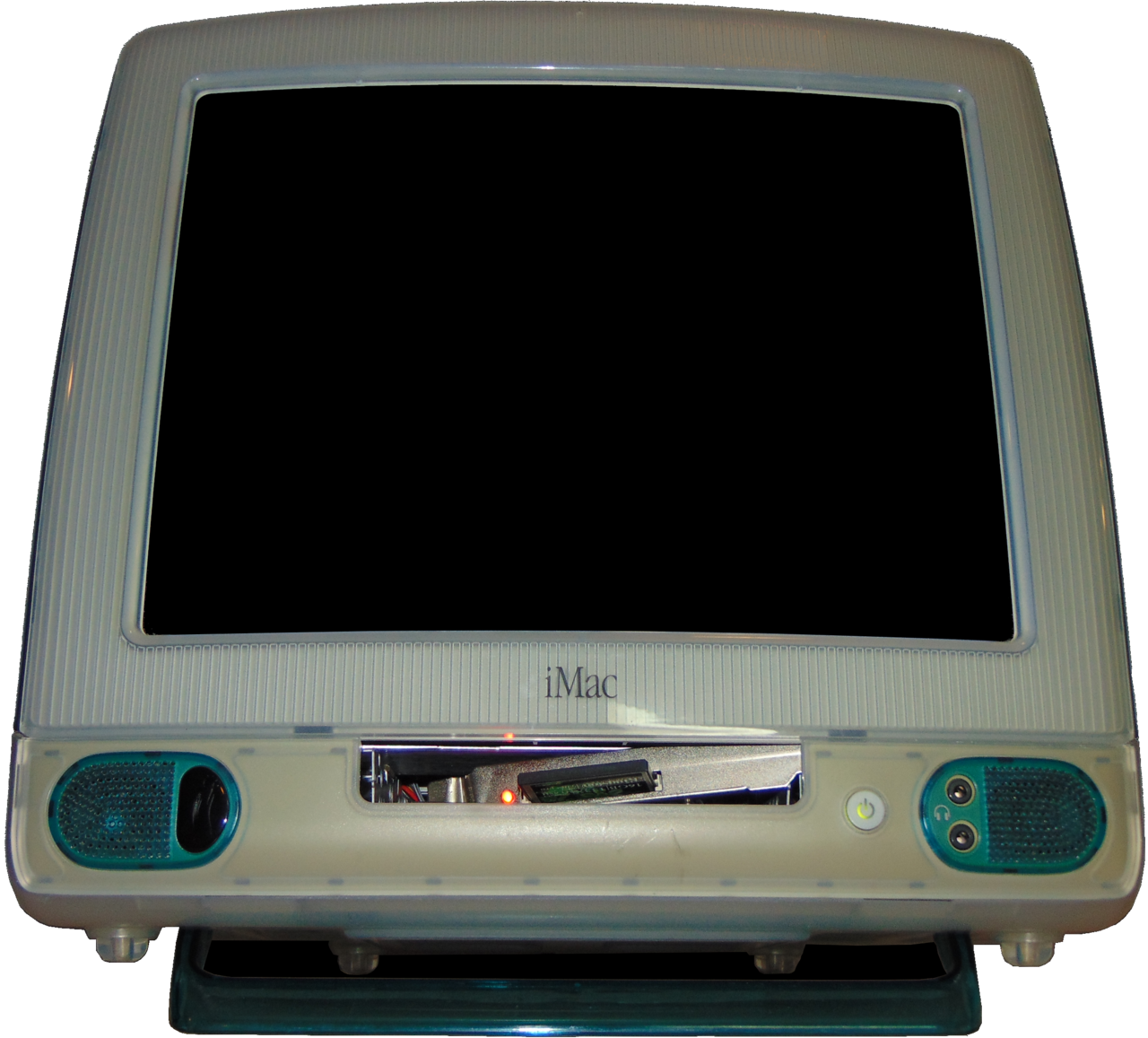
Jobs unveiled the iMac on 6 May 1998 and it shipped on 15 August at $1,299: a 233 MHz PowerPC G3, 32 MB of RAM, a 4 GB disk and a 15-inch CRT inside a translucent Bondi blue shell designed by Jony Ive’s group. It had no floppy drive, no serial ports and no Apple Desktop Bus, only USB, which at the time had almost no peripherals and within two years had all of them (see USB: The Port for Almost Everything).
Apple sold 278,000 in six weeks and 800,000 in twenty. The iMac restored the 1984 proposition, which was one box, one price, no configuration, and it did so by removing more than it added.
Three Processor Transitions
The Macintosh has changed instruction set three times, each time with a translation layer and a deadline.
68k to PowerPC (1994) ran old software in emulation, as above. PowerPC to Intel was announced at WWDC on 6 June 2005, with Jobs citing the performance-per-watt roadmap that PowerPC could not deliver for laptops; the first Intel Macs shipped on 10 January 2006, PowerPC software ran through the Rosetta translator at roughly half to four-fifths of native speed, and the last PowerPC models were replaced on 7 August 2006, about 210 days after the first. Intel to Apple silicon was announced on 22 June 2020, the first M1 Macs were announced on 10 November 2020 and reached buyers a week later, with Rosetta 2 translating x86 binaries, and the transition closed on 5 June 2023 when the Mac Pro moved to the M2 Ultra.
Each transition broke some software and was finished inside three years, which is not how the rest of the industry has managed architecture changes. The x86 line the IBM PC started in 1981 is still running its original instruction set with extensions.
📚 Sources
- Apple Lisa — Wikipedia (19 January 1983 unveiling, $9,995, 5 MHz 68000, 1 MB, 720×364, the Twiggy/FileWare drives, over $50 million development, the 10,000–60,000 sales range, the Lisa 2 at $3,495–$5,495, the Macintosh XL rename, and the 2,700 units buried in Logan, Utah in 1989)
- Macintosh 128K — Wikipedia (24 January 1984 at $2,495, 68000 at 7.8336 MHz, 128 KB RAM soldered as sixteen chips with no upgrade offered, 64 KB ROM, 400 KB drive, 512×342 screen, the fanless design at Jobs’s insistence, the “customization really is mostly software now” remark, the Ridley Scott commercial during Super Bowl XVIII on 22 January 1984, 50,000 units by April 1984 and 70,000 by 3 May, the almost 250,000 hoped for in the first year, and the “Test Drive a Macintosh” promotion with its 200,000 participants, and the September 1984 Macintosh 512K)
- “1984” (advertisement) — Wikipedia (the reported production budget of $370,000 to $900,000 and the third-quarter airing during Super Bowl XVIII)
- Macintosh Plus — Wikipedia (16 January 1986 at $2,599, 1 MB expandable to 4 MB, first Mac with SCSI, 800 KB drive, numeric keypad, and 1,734 days on sale to 15 October 1990)
- LaserWriter — Wikipedia (announced 23 January 1985 at $6,995, Canon CX engine, PostScript, AppleTalk sharing among sixteen Macs at under $450 per user, and the 12 MHz 68000 with 512 KB of RAM that made it the most powerful machine in Apple’s line)
- Macintosh SE — Wikipedia (2 March 1987, $2,900 and $3,900, the Processor Direct Slot and the first cooling fan in a compact Mac)
- Macintosh II — Wikipedia (announced 2 March 1987 at $3,769, 68020 at 16 MHz, six NuBus slots, Color QuickDraw, and the first Mac without a built-in display)
- Jef Raskin — Wikipedia (the 1979 start of the Macintosh project, the appliance concept without a mouse, the naming after his favourite apple, Jobs’s 1981 takeover, and Raskin’s departure in 1982)
- Macintosh — Wikipedia (one million Macs 1984–1989 and ten million more by 1994, the Performa proliferation, and market share falling from 9.4% in 1993 to 3.1% in 1997)
- Power Macintosh — Wikipedia (14 March 1994 introduction of the 6100, 7100 and 8100, the PowerPC 601 and the AIM alliance, the 68k emulator at about two-thirds Quadra speed, 150,000 pre-orders and one million units by January 1995)
- iMac G3 — Wikipedia (6 May 1998 unveiling, 15 August 1998 shipping, 233 MHz PowerPC G3 with 32 MB RAM, 4 GB disk and 15-inch CRT, the Ive design, the removal of the floppy drive and legacy ports in favour of USB, and sales of 278,000 in six weeks and 800,000 in twenty)
- iMac G3/233 Original specifications — EveryMac (the $1,299 introductory price on 15 August 1998)
- Mac transition to Intel processors — Wikipedia (6 June 2005 WWDC announcement, the performance-per-watt reasoning, the 10 January 2006 first Intel Macs, Rosetta at 50–80% of native speed, and completion on 7 August 2006)
- Mac transition to Apple silicon — Wikipedia (22 June 2020 announcement, the 10 November 2020 M1 Macs, Rosetta 2, and completion on 5 June 2023 with the M2 Ultra Mac Pro)
- Image: Computer macintosh 128k, 1984 (all about Apple onlus).jpg by Sailko (CC BY 3.0), via Wikimedia Commons
- Image: Apple Lisa Computer.jpg by Timothy Colegrove (CC BY-SA 4.0), via Wikimedia Commons
- Image: Apple Macintosh Plus white background.jpg by Felix Winkelnkemper (CC BY 2.0), via Wikimedia Commons
- Image: IMac G3 Bondi Blue.png by True Tech Talk Time (CC BY-SA 4.0), via Wikimedia Commons