Heinz Billing
Abstract
Heinz Billing (1914–2017) was a Göttingen physicist who turned wartime magnetic-tape know-how into a magnetic drum memory in 1948 and then built four computers for the Max Planck Society: the G1 (1952), the first program-controlled electronic computer to run in Germany, followed by the G2, G1a, and G3. When commercial machines took over, he moved on to gravitational waves, disproved Joseph Weber’s detection claims, and built the laser-interferometer prototypes in Garching that fed into LIGO. He lived to see the first detection in 2015, at 101.
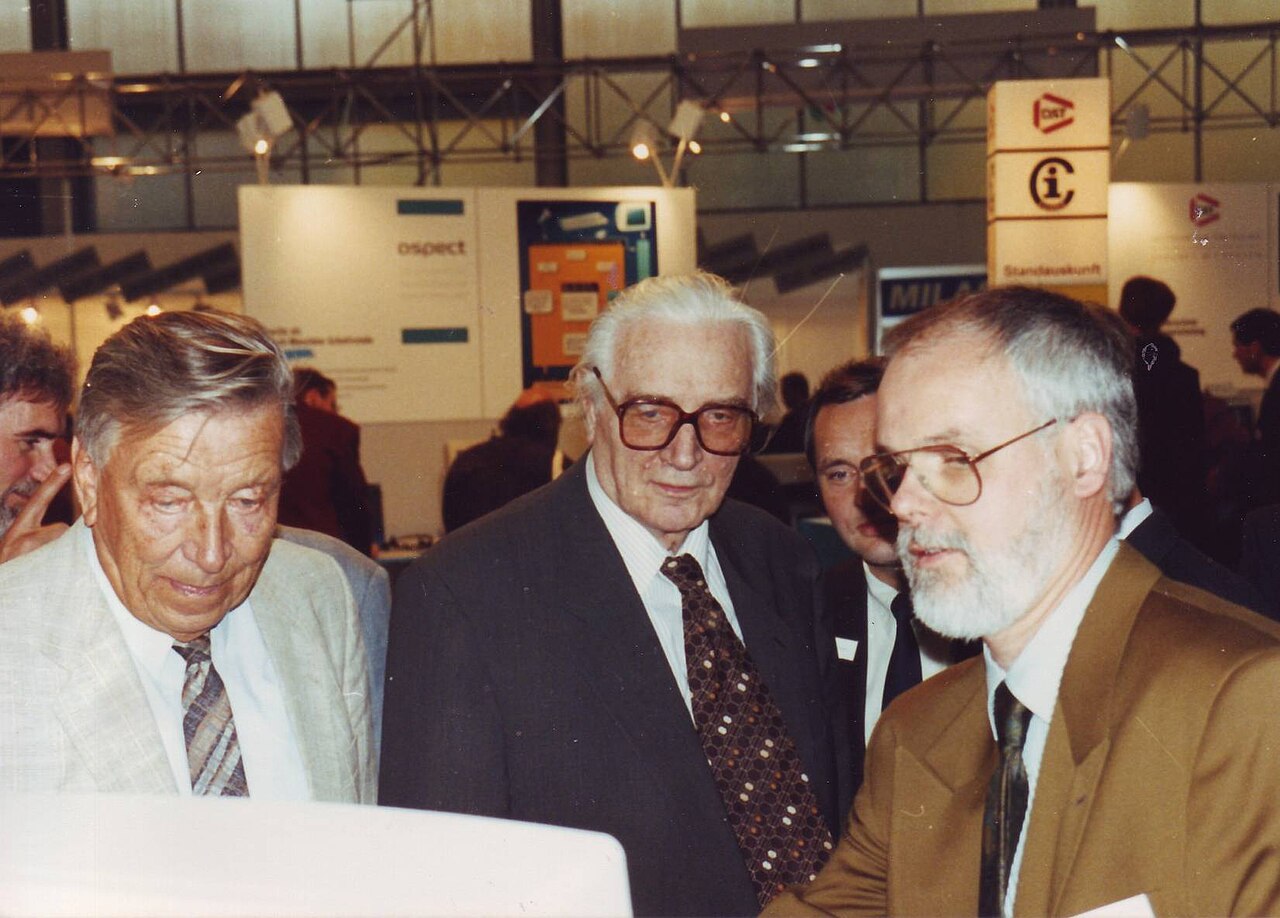
Salzwedel, Munich, and the AVA
Billing was born on 7 April 1914 in Salzwedel in the Altmark, the son of a school headmaster who taught him at home early enough that he skipped the first two years of elementary school. After his Abitur in 1932 he studied physics, one semester in Göttingen and from spring 1933 in Munich under the experimental physicist Walther Gerlach. His doctorate, completed in October 1938, repeated an experiment Einstein had proposed with rotating mirrors.
His first post was at the Aerodynamische Versuchsanstalt (AVA) in Göttingen. During the war he worked there on microphones meant to pick up enemy aircraft, a project that never solved its central problem, the noise of the listening aircraft’s own propellers. It did make him an expert in the Magnetophon, the German magnetic tape recorder, which he had used since 1943. In 1945 Konrad Zuse’s relay computer Z4 passed through the AVA on its way out of Berlin, and Billing probably saw it there.
A Drum Wrapped in Tape
In 1946 the AVA’s instrument group became the Institut für Instrumentenkunde, later part of the Max Planck Society, and Billing headed its high-frequency laboratory. In the late summer of 1947 British computing specialists came to Göttingen and questioned German researchers, among them Zuse, Alwin Walther of Darmstadt, and Billing, about their wartime work. Billing’s memoirs place Alan Turing in the room; whether Turing was actually there is disputed, because Zuse’s memoirs do not mention him. Billing’s note of a conversation with John Womersley of the National Physical Laboratory survives: a binary calculating machine “planned by Womersley and Professor Porter”. The British storage method, hinted at without being named, was the mercury delay line.
The idea impressed Billing because a delay-line machine needed far less hardware than ENIAC. He did not want mercury. He knew magnetic tape, so he proposed recirculating the numbers on a rotating magnetic surface instead. In January 1948 he built a cylinder wrapped in magnetic tape, and by the summer of 1948 the first drum memory was running in Göttingen, designed to hold 192 binary numbers of twenty digits each. He published the principle that year. The drum became the standard working memory of a whole generation of 1950s machines (see Small Computers of the 1950s), and the Gesellschaft für Informatik cited it when it gave Billing the first Konrad Zuse Medal in 1987.
After the currency reform of 1948 the money ran out. Billing went to Australia, where he worked from September 1949 to May 1950 in the electrical engineering department of the University of Sydney. The astrophysicist Ludwig Biermann brought him back, with Marshall Plan funds, to the Max Planck Institute for Physics in Göttingen, where he started in June 1950 as head of a new working group for numerical calculating machines.
G1, G2, G1a, G3
The G1 was a quick job built partly from parts left over from earlier work. It went into service on 7 June 1952 with 476 tubes, 101 relays, and a drum turning at 50 revolutions per second. Its working store held 26 numbers of 32 bits, it read its program from punched tape, and it managed two to three multiplications per second. Billing remembered the relays as a “source of many annoyances”. It computed for Biermann’s astrophysicists and, between jobs, played Nim. It was the first program-controlled electronic computer to run in Germany; the PERM in Munich followed later in the decade.
The G2, completed in 1954, had a larger drum (its first one was destroyed in a head crash) and a 51-bit word. Three copies of a further variant, the G1a, went to Göttingen, Aachen, and Helsinki; the Aachen machine later ended up in the Deutsches Museum. In 1958 the institute moved to Munich and took the machines along; the G1 ran there until 1965.
The G3, inaugurated in 1960, abandoned the drum for a home-built core memory of 4,096 words of 42 bits plus a flag bit, about 176,000 ferrite cores in all, and had a microprogrammed control unit, an idea that had come from England (see Maurice Wilkes and EDSAC). It used 1,500 tubes and 6,000 germanium diodes, ran at 200 kHz, and performed 5,000 to 10,000 operations per second, with floating-point arithmetic, six index registers, and sixteen stack registers. It ran until 1972.
The End of Home-Built Machines
The G3 was the last of the Göttingen machines. By the time it was retired, the institutes were running IBM machines. Billing’s own career shows the change: he sat on the computer commission of the Deutsche Forschungsgemeinschaft from 1957, and from 1968 to 1986 he chaired the Max Planck Society’s new advisory committee on computing facilities, the body that decided which commercial machines its institutes bought. A physics group that had once built a computer to get its sums done now chose one from a catalogue, and Billing, who had led the first kind of work, led the second. Erlangen made him an honorary professor of computer science in 1967.
Not Finding Gravitational Waves
The American physicist Joseph Weber claimed that his aluminium bar detectors had registered gravitational waves. From 1972 Billing’s group in Munich, alongside a group in Frascati, built exact copies of Weber’s apparatus. Neither found anything, and Weber’s claims were rejected. The astronomer Rudolf Kippenhahn later said Billing’s team had been the best in the world at not finding gravitational waves.
In 1975, following a proposal by Rainer Weiss of MIT, Billing switched to laser interferometry and built a 3-metre prototype interferometer; in 1979 his group described an argon-laser instrument in the Journal of Physics E. From 1980 he commissioned a prototype with 30-metre arms at the Max Planck Institute for Astrophysics in Garching. Weiss said in 2013 that LIGO would not have started when it did without what was learned from it. The sensitivity reached by 1980 led to a proposal for a German detector with 3-kilometre arms; the eventual German–British project was GEO600, built from the mid-1990s, and its laser systems became core components of Advanced LIGO.
Billing retired in 1982 and kept advising the Albert Einstein Institute. He wrote two volumes of memoirs, Meine Lebenserinnerungen (1994) and Ein Leben zwischen Forschung und Praxis (1997). The Max Planck Society has awarded the Heinz Billing Prize for the advancement of scientific computing since 1993. On 14 September 2015 LIGO recorded the first gravitational wave; Billing was 101. He died in Garching on 4 January 2017, aged 102, on the same day LIGO recorded the event later catalogued as GW170104.
📚 Sources
- Heinz Nixdorf MuseumsForum blog, “Heinz Billing (1914-2017)” (10 January 2017) (birth, home schooling, Gerlach, AVA microphones, Magnetophon, Z4 at the AVA “probably”, 1947 colloquium and Womersley, January and summer 1948 drum, Australia, Biermann, G1 specifications, Nim, G1a copies, Kippenhahn’s remark)
- Deutsche Biographie: Billing, Heinz (study dates, doctorate October 1938, Sydney September 1949 to May 1950, MPI membership 1961–1982, advisory committee 1968–1986, honours, memoirs, death in Garching)
- Lange, Peter: “Professor Billings bandagierte Blechtrommel”, Computerwoche (29 October 1982) (delay line versus ENIAC, Womersley and Porter note, 192 numbers, Marshall Plan funds, G1 drum and instruction set, relays “Quelle vieler Ärgernisse”, G2 1954 and 51-bit word)
- Max Planck Institute for Gravitational Physics: Obituary, Prof. Dr. Heinz Billing (January 2017) (Weber, Frascati, 1975 interferometry, 30 m prototype, Weiss 2013, retirement 1982, 3 km proposal, GEO600, 14 September 2015)
- GEO600: “Computer and gravitational wave astronomy pioneer Heinz Billing celebrates his 100th birthday” (7 April 2014) (first Konrad Zuse Medal for the drum, IBM machines replacing the G series)
- FAU Erlangen-Nürnberg, ISER collection: core-memory matrix from the G3, inventory I0607 (G3 inaugurated 1960, run until 1972, specifications)
- Rojas, Raúl & Hashagen, Ulf (eds.): The First Computers: History and Architectures (MIT Press, 2000) (chapter “The G1 and the Göttingen Family of Digital Computers”; link is the Isis review of the volume)
- Billing, H.; Maischberger, K.; Rüdiger, A.; Schilling, R. et al.: “An argon laser interferometer for the detection of gravitational radiation”, Journal of Physics E 12, 1043 (1979)
- Shoemaker, D. et al.: “Noise behavior of the Garching 30-meter prototype gravitational-wave detector”, Physical Review D 38, 423 (1988)
- Wikipedia: Heinz Billing (finding aid: Turing dispute, 3 m prototype 1975, GW170104)