Friedrich L. Bauer
Abstract
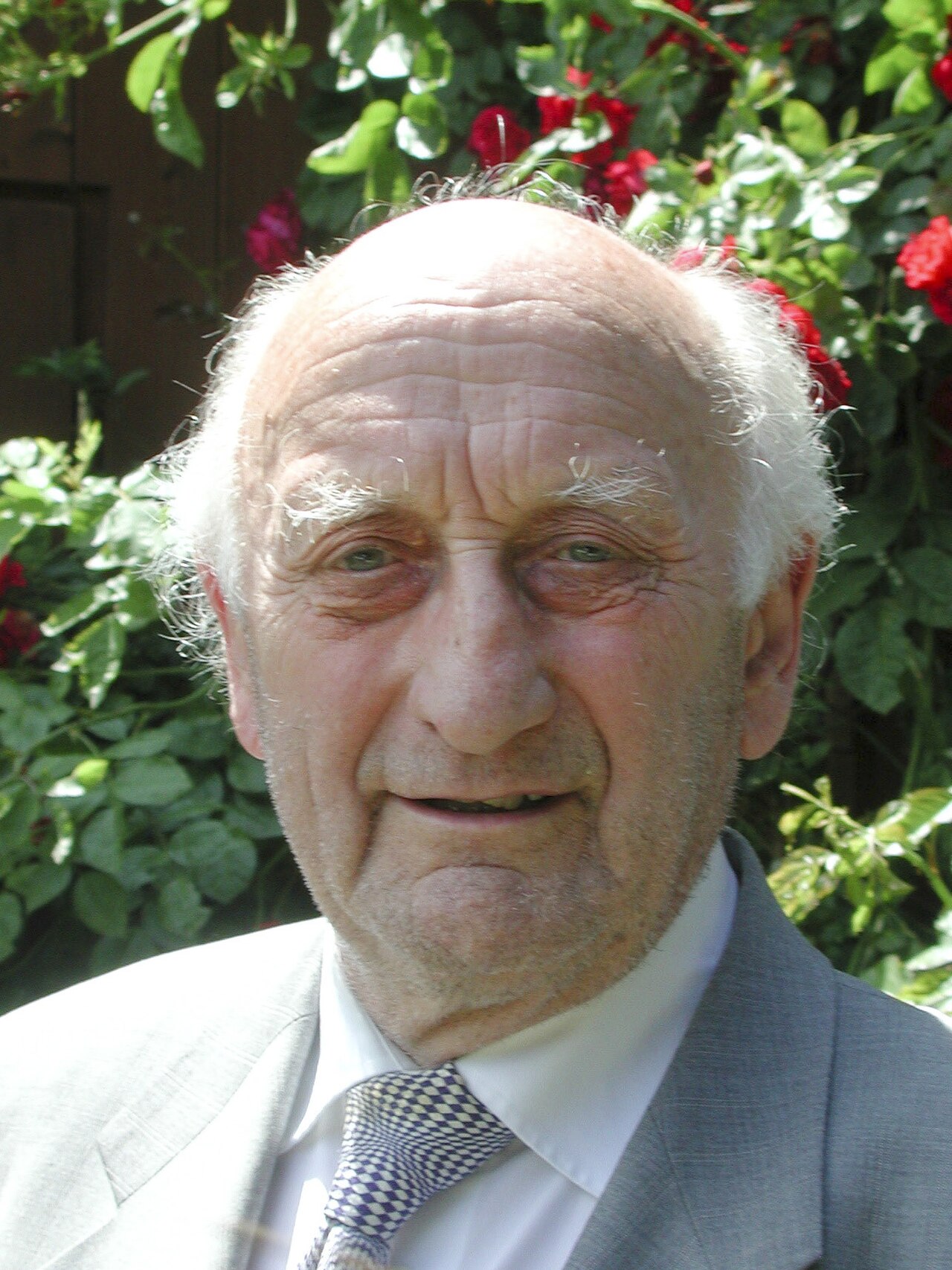
Friedrich Ludwig Bauer (1924–2015) co-invented the stack-based evaluation of expressions, helped design ALGOL 58 and ALGOL 60, taught the first course in Munich that grew into a computer-science degree, and organised the 1968 NATO conference in Garmisch that gave “software engineering” and the “software crisis” their currency. In later life he wrote a standard work on cryptology and designed the computing galleries of the Deutsches Museum. A summary of his work also appears in Germany’s Computing Pioneers.
Regensburg, the War and the PERM
Bauer was born in Regensburg on 10 June 1924, grew up nearby in Thaldorf and took his Abitur at a Munich Gymnasium in 1942. He had hoped to train as a pianist; instead he was sent to the labour service and the front, was wounded and captured in France, and came home in 1945. He studied mathematics, physics and astronomy at the University of Munich and took his doctorate in 1952 under the physicist Fritz Bopp.
He then moved to the Technische Hochschule München and joined the programming group around the PERM, the school’s home-built vacuum-tube computer, which went into operation in 1956 as the third German tube machine after Göttingen’s G1 and G2 (see Germany’s Computing Pioneers). There he worked with Klaus Samelson; in the same year he completed STANISLAUS, a small relay machine that evaluated formulas of propositional logic.
The Cellar
The problem Bauer and Samelson faced was translating arithmetic formulas with nested parentheses into machine instructions. Their answer, developed between 1955 and 1957, was the Kellerprinzip, the “cellar principle”: intermediate operators and values are pushed onto a last-in, first-out store and popped off when they are needed. They filed a patent in 1957 and published the method in 1959. The stack became the standard way to translate expressions and to manage procedure calls, and it ran through the compilers written for ALGOL. The HNF counts Alan Turing and the Australian Charles Hamblin, alongside Bauer, among the inventors of the stack.
ALGOL
Bauer sat on the committees that designed ALGOL 58 and ALGOL 60, the language that introduced block structure and recursive procedures and in which algorithms were published for decades, although it was little used in industry (see ALGOL and the ALGOL Family). The European side of that work, centred on Munich and the PERM group, is the main subject of the oral history he gave to William Aspray in 1987.
Informatik in Munich
Bauer taught applied mathematics at the University of Mainz from 1958 and returned to Munich in 1963. In the winter semester of 1967/68 the Technische Hochschule offered a minor in information processing within the mathematics degree; Bauer gave the introductory lectures, a two-semester course heard by 30 students, and by 1969/70 it ran under the title “Einführung in die Informatik.” The school, renamed Technical University in 1970, appointed its first full professor of computer science, Manfred Paul, that year; Bauer himself took a chair of mathematics and informatics in 1972 and retired in 1989. A generation of German students learned the subject from the textbook he wrote with Gerhard Goos in 1971, known simply as the “Bauer–Goos.” He co-founded the Gesellschaft für Informatik in 1969.
Garmisch 1968
The phrase “software engineering” had appeared in print by June 1965, in an advertisement in Computers and Automation, and in ACM publications in 1966. Bauer made it the name of a field. Using his contacts with the NATO Science Committee, which had begun funding mid-sized conferences in 1967, he initiated the conference “Software Engineering” at the Golfhotel Sonnenbichl in Garmisch-Partenkirchen from 7 to 11 October 1968. Sixty experts from eleven countries attended, among them Alan Perlis, who gave the opening talk, Peter Naur and Edsger Dijkstra; Naur and Brian Randell condensed the discussions into a 226-page report published early in 1969. The meeting made both “software engineering” and the “software crisis” standard terms (see The Software Crisis). A follow-up conference in Rome in October 1969 drew less attention.
Cryptology and History
Bauer was also one of Germany’s leading academic cryptologists. His textbook Entzifferte Geheimnisse (Decrypted Secrets) connected the history of codebreaking with the mathematics behind it and went through four editions (see Cryptography: The Secret Science). In the 1980s he conceived and wrote the texts for the Deutsches Museum’s new department of informatics and automation, along with its galleries for microelectronics and recreational mathematics; in 2007 his Kurze Geschichte der Informatik appeared in cooperation with the Heinz Nixdorf MuseumsForum. The IEEE gave him its Computer Pioneer Award in 1988.
Bauer died on 26 March 2015, in his 91st year.
📚 Sources
- Heinz Nixdorf MuseumsForum blog, “Friedrich L. Bauer (1924-2015)” (1 April 2015)
- Heinz Nixdorf MuseumsForum blog, “50 Jahre Informatik in München” (26 September 2017)
- Heinz Nixdorf MuseumsForum blog, “Die Geburt der „Informatik“” (2 July 2018)
- Heinz Nixdorf MuseumsForum blog, “Software 1968” (9 October 2018)
- Charles Babbage Institute: Oral history interview with Friedrich L. Bauer, OH 128, by William Aspray, 17 February 1987
- Computer History Museum: Bauer, Fritz (Friedrich L.) SIAM oral history, by Ulf Hashagen, 2004
- Wikipedia: Friedrich Ludwig Bauer
- SIAM History of Numerical Analysis and Scientific Computing: Friedrich (Fritz) L. Bauer
- Image: FriedrichLudwigBauer.jpg by Hcii (CC BY-SA 3.0), via Wikimedia Commons