Konrad Zuse and the Z3
Abstract
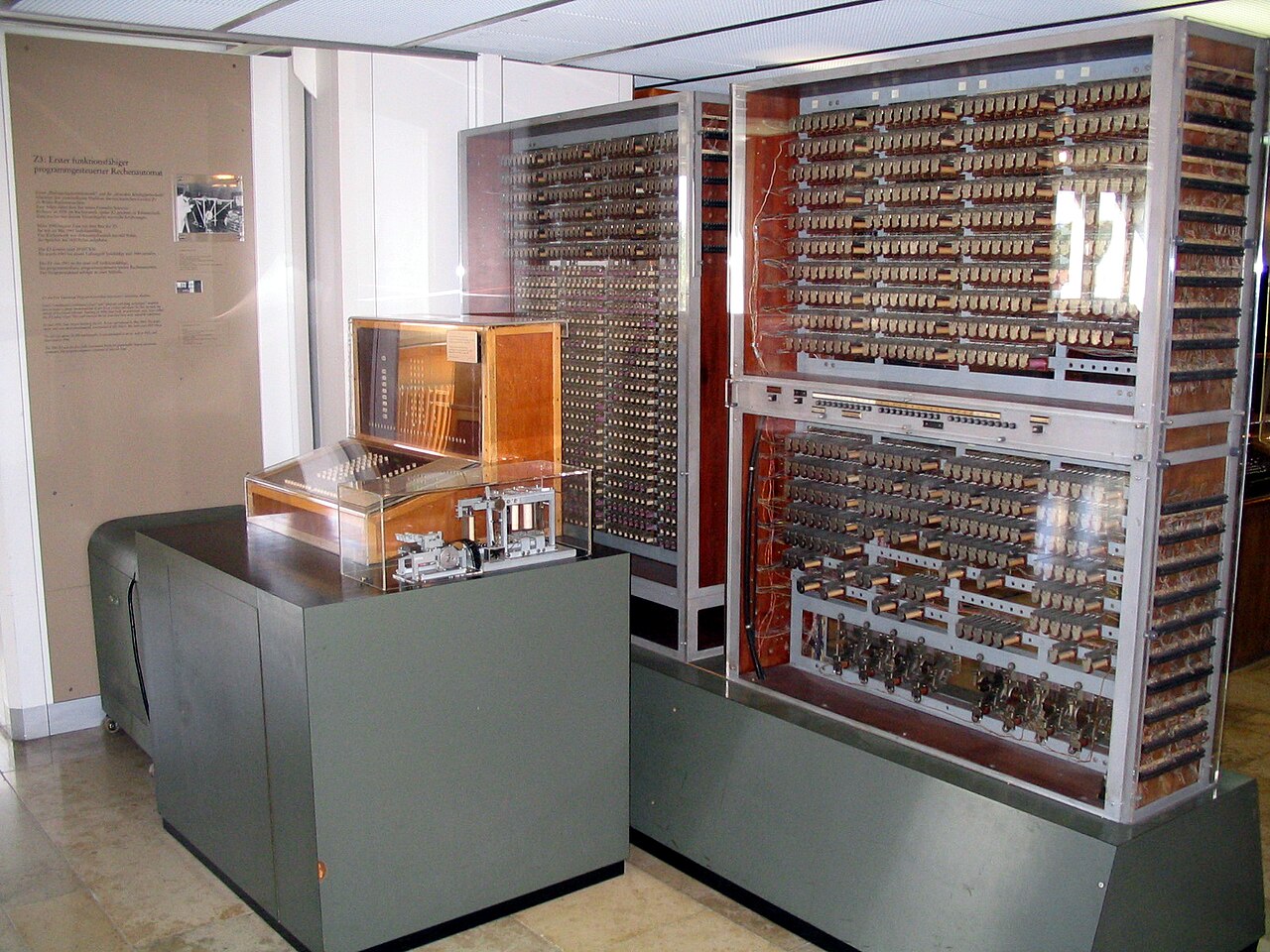
In May 1941, a 30-year-old Berlin engineer presented to a small group of experts a machine consisting of 2,600 telephone relays that performed floating-point arithmetic in binary. It read its instructions from punched 35 mm film strips and was freely programmable, without any physical rewiring. Konrad Zuse’s Z3 was the world’s first working Turing-complete computer. Anglo-American computing history largely ignored it for decades, because it had been built on the wrong side of the war.
The Engineer Who Hated Calculating
Konrad Zuse was born in Berlin in 1910 and studied civil engineering at the Technische Hochschule Berlin-Charlottenburg. As an engineer he faced the same problem daily: structural calculations for aircraft parts, endless columns of numbers to be worked through page by page by hand. Zuse was not lazy, but he thought in terms of efficiency: this work, he realized, was mechanical enough to be done by a machine.
He quit his job at the Henschel aircraft works in 1935 and began building in his parents’ Berlin apartment. His budget was minimal; his supporters were friends who helped as assistants; no institution offered funding for a universal calculating machine.
The Z1: Computing from Metal Plates
From 1936 to 1938, Zuse built the Z1 in his parents’ living room, a fully mechanical calculating machine made not of electronics but of thin metal plates he cut himself. The machine:
- Operated in binary with floating-point representation, both decisions extraordinary for the time and developed independently by Zuse
- Had a 16-word memory
- Read instructions from punched celluloid film (repurposed sections of movie film)
- Was in principle freely programmable
In practice the Z1 ran unreliably. The mechanical tolerances were too tight for hand-cut metal parts; the smallest contamination or temperature fluctuation jammed the logic gates. The Z1 computed, sometimes. But it proved to Zuse that the concept was right.
The Z3: Two Thousand Four Hundred Relays
For the successor, Zuse changed the medium. The Z2 (1940) tested telephone relays for the arithmetic unit: electrical switches that opened and closed reliably and thus enabled reliable logical operations. The experience flowed into the main work.
It could have gone differently: Zuse’s friend and collaborator Helmut Schreyer, a communications engineer at the TH Berlin, pushed for vacuum tubes instead of relays: electronic circuits, a thousand times faster. Zuse stayed with proven relay technology; Schreyer’s proposal for an electronic computer with 2,000 tubes was dismissed by the experts in 1938 as “fantasy” and later rejected by the military, because the war was expected to be won before the machine could be finished.
On May 12, 1941, Zuse presented the Z3. The machine consisted of:
- 2,600 telephone relays in total: 1,400 for the memory, the rest for the arithmetic and control units
- A 22-bit floating-point format: 1 sign bit, 7 exponent bits, 14 bits of mantissa, a structure strikingly close to modern IEEE 754 floating-point numbers
Info
Zuse’s 22-bit floating-point number as an early number format: The Z3 used a binary floating-point representation for which Zuse independently developed the concepts of sign, exponent, and mantissa. The IEEE 754 standard, which unified floating-point arithmetic for all modern processors in 1985, follows the same basic structure, just with more bits (32 or 64 instead of 22). Zuse had solved the logical architecture of a problem for which the hardware world created a global standard only four decades later.
The Z3 worked in parallel: all 22 bits of a word were read from memory simultaneously, not one after another. It could add, subtract, multiply, divide, and take square roots. The clock rate was about 5–10 Hz, five to ten operations per second.
Programming was done via punched film strips: Zuse used 35 mm movie film and punched in the instruction patterns. Programs could be executed as loops by gluing the film strip into a loop. Conditional jumps (IF statements) were missing from the Z3; they were implemented only in later machines.
Whether the Z3 was nevertheless Turing-complete without conditional jumps remained disputed for a long time. In 1998, the computer scientist Raúl Rojas of the Freie Universität Berlin proved that through clever programming with loops the Z3 could still compute any computable function, a retroactive proof that Zuse’s machine was theoretically universal.
From 1940 the work was partly state-funded: the Aerodynamische Versuchsanstalt supported Zuse’s computer building, and for the Henschel works he built the special-purpose computers S1 and S2, which calculated aerodynamic corrections for the wings of radio-guided glide bombs; the S2 is considered an early process control computer. Zuse was never a member of the NSDAP, but his work was commissioned and paid for by the armaments effort. How to judge his relationship to the Nazi regime is still debated in the literature.
Plankalkül: The First Programming Language
Between 1942 and 1945, when Zuse had no way of building new hardware, he worked on something theoretical: a programming language for machines like the Z3.
The Plankalkül (calculus of plans) was the first concept of a high-level programming language ever. It included:
- Floating-point arithmetic as a data type
- Subroutines
- Conditional execution and loops
- Structured data (arrays, records)
- A concept of formal verification: Zuse proposed proving programs mathematically correct
As a demonstration, Zuse wrote a complete chess program in Plankalkül: 49 pages of algorithms for position evaluation and move calculation. It was the first chess program in history, years before Alan Turing and Claude Shannon developed similar ideas.
The manuscript was finished in 1945. Zuse could not submit it: Germany was collapsing. The complete work remained unpublished and unknown until 1972, when it was reissued with commentary. A first compiler for Plankalkül appeared in Joachim Hohmann’s 1975 dissertation; the Freie Universität Berlin built another implementation in 2000, 55 years after the language was completed.
The Z4 Survives the War
The Z3 itself did not survive the war. At the end of 1943, a British bombing raid destroyed Zuse’s workshop in Berlin. The Z3 burned. Zuse continued work on the Z4, an improved version with a mechanical memory.
In February 1945, with Berlin under devastating air attack, Zuse had the unfinished Z4 loaded onto a truck. The machine left Berlin for Göttingen, then for the Bavarian village of Hinterstein, where Zuse hid it and waited out the end of the war.
In 1949, Zuse showed the Z4 to the Swiss mathematician Eduard Stiefel of ETH Zurich. Stiefel recognized the machine’s value immediately. In 1950, the Z4 was delivered to ETH Zurich, for a fee of 30,000 Swiss francs over five years.
At that point the Z4 was the only working digital computer in central Europe and only the second computer ever to be rented or sold. At ETH it was used for aerodynamic and numerical calculations until 1955.
The Zuse KG
In 1949, Zuse founded the Zuse KG with two partners in Neukirchen in the Hünfeld district (from 1957 in Bad Hersfeld), Germany’s first computer company. By 1969 the firm had delivered 251 computers, among them the series-produced relay machine Z11 for surveying and the optics industry, and the Z22, the company’s first vacuum-tube computer with magnetic drum memory, of which 55 units went mostly to universities. By his own account, Zuse was never a businessman: the company repeatedly ran into financial difficulties. In 1964 Brown, Boveri & Cie took control, in 1967 Siemens bought 70 percent (Zuse left the company the same year), in 1969 the rest. In early April 1971 the company name was struck from the register.
Dead End: Isolation and the Missed History
Zuse’s work carries a double tragedy: the machines ran; the recognition did not come.
The isolation of the war was the first factor. While Zuse worked on the Z3 in Berlin, Atanasoff and Berry in Iowa developed their ABC (1939–1942), Turing and the team at Bletchley Park built Colossus (1943–1944), and Eckert/Mauchly developed ENIAC in Philadelphia (1943–1945). All these developments proceeded without knowledge of one another, and after the war the Anglo-American perspective dominated the historiography. Zuse’s work was in German, unpublished, and in a defeated country.
The Plankalkül is the deepest loss. Had Zuse published the manuscript in 1945 or 1946, Plankalkül would have become the foundation of programming language theory, a decade before FORTRAN (1957), before LISP (1958), before ALGOL (1958). Instead, these languages were developed independently, without knowledge of Plankalkül. When the work appeared in 1972, the programming language world was already established. Plankalkül influenced nothing anymore.
The patent was denied him as well. Zuse had filed the Z3 circuit design for a patent in 1941; the application was published in 1952, then Triumph-Adler and IBM filed oppositions. In 1967 the Federal Patent Court finally ruled against granting it, on the grounds of “insufficient inventive step”. The inventor of the computer never held a patent on his central invention; of his 58 patent applications, eight were granted in total.
The priority dispute burdens computing history to this day. The questions (who built the first computer?) cannot be answered cleanly, because “first computer” has no unambiguous definition. The Z3 is the first freely programmable, Turing-complete, binary floating-point computer. The ABC was binary and electronic, but not freely programmable. Colossus was electronic and fast, but specialized for one task. ENIAC was electronic and universal, but originally decimal and not stored-program.
Zuse received the recognition he deserved too late. Honors did come: the Werner von Siemens Ring in 1964, the Harry H. Goode Memorial Award of the American computing society in 1965, the Great Federal Cross of Merit in 1973 (with star in 1985), induction as a Fellow of the Computer History Museum in 1999. In retirement he painted; over 500 pictures, some signed with the pseudonym “Kuno See”; in 2012 documenta 13 in Kassel exhibited his works. He died in 1995, long enough to see his priority acknowledged. But the textbooks, the algorithms, the university courses: they route the history of computer science through Turing and von Neumann, through ENIAC and the Manchester Baby. Zuse appears as a footnote.
The keeper of the record became his eldest son. Horst Zuse, a computer scientist at the Technische Universität Berlin, wrote the standard technical accounts of his father’s machines and, for the centenary of Konrad Zuse’s birth in 2010, built a working Z3 replica from modern relays. It stands in the Konrad-Zuse-Museum in Hünfeld, the town where the Zuse KG once built its computers.
📚 Sources
- Wikipedia: Konrad Zuse
- Wikipedia: Z3 (computer)
- Wikipedia: Z1 (computer)
- Wikipedia: Z4 (computer)
- Wikipedia (de): Zuse KG
- Wikipedia (de): Konrad Zuse
- Wikipedia (de): Horst Zuse (son; 2010 Z3 replica)
- Horst Zuse: Der Nachbau der Z3 (2010 replica, permanent home Konrad-Zuse-Museum Hünfeld)
- Wikipedia: Plankalkül
- Hackaday: The Other First Computer — Konrad Zuse and the Z3
- Springer Nature: Computer Science Before Its Birth — Konrad Zuse and the Forgotten Foundations of Computing
- AllAboutCircuits: Konrad Zuse and the Z1 — The Dawn of Programmable Computing
- INRIA: Reconstruction of Konrad Zuse’s Z3
- Computer History Museum: Konrad Zuse
- Oral history interview with Konrad Zuse — IEEE History Center (ETHW) · interviewed by Frederik Nebeker, August 28, 1994; full transcript covering the relay computers, Z4, and Zuse KG
- DPMA: Konrad Zuse
- Britannica: Plankalkül
- Image: Z3 Deutsches Museum.JPG by Venusianer at German Wikipedia (CC BY-SA 3.0), via Wikimedia Commons