Heinz Zemanek and the Mailüfterl
Abstract
Heinz Zemanek (1920–2014) built the first fully transistorised computer on the European continent in a Vienna university institute with almost no money, named it after a mild May breeze because it could not hope to match the American Whirlwind, and then turned his student team into the IBM Vienna Laboratory, where they wrote the first complete formal definition of a major programming language, PL/I, and started the line of work that became the Vienna Development Method. He was president of IFIP from 1971 to 1974 and an IBM Fellow from 1976. This article is also the vault’s account of Austrian computing, a small country’s story that runs from Gustav Tauschek’s punched-card patents in the 1920s through Zemanek’s laboratory to the formal-methods school it left behind.
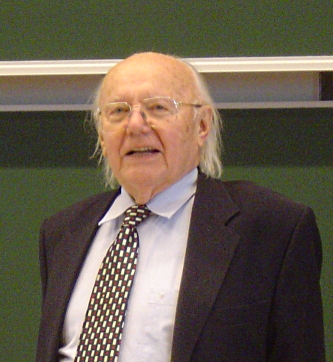
Vienna, War, and a Relay Machine
Heinz Zemanek was born in Vienna on 1 January 1920, took his Matura in 1937, and studied in Vienna and then in Stuttgart. In 1940 he was drafted into the Wehrmacht and served in a signals unit, working on radar; he came back to Vienna after the war and finished his doctorate in 1951 on time-sharing in multiplex telegraphy. The subject is the clue to everything he did afterwards: Zemanek’s route into computing was telecommunications, and he thought of computers as switching systems with a mathematical theory attached.
His first machine was electromechanical. The URR1, the Universal Relay Computer 1, was finished in 1952 at the TH Wien, a relay computer in the tradition of Konrad Zuse’s early machines. It was a demonstration of what an assistant with a few students could do; the next one was a demonstration of what transistors could do.
The Mailüfterl
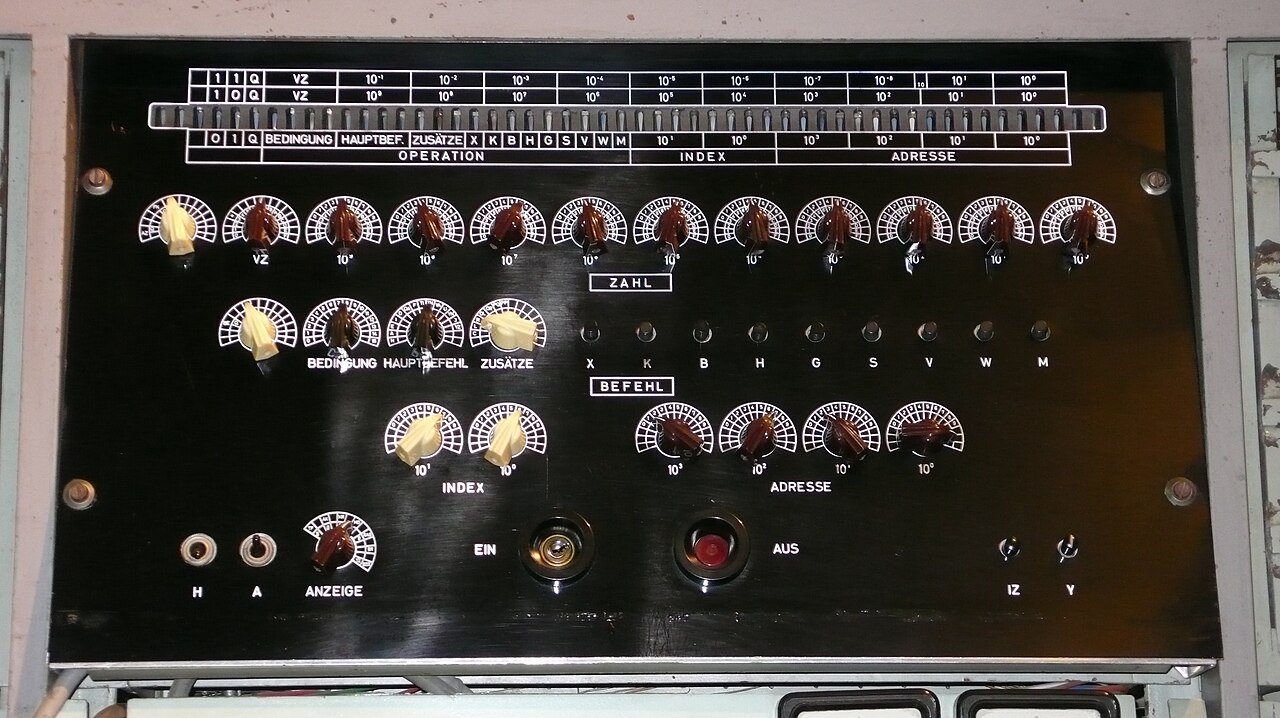
Construction began in 1955 in the institute’s rooms at the TH Wien. Zemanek had no state programme behind him and no company; the machine used 3,000 transistors and 5,000 diodes, and the team was a group of assistants and students that included Rudolf Bodo, Peter Lucas, Viktor Kudielka, Kurt Walk, Ernst Rothauser, Kurt Bandat, Georges Leser and Norbert Teufelhart. The machine they built was four metres wide, two and a half high, half a metre deep, weighed about 500 kilograms, and worked in binary-coded decimal at a clock of 132 kHz. It was presented in May 1958, and on 27 May 1958 it performed its first public calculation, determining that 5,073,548,261 is prime in 66 minutes.
The name was Zemanek’s joke against the odds. The big American machines were called Whirlwind and Typhoon; his, he said, would not reach their speed, but for Vienna a Mailüfterl, a little May breeze, would do. It was one of the first fully transistorised computers on the European continent. The team wrote its own software for it, including an early ALGOL compiler, LOGALGOL.
IBM Comes to Vienna
What made the Mailüfterl matter was not the machine but the way it ended. In 1961 IBM hired Zemanek’s group as a body and bought the computer, and the IBM Laboratory Vienna opened with Zemanek as its manager, a post he held until 1976. The Mailüfterl worked for IBM until 1966, went on loan to the Technisches Museum Wien in 1973 and was given to it outright in 2024. Zemanek had turned a university project into a research laboratory of the largest computer company in the world without leaving the city, which is the reason a country with no computer industry has a place in the history of programming languages.
The laboratory’s assignment was IBM’s new language, PL/I, whose informal specification was long, ambiguous and being implemented by several teams at once. Peter Lucas, Kurt Walk, Hans Bekić and their colleagues wrote a complete formal definition of it in the 1960s in what became known as the Vienna Definition Language (VDL), an operational semantics: an abstract machine whose state transitions define what every PL/I construct means. It was the first time a production language of that size had been defined mathematically, and it established that such a definition was possible at all. Towards the end of 1972 the group turned from defining languages to developing compilers from definitions, and adopted a denotational meta-language, Meta-IV; a formal definition of a PL/I subset in the new style appeared as IBM technical report TR 25.139 on 20 December 1974. When IBM cancelled the compiler project, the method outlived it. Cliff Jones and Dines Bjørner took it out of Vienna as the Vienna Development Method (VDM); Bjørner’s group in Denmark used it to build the first European validated Ada compiler in 1982, and the VDM specification language was standardised as ISO/IEC 13817-1 in 1996. See Formal Methods and Model Checking.
IFIP and the Later Years
Zemanek was one of the Europeans who made IFIP work across the Iron Curtain, and served as its president from 1971 to 1974. IBM made him an IBM Fellow in 1976, the year he left the laboratory’s management; the TU Wien named a lecture hall after him; he received the Wilhelm Exner Medal in 1972 and the Austrian Cross of Honour for Science and Art in 2005, and in 1987 gave the Charles Babbage Institute a two-day oral history in Vienna covering everything from Nazi-occupied Austria to PL/I. He wrote and lectured on the history of computing for the rest of his life, and died in Vienna on 16 July 2014, aged 94.
Austria Beyond Zemanek
Austrian computing before and after him is thin but not empty. Before: Gustav Tauschek’s punched-card and drum-memory patents of the 1920s and 1930s, bought by IBM, are covered in Gustav Tauschek: The Forgotten Inventor. After: the IBM laboratory’s alumni seeded the formal-methods and programming-language groups of the Austrian universities, and the TU Wien, Linz and Graz became research rather than industrial centres. Austria never built a computer industry to lose. Its contribution was one machine, one laboratory and one method, and the method is the part still in use.
Dead End: The Laboratory That Defined a Language Nobody Kept
The Vienna definition of PL/I was complete, rigorous and, for the language it described, largely wasted. PL/I never displaced FORTRAN and COBOL, its size made it hard to implement and hard to teach, and the industry moved to C and later to languages whose designers had read the Vienna work but did not use it. IBM cancelled the compiler that the definition was meant to produce. What survived was the idea that a language should have a mathematical definition before it has three incompatible compilers, and the people who carried it: VDM, and through it the formal-methods school of Britain and Denmark, is a Vienna export. The machine that started it is in a museum; the definition it led to is in the ISO catalogue.
📚 Sources
- Heinz Zemanek — Wikipedia
- Mailüfterl — Wikipedia (German)
- Vienna Development Method — Wikipedia
- Oral history interview with Heinz Zemanek, OH 127 — Charles Babbage Institute, conducted by William Aspray, 14 and 16 February 1987, Vienna
- Technisches Museum Wien — Wikipedia
- Image: Heinz Zemanek JKU 2007.jpg by Christian Wirth (Wirthi) (CC BY-SA 3.0), via Wikimedia Commons