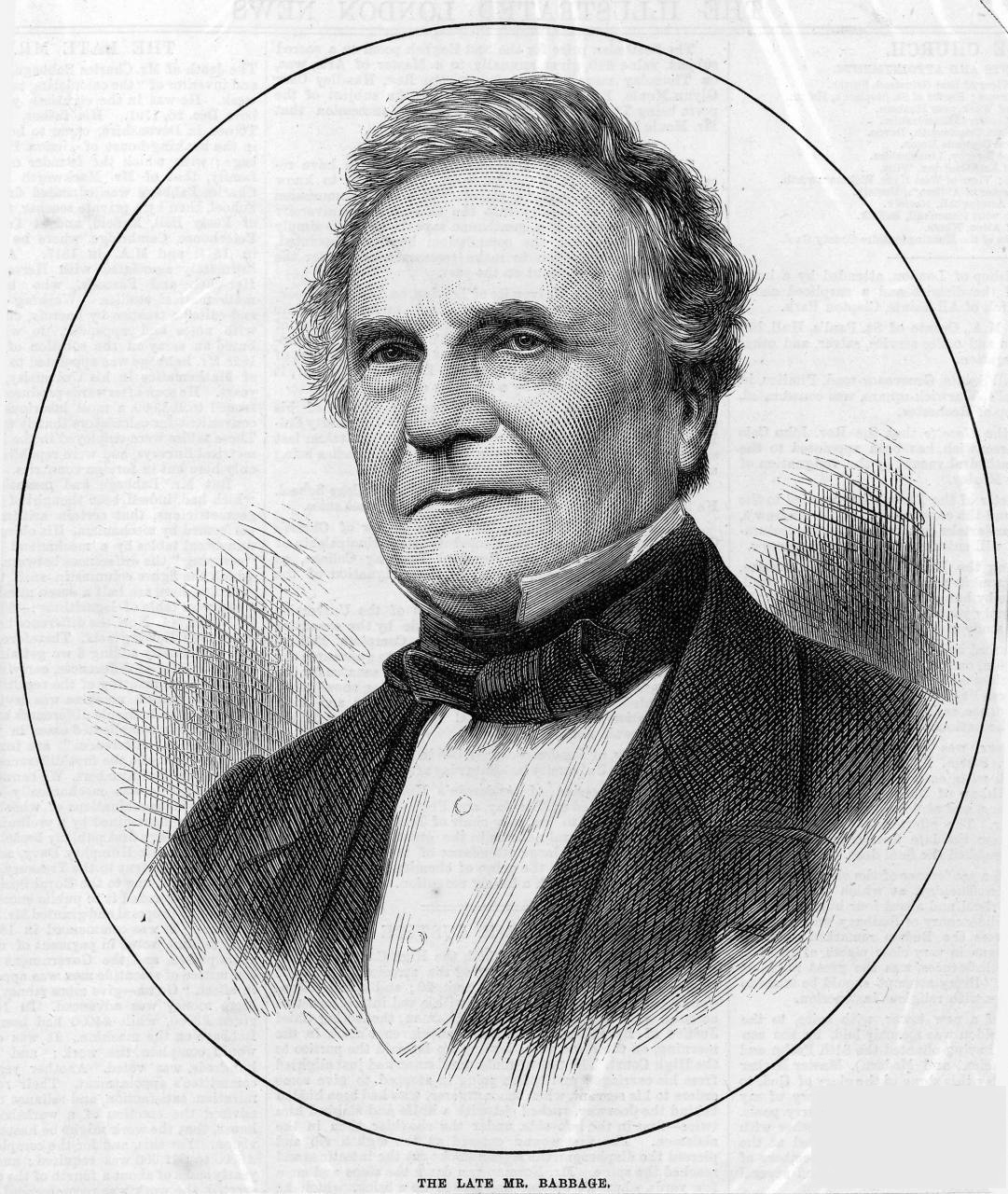
Charles Babbage: The Visionary Architect
Abstract
This article provides an in-depth examination of the life and monumental intellectual contributions of Charles Babbage. As a mathematician, engineer, and philosopher, Babbage’s conceptualization of the Difference Engine and the far more ambitious Analytical Engine represents the foundational moment in the history of computation. By moving from simple automated calculation to the concept of programmable, general-scale logic, Babbage laid the theoretical groundwork for the digital revolution over a century before the first electronic computer was built.
The Mathematical Crisis: The Need for Precision
In the early 19th century, the expansion of the British Empire, the advancement of navigation, and the growth of engineering were all hindered by a critical flaw in mathematical practice: human error in logarithmic and trigonometric tables. These tables, essential for calculating planetary positions and maritime routes, were computed manually by “computers” (human specialists) and were frequently riddled with inaccuracies that could lead to catastrophic navigational failures.
The Human Cost of Error
Babbage was particularly haunted by the realization that sailors’ lives were at risk due to these errors. He viewed the mechanical automation of calculation not just as a mathematical curiosity, but as a moral imperative to ensure safety and reliability in navigation.
Babbage’s motivation was not merely technological but deeply mathematical. He sought to eliminate the “human element” from the creation of these tables through a mechanical process that relied on the immutable laws of arithmetic rather than the fallible precision of human sight and calculation.
The Difference Engine: Automating Polynomials
The Difference Engine was Babbage’s first major attempt to mechanize calculation. Rather than attempting general arithmetic, it focused on a specific mathematical technique: the method of finite differences. This method allows for the evaluation of polynomials by using only addition, avoiding the need for complex multiplication or division.
By arranging gears in columns that represented different orders of differences, Babbage designed a machine that could “step” through a sequence of values and automatically calculate the next result in a table.
Technical Mechanism
The engine’s core consisted of vertical shafts with geared wheels. Each wheel represented a decimal digit (0-9). When a wheel completed a full rotation, it triggered a “carry” mechanism to increment the wheel above it, a mechanical implementation of the carry operation we use in manual addition today.
The machine was designed not only to calculate but also to output its results automatically, impressing the digits into soft material (plaster) to create stereotype moulds from which printing plates could be made, eliminating the risk of human transcription errors during typesetting.
The Challenge of Implementation
Despite receiving significant funding from the British government (approximately £17,000 over a decade), the Difference Engine No. 1 was never completed. Babbage faced two primary obstacles:
- Engineering Precision: The machine required thousands of identical parts with tolerances that pushed the limits of Victorian tool-making.
- The Perfectionist’s Trap: Babbage frequently altered his designs to improve efficiency or accuracy, leading to a cycle of “starting over” that frustrated his financiers and engineers.
This tension eventually led to a bitter fallout with the government, leaving the project unfinished and Babbage disillusioned.
Myth: Babbage’s engines failed because Victorian machining wasn’t precise enough
The popular story (a genius defeated by primitive tools) is largely wrong. Between 1985 and 2002 the Science Museum in London built Difference Engine No. 2 directly from Babbage’s own 1840s drawings, using only tolerances achievable with mid-19th-century technology, and it computed correctly. The mechanics were feasible in Babbage’s own lifetime. What actually sank the work was funding disputes, his bitter split with his master engineer Joseph Clement, and his compulsive habit of redesigning the machine before any version was finished. The failure was managerial and financial, not mechanical. See Myths and Misconceptions.
The Analytical Engine: The Birth of Programmability
While the Difference Engine was a specialized calculator, Babbage’s Analytical Engine was something entirely different: a general-purpose, programmable computer. This jump in complexity represents one of the greatest intellectual leaps in the history of science.
Dead End: The Brass Ceiling
Despite its theoretical brilliance, the Analytical Engine became a “technological dead end” for over a century, but not, as the legend has it, because Victorian metalworking was incapable of building it (the Science Museum’s later reconstruction of the Difference Engine disproved that). Its design was vastly more complex than anything Babbage had attempted, and his constant redesigning meant he never produced a final, stable blueprint for others to build from. Combined with exhausted government funding and his ruined relationships with his engineers and financiers, the machine remained unbuilt in his lifetime for reasons of money, management, and unfinished design rather than raw mechanical impossibility.
Comparison: Specialized vs. General-Purpose
| Feature | Difference Engine | Analytical Engine |
|---|---|---|
| Primary Function | Calculating mathematical tables (polynomials) | General-purpose computation |
| Programmability | Fixed (hardwired for finite differences) | Programmable via punched cards |
| Logic Control | Simple arithmetic progression | Conditional logic (IF/THEN) and loops |
| Complexity | High, but mathematically limited | Extremely high; conceptually universal |
A New Architecture
The Analytical Engine moved beyond the linear progression of the Difference Engine by introducing a separation between storage and processing, a concept that mirrors the modern CPU and RAM architecture.
Babbage conceptualized two main components:
- The Store: Where numbers (variables) were held in mechanical form using columns of gears.
- The Mill: The central processing unit where arithmetic operations were actually performed.
To control the Mill, Babbage utilized a system of punched cards, inspired by the Jacquard loom. This allowed the machine to be “programmed” with different instructions without needing to rebuild its physical structure. Most crucially, he introduced the concept of conditional branching, allowing the machine to make decisions (e.g., “if value X is negative, perform operation A; otherwise, perform operation B”), which is the fundamental requirement for any Turing-complete system.
The Role of Ada Lovelace: The First Programmer
It is impossible to discuss the Analytical Engine without mentioning Ada Lovelace and the Analytical Engine. While Babbage focused on the mechanical and mathematical architecture, Lovelace grasped the symbolic potential of the machine. She famously realized that if a machine could manipulate numbers according to rules, it could also manipulate any symbol, music, graphics, or logic. Her extensive “Notes” on the engine included the first published algorithm intended for implementation on a machine (the calculation of Bernoulli numbers), earning her the title of the world’s first computer programmer.
The Legacy: A Technological Hiatus and Eventual Resurrection
The Analytical Engine remained a theoretical masterpiece, an “unfinished dream” that would not be realized in physical form for over a hundred years. The lack of precision engineering and the economic realities of 19th-century Britain meant that Babbage’s vision was essentially a “technological dead end” in terms of contemporary implementation.
The work did not end entirely with Babbage’s death in 1871. His youngest surviving son, Henry Prevost Babbage, a Major-General in the Indian Army, spent his retirement on his father’s unfinished machines. He collected and published the scattered papers as Babbage’s Calculating Engines (1889), and had a demonstration piece of the Analytical Engine’s mill built from the original drawings by the engineering firm R. W. Munro. Completed in 1910, it computed and printed the first 25 multiples of pi to 29 figures (the printed table contained errors), the closest any part of the Analytical Engine came to working in metal.
However, his legacy is not found in completed brass gears, but in the mathematical logic he bequeathed to the future. The first person to show that the Analytical Engine could be built (not in brass but in electromagnets and relays) was the Spanish engineer Leonardo Torres Quevedo, who around 1914–1920 constructed working electromechanical calculators explicitly as a realization of Babbage’s design. When the electronic age arrived in the 20th century, researchers like Alan Turing and John von Neumann were building upon the very foundations of programmable computation that Babbage had laid. The “software” concept (the idea that a machine’s function can be changed without changing its hardware) is his greatest gift to the modern world.
📚 Sources
- Charles Babbage - Britannica
- The Analytical Engine - Computer History Museum
- Charles Babbage — Wikipedia
- The Method of Finite Differences - Wolfram MathWorld
- Swade, Doron: The Difference Engine: Charles Babbage and the Quest to Build the First Computer (2001) — on the Science Museum’s working reconstruction
- Difference Engine (incl. Science Museum’s No. 2 reconstruction, 1985–2002, and printing mechanism) — Wikipedia
- Henry Prevost Babbage — Wikipedia (the 1889 papers and the mill demonstration piece)
- Babbage, Henry P.: “Babbage’s Analytical Engine” — Monthly Notices of the Royal Astronomical Society (1910), on the completed mill and the pi table