Helmut Hölzer
Abstract
Helmut Hölzer (1912–1996) was a Darmstadt engineering student and glider pilot who worked out in 1935 that an electrical circuit could integrate and differentiate, was told by his professors to drop it, and built it six years later at Peenemünde for the V-2. His Mischgerät, the rocket’s onboard “mixing device”, was the first electronic computer to fly, solving the guidance equations continuously on a ballistic missile from 1942; the general-purpose analog computer he assembled alongside it to simulate the rocket on the ground was the first fully electronic analog computer anywhere. He wrote it up as a doctoral thesis in 1946, went to the United States with the von Braun group under Operation Paperclip, and ended his career as director of the computation laboratory at NASA’s Marshall Space Flight Center, where the Saturn V was simulated before it was built. The history of the machines is in Analog Computers; this is the life.
Darmstadt
Hölzer was born on February 27, 1912, in Bad Liebenstein, a spa town in Thuringia. He studied electrical engineering at the Technische Hochschule Darmstadt, and the idea that shaped his life arrived in 1935 from a hobby: as a beginning glider pilot he wanted an instrument that would show his ground speed and distance flown, which meant integrating a measured velocity over time. He proposed doing it electrically, with a resistor-capacitor network and an amplifier, and his professors talked him out of it as a student project. He kept the notes. After graduating in May 1939 he spent half a year in Telefunken’s high-frequency laboratory in Berlin, working on radio guidance for aircraft, and then went straight to the Army’s rocket research centre at Peenemünde on the island of Usedom, where Wernher von Braun’s team was building the A4, a ballistic missile that would need to be steered for the sixty seconds its engine burned and could not be steered by a pilot.
Peenemünde
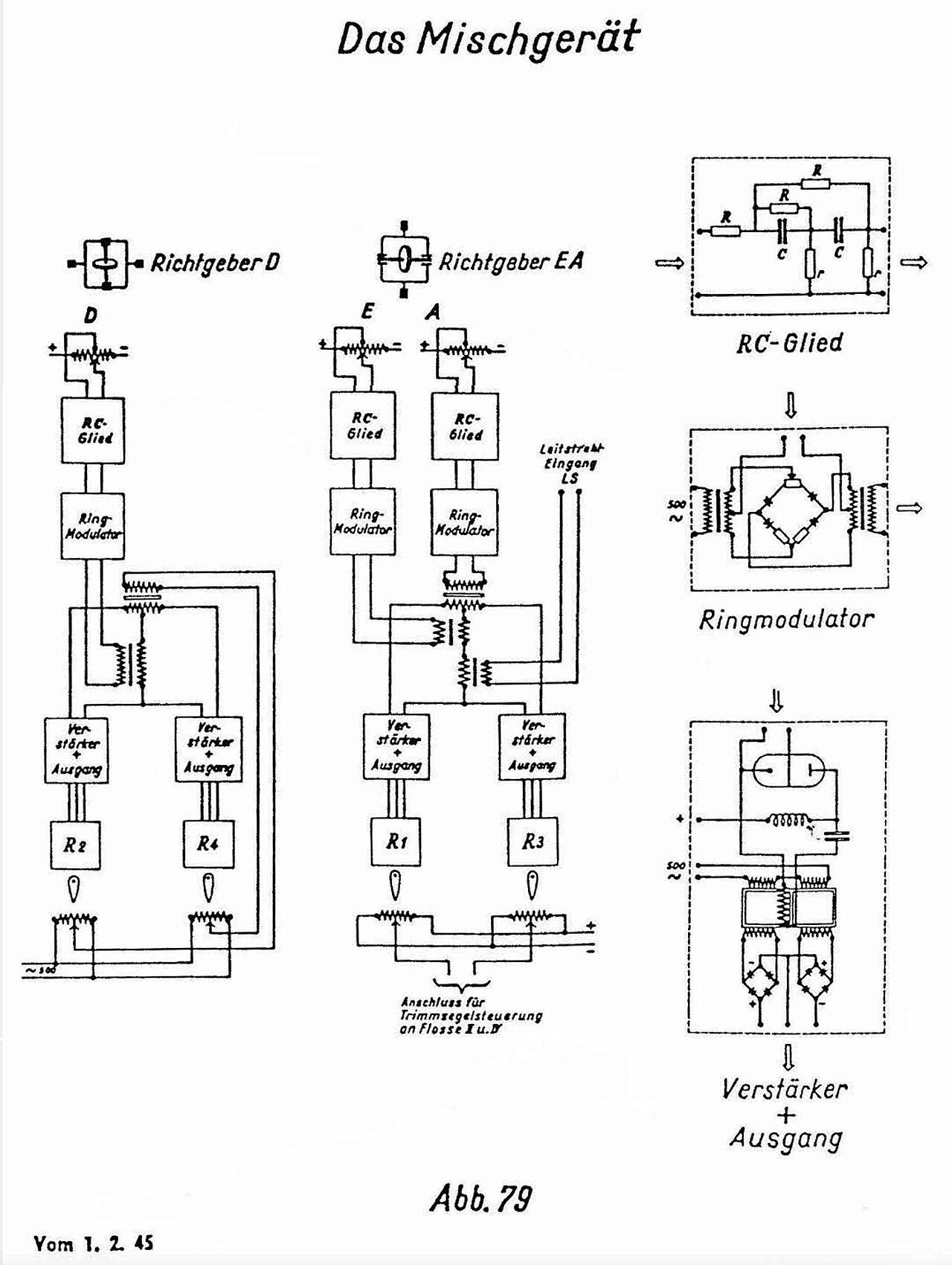
The guidance problem was one of control theory. Gyroscopes measured the rocket’s attitude; graphite vanes in the exhaust and rudders on the fins corrected it; between them something had to take the gyroscope signals, compute the correction, including its rate of change and its accumulated drift, and drive the vanes, continuously, in flight, in a device that could ride the rocket. Hölzer’s circuit did it. The Mischgerät took the gyroscope outputs, differentiated and integrated them electronically with vacuum tubes and RC networks, mixed them into a command signal, and fed the servos. It was the first electronic computer to fly, and the first embedded control computer of any kind, in production from 1942 and in the A4s that fell on London and Antwerp from September 1944 as the V-2.
To design it he needed to test it, and the rocket was too expensive to test by launching. So in 1941, with an assistant, he built a general-purpose electronic analog computer on the same principles: a rack of tube amplifiers and networks that could be wired to solve the differential equations of the rocket’s motion, so that the guidance loop could be tuned on the bench with the Mischgerät in the loop. It integrated, differentiated, multiplied, divided and took square roots, and it was fully electronic, with no mechanical wheels or shafts, which nothing before it had been; James Tomayko’s 1985 study established its priority. It was, in the same act, one of the first flight simulators.
The Army’s engineering was in the service of a weapon built by slave labour at Mittelwerk, where more people died making the V-2 than it killed at its targets. Hölzer designed the guidance and, like the rest of the Peenemünde group, went where the guidance went afterwards.
Fort Bliss to Huntsville
In 1946 he submitted the analog computer as a doctoral thesis at Darmstadt, Anwendung elektrischer Netzwerke zur Lösung von Differentialgleichungen und zur Stabilisierung von Regelvorgängen, the application of electrical networks to solving differential equations and stabilising control processes. Under Operation Paperclip he went to Fort Bliss in Texas and White Sands, where the captured V-2s were fired, and in 1950 to Huntsville, Alabama, with the rest of von Braun’s team. At the Army Ballistic Missile Agency and, from 1960, at NASA’s George C. Marshall Space Flight Center, he ran the Computation Laboratory, the division that did the simulation and data processing for the Redstone, Jupiter and Saturn rockets: analog and hybrid computers for flight dynamics, and later the large digital machines on which the Saturn V’s trajectories and structural loads were calculated before anything was built. He retired in the 1970s; NASA had given him its Exceptional Service Medal. In 1990 he lectured on the Mischgerät at the Deutsches Technikmuseum in Berlin, one of the few first-hand accounts. His papers, including the thesis, are at the Charles Babbage Institute in Minnesota.
Helmut Hölzer died in Huntsville on August 19, 1996. A memorial stone was set up in 1995 at the forestry office in Neu Pudagla on Usedom, where his department and its analog computer had been moved after the bombing of Peenemünde in 1943. His granddaughter Margaret Hoelzer swam for the United States at the 2008 Olympics and won two silver medals and a bronze.
📚 Sources
- Helmut Hölzer — Wikipedia
- Tomayko, James E. — “Helmut Hoelzer’s Fully Electronic Analog Computer”, IEEE Annals of the History of Computing 7(3), July 1985, pp. 227–240 (the 1935 integrator idea, the 1941 machine built with an assistant, its use for the A-4 guidance system)
- Mischgerät (V-2 guidance computer) — Wikipedia
- Hoelzer’s V2 analog computer — Foundation for German communication and related technologies, cdvandt.org (the 1946 Darmstadt dissertation, the Mischgerät’s operations, the 1990 Deutsches Technikmuseum lecture)
- “Nachruf Dr.-Ing. Helmut Hoelzer”, RZ-Mitteilungen 13, Humboldt-Universität zu Berlin, January 1997 (the May 1939 diploma, the half year at Telefunken, the 1946 doctorate under Alwin Walther, death on August 19, 1996, the 1995 memorial stone)
- Helmut Hölzer — German Wikipedia (Neu Pudagla, honours)
- Helmut Hoelzer papers — Charles Babbage Institute, University of Minnesota
- Analog Computers — Wikipedia (Hölzer’s place among the electronic analog machines)